Orange Water Near a Pennsylvania Facility Usually Comes From Mine Drainage, Rusting Iron on Site, or Naturally Iron-Rich Ground. Here's How to Tell Which One You're Looking At.
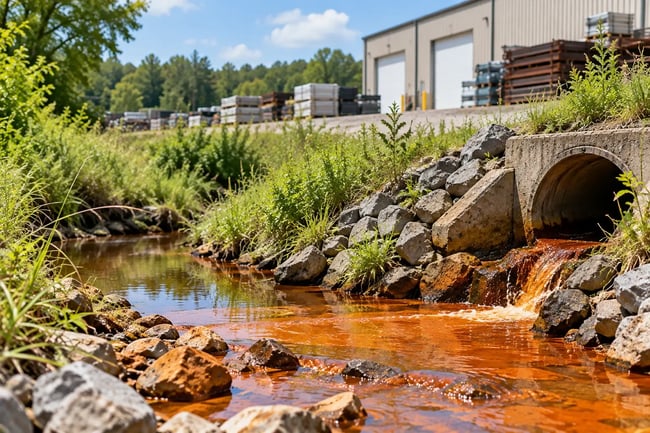
You walk out to the back of the property after a storm and the ditch, the creek, or the puddle by the outfall is bright orange. Or a neighbor calls to ask what your plant is dumping. In Pennsylvania, orange water almost always means iron, and there are three common sources: abandoned mine drainage from old coal mines, rust from scrap, steel, or corroded surfaces at your own facility, and soils and groundwater that are naturally rich in iron. Mine drainage is the most widespread of the three, but it doesn't automatically clear your facility. Where the color shows up, when it shows up, and whether it tracks with your storage areas will usually point to the source.
Below we walk through each of the three causes, the field clues that help separate them, a simple likely-cause comparison table, and how to document what you're seeing with photos and basic testing. We also explain why PA DEP may still ask questions even when a stream is known for mine drainage, and what to do if your own stormwater runoff turns out to be part of the problem. If you'd like a second set of eyes on an orange-water question at your site, feel free to reach out to RMA.
Table of Contents
TL;DR
Orange water near a Pennsylvania facility is almost always iron, and it usually comes from abandoned coal mine drainage, rusting materials on the facility itself, or naturally iron-rich ground. Color that's already there upstream and stays orange in dry weather points to mine drainage or groundwater, while color that shows up mainly during rain and below scrap, steel, or corroded areas points to your own runoff. Even when a stream is known for mine drainage, DEP may ask whether your site is adding to it, so photos, upstream and downstream checks, and sampling are worth having. If your runoff is contributing, covering or moving the iron sources and updating your stormwater plan usually fixes it.
What Causes Orange Water Near a Pennsylvania Facility?
Orange water is a chemistry problem before it's a regulatory one. Iron dissolves easily in water that's low in oxygen or acidic, like water coming out of a flooded mine or up from underground. Once that water hits the air, the dissolved iron reacts with oxygen and turns into iron hydroxide, a fine orange solid that coats rocks, settles into sludge, and stains everything it touches. The same reaction happens on a smaller scale when rain runs over a rusting scrap pile or a corroded metal roof and carries the rust particles away.
That's why the color alone doesn't tell you the source. A creek fed by a mine discharge two miles upstream and a ditch fed by your steel laydown yard can look almost identical. What separates them is the pattern: where the color starts, whether it depends on rain, whether it's there in the middle of a dry week, and whether it lines up with specific parts of your property. We'll get to those clues shortly, but first it helps to understand each source on its own.
How Abandoned Mine Drainage Turns Pennsylvania Streams Orange
Pennsylvania has more than two centuries of coal mining behind it, and much of it happened long before modern reclamation rules. When old underground mines flooded, the water picked up iron, aluminum, manganese, and acidity from the exposed rock and began flowing out of mine openings, boreholes, and seeps. PA DEP estimates that abandoned mine drainage affects roughly 5,500 miles of the state's streams, which makes it one of the largest sources of water pollution in Pennsylvania.
It's concentrated where the coal is. In the northeast, the anthracite fields around Schuylkill, Luzerne, Lackawanna, Carbon, and Northumberland counties have long stretches of orange streams. In the west and southwest, the bituminous fields across counties like Cambria, Somerset, Indiana, Clearfield, Westmoreland, and Fayette have many more. Some of these streams have been orange for generations, and locals sometimes call the orange sludge "yellow boy."
Mine drainage isn't always orange, either. Where aluminum is high, deposits can look white or milky, and manganese can leave black coatings on rocks. Some discharges are strongly acidic and others are close to neutral. If your facility sits in coal country and the stream next to you has looked orange since anyone can remember, mine drainage is the leading suspect. That's a starting point, though, not a conclusion.
How Rust and Iron at Your Facility Can Tint Stormwater Runoff
Plenty of facilities create their own orange water. Scrap yards and recyclers with piles of ferrous metal are the classic example, but the same thing happens at fabrication shops with steel stored outdoors, concrete and precast plants with rebar and forms in the yard, equipment yards with rusting attachments, and any site with old corrugated metal roofs, rusted siding, or corroded tanks and dumpsters. Every rain washes a little rust off those surfaces and carries it toward the nearest drain, ditch, or outfall.
Facility iron tends to show up as rusty water running off specific areas during and right after storms, with orange staining in the gravel or pavement below material piles, and orange sediment collecting in catch basins and swales. It usually fades between storms. Because iron is a common stormwater pollutant from metal-heavy industries, some facilities have iron in their permit monitoring, and others see high iron in their results without expecting it. Our article on iron in stormwater monitoring covers how that plays out.
This is exactly the kind of runoff that industrial stormwater permits are meant to control. If your facility is in a covered industry and has iron-bearing materials exposed to rain, that runoff is stormwater associated with industrial activity, and your PAG-03 coverage and PPC Plan are supposed to address it.
Natural Iron in Soils, Groundwater Seeps, and Iron Bacteria
Some orange water has nothing to do with mining or industry. Many Pennsylvania soils and shallow groundwater carry natural iron, and where that groundwater seeps out along a hillside, a road cut, a stream bank, or the bottom of a ditch, it can leave orange deposits. You'll often see this at a spring, at the toe of a slope, or where a sump pump or footer drain discharges.
Those seeps frequently feed iron-oxidizing bacteria, which are harmless microbes that live on dissolved iron. They leave fluffy orange deposits and sometimes an oily-looking, rainbow-colored film on the water's surface that people mistake for a petroleum spill. There's a simple field test. Poke the film with a stick. If it breaks into separate flat pieces that stay apart, it's most likely bacterial. If it swirls and flows back together, it may be petroleum, and that needs a different response.
Natural iron behaves a lot like mine drainage in the field. It's there in dry weather, it starts at a specific seep, and it doesn't care what's stored on your property. The difference is usually scale. A natural seep stains a few feet of ditch or bank, while a mine discharge can turn miles of stream orange.
Field Clues That Separate Mine Drainage From Your Own Runoff
The single most useful check is to walk upstream. If the stream is already orange before it reaches your property line, the source is somewhere above you. If it runs clear until it passes your outfall, ditch, or a particular corner of your site and then turns orange, your facility deserves a close look. Do the same check on any ditch or swale that collects your runoff, following it back to where the color first appears.
The second clue is timing. Mine drainage and groundwater seeps flow all the time, so the color is there on a dry Tuesday with no rain in the forecast. Facility runoff mostly shows up during and right after rain, and the first flush of a storm is often the most orange. If your ditch only turns orange when it rains, and only below the scrap bins, steel racks, or rusty roof, the pattern is pointing at you.
The third clue is location on your own site. Map where you see orange staining on the ground and in catch basins, and compare it to where iron-bearing materials sit. A strong match between the two is hard to explain any other way. A visual check during rain is one of the best tools here, and our guide on how to do a stormwater visual inspection walks through what to look for. Keep in mind that more than one source can be at work. A facility on a mine-drainage stream can still add its own iron during storms.
Likely-Cause Comparison Table for Orange Water
The table below pulls those clues together. No single row settles the question, but when most of your observations land in one column, you have a reasonable working answer to confirm with sampling.
| What You See |
Abandoned Mine Drainage |
Your Facility's Runoff |
Natural Iron or Iron Bacteria |
| Orange upstream of your property? |
Usually yes |
No, starts at or below your site |
Depends on where the seep is |
| Orange in dry weather? |
Yes, flows constantly |
Rarely, mostly during and after rain |
Yes, at the seep |
| Lines up with storage areas? |
No |
Yes, below scrap, steel, or rusty surfaces |
No |
| How far it extends |
Long stretches of stream |
Ditches, swales, and the area near outfalls |
A few feet to a short reach |
| Other signs |
Coal region, mine openings or seeps, sometimes white or black deposits |
Orange sediment in catch basins, stained gravel below piles |
Fluffy deposits, film that breaks apart when poked |
If your observations are split between columns, that's a sign of more than one source, which is common in coal country. That's also the situation where sampling earns its keep.
How to Document Orange Water With Photos and Simple Testing
Good records turn a hunch into something you can show an inspector or a neighbor. Start with photos. Take them from the same spots each time: upstream of your property, at each outfall or ditch where your runoff leaves, and downstream. Photograph once during dry weather and again during a storm, and note the date, time, and recent rainfall on each one. A phone with location turned on works fine. Over a few weeks, that photo set alone often makes the pattern obvious.
Simple field checks add a lot. A pH meter or test strips will show whether water is strongly acidic, which leans toward mine drainage, though plenty of mine discharges are close to neutral. The stick test on any oily-looking film helps rule bacteria in or out. And a walk of your site during rain, noting where orange water is flowing, ties the photos to specific sources.
When you need a firmer answer, collect samples upstream, at your outfall, and downstream during the same storm, and have a lab test them for iron, plus aluminum, manganese, and pH if mine drainage is a possibility. If iron is clearly higher at your outfall than upstream, your site is adding to it. Our articles on why you should take your own stormwater samples and how to pick a water testing lab cover the practical side.
Why PA DEP May Still Ask Questions Even If It's Mine Drainage
Orange water draws complaints, and complaints bring inspectors. When someone calls DEP about an orange stream next to an industrial site, the inspector usually can't tell at a glance whether the color came from a mine a mile upstream or a scrap pile fifty feet away. The facility is the obvious place to start asking, so expect questions about what you store outdoors, where your runoff goes, and what your monitoring shows. Our walkthrough of what happens during a PA DEP stormwater inspection explains what that visit typically covers.
A stream already damaged by mine drainage also doesn't give anyone a pass to add more. Under the Clean Streams Law, a facility is responsible for what leaves its own property, regardless of what's already in the stream. Many mine-drainage streams are listed as impaired, and some have cleanup plans (called TMDLs) that limit how much more iron and other metals the stream can take, which can put more attention on every source in the watershed. Our article on TMDLs, impaired waters, and stormwater permits explains how that connects to your permit.
If your facility has PAG-03 coverage, the inspector will also look at whether your PPC Plan identifies iron-bearing materials, whether your controls for them are working, and whether your inspections and sampling are up to date. If your site has iron exposed to rain but no permit coverage, an orange-water complaint can be how that gap comes to light. The upstream photos and sampling data described above are your best way to show what's yours and what isn't.
What to Do If Your Facility's Runoff Is Turning Water Orange
The good part about facility iron is that it's usually fixable with practical steps. The most effective one is keeping rain off the iron. Move steel, rebar, and small scrap under a roof or tarp, put covers or lids on scrap bins and roll-offs, and keep piles off areas that drain straight to an outfall. Where you can't cover material, direct runoff away from it or through a settling area so the rust particles drop out before water leaves the site.
Housekeeping matters too. Sweep up rust and fines around storage areas, clean orange sediment out of catch basins before it washes through in the next storm, and add simple filtering at inlets where it helps. Corroded roofing, siding, and old tanks may need coating or replacement over time. These are the kinds of stormwater best management practices that belong in your PPC Plan, and any change you make should be reflected there.
If your sampling results came back high, our guide on what to do when stormwater results are high covers the follow-up steps. And if DEP has already sent a notice of violation over the orange water, it's a good idea to talk with an environmental attorney before you respond.
How RMA Helps Pennsylvania Facilities Sort Out Orange Stormwater
Figuring out where orange water comes from is detective work, and it's the kind we enjoy. RMA is a family-run environmental consulting firm based in New Jersey, and we work with facilities across Pennsylvania on industrial stormwater. We can help you review your site and drainage, set up upstream and downstream sampling that separates your contribution from mine drainage or natural iron, interpret the results, and recommend practical controls if your runoff is part of the picture. If it turns out the color has nothing to do with you, we'll tell you that too.
We also help with the permit side, including PAG-03 coverage, No Exposure Certifications, PPC Plan updates, and preparing for a DEP inspection. There's no pressure and no obligation. You can call us, send an email, or fill out the form on our website, and when you're ready, contact RMA to talk through what you're seeing.


