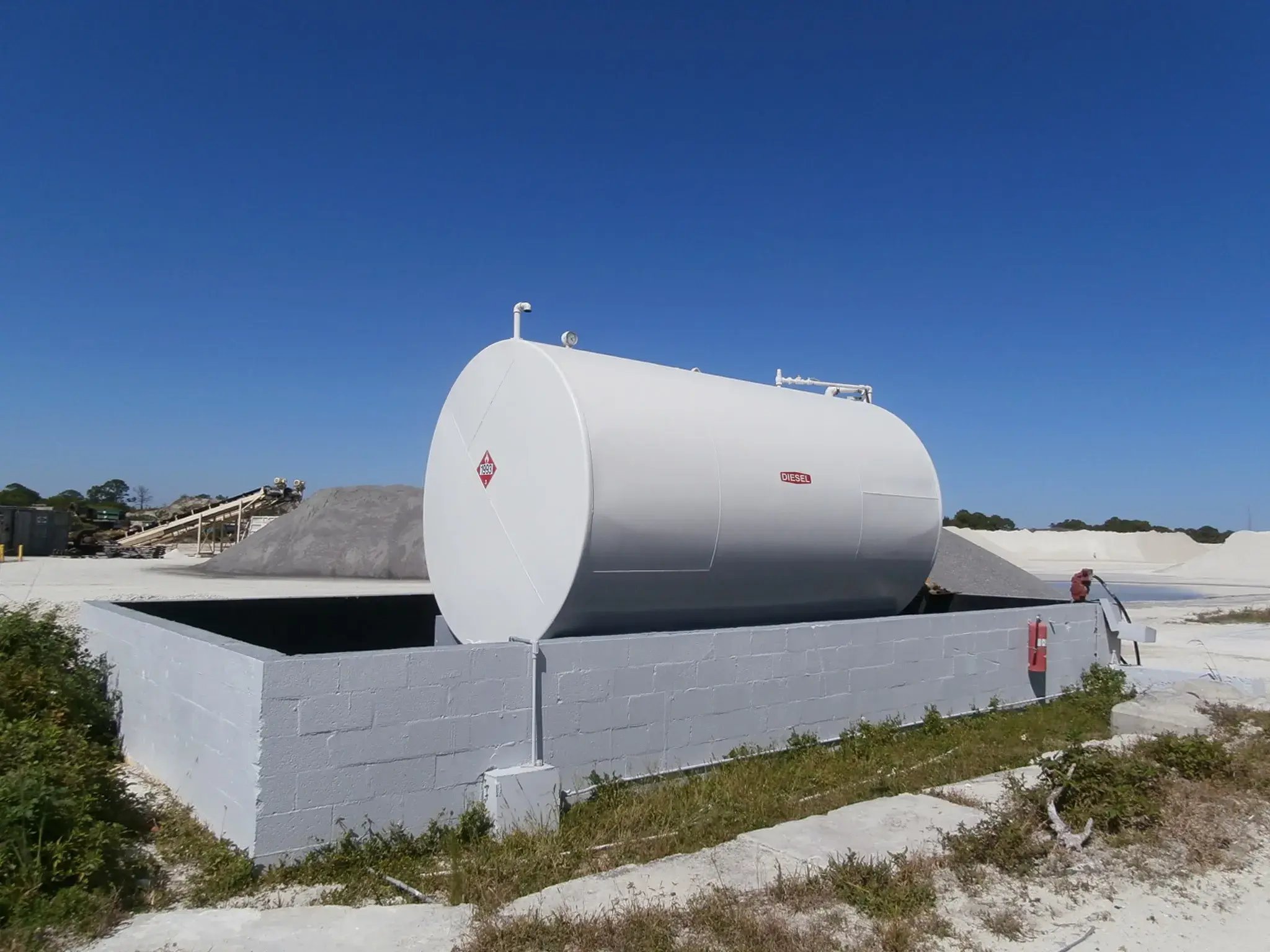
Alarms, Gauges, and Fill Procedures for Pennsylvania Facilities, Plus What to Settle With Your Fuel Supplier Before the Next Delivery
Most oil tank spills don't start with a cracked tank or a failed weld. They start on delivery day, when a driver is pumping product into a tank that has less room than anyone realized. EPA has pointed to overfills as a frequent cause of oil discharges, and its 2024 technical alert on overfill prevention failures stressed that these systems have to be designed well, kept up, and inspected, not just installed. If your facility stores enough oil to need a Spill Prevention, Control, and Countermeasure (SPCC) Plan, the written federal plan for preventing and responding to oil spills, each bulk container needs at least one overfill measure: a high-level alarm, an automatic shutoff, direct communication between the person watching the tank and the person pumping, or a fast-reading gauge with someone watching it. Whatever you choose has to be tested regularly.
This article covers what the rule asks for, how the four options compare, how expectations change between Tier I, Tier II, and PE-certified plans, how to test what you install, and what to settle with your fuel supplier before the next truck shows up. We also look at how Pennsylvania's tank program sits alongside the federal rule. If you'd like someone to look at your own tanks and delivery routine, you can reach out to RMA at any point, and we'll tell you plainly what you have and what's missing.
Table of Contents
TL;DR
Under the federal SPCC rule, every bulk oil container that gets filled at your facility needs at least one overfill measure: a high-level alarm, an automatic pump cutoff, direct communication between the person watching the tank and the person pumping, or a fast-reading gauge with someone watching during the fill. You also have to test the liquid level devices regularly and keep the records. Pick the option that fits how the tank is really filled, write it into your SPCC Plan, and agree on the delivery routine with your fuel supplier before the truck arrives. Pennsylvania's tank program adds its own requirements for regulated tanks, so check those separately.
What Does SPCC Require for Overfill Prevention on Oil Tanks?
The requirement sits in 40 CFR 112.8(c)(8). Each container installation has to be engineered using good engineering practice to avoid discharges, and you must provide at least one of four things: a high liquid level alarm, a high liquid level pump cutoff, direct audible or code signal communication between the person gauging the tank and the pumping station, or a fast-response gauging system with a person present to monitor the gauges and the filling. Separately, you must regularly test your liquid level sensing devices. It's "at least one," not all four, so plenty of facilities do fine with a single measure that matches how the tank is filled.
The rule only reaches facilities that need an SPCC Plan in the first place. If your aboveground oil storage adds up to more than 1,320 gallons, counting only containers of 55 gallons or more, or your buried storage is over 42,000 gallons, federal rules call for a plan. Capacity counts, not how full the tanks are today, and oil includes diesel, gasoline, hydraulic oil, lube oil, and animal fats and vegetable oils. Our guide to everything you need to know about SPCC plans helps you run the numbers. The overfill paragraph is about filling, so drums and totes that arrive full and are never filled on site don't need devices. If you already have a plan, it should describe the overfill measure for each tank you do fill, and match what your people do on delivery day, because an inspector will compare the two.
| Option |
How it works |
Watch for |
| High-level alarm |
Audible or visual signal at a constantly attended station when the level hits a set point |
An alarm in an empty building protects nothing |
| High-level pump cutoff |
Stops flow automatically at a preset level |
A delivery truck's pump isn't wired into your controls, so it generally needs a shutoff valve in the fill line |
| Direct communication |
Audible or code signal between the gauger and the pumper |
Relies on people, so it needs a written procedure and training |
| Fast-response gauging with a person present |
Digital or direct-vision gauges, watched throughout the fill |
The person has to stay for the whole transfer, and the gauge has to work |
How Do High-Level Alarms and Automatic Shutoffs Work?
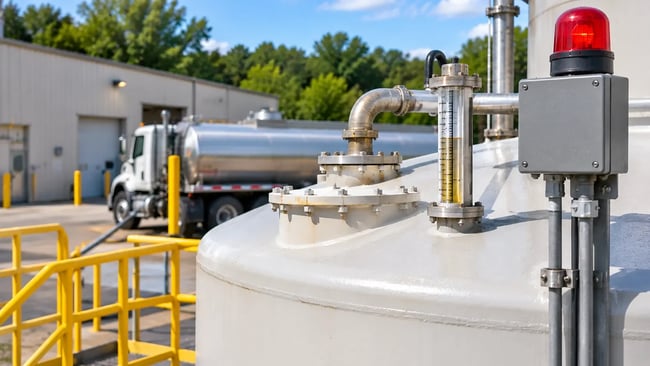
A high-level alarm uses a float switch or level probe to warn someone when product reaches a set height. An automatic shutoff senses the level the same way but acts on its own, either by stopping a pump you control or by closing a valve in the fill line. Both count as devices, so both fall under the testing requirement, and both only help if they're set at the right point and placed where somebody will notice them.
The set point is where many facilities go wrong. The alarm has to go off early enough that a person can react before the tank is full, and how early depends on how fast product is going in and how long someone needs to respond. Say a delivery truck pumps 100 gallons a minute and the person who hears the alarm needs two minutes to reach the fill port and wave the driver off. That's 200 gallons of room that has to remain between the alarm point and the top of the tank, before any margin. On a small tank, an alarm set a few gallons below full can't do that job no matter how loud it is. EPA's guidance on filling procedures names fill rate, reaction time, and containment capacity as factors to weigh, and industry references like PEI/RP600 for shop-fabricated aboveground tanks, or API 2350 for larger tanks at petroleum facilities, are where many designers start.
Where the signal goes matters as much as where the sensor sits. The rule describes an alarm that reaches a constantly attended station, and a horn on a tank at an empty building at 2 a.m. gives nobody a chance to react. If trucks deliver after hours, think through who's there to respond, and consider a shutoff device or a beacon the driver can see from the fill port. Generator sub-base and day tanks often come with manufacturer level controls that can serve as your overfill measure, but they still need to be described in the plan and tested. Installing or replacing this equipment is a job for a tank contractor or electrician, and on regulated tanks in Pennsylvania it may require DEP-certified installers. We don't install equipment or prepare installation permits, but we can update the plan and procedures to match what's on site afterward.
When Is Direct Gauge Reading or Constant Communication Enough?
The last two options rely on a person instead of a sensor. With direct communication, the person gauging the tank and the person pumping stay in contact by voice, radio, or a signal both understand, and pumping stops when the gauger says so. With fast-response gauging, someone watches digital or direct-vision gauges for the entire fill. For small containers that can be watched easily, EPA's guidance says a documented filling procedure that ensures communication between gauger and pumper satisfies the rule, with no environmental equivalence paperwork. A simple one has three steps: confirm the container has room for the transfer, watch the level the whole time, and post the written procedure at the fill pipe.
The approach gets shaky as tanks get larger and fill rates climb. A person can be pulled away to answer a phone, a gauge can stick, and a driver standing at the truck can't see the level in your tank at all. For a large diesel tank filled by a tanker truck, we usually steer facilities toward a device, either alone or paired with a watched gauge, with the person watching as the second layer. The dike is the backstop behind all of it, and our article on how big your SPCC oil spill containment needs to be covers sizing it.
What Changes for Tier I, Tier II, and PE-Certified Plans?
The overfill rule applies to every plan, but your flexibility depends on the plan type. Our guide to the different types of SPCC plans covers all three in full, and this table sticks to the overfill piece.
| Plan type |
Overfill requirement |
Alternatives to the listed options |
| Tier I qualified facility (10,000 gallons or less aboveground, no container over 5,000 gallons, qualifying spill history) |
A system or documented procedure for each container, described in the plan and tested regularly for proper operation or efficacy |
None allowed in a self-certified Tier I plan |
| Tier II qualified facility (10,000 gallons or less aboveground, qualifying spill history) |
Follows 112.8(c)(8) as written |
Only with written review and certification by a professional engineer |
| PE-certified plan (larger facilities, or any facility that chooses it) |
Follows 112.8(c)(8) as written |
Allowed if the plan explains why and shows equivalent environmental protection |
Most facilities pick one of the four listed options and skip the alternatives. A PE-certified approach can make sense for unusual setups, such as very large tanks or tanks with nobody on site during fills, and our article on professional engineers and SPCC plan requirements explains when PE certification is required. When a plan needs one, we work with an outside professional engineer.
How Do You Test Overfill Prevention Devices and Document It?
The rule says to test liquid level sensing devices "regularly" and doesn't put a number on it, and Tier I plans use similar wording. That leaves the interval up to you, which means your plan should state one and you should keep it. Start with the manufacturer's instructions, tie testing to a schedule you'll keep, such as your monthly or annual inspection rounds, and add a test after any repair, sensor replacement, or change to the tank. Our list of the top 10 things to do during your SPCC plan monthly inspections is a good base for building those rounds.
| Measure |
What a test looks like |
What to record |
| High-level alarm |
Trigger it with the manufacturer's test function, then confirm the signal reaches the attended location and the fill port. Check power and batteries. |
Date, tester, result, repairs |
| Shutoff or pump cutoff |
Follow the manufacturer's procedure to confirm flow stops at the set point and the device resets. |
Date, tester, set point, result |
| Gauges |
Compare the reading against a manual measurement, such as a gauge stick or tape, and note any drift. |
Both readings, correction made |
| Communication procedure |
Observe a delivery or run a drill to confirm the driver and your person know the signals and the posted procedure matches practice. |
Date, observer, gaps, fixes |
The SPCC rule calls for inspections and tests to follow written procedures, signed by the appropriate supervisor or inspector, and kept with the plan for three years. Records you already keep in normal business practice are fine. If a device fails a test, tag it, fix it, and use another measure in the meantime, such as manual gauging with a person present. Your annual discharge prevention briefing for oil-handling employees is the place to talk through failed components, and our guide on what SPCC training should include and our online training library can help you cover it.
What Should You Coordinate With Your Fuel Supplier Before Deliveries?
The driver is the person at the other end of the hose, so the best overfill system doesn't help if the driver doesn't know it's there. Federal DOT rules require a qualified person to attend a cargo tank while it's being unloaded, generally staying alert and within 25 feet with a clear view of the tank and delivery hose. That keeps someone at the truck, but not in a position to see your tank's level, which is why your facility needs its own measure. A short conversation with your supplier, plus a copy of your delivery procedure for their dispatcher and drivers, closes most of the gaps.
- Order by measured room. Check the available space before ordering, tell the supplier the gallons you want and the most the tank can take, and ask that drivers not top off beyond it.
- Name who's watching. If your measure depends on a person, agree on who, where they'll stand, and what signal tells the driver to stop.
- Set delivery windows. Schedule deliveries when someone qualified is on site, or agree on how after-hours deliveries work, including keys and who's on call.
- Label and secure fill ports. Mark each with the product and tank size, and keep them locked, since SPCC security requirements address loading and unloading connections.
- Agree on the stop procedure and reconcile afterward. Decide who can halt a delivery and what the driver does if the alarm sounds, then compare the delivery ticket against your gauge reading. A mismatch can flag an overfill, a gauge problem, or a leak.
Settle what happens if a spill occurs anyway. Stop the transfer, keep ignition sources and people away, and call 911 first if there's a fire or safety hazard. Contain what you can, and report the discharge to the agencies that require it once it meets the reporting triggers, which our article on when you have to report an oil spill covers. If a spill leads to enforcement or a liability claim, an environmental attorney may be the right person to bring in alongside your consultant. If you have a truck loading or unloading rack, 112.7(h) adds requirements such as warning lights, barriers, wheel chocks, or a brake interlock, plus a check of the truck's lowermost drain and outlets before it leaves.
How Do Pennsylvania DEP Tank Rules Fit With SPCC Overfill Requirements?
In Pennsylvania, two sets of rules can reach the same tank. EPA Region 3 enforces the federal SPCC rule. Separately, the Department of Environmental Protection runs the storage tank program under the Storage Tank and Spill Prevention Act and 25 Pa. Code Chapter 245. Whether a tank falls under DEP's program depends on its size, type, and use, and the rules differ for regulated aboveground tanks, small aboveground tanks under a simplified program, and underground tanks. Completely buried tanks regulated under the federal underground storage tank rules are outside SPCC and handled under those rules instead.
The two programs don't substitute for each other. Chapter 245 has its own technical standards, operations and maintenance requirements, and inspections for regulated tanks, and regulated underground tanks have their own spill and overfill prevention equipment requirements. DEP's 2018 amendments, effective December 22, 2018, tightened operation and maintenance requirements for regulated underground tank equipment, including periodic testing. Meeting the SPCC paragraph doesn't automatically satisfy DEP, and the reverse is also true. The SPCC rule asks your plan to discuss conformance with any more stringent state requirements, so it should reflect what you do under both. Local fire codes, enforced by your municipality, can also address venting, fill details, and overfill protection, so check with your local fire official. To pin down which DEP requirements cover your tanks, start with DEP's storage tank program and confirm against your own tank inventory.
How Can RMA Help With Oil Tank Overfill Prevention?
We can look at how each tank at your facility gets filled, who's there when it happens, and which of the four options fits, then write that into your SPCC Plan in terms that match what your people do. If you don't have a plan yet and think your storage puts you over the threshold, we can help you figure that out and prepare one. Tier I plans typically run about $1,500 to $4,000, and our overall SPCC range runs from $1,500 to $15,000 depending on the number of tanks and whether the plan needs PE certification. Initial SPCC training is free with a new plan from us, which gives your delivery team a chance to learn the procedure.
If you already have a plan that describes your overfill setup accurately, you test it, and you keep the records, you may not need us at all. If you're not sure, or you'd like a second set of eyes before the next delivery, you can call, email, or fill out the form on our website and contact RMA. There's no obligation, and we'll give you a straight answer on what you need.