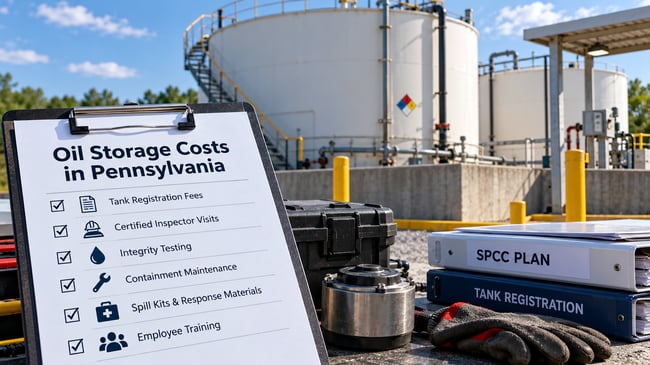
DEP Registration, Certified Inspections, Integrity Testing, Containment, Spill Kits, and Training: The Recurring Costs That Show Up After Your SPCC Plan Is Done
You paid for the oil spill plan, the binder is on the shelf, and the oil storage line in the budget feels closed. Then a DEP invoice lands on your desk, a certified inspector needs to see a tank, the five-year plan review comes due, and somebody asks who's restocking the spill kits. Oil storage in Pennsylvania runs on recurring costs that never show up in the price of the plan itself. Most of them are small on their own, but they add up fast at a facility with several tanks. The short answer on registration: DEP charges $50, $125, or $300 per aboveground tank per year depending on size, and everything else depends on what you store and how big your tanks are.
In this article we'll walk through each recurring cost in plain terms, including how often it comes around, who you pay, and what drives the price up or down. We'll use published figures where DEP or RMA has them and explain the variables where the number depends on your site. If you'd rather talk through your own facility's numbers, feel free to reach out to RMA and we'll help you sort out what applies.
Table of Contents
TL;DR
DEP charges $50, $125, or $300 per aboveground tank each year depending on size, and that fee is usually the smallest line in the budget. The bigger recurring costs are certified inspections for tanks over 5,000 gallons (at least every five years), SPCC integrity testing and routine inspections, secondary containment upkeep, spill kits, annual training, and the five-year review of the SPCC Plan. Inspector, testing, containment, and supply prices depend on your tanks and your site, so get quotes, while training and plan updates have published ranges you can plan around.
What Recurring Costs Come With Pennsylvania Oil Storage?
Pennsylvania oil storage sits under two separate sets of rules, and each one brings its own costs. The federal SPCC rule (Spill Prevention, Control, and Countermeasure, 40 CFR Part 112) is enforced in Pennsylvania by EPA Region 3, and our article on who enforces SPCC Plans explains how the federal and state roles split. The plan stays on site and isn't filed with the agency, but it comes with inspections, testing, training, and a review every five years. The state storage tank program is run by DEP under the Storage Tank and Spill Prevention Act and 25 Pa. Code Chapter 245. It bills you every year for each regulated tank and requires DEP-certified people for certain inspections. A facility can fall under one program, the other, or both, and the costs stack when both apply.
The table below lists each recurring item, how often it comes around, and who you pay. We've included dollar figures wherever DEP or RMA publishes them. Where the price depends on your tanks, your site, and the contractor, we say so instead of guessing, because a made-up average does more harm than good when you're building a budget.
| Cost item |
How often |
Who you pay |
What it costs |
| DEP tank registration fee |
Every year, per tank |
PA DEP |
$50, $125, or $300 per aboveground tank by size; $50 per underground tank |
| Certified in-service tank inspection |
At least every 5 years for tanks over 5,000 gallons, sooner if conditions call for it |
DEP-certified inspector or inspection firm |
Quoted per job; depends on tank size, type, and travel |
| Cathodic protection testing (tanks that have it) |
Every 3 years for sacrificial systems, every year for impressed current systems |
Your tank contractor or inspector |
Quoted per job |
| SPCC integrity testing |
On the schedule in your plan, and after repairs |
Qualified inspector or testing contractor |
Staff time for visual checks; quoted for formal testing |
| Routine SPCC inspections |
As your plan requires, often monthly |
Your own trained staff |
Staff time |
| Secondary containment upkeep |
Ongoing, plus repairs as found |
Contractor or your maintenance staff |
Varies with the type of containment and its condition |
| Spill kits and absorbents |
Check regularly, restock after use |
Industrial or safety supply vendor |
Varies with kit size and what you stock |
| Annual SPCC training |
Every year |
In-house, online course provider, or consultant |
Free in-house; RMA's online course is $135 per user; live training runs $500 to $5,000+ |
| SPCC Plan five-year review and updates |
At least every 5 years, and when the facility changes |
Environmental consultant, plus an outside PE if certification is needed |
About $1,500 for a simple Tier I update; $7,500+ for a PE-certified plan at a complex site |
Most facilities won't see every row. A small site may only deal with a DEP fee, a few hours of staff inspection time, and annual training, while a site with a large aboveground tank carries nearly the whole list. The rest of this article goes row by row so you can tell which ones are yours.
How Much Are Pennsylvania DEP Tank Registration Fees?
DEP's annual registration fees are set by tank capacity for aboveground tanks, and they're billed per tank, not per facility. Registering also renews the tank's operating permit, so the invoice isn't optional paperwork. Here's the current schedule:
| Tank type and capacity |
Annual DEP registration fee |
| Aboveground tank, 5,000 gallons or less |
$50 per tank |
| Aboveground tank, 5,001 to 50,000 gallons |
$125 per tank |
| Aboveground tank, over 50,000 gallons |
$300 per tank |
| Underground tank |
$50 per tank |
Here's how that adds up. A facility with two 1,000-gallon aboveground diesel tanks and one 12,000-gallon aboveground tank pays $50 plus $50 plus $125, which is $225 a year. DEP counts each compartment of a multi-compartment aboveground tank as its own tank, so a split tank can cost more than its footprint suggests. Underground tank owners also pay separate fees into the Underground Storage Tank Indemnification Fund (USTIF), which is billed apart from the DEP registration fee, so it's common to see two different charges for the same underground tank.
Not every tank is regulated. A regulated aboveground tank is generally a stationary tank over 250 gallons holding petroleum products or certain hazardous substances, and a list of exemptions applies, so whether a particular tank is on your invoice depends on its size, type, and use. The reason to pay on time goes beyond the dollar amount. DEP can withhold or deny the operating permit for a tank when fees go unpaid, using a regulated tank without registration is illegal, and anyone who delivers product to an unregistered regulated tank can be held liable for a release from it. For a facility that depends on fuel deliveries, a $50 invoice is the cheapest problem you can avoid.
What Do DEP-Certified Aboveground Tank Inspections Cost?
Pennsylvania requires some aboveground tanks to be inspected by a DEP-certified inspector, and this is where the budget starts to move. For the smaller aboveground tanks, the rule calls for in-service inspections at least every five years when the tank holds a regulated substance and has a capacity over 5,000 gallons, or sooner when corrosion or other conditions call for it. Larger aboveground tanks, generally those over 21,000 gallons, follow a more detailed schedule. They're inspected within five years of installation, then at intervals based on measured corrosion rates with a maximum of five years between in-service inspections, plus out-of-service inspections that can stretch up to 20 years apart. DEP can also require more frequent inspections when a prior inspection finds corrosion or other problems. Tanks of 5,000 gallons or less generally don't face that periodic five-year certified inspection under the small tank rules, though they still have to meet DEP's installation, operating, and recordkeeping requirements.
One rule affects who you can hire: a certified inspector can't be an employee of the tank owner, so you'll be paying an outside inspector or inspection firm. We don't publish a price for this work because RMA doesn't perform DEP tank inspections, and any single dollar figure would mislead you. Quotes vary with the number of tanks, whether they're shop-built or field-erected, how hard the tanks are to reach, and how far the inspector has to travel. When you collect quotes, ask what the report covers, whether follow-up visits for deficiencies are billed separately, and whether the inspector's findings can be documented in a form that also supports your SPCC integrity records. The bigger cost risk isn't the inspection itself. It's the repair list that comes back with it, and DEP expects deficiencies found during an inspection to be addressed and remedied.
Tanks with cathodic protection add a smaller testing item. DEP's rules call for checks on sacrificial anode systems every three years and on impressed current systems every year, so if your tanks have corrosion protection, ask your tank contractor or inspector to build that testing into the same visit where possible.
What Does SPCC Integrity Testing and Routine Inspection Cost?
The federal rule has its own inspection and testing requirements, separate from DEP's. Under 40 CFR 112.8(c)(6), each aboveground container has to be tested or inspected for integrity on a regular schedule and whenever repairs are made. The rule doesn't fix a number of years. Instead, your plan sets the type and frequency of testing, usually guided by an industry standard such as STI SP001 or API 653, and you keep the inspection and testing records for three years. STI's inspection checklist notes that periodic visual inspections of the tank and its containment don't require a certified inspector, which means a trained employee can handle them.
That splits the cost into two tiers. The routine part, a walk-through of tanks, valves, piping, and containment, costs you staff time. Most plans call for this monthly, and a good checklist keeps it to a short task per tank. Our guide to the top 10 things to do during SPCC monthly inspections covers what to look for. The formal part, which can include ultrasonic thickness readings or other non-destructive testing on larger shop-built or field-erected tanks, is quoted by a qualified inspector or testing contractor. Smaller tanks with simple visual inspection requirements may cost you nothing beyond time, while a large field-erected tank can call for a more involved program. The cheapest way to handle this is to make sure your plan matches your actual tanks, since a plan that promises testing you aren't doing is a violation waiting to be found.
What Does Secondary Containment Maintenance Cost?
Secondary containment is the dike, berm, double-walled tank, or concrete curb that catches oil if a tank fails. For bulk storage containers, the SPCC rule calls for containment sized to hold the entire capacity of the largest single container plus enough freeboard for precipitation, and it has to be sufficiently impervious to contain oil. We cover the sizing math in our article on how big SPCC containment needs to be. Building new containment is a construction project that falls to your contractor, and RMA doesn't build it. What lands in the operating budget is keeping the containment you have in working order.
The recurring items are fairly ordinary. Cracks in concrete need sealing, liners and gaskets wear out, and drain valves have to stay closed and in good shape. Rainwater that collects inside a dike has to be checked for oil before it's drained, and water with a sheen needs proper disposal instead of going out the drain. Costs depend on the type of containment, its age, and how often rain or snowmelt has to be managed. The expensive moment is when an inspector or your own monthly walk-through finds a failing wall or liner, so treat a small containment repair line in the budget as a normal expense, not a surprise.
How Much Should You Budget for Spill Kits and Response Supplies?
Your SPCC Plan describes the equipment you'll use to contain and clean up a spill, so the spill kits it names need to exist, sit where oil gets transferred or stored, and be stocked. This is one of the few costs that scales with what you do on site. A small site with a few drums and a single tank needs a modest kit near the transfer point. A site with large tanks, truck loading, or equipment that fuels on site needs more absorbent capacity, and often drain covers, booms, and a way to move waste out of the area.
Prices depend on kit size, the type of absorbent, and the vendor, so a published average wouldn't help you. Plan for two things instead: an initial purchase sized to your largest realistic spill, and a restocking cost whenever the kit gets used or the absorbents age or get damp. Used absorbents then have to be disposed of properly, and depending on what they soaked up, they can fall under waste rules, which our article on used oil regulations helps you sort out. Budget for the disposal as well as the kit, since the disposal is the piece people forget.
How Much Does Annual SPCC Training Cost?
The SPCC rule requires oil-handling personnel to receive discharge prevention briefings at least once a year, and the training has to be documented. This is the most flexible cost in the whole list, because the federal rule doesn't require you to hire an outside expert. Our article on annual SPCC training requirements explains what the rule expects.
- Initial training with a new plan: free from RMA when we develop your plan, delivered as a short video walkthrough of your plan and the basics of the rule.
- In-house training: free in dollars, but your own people have to know the plan well enough to teach it, and you're responsible if a regulator finds it lacking.
- Premade online courses: generally $50 to $500+ per person depending on the provider, and RMA's online SPCC annual training course is $135 per user.
- Custom online training: $2,000 to $10,000+ to develop, which only makes sense for large groups or multi-site operations.
- Live or on-site training from a consultant: $500 to $5,000+ depending on format, group size, and travel.
For most Pennsylvania facilities, an online course for each oil-handling employee is the most practical choice, and you can browse our online training library to see what's available. Our full breakdown of SPCC training costs compares each option. Whatever you choose, keep the certificates or sign-in sheets with your plan.
What Do SPCC Plan Reviews and Updates Cost?
The SPCC Plan itself isn't a one-time purchase. You have to review it at least every five years, and amend it when something changes at the facility that affects your spill risk, such as adding or removing tanks, changing containment, or moving to new responsible staff. How much that costs depends on how complicated the facility is and who wrote the original plan. RMA's published ranges are about $1,500 to $4,000 for a Tier I plan, $1,500 to $15,000 across all SPCC Plan types, about $1,500 for a simple Tier I update, and $7,500 or more for a PE-certified update at a complex site. Our article on what an SPCC Plan costs breaks down what moves the price, and you can use the pricing calculator below to see what RMA's help with your plan would run.
Two details save people money. First, updates are cheapest when we wrote the plan, because we already have your site details on file. We typically don't update another firm's plan and usually rebuild it from scratch, which is worth knowing before you assume an old plan can be patched cheaply. Our article on whether you can get your SPCC Plan updated explains when an update makes sense and when it doesn't, and our guide to five-year reviews covers the same question for the review cycle. Second, when a plan needs a Professional Engineer's certification, the engineer's review adds both cost and time. RMA doesn't have a PE on staff. We work with an outside professional engineer licensed in the state the plan is for, and our article on professional engineers and SPCC requirements explains when certification is required.
How Do You Build a Realistic Pennsylvania Oil Storage Budget?
The simplest approach is to split the list into costs that repeat every year and costs that come around every few years, then set aside a share of the multi-year items each year so they don't hit all at once. Here's a worked example using the published figures from earlier in this article. It's a sample, not a quote, because inspector and contractor prices come from your own quotes.
| Line item |
How it's figured |
Annual amount |
| DEP registration |
Two 1,000-gallon tanks at $50 each, one 12,000-gallon tank at $125 |
$225 |
| Annual SPCC training |
Five oil-handling employees on RMA's online course at $135 each |
$675 |
| Known recurring total |
|
$900 |
| Certified inspection of the 12,000-gallon tank |
Every 5 years at the inspector's quote; divide the quote by 5 |
One fifth of your quote |
| SPCC Plan review or update |
Every 5 years at the consultant's quote; divide the quote by 5 |
One fifth of your quote |
| Containment repairs, spill kit restocking, formal integrity testing |
Based on your own site conditions and last year's spending |
Your estimate |
Two things sit outside this budget. If you're adding or replacing a tank, installation by DEP-certified installers, along with any building permits and construction-phase approvals, belongs to your contractor and engineer, and RMA doesn't prepare or manage those. Once the tank is in service, though, the operating items above start, so it's smart to build them into the project's budget before the equipment arrives. And the cost of skipping all of this is a gap in compliance, which is why it helps to look at the most common SPCC violations and fines alongside your spending plan.
How Does RMA Help With Pennsylvania Oil Storage Costs?
We're a family-run environmental consulting firm based in New Jersey, and we work with facilities across Pennsylvania on the federal oil spill side of storage compliance. That means figuring out whether you need an SPCC Plan at all, writing or rebuilding it, working with an outside PE when certification is needed, training your team, and giving you honest numbers so the budget doesn't surprise anyone. Senior staff do the work. A lot of the state side, including DEP registration and paying the annual invoice, is something many facility managers handle on their own, and tank inspections, installation, and removal belong with DEP-certified contractors. We'll help you figure out who you need for that part, and we'll tell you plainly if you're under the SPCC threshold and don't need us.
If you're trying to put numbers on a Pennsylvania facility, you can call us at 888-RMA-0230, send an email, or fill out the form on our website. There's no obligation, and a short conversation is usually enough to tell you which of these costs apply and which don't. When you're ready, contact RMA and we'll take it from there.