Who Has to Be DEP-Certified to Install, Modify, Remove, or Inspect Oil Tanks in Pennsylvania, and How It Fits With SPCC Integrity Testing
If you store diesel, hydraulic oil, or other oil in a tank at a Pennsylvania facility, two sets of rules probably apply to you, and they use the word "inspection" for different things. Pennsylvania’s Department of Environmental Protection (DEP) requires certain tank work and certain inspections to be done by people DEP has certified. Separately, the federal oil spill prevention rule, known as SPCC, requires you to test or inspect your aboveground oil containers for integrity on a regular schedule. Owners tend to wonder whether one inspection satisfies the other, and whether the person who services their tank is even allowed to touch it.
The short answer is that if DEP regulates your tank, the inspections DEP requires and any work that changes the tank have to be done by DEP-certified people, while a DEP inspection doesn’t replace your SPCC obligations. This article covers when you need a DEP-certified installer or inspector, which tank sizes trigger which inspections, how to find a certified company, and where a DEP inspection and your SPCC integrity testing overlap. If you’d rather talk through your own tanks, you can reach out to RMA at any point.
Table of Contents
TL;DR
In Pennsylvania, only DEP-certified installers can install, modify, or remove a regulated aboveground tank, and only DEP-certified inspectors can do the inspections DEP requires. Regulated tanks are stationary tanks over 250 gallons holding oil or other regulated substances, with some exclusions. Periodic inspections apply to tanks over 5,000 gallons, at least every five years in most cases, and tanks over 21,000 gallons also need a certified inspector at installation and after major modifications. A DEP inspection often covers much of the same ground as SPCC integrity testing and can support your records, but it doesn’t replace the SPCC rule, which also reaches containers DEP doesn’t regulate.
What Does "DEP-Certified" Mean for Pennsylvania Aboveground Tanks?
Pennsylvania runs its own tank program under the Storage Tank and Spill Prevention Act and DEP’s regulations in 25 Pa. Code Chapter 245. One feature of that program is that DEP doesn’t send its own staff to do most of the hands-on work. It certifies private installers and inspectors instead, and it expects tank owners to use them. Under the program, only DEP-certified installers or inspectors may install, modify, remove, or inspect regulated storage tanks, and the rules direct owners and operators to use certified people for that work.
Certification is issued by category, so a person certified for one kind of work isn’t automatically certified for another. Installers and inspectors also play different roles. A certified installer can be an employee of the tank owner, so a facility with its own maintenance crew can certify some of them. A certified inspector can’t be an employee of the tank owner, which keeps the inspection independent, and an inspector generally can’t inspect a tank handling job they carried out themselves as the installer. Companies that employ certified individuals need their own DEP company certification, and individual certifications are valid for three years before renewal.
The table below shows the categories you’re most likely to run into on aboveground oil tanks.
| Category |
What it covers |
| IAM |
Inspection of aboveground manufactured (shop-built) tank systems and facilities |
| IAF |
Inspection of aboveground field-constructed tanks and manufactured tanks |
| AMMX |
Installation and modification of aboveground manufactured metallic tank systems |
| AMNX |
Installation and modification of aboveground nonmetallic tank systems, such as fiberglass |
| AFMX |
Installation, modification, and removal of field-constructed metallic tanks, plus modification of manufactured metallic tanks |
| AMR |
Removal of aboveground manufactured tank systems |
You can read how DEP describes the program on DEP’s installer and inspector certification page.
Which Pennsylvania Aboveground Tanks Does DEP Regulate?
DEP regulates stationary aboveground tanks with a capacity over 250 gallons that hold a regulated substance, where most of the tank’s volume sits above the ground. Regulated substances include petroleum products such as diesel, gasoline, fuel oil, kerosene, and used oil, along with CERCLA hazardous substances and some nonpetroleum oils such as biodiesel. Each regulated tank has to be registered with DEP, and the registration is renewed every year with a fee. DEP also sorts tanks by size: a small aboveground tank holds 21,000 gallons or less, and a large one holds more. Those size bands drive most of the inspection rules below.
Some tanks fall outside the program entirely. The table lists the exclusions most likely to matter at an industrial or small business facility.
| Tank |
DEP treatment |
| Motor fuel tank of 1,100 gallons or less used for noncommercial purposes, or a motor oil tank of 1,100 gallons or less |
Excluded |
| Heating oil tank used on the same premises where the oil is burned (stored in an aboveground tank of 30,000 gallons or less) |
Excluded |
| Farm tank of 1,100 gallons or less storing substances used to produce crops or livestock on the farm |
Excluded |
| Equipment or machinery that holds oil for operation, such as hydraulic lift tanks and electrical equipment |
Excluded |
| Flow-through process tanks, including oil and water separators |
Excluded |
| Farm motor fuel tank over 1,100 gallons |
Regulated |
Whether a specific tank is regulated depends on its size, what’s in it, and how it’s used, so check yours against DEP’s storage tank program before you assume it’s exempt. An exemption from DEP also doesn’t take a container out of the federal oil spill rules, which we cover in the last section.
When Do You Need a DEP-Certified Installer for Tank Work?
The rule is straightforward on paper. Tank handling activities have to be done by a DEP-certified installer, or performed under that installer’s direct onsite supervision and control. DEP defines tank handling as installing a tank system, modifying it, changing what it stores (a "change-in-service"), or closing all or part of it. Routine maintenance doesn’t count as tank handling. The one carve-out is that a manufacturer can modify its own aboveground nonmetallic tank.
The harder question is where maintenance ends and modification begins. DEP draws the line using two terms. A major modification changes the design of the tank system or may affect its integrity, and it includes work that directly affects the tank itself. A minor modification doesn’t change the design but may affect integrity, and it doesn’t involve the tank itself. Maintenance is the normal upkeep that keeps a tank from releasing product when the job is neither of those. Cutting a new opening into a tank, repairing the shell, replacing a tank bottom, relocating a tank, or switching to a different product are the kind of jobs that call for a certified installer. Whether a smaller repair counts as maintenance depends on whether it changes the design or could affect the integrity of the system, so ask DEP’s Division of Storage Tanks before the work starts, not after.
Certified installers report required tank handling activities to DEP, and their certification information goes on the registration form when one is required. Tanks over 21,000 gallons and all field-constructed tanks need a certified inspector to inspect the tank handling work as well, except for minor modifications and removal from service.
If you’re building or expanding a facility, tank installation sits inside a larger set of construction-phase approvals, which can include building and fire permits and local review. Fire code requirements for tanks are enforced locally and vary by municipality. RMA doesn’t prepare construction permits or approvals and we don’t install tanks, so that side belongs with your engineer, your contractor, and your certified installer. Once the facility is running, a new or bigger oil storage setup almost always needs operational pieces: DEP registration, scheduled inspections, an SPCC Plan or an amendment to an existing one, and employee training. Those are the parts we help with, and we can help you work out what the construction phase will need and point you toward the right people.
When Do You Need a DEP-Certified Tank Inspector?
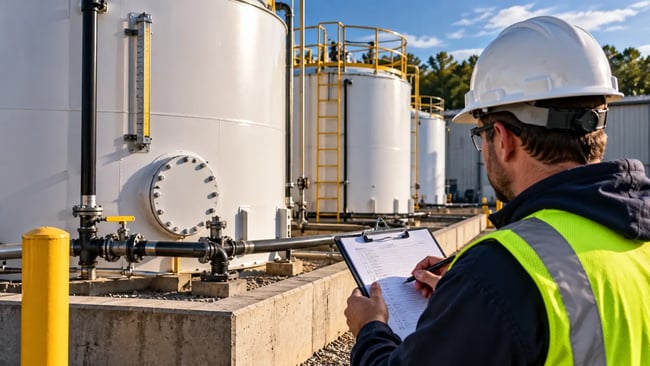
DEP requires periodic inspections on aboveground tanks over 5,000 gallons, and on tanks storing highly hazardous substances over 1,100 gallons. The inspection has to be done by a DEP-certified aboveground tank inspector holding an IAM certification (manufactured tanks) or an IAF certification (field-constructed tanks). The table below lays out the maximum intervals DEP publishes.
| Tank |
Inspection type |
First inspection |
Repeat inspections |
| Aboveground tank over 5,000 gallons |
In-service (external) |
Within 5 years after installation |
5 years maximum |
| Highly hazardous substance tank over 1,100 gallons |
In-service (external) |
Within 5 years after installation |
5 years maximum |
| Aboveground tank over 5,000 gallons in an underground vault |
In-service (external) |
6 to 12 months after installation |
3 years maximum |
| Tank over 21,000 gallons |
Out-of-service (internal and external) |
Within 10 years after installing a new tank or tank bottom |
20 years maximum |
| Internally lined tank over 21,000 gallons |
Lining inspection |
Within 10 years after lining installation |
10 years maximum |
Those are ceilings, not schedules. The certified inspector sets your actual due date at each inspection based on the tank’s condition and corrosion rate, so a tank with active corrosion, past repairs, or poor coatings can land on a shorter cycle. DEP can also require a facility inspection by a certified inspector when it sends written notice or when a permit calls for one.
Some inspections are triggered by events rather than the calendar. Every tank over 21,000 gallons, and every field-constructed tank regardless of size, has to be inspected at installation, reconstruction, or relocation, and again when a major modification is made. Modification inspections are reported to DEP within 30 days. An in-service inspection evaluates the containment area, foundation and supports, shell, roof, piping and other ancillary equipment, leak detection, cathodic protection if the tank has it, coatings, and overall suitability for continued service.
What about tanks between 250 and 5,000 gallons? DEP’s periodic inspection table doesn’t reach them, so they don’t need a recurring third-party inspection under that table. They still need registration and certified installers for tank handling, and DEP publishes a sample monthly maintenance checklist for owners of small tanks to use on their own walk-throughs. Monthly checks by your own staff are standard practice for any oil tank, whether or not a certified inspector is also involved.
How Do You Find and Hire a DEP-Certified Tank Inspector or Installer?
DEP maintains a Certified Storage Tank Companies search that’s updated daily. You can filter it by DEP region, county, and certification category, so start by picking the category that matches the job. For a periodic inspection of a shop-built tank, you want a company that employs an IAM inspector. For a field-constructed tank, you want IAF. For modifications, you want an installer holding the category that matches your tank type. DEP also publishes a list of companies and individuals whose certifications have been revoked, which is worth a look before you sign anything. Questions about certification or your tanks can go to the Division of Storage Tanks at 1-800-42-TANKS or tanks@pa.gov.
Before you hire, confirm the person who’ll do the work holds the right category, not just that the company is listed. Tell them the tank type (manufactured or field-constructed), capacity, whether it’s lined or in a vault, and the date of the last inspection. Quotes vary with the number of tanks, tank size, access to the shell and foundation, whether an internal inspection is needed, and whether the inspector finds deficiencies that need repair. Get a few quotes and book ahead, because a due date doesn’t stretch when the inspector’s schedule fills up.
Keep the paperwork. For tanks over 21,000 gallons, the rules call for the complete inspection report to stay at the facility until the next out-of-service inspection is done. Deficiencies the inspector notes have to be fixed, and repairs that count as tank handling go back to a certified installer. Put your due dates on a calendar that more than one person can see, so an inspection doesn’t slip when the person who set it up changes roles.
How Does a DEP Tank Inspection Overlap With SPCC Integrity Testing?
An SPCC Plan is a written oil spill prevention plan required under the federal Spill Prevention, Control, and Countermeasure rule, 40 CFR Part 112. In Pennsylvania, EPA Region 3 enforces it. You need one if your aboveground oil storage capacity is over 1,320 gallons, counting only containers of 55 gallons or more, or if your buried oil storage is over 42,000 gallons. Capacity is what counts, not how full the tanks are. If you cross that threshold you’ll need a plan, and if you already have one, it has to be reviewed every five years and updated when your storage changes. For the basics, see what an SPCC Plan is, or follow this walkthrough to figure out whether you need an SPCC Plan.
The SPCC rule has its own integrity testing requirement. Section 112.8(c)(6) says you must test or inspect each aboveground bulk container for integrity on a regular schedule and whenever you make material repairs. You determine the qualifications for the people doing the testing, the frequency, and the type of testing based on industry standards, taking into account container size and design. The rule lists visual inspection, hydrostatic testing, ultrasonic testing, radiographic testing, and acoustic emissions testing as examples. You also have to keep comparison records and inspect supports and foundations. Common industry standards include STI SP001 for shop-built tanks and API 653 for field-erected tanks, and DEP’s own in-service inspection rule points to API 653 as well.
That shared footing is where the overlap comes from, and it comes with some limits.
- For tanks DEP regulates, the Pennsylvania requirement controls who does the inspection. The federal rule doesn’t require DEP certification, but your tank does, so a periodic inspection has to come from a certified inspector no matter what your SPCC Plan says.
- A DEP-certified inspection covers much of the same ground as SPCC integrity testing (shell, foundation, supports, piping, containment), so its report can often serve as the integrity testing record for that tank. Whether it fully satisfies your plan depends on what the plan commits to. If the plan calls for an annual formal inspection under an industry standard, a five-year DEP inspection won’t replace it.
- The SPCC rule reaches containers DEP doesn’t. SPCC counts every container of 55 gallons or more, so drums, totes, small tanks, and oil-filled equipment can all fall under your plan even though they sit outside DEP’s periodic inspection table. Here’s how it works for 55-gallon drums. Because the rule leaves personnel qualifications to industry standards, a trained employee often handles routine inspections on smaller containers.
- Routine inspections stay on your calendar. The walk-throughs your plan sets are separate from either type of formal inspection, and our guide to routine SPCC inspections covers what to look at.
The practical move is to build the two schedules together. Give your inspector a copy of your SPCC Plan, ask for a report format that holds up as an integrity testing record, and file it with your plan documents. If an inspection leads to a repair or a new tank, check whether the work changes your storage capacity, containment, or piping. If it does and you already have an SPCC Plan, you’ll likely need to update the plan, and if the change pushes you over the threshold, you’ll need a plan you didn’t have before. At your five-year review, confirm that the inspection history in your plan matches what’s in your DEP records, and if you’re sizing containment for a new tank, see how big your containment needs to be. Our article on when a Professional Engineer is involved covers the certification side.
How Can RMA Help With Pennsylvania Tank Inspections and SPCC Compliance?
The certified work has to come from DEP-certified companies, so there’s no shortcut we can offer there. What we do is handle the plan side so the pieces fit together. We help you work out whether your oil storage puts you over the SPCC threshold, build or rebuild the SPCC Plan, set up an integrity testing schedule that lines up with your DEP due dates so you aren’t paying for the same walk-down twice, and train your people to run routine inspections. Initial SPCC training is free with a new plan from us, and our online training library covers refreshers.
We’ll also tell you when you don’t need us. If your tanks are all small, your total storage stays under 1,320 gallons, and nothing you own crosses DEP’s thresholds, you’re probably under both sets of rules and may not need a plan or a certified inspector at all. For facilities that do need an SPCC Plan, our plans run from about $1,500 to $15,000 depending on size and complexity, and simple Tier I plans run roughly $1,500 to $4,000. Our article on what SPCC Plans cost explains what moves the price, and our guide to the different types of SPCC Plans shows how the tiers work.
There’s no pressure and no obligation. You can call us at 888-RMA-0230, send an email, or fill out the form on our contact page, and we’ll talk through your tanks and what applies to them. If you’d like a broader primer first, start with everything you need to know about SPCC Plans.


