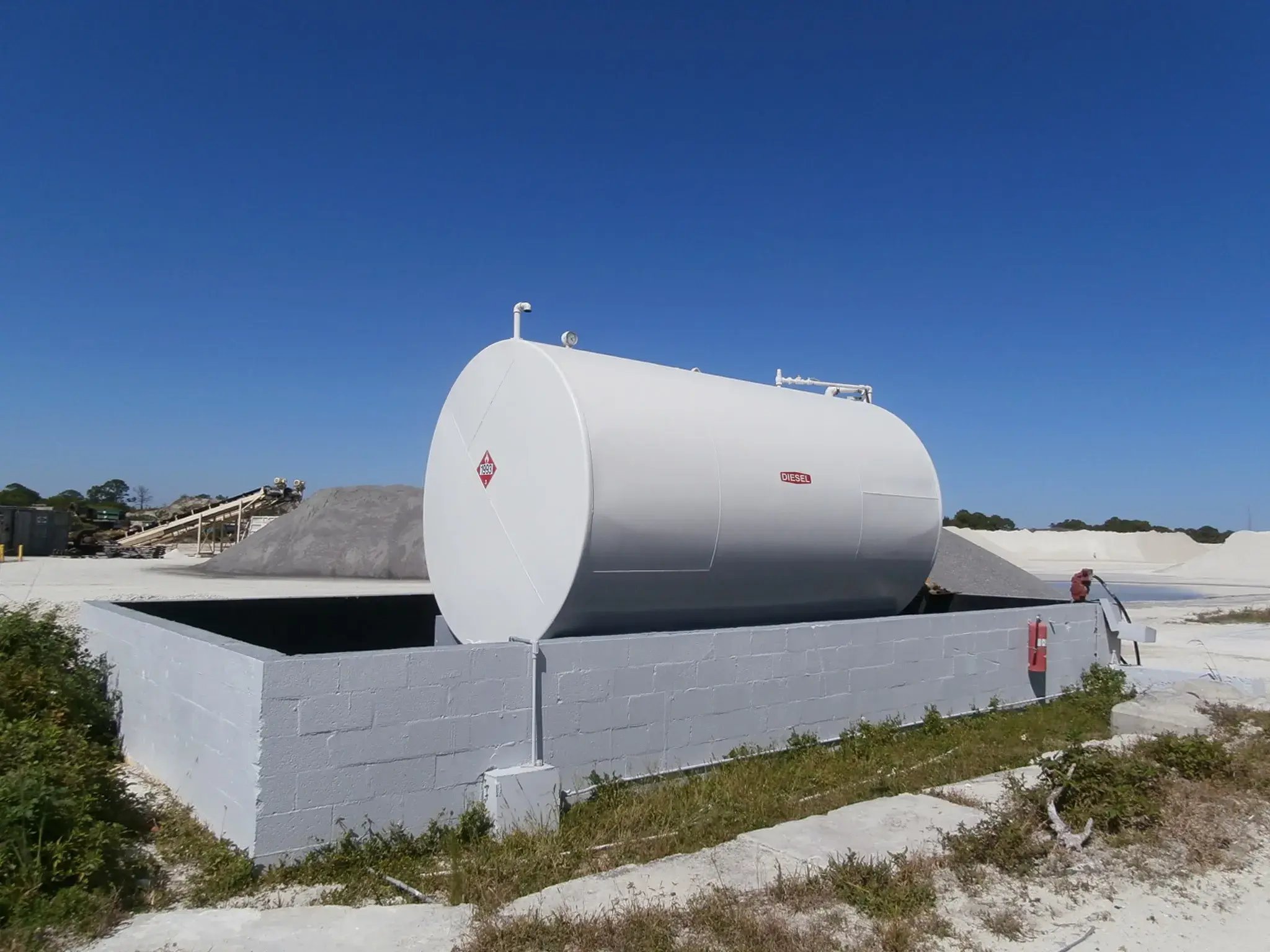
Pennsylvania's SPRP Requirement, the 21,000 Gallon Trigger, and How It Fits With Your SPCC and PPC Plans
If you store fuel in Pennsylvania, you've probably heard of an SPCC plan, and you may have a stormwater permit that mentions a PPC plan. Then DEP, a customer, or a tank inspector brings up a third one, the Spill Prevention Response Plan, and the alphabet soup gets worse. The SPRP is Pennsylvania's own spill plan for facilities with large aboveground storage tanks, and unlike an SPCC plan, it gets filed with DEP.
The short answer is that you need an SPRP when the total aboveground storage tank capacity at your facility is greater than 21,000 gallons of regulated substances. Below that line, this particular plan isn't required. In this article we'll walk through who falls over the line, what DEP expects in the plan, how it compares to an SPCC plan and a PPC plan, and how many facilities end up with one combined document instead of three. If you'd rather talk through your own tanks, you can reach out to RMA and we'll tell you where you stand.
Table of Contents
TL;DR
Pennsylvania requires a Spill Prevention Response Plan, or SPRP, at facilities with more than 21,000 gallons of total aboveground storage tank capacity for regulated substances, and it gets filed with DEP. It's nearly identical to a PPC plan, with one addition: a downstream notification list covering 20 miles and an annual notice to everyone on it. An SPCC plan is a separate federal plan with a much lower threshold, but the content overlaps enough that DEP encourages consolidating the state plans, and many facilities fold the SPCC plan into the same document.
What Is Pennsylvania's Spill Prevention Response Plan (SPRP)?
The Storage Tank and Spill Prevention Act (Act 32 of 1989) and DEP's rules in 25 Pa. Code Chapter 245 require owners of large aboveground storage tank facilities to develop a Spill Prevention Response Plan and file it with DEP. The plan describes how you'll prevent a spill, how you'll contain and control one if it happens, and who you'll notify, including DEP, local emergency management agencies, and the municipalities and water users downstream of your site. It covers regulated substances, which means petroleum products and hazardous substances, so it isn't strictly an oil rule the way SPCC is.
DEP runs the program through the storage tank staff in its six regional offices. That's a different agency and a different rulebook from the federal SPCC rule in 40 CFR Part 112, which EPA enforces (EPA Region 3 in Pennsylvania). Plenty of facilities have a solid SPCC plan and have never heard of the SPRP, simply because SPCC gets most of the attention. If you want the federal side first, our complete guide to SPCC plans covers it, and this plain-English explainer is the short version.
Who Needs a Spill Prevention Response Plan in Pennsylvania?
The trigger is total aboveground capacity. If your facility has more than 21,000 gallons of regulated aboveground storage tank capacity, you need an SPRP. Chapter 245 defines a large aboveground storage tank as a single tank over 21,000 gallons and a large aboveground storage tank facility as one with more than 21,000 gallons in total, so a site with one 25,000 gallon tank and a site with five 5,000 gallon tanks end up in the same place. You add up the regulated tanks at the facility, and it's the tank's capacity that counts, not how full it is.
The counting rules differ from SPCC, and that trips people up. DEP defines an aboveground storage tank as a stationary tank over 250 gallons with more than 90 percent of its volume above the ground, so 55 gallon drums and small totes generally aren't what builds your SPRP number, even though containers of 55 gallons and up count toward the SPCC threshold of 1,320 gallons. The tank rules have exemptions and edge cases, so check your own inventory against DEP's storage tank program before you decide you're under the line. If you're not sure whether you need an SPCC plan at all, this four-step guide walks through it.
New and expanding facilities get pulled in as well. A new large aboveground tank facility, or a new tank over 21,000 gallons at an existing large facility, needs an initial plan filed with DEP as part of DEP's tank installation permitting, and adding or removing a tank at an existing large facility is one of the changes that triggers an update. The construction side of that work, meaning the tank installation itself (which in Pennsylvania generally calls for DEP-certified installers), building and fire permits, and any construction-phase approvals, runs through your engineer and contractor, and we don't prepare those. Where we come in is the operating side once the tanks are in place: the plans, inspections, and training a running facility needs.
If your regulated tank capacity is 21,000 gallons or less, the SPRP requirement doesn't apply to you. You can still need an SPCC plan, a PPC plan under a permit, and DEP tank registration, but this particular plan stays off your list.
What Does a Pennsylvania SPRP Have to Include and Who Gets a Copy?
DEP's guidance lists four core pieces. The plan needs a detailed description of the facility, including a 7½ minute USGS topographic map or equivalent showing the tank facility, an organizational strategy for carrying out the plan, the facility's spill prevention and response programs, and the network of emergency response agencies and downstream notifications. DEP says the plan doesn't need to be long and complex to work, and it expects the plan to be written for your specific facility by someone who knows the day-to-day operations. A consultant has to be able to study how you store, handle, use, and dispose of the regulated substances, so a generic template won't do the job.
The downstream notification requirement is what makes an SPRP different from other plans. If you have a release, you have to notify the surface water users and the municipal and county officials within 20 downstream miles of the facility. You build that list with your county emergency management agency, and it includes municipal water users, water companies, and industrial users. Every year you also send each of them a written notice with your inventory of regulated substances, a summary of any spills and releases from the previous year and the cleanup, and the measures you've put in place to prevent future ones. The list itself gets updated annually, again with the county emergency management agency. This is the piece that gets missed when a facility treats its SPRP as a copy of its PPC plan.
The plan goes to the appropriate DEP regional office. DEP's materials describe the plan as covering notification of DEP and local emergency management agencies, and they have you build the downstream list with the county emergency management agency, so that office is your first call. Whether your county or local emergency officials want a copy of the full plan can vary, so ask them while you're building the list. After the initial filing there's no fixed update schedule, but you're expected to review the plan periodically and submit a revised plan or addendum when things change, such as when you add or remove a tank, modify equipment or operations in a way that raises the chance of a release, change your emergency organization, or find that the plan failed in a real emergency. DEP can also ask for an updated plan at any time, and if a release happens, you put the plan into action right away.

How Does an SPRP Compare to an SPCC Plan and a PPC Plan?
All three plans deal with preventing, containing, and responding to spills, and a lot of the content overlaps. The differences come from who requires each one and what triggers it.
| |
SPCC Plan |
PPC Plan |
SPRP |
| Full name |
Spill Prevention, Control, and Countermeasure Plan |
Preparedness, Prevention, and Contingency Plan |
Spill Prevention Response Plan |
| Where it comes from |
Federal rule, 40 CFR Part 112 |
DEP permits and guidance, including 25 Pa. Code § 91.34 |
Storage Tank and Spill Prevention Act and 25 Pa. Code Chapter 245 |
| Who enforces it |
EPA (Region 3 in Pennsylvania) |
PA DEP, through the permit |
PA DEP storage tank program |
| What triggers it |
More than 1,320 gallons of aboveground oil storage in containers of 55 gallons or more, or more than 42,000 gallons buried, plus a reasonable expectation of a discharge to navigable waters |
A DEP permit that requires one, such as PAG-03 industrial stormwater coverage |
More than 21,000 gallons of total regulated aboveground tank capacity |
| Filed with an agency? |
Not routinely, kept at the facility |
Provided to DEP as the permit requires |
Yes, filed with the DEP regional office |
| What's unique |
Containment, inspection, and integrity testing rules, certification, and a five-year review |
Pollution prevention and emergency procedures for the whole facility |
Downstream notification list and annual notice |
DEP describes the only difference between a PPC plan and an SPRP as the downstream notification list. A facility with an up-to-date PPC plan only needs to add that list to meet the SPRP requirement. The SPCC plan is the odd one out because it comes from EPA, uses a much lower trigger, and is self-certified or certified by a Professional Engineer depending on the facility instead of being routinely filed. We explain that split in our guide to the types of SPCC plans and the engineering rules in this article on Professional Engineers and SPCC plans, and who enforces SPCC plans covers how EPA and the state agencies divide the work.
Here's how the triggers usually stack up for a Pennsylvania facility. These are general patterns, and your permits and tank inventory decide the real answer.
| Your Situation |
Plans You'll Likely Need |
| More than 1,320 gallons of oil in aboveground containers, 21,000 gallons or less of regulated tank capacity, and no permit that calls for a PPC plan |
SPCC plan |
| Same oil storage, plus a permit such as PAG-03 stormwater coverage |
SPCC plan and PPC plan |
| Oil storage with more than 21,000 gallons of regulated aboveground tank capacity |
SPCC plan and SPRP (the SPRP carries the PPC content), plus a PPC plan if a permit calls for one |
| Regulated hazardous substances in aboveground tanks totaling more than 21,000 gallons |
SPRP, because the SPCC rule only covers oil |
How Can One Document Satisfy SPRP, SPCC, and PPC Requirements?
DEP strongly recommends that facilities consolidate their PPC plan and SPRP into a single document and keep it current, and its guidance document 400-2200-001 sets out the format. Facilities that also have an SPCC plan often fold it into the same document. The SPCC rule allows this. A plan can follow a different format than the one in the rule as long as it meets every SPCC requirement and includes a cross-reference showing where each one is addressed (40 CFR 112.7(a)(1)), and the rule separately asks the plan to discuss conformance with applicable state requirements (40 CFR 112.7(j)). EPA's "one plan" integrated contingency plan guidance was built for the same purpose.
In practice, the combined plan uses the DEP format as its backbone and keeps the SPCC content easy to find. That means a cross-reference table up front, the SPCC items (containment analysis, inspection and integrity testing procedures, training, and the certification page) clearly labeled, and the downstream notification list and annual notice schedule built into the response section. The tank inventory, site map, contact lists, and response procedures only get written once, which is where most of the time savings come from.
A few things need attention when you combine. The update clocks differ: an SPCC plan has its own five-year review and amendment rules (our article on SPCC five-year reviews covers them), while an SPRP gets revised when your tanks, equipment, or organization change or when DEP asks. Anything that has to be certified by a Professional Engineer stays certified, and we work with an outside PE in Pennsylvania when a plan needs one. And because the SPRP is filed with DEP, submitting the full combined document can put the SPCC portion in front of DEP too. Some facilities keep the SPCC section as a pull-out part so what they file is what DEP asks for, and you should decide that before you file, not after.
Combining isn't always the right call. A company with several very different sites, or one that keeps a stormwater plan separate for good reasons, may do better with separate plans that reference each other. This article on keeping SWPPP and SPCC plans together covers the same question for stormwater. Whichever structure you pick, your people have to know what's in the plan, and our online training library covers the training side.
What Affects the Cost of Pennsylvania SPRP, SPCC, and PPC Plans?
We publish our SPCC pricing. Plans typically run $2,500 to $15,000 depending on the facility, a simple Tier I plan update is around $1,500, and a PE-certified update on a complex site starts at $7,500. Our SPCC cost breakdown shows what moves a plan up or down that range. SPRP and PPC work is priced by scope, because the biggest variables come from your site rather than the document.
Cost follows the number of tanks and their total capacity, how many locations you have, whether any of the plan needs PE certification, whether your secondary containment needs to be evaluated (here's how containment sizing works), how good your existing plans are, and how much research the downstream notification list takes. Starting from a solid PPC or SPCC plan costs less than starting from nothing. Below is our SPCC pricing calculator, which gives you a ballpark for our help with the SPCC portion. If you also need the SPRP and PPC pieces, tell us and we'll scope the whole thing.
How Does RMA Help With Pennsylvania SPRP, SPCC, and PPC Planning?
We're based in New Jersey and work with facilities across Pennsylvania on SPCC plans and the state and federal oil storage requirements around them. The first step is usually a short conversation about your tanks and your permits, which tells us whether you're over the 21,000 gallon line, what you already have, and what can be combined. If you're under the thresholds or your existing plans already cover you, we'll say so. If a combined plan makes sense, we'll talk through scope and timing with you before anything starts.
You can call us at 888-RMA-0230 or fill out the form on our website whenever you're ready. If you'd like to contact RMA with a question about SPRP requirements, there's no obligation and no pressure.