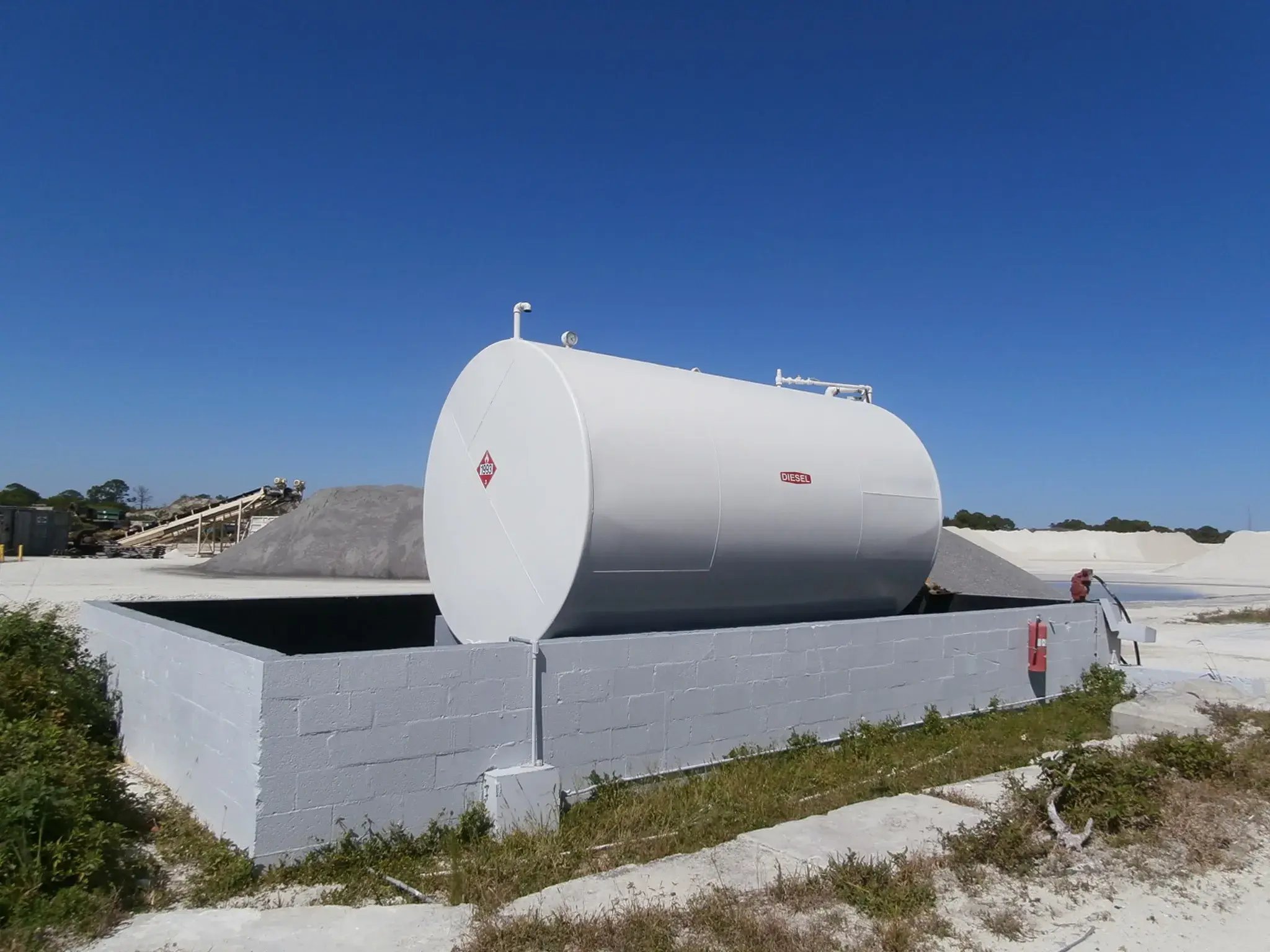
How EPA Decides Whether a Pennsylvania Facility Could Reasonably Discharge Oil to Navigable Waters, and Why Drainage Features Usually Settle the Question
A lot of facility managers read the oil spill rules, look out the window at a parking lot and a loading dock, and decide none of it applies because there isn't a creek anywhere on the property. The logic feels sound. SPCC, short for Spill Prevention, Control, and Countermeasure, is the federal rule that requires a written oil spill plan for facilities that store enough oil, and it only reaches facilities that could reasonably be expected to discharge oil to navigable waters or adjoining shorelines. If the nearest river is half a mile away, that language seems like it should let you off the hook. In Pennsylvania it rarely does, and the reason comes down to how EPA reads the word "reasonably."
This article walks through how EPA looks at the question, why storm drains, ditches, and swales count as pathways even when the water body is far away, and why dikes and berms can't be used to argue your way out. We'll also cover how Pennsylvania's dense stream network and the shifting "waters of the United States" definition affect the analysis. And we'll be straight about the cases where a facility really is exempt, which usually comes down to how much oil you store rather than where you sit. If you'd like a second set of eyes on your own site, you can reach out to RMA and we'll talk it through.
Table of Contents
TL;DR
If you store enough oil to hit the SPCC thresholds, the rule covers you when a spill could reasonably reach navigable waters. EPA makes that call using location, drainage, and land contour, and it ignores dikes, berms, and other manmade containment. Almost every industrial site has a ditch, swale, or storm drain, and those connect to creeks, streams, and rivers, so "we're not near water" rarely holds up, especially in Pennsylvania. The better first question is whether you're over the storage thresholds at all. If you are, expect to need an SPCC Plan unless a careful site review shows otherwise.
What Does 'Reasonable Expectation of Discharge' Mean Under the SPCC Rule?
Two separate tests decide whether the SPCC rule (40 CFR Part 112) covers your facility, and people tend to blur them together. The first is about storage. A facility is generally in the rule's sights when it has more than 1,320 gallons of oil in aboveground containers, counting only containers of 55 gallons or larger, or more than 42,000 gallons in completely buried tanks (tanks already covered by the federal underground storage tank rules are left out of that buried count). The second test is about location. Under 40 CFR 112.1(b), the rule applies to facilities that, because of where they sit, could reasonably be expected to discharge a harmful quantity of oil into or upon navigable waters or adjoining shorelines. A harmful quantity includes enough oil to leave a sheen on the water, which is why even small spills and the sheen rule deserve attention.
The location test is where the confusion starts. The exemption in 112.1(d)(1)(i) is written for a facility that could not reasonably be expected to have that kind of discharge, and it says the call has to rest solely on the geography and location of the site: proximity to navigable waters, land contour, drainage, and similar features. Read that wording closely. It isn't asking whether a river borders your property. It's asking whether there's any reasonable path for oil to reach one, and in practice you're the one who has to make the case that there isn't.
EPA's own guidance spells out what goes into the analysis. Inspectors look at where the facility sits relative to streams, ponds, and ditches, whether perennial or intermittent, along with storm and sanitary sewers, wetlands, and similar features. They also weigh the distance to those waters, the volume of oil stored, worst-case weather, drainage patterns, land contours, and soil conditions. Distance is one factor among several, which is why "we're not near water" carries less weight than people hope. If you're newer to the rule, our overview of SPCC Plans covers the basics before you dig into the applicability question.
Why Do Storm Drains, Ditches, and Swales Count as Pathways to Navigable Waters?
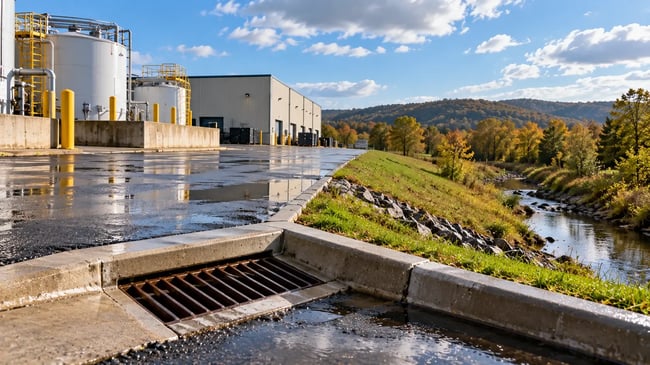
Walk out the door of almost any industrial facility and you'll find some way for water to leave the site. There's a catch basin in the parking lot, a swale along the access road, a ditch along the street, a culvert under the driveway, or a stormwater pond with an outlet pipe. None of these look like waterways, but each one is a path, and EPA's guidance names ditches and storm sewers specifically as features to evaluate. Oil spilled near a loading dock doesn't stay put once it reaches a storm drain. It moves with the water.
The chain after that is what trips people up. A parking lot catch basin typically feeds a storm sewer. The storm sewer discharges at an outfall, often into a roadside ditch or a small creek that doesn't have a name on most maps. That creek joins a larger stream, the stream joins a river, and the river eventually reaches the Chesapeake Bay, the Delaware estuary, Lake Erie, or the Gulf of Mexico by way of the Ohio and Mississippi. Every one of those hops can be a long way, but the rule doesn't set a maximum distance. In our experience, if a facility has any drainage feature at all, and virtually every one does, there's a route someone can credibly argue leads to navigable waters. An EPA inspector can make that argument as easily as we can.
The table below shows how common site features tend to connect downstream, and what to ask about each one.
| Site Feature |
Where It Commonly Leads |
What to Ask |
| Parking lot catch basin |
A storm sewer, then an outfall to a ditch, creek, or stream |
Where is the outfall, and what does it discharge to? |
| Roadside ditch or swale |
A culvert, then a nearby creek or storm system |
Does it flow all year or only after rain, and where does it end? |
| Culvert or pipe under a driveway or road |
The next ditch or stream downstream |
Where does the pipe come out? |
| Stormwater pond or basin |
Usually an outlet structure to a storm system or stream |
Where does the outlet go? |
| Floor drain or sanitary sewer connection |
A municipal or private treatment system, depending on how the site is plumbed |
EPA lists sanitary sewers among features to evaluate, so confirm where yours goes |
| Sloped, unpaved ground |
Overland flow toward the lowest point, often a ditch or stream |
What do the land contour and soil conditions suggest? |
If you already hold a stormwater permit or keep a SWPPP, you've probably mapped many of these features already. That same drainage map is a good starting point for SPCC, though the two plans answer different questions, as we explain in our comparison of SPCC Plans and SWPPPs.
Why Can't You Count Dikes, Berms, and Other Manmade Features?
The rule is direct about this. The same provision that sets up the location test says the determination must exclude manmade features such as dikes, equipment, or other structures that may restrain, hinder, contain, or otherwise prevent a discharge. EPA's public guidance puts it more simply: assume those features aren't there when you make the determination.
In practice, that means a tank sitting inside a concrete dike with a locked drain valve gets analyzed as though the dike weren't there. Berms, curbing, closed valves, oil/water separators, and spill kits all fall into the same group. This catches a lot of facilities off guard because it feels backward. If you've spent money on containment, it seems like it should count for something. The reasoning is that the applicability question asks whether oil could reach water in a worst case, and containment is what you're expected to build, inspect, and document once the rule applies. It doesn't get a second life as a reason the rule doesn't apply.
"We have secondary containment, so we're fine" blends two questions together. Whether you're covered depends on the site's geography. Whether your containment is adequate is a later question with its own sizing and inspection requirements, and our guide on how big SPCC oil spill containment needs to be covers that side of it.
Why Does 'We're Not Near Water' Fail So Often in Pennsylvania?
Pennsylvania has a lot of water to be near. DEP estimates the state has roughly 85,000 miles of rivers and streams, spread across six major river basins that include the Susquehanna, the Delaware, and the Ohio. That number covers everything from the big rivers down to small creeks, and a storm sewer outfall is as likely to end in the second kind as the first. Add hilly terrain that pushes runoff toward hollows and valley floors, and it's hard to find an industrial site where oil leaving the property couldn't plausibly end up in a stream.
The misconception shows up across all kinds of Pennsylvania facilities. Data centers with generator fuel tanks, concrete plants, fleet yards, warehouses running forklifts with hydraulic oil, and manufacturers with oil-filled equipment all tend to assume the rule is for refineries and marinas. Our guides on concrete plants and SPCC and data centers and SPCC show how often that assumption falls apart once the storage is counted.
EPA Region 3 enforces SPCC in Pennsylvania, and inspectors there apply the same location test described above. If you want to know how that works day to day, we cover it in our article on who enforces SPCC Plans. Keep in mind that the federal rule is separate from DEP's storage tank program, which has its own registration rules. Whether a particular tank needs DEP registration depends on its size, type, and use, so confirm yours against DEP's program rather than assuming one program covers the other.
Does the Changing 'Waters of the United States' Definition Change the Answer?
A fair objection to everything above is that the definition of navigable waters keeps moving. For SPCC purposes, 40 CFR 112.2 defines navigable waters as the waters of the United States, pointing to the Clean Water Act definition in 40 CFR 120.2. That definition has been in flux for more than a decade. In 2023, the Supreme Court's Sackett decision limited federal jurisdiction to relatively permanent, standing or continuously flowing bodies of water, and to wetlands with a continuous surface connection to them.
Here's where things stand according to EPA's September 2026 status update. Because of ongoing litigation, EPA and the Army are implementing the 2023 rule, as amended to match Sackett, in 24 states, the District of Columbia, and the territories. In the other 26 states, they're applying the pre-2015 approach along with Sackett. The states where courts blocked the 2023 rule don't include Pennsylvania, so the amended 2023 rule is the one in use here. Separately, the agencies proposed a narrower definition in November 2025 and issued a supplemental proposal in September 2026 that includes an option limiting jurisdiction to perennial waters. Those are proposals, not final rules, and the definition could change again before it settles.
So what does that mean for the reasonable expectation question? Less than people hope. A narrower definition could matter at the margins, for example a dry ditch that only carries water during a storm and ends in a field with no connection to anything downstream. But the SPCC question isn't whether your ditch is itself a regulated water. It's whether oil leaving your site could reasonably reach one. A swale that feeds a storm sewer that discharges to a perennial stream gets there under any version of the definition. Our read is that a narrower definition would shrink the number of edge cases, not the number of ordinary industrial sites with a catch basin and a creek downstream. If your argument depends on how a specific ditch or wetland is classified, that's a technical and legal call worth getting right before you rely on it, and since the rule is still moving, check the current status first.
When Can a Facility Legitimately Claim It's Exempt From SPCC?
Start with storage, because that's where most real exemptions come from. If your total aboveground oil capacity is 1,320 gallons or less and your completely buried capacity is 42,000 gallons or less, the rule doesn't apply no matter where you're located, and you don't need an SPCC Plan or us. Containers under 55 gallons don't count toward the 1,320 total. Permanently closed containers and vehicle fuel tanks that power the vehicle (motive power containers) are excluded too, though a fuel trailer or skid tank isn't. Capacity is what counts, not how full a container is. Oil also includes more than petroleum. Animal fats and vegetable oils are covered, so cooking oil storage can push a restaurant supplier or food facility over the line.
The location-based exemption does exist, and we won't pretend otherwise. A facility could qualify if, judged on geography alone and with every dike and berm ignored, oil has no reasonable way off the site and on to a waterway. Given how the test works, that's a hard position to hold for any site with surface drainage, and we'd want to see the reasoning written down and the drainage traced on paper before anyone relied on it. Our 4-step guide to figuring out if you need an SPCC Plan walks through the broader screening.
Concluding you're exempt doesn't necessarily end the conversation, either. Under 40 CFR 112.1(f), the EPA Regional Administrator, which for Pennsylvania means Region 3, can require a facility to prepare a plan after sending written notice with the reasons. The owner then has 30 days to respond with information and can appeal a final determination. If a facility is told to prepare a plan, it has six months to write it and up to a year after the final determination to implement it.
A practical way to test your own conclusion is to walk the site after a rain with a drainage map in hand. Find every catch basin, ditch, swale, culvert, and outfall, then follow each one downstream using county maps or topographic maps until you reach a named stream or river. Note where flow goes when the drains are open and when they're blocked. If you can't find a route to water on paper, write down why. If you can, you've found the same route an inspector would.
How Can RMA Help You Decide Whether SPCC Applies to Your Facility?
If you're not sure which side of the line your facility falls on, we can help you work it out. We're based in New Jersey and work with facilities across Pennsylvania, and it starts with the storage count and the drainage trace described above. If you're under the thresholds, we'll tell you so. If you're over, we'll walk you through whether you're looking at a self-certified plan or one that needs a Professional Engineer's certification, which our guide on the types of SPCC Plans explains.
SPCC Plans typically run from $2,500 to $15,000, depending on how many containers you have, how complex the site is, and whether PE certification is needed. Our breakdown of SPCC Plan costs goes through what drives the number. Senior staff do the work here, and we don't use AI to produce client deliverables.
There's no pressure and no obligation. You can call us at 888-RMA-0230, email us, or fill out the form on our website, or you can contact RMA directly. If you've already received an inspection notice or an information request from EPA, talk to an environmental attorney before you respond, and we're glad to work alongside them on the technical side. Our article on top SPCC Plan violations and fines covers what enforcement tends to look like.