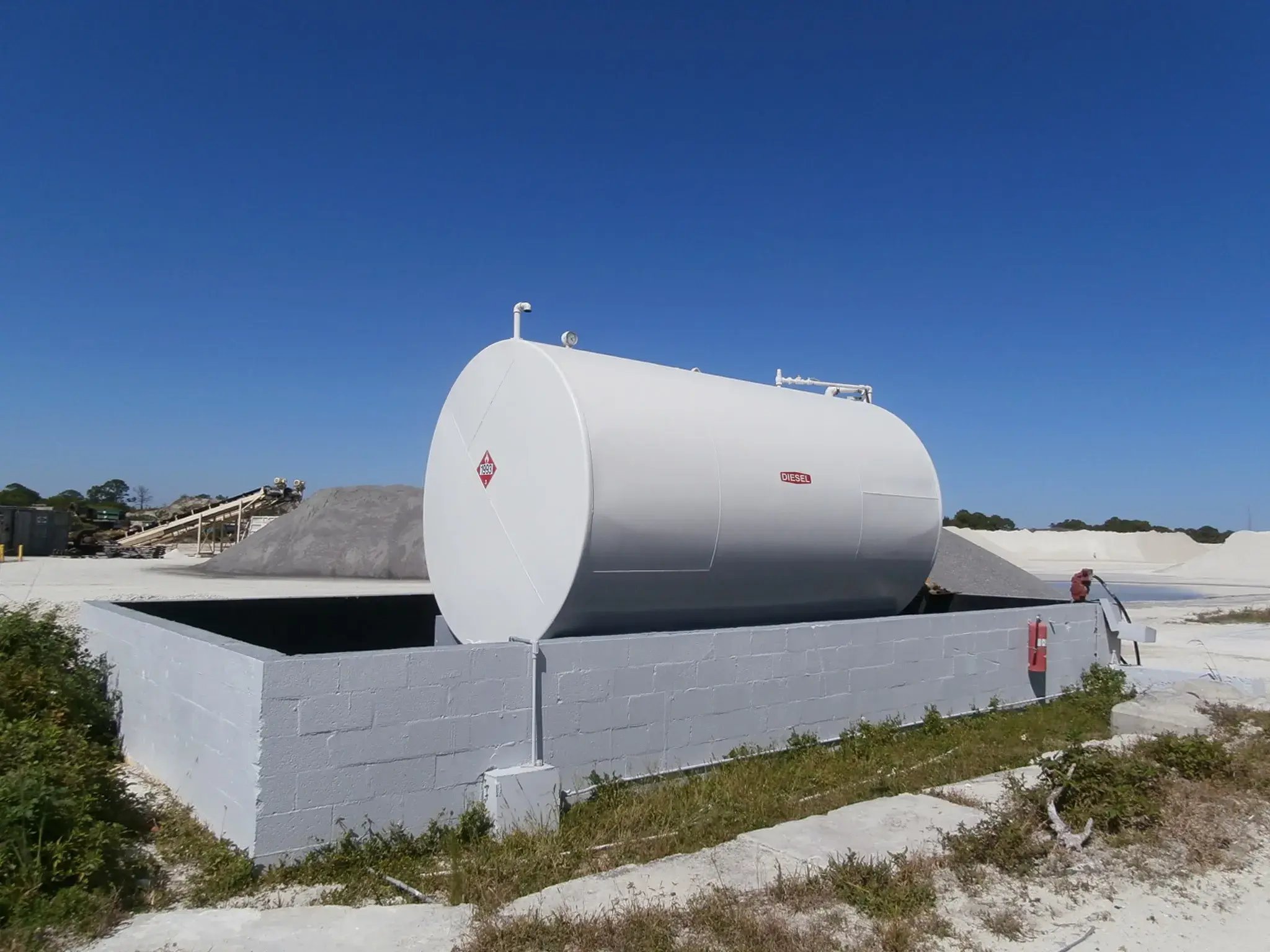
SPCC Exemptions Explained: Which Oil Containers and Facilities the Federal Oil Spill Rule Doesn't Cover
Most facility managers who hear about SPCC for the first time ask the same thing: does my stuff actually count? The federal Spill Prevention, Control, and Countermeasure rule applies to facilities that store more than 1,320 gallons of oil above ground, but the rule has a specific list of containers that are left out of that math or exempt outright. Knowing the list can be the difference between needing an oil spill plan and not needing one.
This article walks through each exemption in the rule, with a table you can scan, then covers the catches that trip people up and what Pennsylvania's separate tank program does with the same containers. If you'd rather have someone check your inventory against the rule, you can reach out to RMA and we'll tell you straight whether you're in or out.
Table of Contents
TL;DR
SPCC is the federal oil spill plan rule in 40 CFR Part 112. It exempts containers under 55 gallons, permanently closed containers, motive power containers on vehicles and equipment, hot-mix asphalt, single-family residential heating oil, pesticide application equipment, milk containers, certain wastewater treatment facilities, and completely buried tanks already covered by the federal UST rules. Everything else of 55 gallons or more counts toward the 1,320 gallon aboveground threshold, including empty tanks and oil-filled equipment. An SPCC exemption doesn't settle things in Pennsylvania, because DEP's storage tank program has its own thresholds and its own exemptions.
How Does SPCC Decide Which Oil Containers Count?
SPCC is the federal oil spill prevention rule found in 40 CFR Part 112, and in Pennsylvania it's enforced by EPA Region 3. A facility needs an SPCC Plan when it could reasonably be expected to discharge oil to navigable waters or adjoining shorelines and it has more than 1,320 gallons of aboveground oil storage capacity, or more than 42,000 gallons of completely buried capacity. If you want the full background first, our guide to what an SPCC Plan is covers it.
The word to hold onto is capacity. The rule counts the shell capacity of each container, not how much oil is in it today, so an empty 1,000 gallon tank counts the same as a full one. Only containers of 55 gallons or more go into the aboveground total. And "oil" means oil of any kind, including diesel, hydraulic and lube oil, mineral and synthetic oils, and animal fats and vegetable oils, which is why cooking oil can trigger the rule. Propane and diesel exhaust fluid aren't oil, so they stay out of the count.
The exemptions come in two forms. Some containers are exempt outright. Others are carved out of the aboveground tally you use to decide whether your facility crosses 1,320 gallons. Either way, the result for your math is the same: an exempt container doesn't go in the total.
Which Containers Are Exempt From SPCC? A Quick Reference Table
This list comes from 40 CFR 112.1(d) and the definitions in 112.2, and we checked it against the current text of the rule. The right-hand column is where most of the real-world questions come from, because each exemption has an edge.
| Exemption |
What qualifies |
Where the exemption stops |
| Containers under 55 gallons |
Any single container with less than 55 gallons of oil capacity, such as 5 gallon pails and small drums |
A 55 gallon drum is not under 55 gallons, so it counts |
| Permanently closed containers |
All liquid and sludge removed, lines disconnected and blanked off, valves closed and locked, and conspicuous signs stating it's permanently closed with the closure date |
An empty tank that's still piped up and usable is not closed |
| Motive power containers |
The onboard container that primarily powers the movement of a motor vehicle, or ancillary onboard oil-filled operational equipment |
Onboard containers that store or transfer oil for further distribution, drilling and workover rigs, and the act of fueling a vehicle at a regulated facility |
| Hot-mix asphalt |
Hot-mix asphalt and the containers that hold it |
Asphalt cement, asphalt emulsions, and cutbacks aren't hot-mix asphalt, and diesel and hydraulic oil at the plant still count |
| Single-family residential heating oil |
A heating oil container used solely at a single-family residence |
Heating oil at shops, offices, warehouses, and apartment buildings |
| Pesticide application equipment |
Pesticide application equipment and related mix containers |
Other oil stored at the same site, like a diesel tank, is judged on its own |
| Milk and milk product containers |
Milk and milk product containers, with the associated piping and appurtenances |
Diesel, hydraulic oil, and lubricants at the dairy still count |
| Wastewater treatment facilities |
A facility, or part of one, used exclusively for wastewater treatment and not used to satisfy any requirement of the SPCC rule |
Producing, recovering, or recycling oil is not wastewater treatment |
| Completely buried tanks under the UST rules |
Completely buried tanks, piping, and containment subject to all the technical requirements of 40 CFR Part 280 or an EPA-approved state UST program |
Buried tanks those rules don't fully cover, plus bunkered, partially buried, and vaulted tanks, which count as aboveground |
Which Oil Containers Still Count Toward the SPCC Threshold?
Most of the confusion runs the other direction, with containers people assume are exempt that aren't. Empty tanks count, because capacity is what gets measured. Containers used for standby, seasonal, or temporary storage count, and so does any container that isn't permanently closed under the rule's definition. Oil-filled operational equipment, like hydraulic systems, lubrication systems, transformers, and circuit breakers, goes into the total even though it isn't a bulk storage container. Totes and drums of 55 gallons or more count too, and our article on 55 gallon drums and SPCC Plans goes through how that plays out. Heating oil counts everywhere except a single-family home, so the tank that heats your shop or office is in the math.
Here's what that looks like on a real site. A small repair shop has a 500 gallon waste oil tank, a 275 gallon heating oil tank for the building, a 330 gallon tote of new hydraulic oil, and five 55 gallon drums of motor oil. That's 500 plus 275 plus 330 plus 275, or 1,380 gallons, which is over the 1,320 gallon line even though no single container looks large. The owner's pickup truck and a few 5 gallon pails of grease stay out of the total. Whether that shop also meets the rule's discharge-to-water test is a separate question, but the capacity math is where most facilities get caught.
Where Do SPCC Exemptions for Vehicles, Buried Tanks, and Wastewater Get Tricky?
Motive Power Containers vs. Fuel Trailers and Skid Tanks
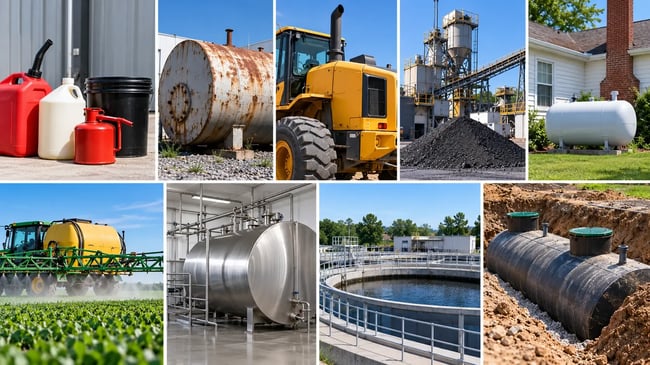
The motive power exemption covers the tank that moves a vehicle or piece of equipment, plus ancillary onboard oil-filled operational equipment like the hydraulic system on a truck. It stops there. An onboard container used to store or transfer oil for further distribution isn't a motive power container, which is why mobile refuelers, fuel trailers, and skid tanks that feed other equipment fall under the rule. The exemption also doesn't cover the transfer itself, so fueling a truck from a regulated tank is still covered. Contractors, fleets, and concrete and aggregate operations run into this most, since fuel is often staged on site for loaders and mixer trucks.
Completely Buried Tanks and the 42,000 Gallon Limit
The buried tank exemption sounds like it clears every underground tank, but the wording is narrower. The tank, its piping, and its containment have to be subject to all of the technical requirements of the federal underground storage tank rules in 40 CFR Part 280, or of an EPA-approved state program. Buried tanks those rules leave out, such as heating oil tanks used on the premises where the oil is burned, don't get the exemption, and their capacity goes toward the 42,000 gallon test. Bunkered tanks, partially buried tanks, and tanks in vaults are treated as aboveground containers, so they count toward the 1,320 gallon figure.
The wastewater treatment exemption works the same way, with a condition attached. It covers a facility or part of one used exclusively for wastewater treatment and not used to satisfy any requirement of the SPCC rule, so a unit that also serves an SPCC requirement doesn't qualify. Producing, recovering, or recycling oil isn't wastewater treatment under the rule, so an oil recycler can't lean on it.
Two exemptions sit outside the container list. A facility that couldn't reasonably be expected to discharge oil to navigable waters or adjoining shorelines is exempt, but that call has to rest on geography alone, like distance to water, land contour, and drainage. Dikes, tanks, and other manmade features can't be counted in your favor. Equipment and operations under the authority of the U.S. Department of Transportation are handled through a separate split between EPA and DOT, and that line gets blurry at facilities that mix transportation and non-transportation activity. Farms follow their own path as well. Congress set special farm thresholds in the Water Resources Reform and Development Act of 2014, and under EPA's guidance a farm with less than 2,500 gallons of aboveground storage capacity isn't required to have a plan, with different rules for farms above that figure. EPA's farm fact sheet is the place to check yours. Even when an exemption applies, the rule lets the EPA Regional Administrator require a plan, or part of one, for a facility under EPA's jurisdiction, through a written notice and a defined process.
Does an SPCC Exemption Also Exempt a Tank From Pennsylvania's Storage Tank Program?
No. DEP's storage tank program runs under the Storage Tank and Spill Prevention Act and 25 Pa. Code Chapter 245, and it has its own thresholds, definitions, and exemptions. In general, a stationary aboveground tank holding more than 250 gallons of a regulated substance, or an underground tank holding more than 110 gallons, has to be registered with DEP unless one of DEP's exemptions applies. Work on a regulated tank system, other than routine maintenance, has to be done by a DEP-certified installer, and the required inspections have to be done by a certified inspector.
The two programs overlap but don't line up. Tanks of 250 gallons or less generally fall outside DEP's aboveground tank definition, yet SPCC counts every container of 55 gallons or more. DEP's program generally excludes oil-filled operational equipment, while SPCC counts it. A tank that's permanently closed under SPCC's definition isn't automatically closed under DEP's, since DEP expects aboveground tank systems that are no longer needed to be closed in place or removed properly. Larger facilities have one more layer: a single aboveground tank over 21,000 gallons, or a facility with more than 21,000 gallons of regulated aboveground capacity, needs a Spill Prevention Response plan under DEP's rules.
Whether a particular tank needs DEP registration depends on its size, type, and use, so confirm yours against DEP's storage tank program before you assume either way. Local fire code requirements for tanks vary by municipality and are a separate check as well.
What Should You Do If Your Pennsylvania Facility Falls Under the SPCC Threshold?
If your tally comes in under 1,320 gallons, you probably don't need an SPCC Plan, and we'll tell you so plainly. Write the calculation down anyway. A one page list of each container, its capacity, whether you counted or excluded it, and why gives you something to hand an inspector, an insurer, or a lender. Redo it when you add a tank, bring in a tote, move equipment, or take over a neighboring property, because it's easy to cross the line without noticing. Our four steps to figure out if you need an SPCC Plan walks through the full process.
If you're close to the line, say within a few hundred gallons, take a second look at what you excluded. Exclusions are where most miscounts happen, especially permanently closed tanks that were never signed and dated, and heating oil tanks at commercial buildings. Being under the threshold also doesn't end your oil responsibilities. Spill reporting rules apply whether or not you have a plan, and our article on the oil spill sheen rule explains when a release has to be reported.
If you land over the line, a Tier I plan for a simple site runs about $1,500 to $4,000 with us, and our overall SPCC range is about $1,500 to $15,000 depending on size and complexity. Our SPCC plan cost breakdown shows what moves the price, and the different types of SPCC Plans explains the Tier I and PE-certified options.
How Can RMA Help You Check Your SPCC Exemptions?
RMA is a family-run environmental consulting firm based in New Jersey, and we work with facilities across Pennsylvania. If you'd like a second set of eyes on your container inventory, we'll go through what counts, what's exempt, and whether a plan is required, and if the answer is that you don't need us, we'll say that too. When a plan is needed, our senior staff do the work, and we'll point out where DEP's tank program might apply alongside it. You can call us, email us, or fill out the form on our website whenever you're ready, with no obligation. If you'd like to talk it through, just contact RMA and we'll take it from there.