How to Stock, Size, Place, and Inspect Spill Kits So Your Oil Spill Plan's Response Capability Works When a Drum Tips or a Hose Fails
If you store oil in New Jersey, you almost certainly have a spill kit somewhere on site. Maybe it's a yellow bucket by the shop door that was there before you started, or a wheeled bin a vendor sold you years ago. The question we hear most is whether that kit is the right one, in the right spot, and big enough for what your oil spill plan says your people will do. Your Spill Prevention, Control, and Countermeasure (SPCC) Plan is the federal oil spill plan required under 40 CFR Part 112, and the spill kit is the part of it that someone has to pick up and use on the worst day of the month.
The short answer is this: stock oil-appropriate absorbents, absorbent socks or booms, drain covers, PPE, and disposal bags, size them to the largest spill you can reasonably predict at each location, and put them within a quick walk of every place oil is handled. The rest of this article covers what the SPCC rule says about response capability, what to put in the kit, how to size it, where it should sit, and how to inspect and restock it. We also get into what happens to used materials and when a kit-sized spill still means a call to NJDEP. If you'd like a second set of eyes on your own setup, you can reach out to RMA anytime, no obligation.
Table of Contents
TL;DR
The SPCC rule doesn't hand you a spill kit shopping list, but it does require your plan to describe how your facility will discover, respond to, and clean up a discharge. A good kit holds the right absorbents for your oil, socks or booms, drain covers, PPE, disposal bags, and a card with phone numbers. Size each kit to the biggest spill you can reasonably predict at that spot, place it outside containment but within a short walk of fueling, unloading, drum storage, and drains, and check it monthly. A kit never replaces secondary containment, and in New Jersey a cleaned-up spill can still require an immediate call to the NJDEP hotline.
What Role Does a Spill Kit Play in an SPCC Plan?
The SPCC rule doesn't say your facility needs a 20-gallon kit or a particular number of socks. What it does say, in 40 CFR 112.7(a)(3), is that your plan has to describe countermeasures for discovering, responding to, and cleaning up a discharge, covering both what your facility can do itself and what a contractor might have to do. It also has to explain how you'll dispose of the material you recover and list who to call, including the National Response Center and any cleanup contractors you have an agreement with. Your spill kits are the "what the facility can do itself" half of that requirement.
Two other pieces of the rule shape kit decisions. Where experience shows a reasonable chance of equipment failure, such as loading and unloading equipment or a tank overflow, the plan has to predict the direction, rate of flow, and total quantity of oil that could be discharged. Those predictions are the best starting point for sizing a kit. The rule also lists booms and sorbent materials among the ways to provide general containment. For bulk storage tanks, though, the rule asks for secondary containment sized for the largest single container, so a spill kit never stands in for a dike or containment system. The kit handles the drip, the leaking hose, and the tipped drum. Containment handles the tank failure. If you're unsure how big your containment needs to be, our article on SPCC oil spill containment sizing walks through it.
New Jersey adds a second layer. Facilities that qualify as "major facilities" under N.J.A.C. 7:1E file a Discharge Prevention, Containment, and Countermeasure (DPCC) plan, and the Discharge Cleanup and Removal (DCR) plan that goes with it addresses containment and removal equipment and annual response drills. Whether you're a major facility depends on what you store and how much, so check the rule against your own inventory. If you are one, your kit stock should line up with the equipment those plans describe. Our guide to SPCC plans in New Jersey explains how the federal and state pieces fit together.
What Should You Stock in an SPCC Spill Kit?
Buy for the fluids you actually handle, not for whatever the catalog bundles together. A shop that stores diesel, hydraulic oil, and motor oil needs different material than a plant that also handles coolants or battery acid. The table below lays out what most oil-handling facilities should carry, and what each item is for.
| Item |
What to Stock |
Why and Notes |
| Absorbent pads and rolls |
Oil-only (hydrophobic) pads for fuels and lubricating oils. Universal pads if you also handle coolants or other water-based fluids. |
Oil-only material floats and doesn't soak up rain or wash water, so it works outdoors and near drains. Vendors usually color-code them (white for oil-only, gray for universal, yellow for hazmat), but read the label. |
| Loose absorbent |
A bag or pail of granular or loose-fill absorbent, plus a broom, dustpan, and shovel. |
Handles puddles on pavement and leaves the surface less slick. Use non-sparking tools where flammable fuels are handled. |
| Absorbent socks and booms |
Several socks, plus longer booms at fueling and unloading areas. |
Ring the spill to stop it from spreading, or build a barrier ahead of a drain or a slope. |
| Drain covers or plugs |
Reusable mats or inlet covers sized to the storm drains nearest each oil-handling area. |
Measure your grates instead of guessing. A cover that doesn't seal the inlet is just a mat. These are for temporary use during a response, not permanent fixtures. |
| PPE |
Nitrile gloves, splash goggles, boot covers, and disposable coveralls in a few sizes. |
Check the safety data sheet for each fluid, since some products call for different gloves or respiratory protection. Only stock respirators if your training program supports using them. |
| Disposal bags and containers |
Heavy-duty bags with ties, labels, and a lidded pail. Keep an open-top overpack drum near drum storage. |
Used material has to go somewhere safe right away. An overpack drum can also hold a leaking drum until it's emptied. |
| Tools and signage |
Scoops, flashlight, leak-plugging putty, plastic sheeting, cones, and caution tape. |
Lets one person secure the area and stop a small leak at the source while others handle cleanup. |
| Response card |
A laminated card with response steps, the response coordinator, your cleanup contractor, the NJDEP hotline, and the National Response Center. |
Nobody should have to hunt through a binder while oil is moving toward a drain. |
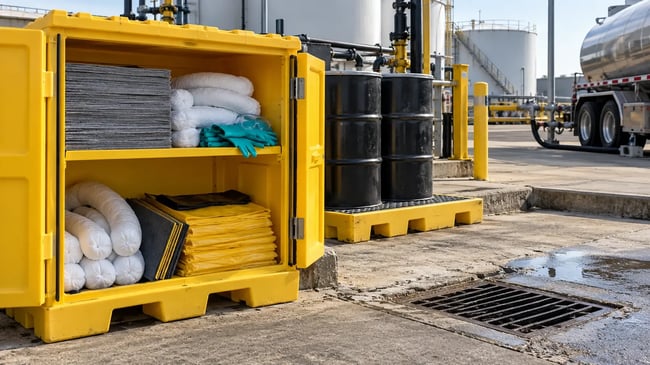
Tape a contents list inside each lid so the person doing inspections can tell at a glance what's missing. And keep your kits matched to what's on your plan. If the plan says drivers will place drain covers before unloading, the covers need to be at the unloading area, not in the maintenance office.
How Do You Size an SPCC Spill Kit to Likely Spills?
Start with the predictions already in your plan. For each place where oil is handled, ask what a realistic failure looks like. A forklift hydraulic hose can let go and put a few gallons on the floor. A tipped 55-gallon drum puts the whole drum on the ground. A fuel delivery hose can pop off a coupling, and how much oil comes out depends on the flow rate and how fast someone reaches the shutoff. Write down the volume you'd expect at each spot, and that's the number your kit has to beat.
Then check the absorbency rating printed on the kit or the pads, usually listed in gallons. Those ratings come from ideal conditions, with the material fully saturated, so plan on getting less in the field. Kits run from small buckets rated for a handful of gallons up to wheeled bins rated around 95 gallons. We'd rather see a kit rated comfortably above the volume you predicted than one that only just covers it, because the people using it will be in a hurry and won't use every pad perfectly.
There's also a ceiling on what a kit can do. A tank truck compartment can hold thousands of gallons, and no kit is going to absorb that. For loading and unloading areas, the rule requires containment sized for at least the maximum capacity of any single compartment of a tank car or tank truck, unless drainage flows to a catchment basin or treatment facility designed to handle discharges. When the predicted spill is bigger than your kit, the answer is containment plus a cleanup contractor, and your plan should name that contractor. The plan has to address what your facility can handle itself and what you'd hand off, so this is where you draw that line on paper.
Where Should You Place Spill Kits at an SPCC Facility?
A great kit in the wrong place is a decoration. Put kits where spills are most likely, close enough that someone can grab one and be back at the spill in under a minute. Keep them outside secondary containment, because if a tank fails inside the dike, you don't want your absorbents sitting in the pool. Leave them unlocked, easy to see, and protected from weather. The table below covers the usual spots.
| Location |
Likely Spill |
Kit Setup |
| Fueling areas |
Nozzle drips, overfills, and hose damage during vehicle or equipment fueling. |
Oil-only pads, socks, and a drain cover at the fuel island or tank. A mid-size kit sized to your largest predicted fueling spill. |
| Truck unloading and loading areas |
Coupling leaks, hose failures, and overfills during transfers. |
A larger wheeled kit at the transfer point, with drain covers pre-staged for nearby inlets and booms ready to ring the area. |
| Drum and container storage |
Punctures, tipped drums, and leaking bungs or valves. Our article on 55-gallon drums and SPCC plans covers when drums count. |
A kit at the entrance to the storage area, plus an overpack drum. Use universal absorbent if the area holds mixed fluids. |
| Near storm drains and outfalls |
Any spill that gets loose and travels downhill. |
Drain covers and socks within reach of each inlet. Know which inlets lead to a waterway and which go to a treatment system. |
| Generators, transformers, and hydraulic equipment |
Hose and seal leaks, small but frequent. |
A smaller kit nearby, with pads sized for a slow leak and a way to catch drips while repairs are made. |
| Service trucks and mobile equipment |
Hose failures and refueling spills away from the main site. |
A compact kit on each vehicle, so a spill in a customer's lot doesn't depend on a kit back at the yard. |
Mark kit locations on your facility diagram or in the response section of your plan. The rule doesn't require it, but anyone reading the plan, including a new hire or an inspector, can then find the equipment without a tour. Post a sign above or beside each kit so it's easy to spot from the work area.
How Do You Inspect and Restock SPCC Spill Kits?
The rule doesn't set an inspection frequency for spill kits, so your plan does. For most facilities, checking kits during the monthly tank and container walk-through works well, since someone is already out there looking at the equipment. Keep the checklist with your other inspection records. The rule requires you to keep records of the inspections and tests your plan calls for, signed by the inspector or supervisor, for three years. Our article on the top 10 things to do during SPCC monthly inspections fits neatly alongside this.
Here's what a kit check should cover:
- The kit is where the plan says it is, and nothing is stacked in front of it.
- The seal or lid is intact, and the contents match the list inside the lid.
- Pads and socks are dry, clean, and not crumbling or moldy.
- Gloves, goggles, and coveralls are in the sizes your people actually wear.
- Drain covers are the right size and free of cracks or hardened edges.
- The response card has the current phone numbers and names.
Restock the same day a kit is used, and make it part of the cleanup, not a separate project that drifts for a week. A simple usage log tells you which locations burn through supplies, and that's usually a sign the equipment in that area needs attention. If a kit keeps getting used at the same spot, the better fix may be a drip pan, a repaired fitting, or a changed procedure.
What Do You Do With Used Spill Kit Materials?
Your SPCC Plan has to cover how you'll dispose of recovered material in line with applicable legal requirements, so plan for this before the first spill. Used absorbents are a waste, and as the generator, you're responsible for deciding what kind. EPA's guidance says sorbents used on oil are generally not federally regulated as hazardous waste unless they're also contaminated with hazardous waste, but you still have to make that determination. If free-flowing used oil is visible in the absorbent, EPA's used oil standards apply to it. New Jersey adds its own rules on top, and the answer changes if the spill involved something other than petroleum, like a solvent or a listed waste.
In practice, bag or drum the used material, label it with the contents and date, keep it closed, and ask your licensed waste hauler how they want it handled. If you're not sure what you've got, test it or check the safety data sheet before it leaves your site. Our guide to used oil regulations covers the oil side of this in more detail.
When Does a Spill Kit Cleanup Still Mean Calling NJDEP?
If anyone is hurt, there's fire, or vapors are building up, call 911 first and leave the cleanup to responders. Safety comes before any spill kit.
A spill you can clean up with a kit may still be a spill you have to report. New Jersey's Spill Compensation and Control Act, known as the Spill Act, covers discharges of petroleum and other hazardous substances. Under N.J.A.C. 7:1E-5.3, people responsible for a discharge who know or reasonably should know about it have to notify NJDEP immediately by calling the hotline at 1-877-WARNDEP (1-877-927-6337). The rule has some narrow exceptions, and follow-up reporting differs depending on the type of facility, so we'd rather you make the call than spend an hour arguing with yourself that your spill was too small. Put that number on the response card inside every kit.
Federal reporting is a separate track. If oil reaches navigable waters or adjoining shorelines and causes a sheen, discoloration, or sludge, federal rules under 40 CFR Part 110 call for an immediate report to the National Response Center at 1-800-424-8802. A storm drain that leads to a creek can turn a puddle into a federal report in minutes, which is a big reason drain covers belong in your kits. Our article on when you have to report an oil spill goes through the sheen rule in plain terms.
Spill Act liability is generally described as strict, joint and several, which in plain terms means the cost of a cleanup can land on the parties connected to a discharge regardless of fault. We can't give legal conclusions, and for a significant discharge, talking with an environmental attorney is often a reasonable step. You can also review our breakdown of SPCC plan violations and fines to see how enforcement tends to go.
How Does Employee Training Fit With SPCC Spill Kits?
A stocked kit does nothing if nobody knows it exists or how to use it. The SPCC rule requires you to train oil-handling personnel on equipment operation and maintenance to prevent discharges, discharge procedure protocols, applicable pollution control laws, general facility operations, and the contents of your SPCC Plan. It also requires a designated person accountable for discharge prevention and discharge prevention briefings for oil-handling staff at least once a year.
Use the annual briefing to open a real kit and walk through it. Show where each one is, practice placing a drain cover, and make sure people know where the line sits between a small spill they can handle safely and one that calls for the response coordinator or a contractor. OSHA's hazardous waste operations and emergency response rules (HAZWOPER) govern how far employees can go in responding, so your plan and training should reflect which spills your staff can safely handle. Our articles on what SPCC training should include and annual SPCC training requirements cover this, and if you'd rather give people a self-paced option, our online training library is available.
How Can RMA Help With SPCC Spill Response Planning?
We're based in New Jersey, so we know how NJDEP and EPA Region 2 expect these plans to read and how they get checked on site. We write SPCC Plans and update existing ones, and we can review the response section of yours, including where your kits are, what's in them, and whether your plan matches what's on the ground. If your kits are stocked, sized to your predictions, and listed accurately in the plan, you don't need us for this, and we'll tell you so. If you're not sure, or if you have several sites and want them handled consistently, we're glad to help. For background on the plan itself, start with our overview of everything you need to know about SPCC plans.
If you want to talk it through, you can call, email, or fill out the form on our website, and a member of our team will follow up. There's no pressure and no obligation. Just contact us and we'll take it from there.