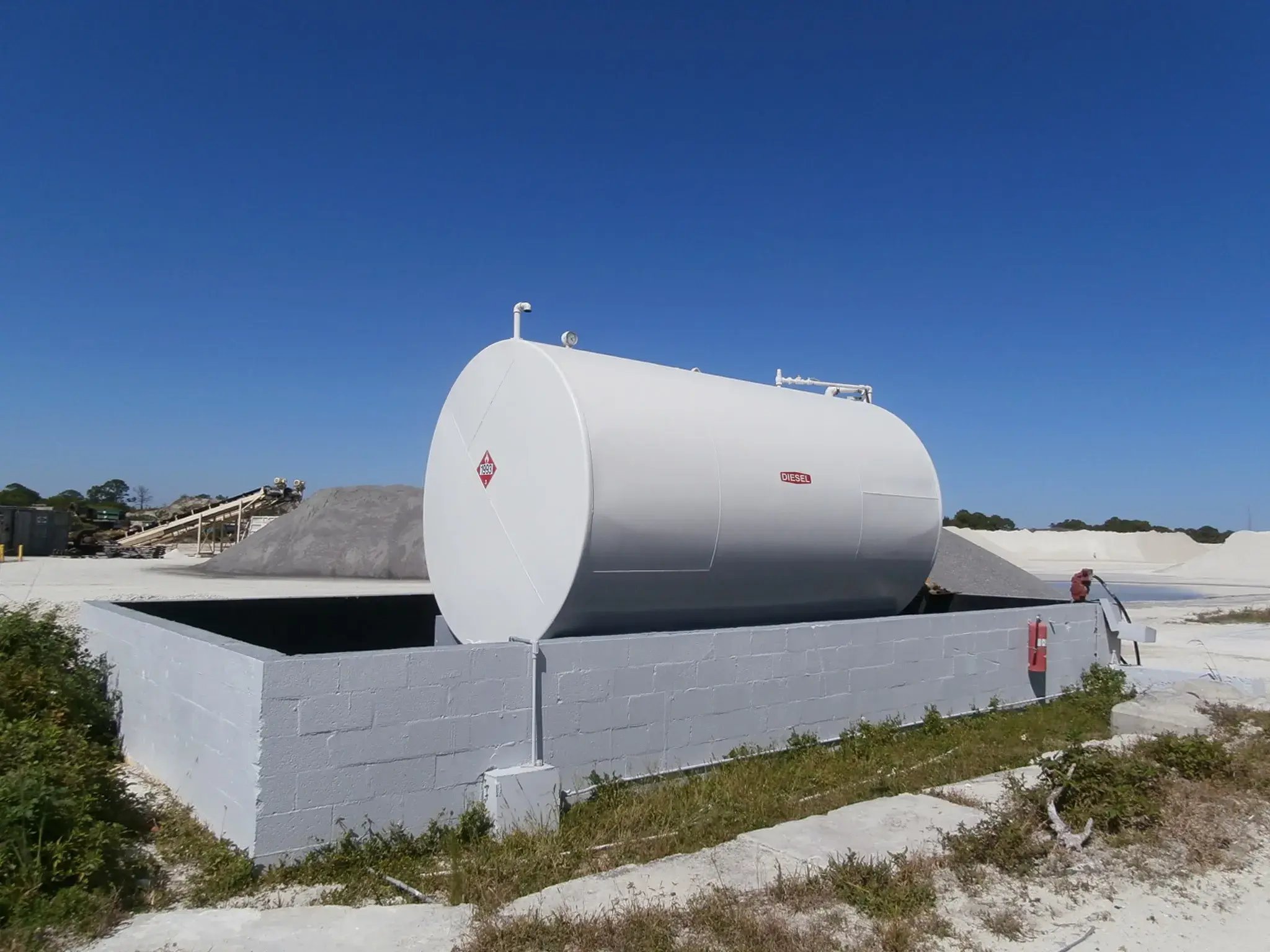
STI SP001 Tank Inspections for Pennsylvania Facilities: What the Standard Requires, How Often, and Who Does the Work
If your SPCC Plan covers a shop-built steel tank, there's a good chance it says something like "tank integrity testing will follow STI SP001." Plenty of facility managers sign off on that line without ever seeing the standard, then find out later that it commits them to monthly checklists, an annual walk-through, and a formal inspection by a certified inspector on a schedule nobody wrote on a calendar.
This article covers what the standard asks for, how to sort your tanks into its three categories, how the intervals work, who's qualified to inspect, what to do if you're just finding out you need an SPCC Plan, and where Pennsylvania DEP's own rules overlay it. The short answer to who needs one: any facility whose SPCC Plan names SP001 needs owner inspections on every covered tank, plus formal inspections by a certified inspector on the tanks the schedule calls for, which includes every shop-built tank over 5,000 gallons and some smaller ones. If you'd rather have someone sort your tanks and build the schedule with you, you can reach out to RMA.
Table of Contents
TL;DR
STI SP001 is the inspection standard most SPCC Plans use for shop-built aboveground tanks, and you only need it if your facility needs an SPCC Plan, which starts at more than 1,320 gallons of aboveground oil storage. Your own staff do monthly and annual checklists on every covered tank, and a certified inspector does formal inspections on a schedule set by the tank's size and category, which depends on whether it has containment and a way to detect leaks. Small, well-protected tanks may need owner inspections only, while larger tanks with no containment need a certified inspection every five years. In Pennsylvania, DEP adds its own certified inspector rules for regulated tanks over 5,000 gallons.
What Is the STI SP001 Tank Inspection Standard?
STI SP001 is the Steel Tank Institute's Standard for the Inspection of Aboveground Storage Tanks. STI first published it in 2000 for shop-fabricated tanks, the factory-built steel fuel and oil tanks common at fleet yards, plants, quarries, and data centers. Large field-built tanks already had API 653, the American Petroleum Institute's standard, but nothing in it fit a 2,000-gallon double-wall diesel tank. The current version is the seventh edition, released in February 2024.
It's a standard, not a law. It binds a facility only when a regulation, permit, or plan adopts it, and your SPCC Plan is usually what does that. The standard is also risk-based: a tank with solid containment and a way to detect leaks gets a lighter schedule, and a tank with neither gets a heavier one, including internal inspections. The seventh edition left the schedules and categories alone. It added emphasis on acting on inspection findings, documenting how the tank was originally built (STI calls this the AST Record), and keeping the inspection clock, which starts when product first goes into the tank, running through a sale or move.
Do You Need an SPCC Plan Before STI SP001 Even Applies?
Some people land on this article because a customer, insurer, or inspector mentioned STI SP001 and they've never heard of it. If that's you, there's a step before the standard: SP001 only matters if your facility needs an SPCC Plan. SPCC stands for Spill Prevention, Control, and Countermeasure. It's a federal rule under 40 CFR Part 112 that requires a written oil spill prevention plan at facilities that store oil above certain amounts, and the plan is where SP001 gets named as your tank inspection method.
The threshold is more than 1,320 gallons of total aboveground oil storage, counting only containers of 55 gallons or more, or more than 42,000 gallons of buried storage. Capacity counts, not how full the tanks are, and oil-filled equipment adds to the total. Oil covers more than fuel. Hydraulic oil, lube oil, used oil, and animal fats and vegetable oils all count, while propane and DEF don't. Add up your totes, drums, generator tank, and hydraulic reservoirs before assuming you're under the line.
If you're over it, the plan has to be written and followed. It covers how you store oil, your containment, inspections and training, and what you'd do in a spill, and it needs a review every five years. Smaller facilities may be able to self-certify the plan, while larger or more complex ones need a Professional Engineer to certify it, which the different types of SPCC plans explains. In Pennsylvania, DEP's storage tank program can apply on top of the federal rule. For more on the basics, see what an SPCC plan is and figuring out whether you need an SPCC plan.
Writing SPCC Plans is what we do at RMA. We visit the site or work remotely, build the plan, and train your people. Our Tier I plans run about $1,500 to $4,000, and SPCC plans overall run about $1,500 to $15,000, depending on how much oil you store, how many containers you have, whether a PE certification is needed, and whether your secondary containment needs evaluating. When a PE certification is needed, we work with an outside professional engineer. Our pricing calculator below gives a ballpark for having us handle the plan, and if the honest answer is that you're under the threshold, we'll tell you.
Why Do SPCC Plans Rely on STI SP001 for Tank Integrity Testing?
The federal SPCC rule requires you to test or inspect each aboveground oil container for integrity on a regular schedule and whenever you make material repairs. Under 40 CFR 112.8(c)(6), you determine, in accordance with industry standards, the qualifications of the people doing the work and the frequency and type of testing, based on the container's size, configuration, and design.
The rule doesn't name a standard. For shop-built tanks the common choices are SP001 and API 653, and EPA's tank inspection page for qualified facilities says SP001 may be used for shop-built containers. EPA Region 3 enforces the rule in Pennsylvania, so its inspectors are the ones who would compare your records to what your plan promises. A plan that names SP001 with no schedule or records behind it can draw a violation, as covered in common SPCC violations, and who enforces SPCC plans explains how inspections work.
Which Tanks Need STI SP001 Inspections?
If your facility is over the SPCC threshold, SP001 applies to each tank your plan assigns to it, which in practice means shop-built steel tanks. Portable containers like drums and totes get periodic owner inspections only, with no certified inspection. Large field-erected tanks usually follow API 653 instead, so check which standard your plan names for them. Under the threshold, the SPCC integrity testing paragraph doesn't apply, though Pennsylvania's tank rules can still reach a tank over 250 gallons.
What Types of Inspections Does STI SP001 Require?
SP001 sorts inspection work into four types. Every covered tank gets the first one, and the category and size decide which others apply.
| Inspection type |
Who performs it |
What it involves |
| Periodic (monthly and annual) |
A qualified party the owner designates, usually facility staff |
Checklist walk-throughs of the tank, containment, and equipment. |
| Formal external |
Certified inspector |
Detailed inspection of shell, supports, foundation, and containment, with thickness readings and a written report. |
| Formal internal |
Certified inspector |
Tank is emptied and opened for interior inspection. Used on higher-risk tanks. |
| Leak test |
Owner or the owner's designee |
An alternative to internal inspection on some higher-risk tanks. |
The monthly checklist is a visual walk-around, and the annual checklist digs further, confirming that valves, vents, gauges, and alarms work. A locally written checklist works instead of STI's model forms if it covers the same ground and matches your plan. The seventh edition directs the person inspecting to flag problems and obligates the owner to address them. Water in the tank gets checked monthly by default, though the standard lets some tanks check less often. For a practical list of what to look for, see what to look for during monthly inspections.
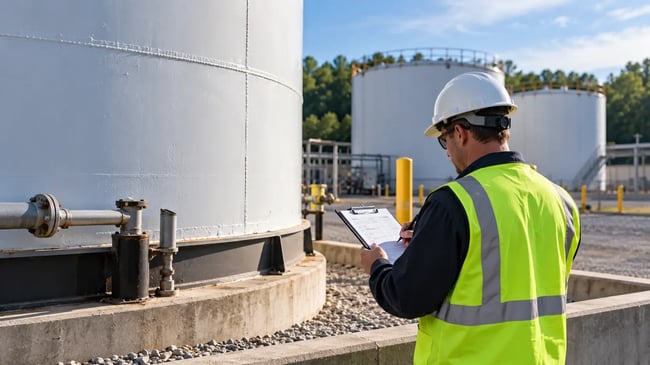
For formal inspections, a certified inspector examines the tank, takes thickness readings, confirms the tank record is on file and accurate, and writes a report with a statement on suitability for continued service. Internal inspections mean entering the tank, which brings OSHA confined space rules.
How Do You Figure Out Which SP001 Category Your Tank Falls In?
SP001's categories turn on how the tank system is built, not on what's stored in it.
| Category |
What the tank system has |
Inspection burden |
| Category 1 |
Spill control (secondary containment), a release detection method, and overfill prevention if the tank is double-wall |
Lightest |
| Category 2 |
Spill control, but no designed means of detecting a leak |
Middle |
| Category 3 |
No spill control |
Heaviest |
Spill control means containment that would hold a release, such as a berm, a dike, or a double-wall tank with overfill protection. An insulation jacket doesn't count as a second wall. Release detection means a built-in way to know if the primary tank starts leaking, which SP001 calls a continuous release detection method, or CRDM.
To categorize a tank, look for containment first, then a built-in way to detect a leak, then overfill prevention if it's double-wall. All of them makes it Category 1, containment alone makes it Category 2, and no containment makes it Category 3. If you're sizing or fixing containment, see how big your containment needs to be. A category isn't permanent. If a monthly inspection finds cracked containment or release detection that's out of service, the owner either fixes the problem or adopts the heavier category's schedule.
How Often Does Each Tank Need a Formal STI SP001 Inspection?
Once you know the category, capacity sets the interval. This table covers shop-built tanks. Every tank also gets the owner's monthly and annual inspections on top of whatever appears in its row. Where a cell shows two options, the tank follows one or the other, and your plan should say which.
| Tank capacity |
Category 1 |
Category 2 |
Category 3 |
| Up to 1,100 gallons |
Owner inspections only |
Owner inspections only |
Formal external inspection and leak test every 10 years |
| 1,101 to 5,000 gallons |
Owner inspections only |
Formal external inspection and leak test every 10 years |
Either formal external inspection and leak test every 5 years plus formal internal inspection every 10 years, or formal external inspection every 5 years plus leak test every 2 years |
| 5,001 to 30,000 gallons |
Formal external inspection every 20 years |
Either formal external inspection every 10 years plus formal internal inspection every 20 years, or formal external inspection every 5 years plus leak test every 10 years |
Either formal external inspection and leak test every 5 years plus formal internal inspection every 10 years, or formal external inspection every 5 years plus leak test every year |
| 30,001 to 75,000 gallons |
Formal external inspection every 20 years |
Formal external inspection and leak test every 5 years plus formal internal inspection every 15 years |
Formal external inspection and leak test every 5 years plus formal internal inspection every 10 years |
Treat these as maximums measured from the tank's initial service date, and know that findings can call for sooner. STI's own summary of the seventh edition confirms the schedules didn't change from the sixth. If the initial service date is unknown, as with rented or repurposed tanks, ask your inspector how SP001 handles it.
A 2,000-gallon double-wall diesel tank with leak detection and overfill prevention is Category 1 and gets owner inspections only. A 6,000-gallon skid tank on gravel with no containment is Category 3, the toughest cycle in the table, and adding containment would move it down a category.
For periodic inspections and leak tests, the seventh edition says the owner designates a qualified party. That's usually maintenance or environmental staff trained on the tank's components, the checklist, and what your plan requires. Our online training library is one way to cover the basics for the people doing monthly walk-arounds.
Formal inspections need a certified inspector. STI certifies SP001 inspectors through a training course and exam, and API 653 inspectors can add an SP001 certification. STI's list of certified inspectors sits behind its members login, so you may need to ask STI or an inspection firm for names. Before you hire one, confirm the certification is current and that the report includes a written statement of suitability for continued service. Prices come from the inspection firm and swing with the number and size of tanks and, for internal inspections, the work of emptying and entering the tank. In Pennsylvania, tanks DEP regulates also need an inspector with DEP's certification, covered next.
How Do Pennsylvania DEP Tank Inspection Rules Fit With STI SP001?
Pennsylvania facilities answer to two rule sets. The federal SPCC rule, enforced by EPA Region 3, uses SP001 through your plan. The Storage Tank and Spill Prevention Act and 25 Pa. Code Chapter 245 add DEP's storage tank program on top. DEP regulates stationary aboveground tanks over 250 gallons that hold regulated substances, with exclusions such as some heating oil tanks and oil-filled operating equipment. Its periodic inspection requirement applies to regulated aboveground tanks over 5,000 gallons and to highly hazardous substance tanks over 1,100 gallons. These are the maximum intervals DEP publishes for the most common cases.
| DEP inspection type |
Tank |
First inspection |
After that |
| In-service |
Aboveground tanks over 5,000 gallons |
Within 5 years after installation |
5 years maximum |
| In-service |
Highly hazardous substance tanks over 1,100 gallons |
Within 5 years after installation |
5 years maximum |
| Out-of-service (internal) |
Aboveground tanks over 21,000 gallons |
Within 10 years after installing a new tank or tank bottom |
20 years maximum |
The inspector sets each due date based on conditions at the inspection, and DEP lists more intervals on DEP's AST inspection page. These inspections must be done by DEP-certified inspectors. For manufactured tanks that's the IAM certification, held by inspectors who carry an STI or API 653 certification and pass a DEP exam. DEP publishes a searchable list of certified companies.
The two programs can pull in different directions. Take a 12,000-gallon Category 1 shop-built tank at a regulated Pennsylvania facility. SP001 alone points to a formal external inspection every 20 years, but DEP's in-service maximum for a regulated tank over 5,000 gallons is 5 years. Unless an exclusion applies to your tank, you follow the shorter interval. Tanks under 21,000 gallons fall under DEP's simplified small tank program, which has the same 5-year maximum for tanks over 5,000 gallons. Ask any inspector you're considering whether they can cover the SP001 and DEP requirements in one visit. Which rules reach a given tank depends on its size, contents, and registration, so confirm yours with DEP's Division of Storage Tanks at 1-800-42-TANKS or 717-772-5599. Local fire officials can add tank requirements too, and those vary by municipality.
If you're building or expanding a facility, tank installation is a separate track. In Pennsylvania, people who handle regulated tanks must be DEP-certified, and DEP calls for inspections at installation for tanks over 21,000 gallons and all field-constructed tanks. Building and fire permits and other construction-phase approvals run through your installer, engineer, or contractor, and RMA doesn't prepare those or install tanks. Once the facility is running, we help with the operational side, including your SPCC Plan or amendment, inspection program, and training, and we can help you work out what the construction phase will need and point you toward the right people.
How Do You Run an STI SP001 Inspection Program and Handle Findings?
A workable program comes down to four steps.
- List every aboveground container of 55 gallons or more with its capacity and the date product first went in, and assign each tank a category.
- Match each tank to the schedule, put formal inspection due dates on a calendar, and write the same schedule into your plan.
- Name who does the monthly and annual inspections, train them, and give them checklists that match your plan.
- Book a certified inspector well ahead of each due date, confirm DEP certification for regulated tanks, and file every checklist and formal report with your SPCC Plan.
When an inspection turns up a problem, SP001 expects action, not a note in the file. A weeping seam, a cracked dike, or a dead alarm gets fixed, and material repairs trigger their own integrity testing under the SPCC rule. Keep formal reports for the life of the tank so the next inspector can compare thickness readings. If you change how you test tanks, or add, remove, or modify tanks, your plan may need an amendment, and technical amendments to a PE-certified plan need the PE's certification. See when a plan needs a Professional Engineer and our article on the five-year review for how that works.
How Can RMA Help With STI SP001 Tank Inspections?
The formal inspections themselves come from a certified inspector or inspection firm. The groundwork around them is where we help. We'll go through your tanks with you, sort them into SP001 categories, check that your plan's schedule matches what you have, set up checklists that fit your site, and train the people who'll use them. Initial SPCC training is free with a new RMA plan.
If you already have a plan and a tank list, we'll tell you whether you need us at all. Sometimes a good checklist and a calendar reminder are all it takes, and we'll say so. There's no pressure and no obligation. You can call us at 888-RMA-0230, send an email, or fill out the form on our website, and if you'd like to talk through your tanks, you can reach out to RMA.