How Storm Drains, Ditches, and Creeks Decide Whether Your Pennsylvania Oil Storage Falls Under the Federal SPCC Rule
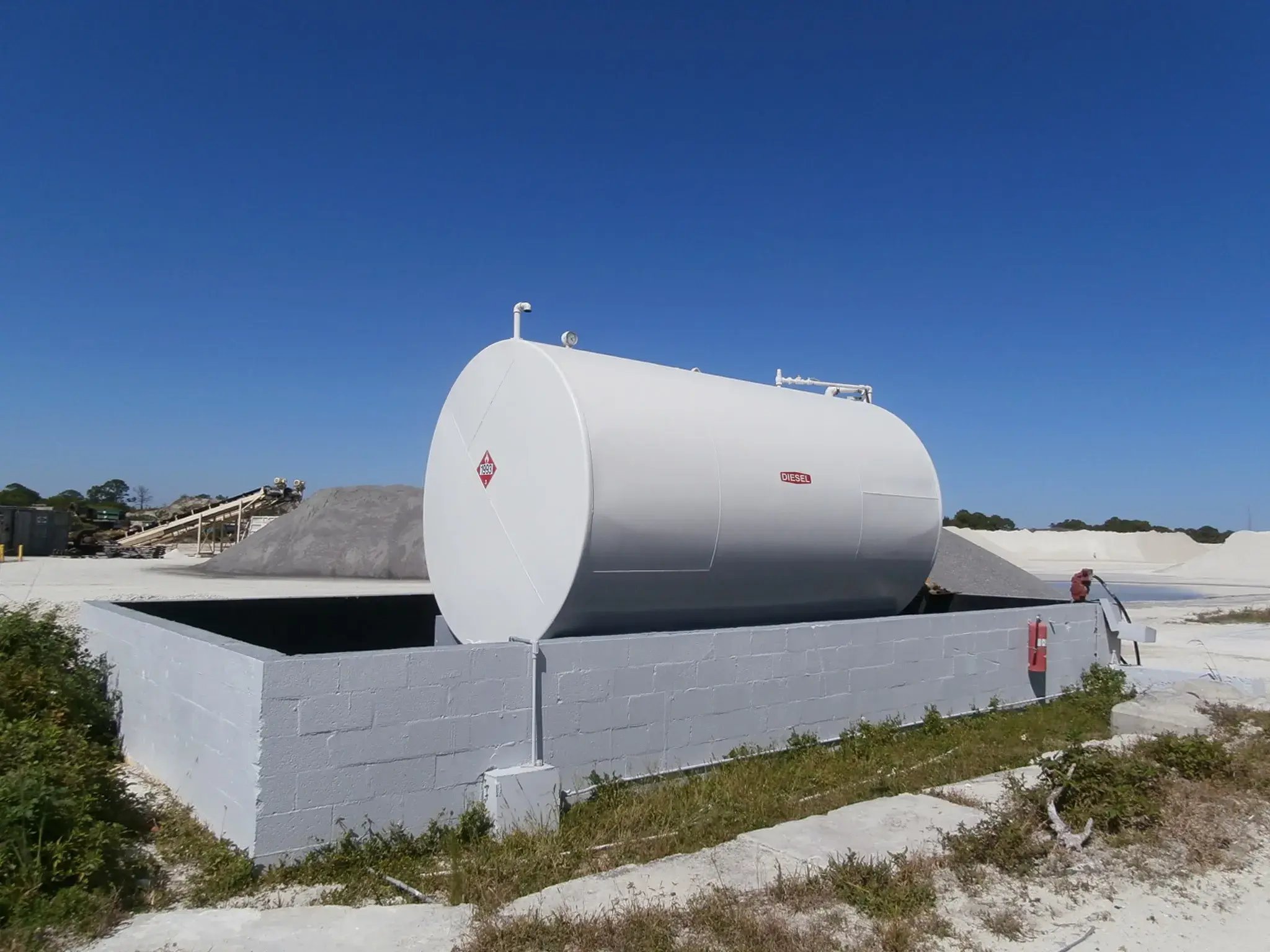
Picture a diesel tank sitting in the middle of a paved lot in Harrisburg. The nearest creek is a few blocks away, with a building, a fence, and a parking lot between the tank and anything you'd call water, so it feels safe to assume the federal oil spill rules are someone else's problem. That assumption trips up a lot of facilities. The SPCC rule (Spill Prevention, Control, and Countermeasure, the federal oil spill prevention rule in 40 CFR Part 112) doesn't ask how close your tank is to a stream. It asks where oil would go if it got loose, and a storm drain in the lot is often a short, direct route to a creek.
The short answer is yes: a storm drain, ditch, or sewer that could carry oil to a creek or river can bring a facility under SPCC, as long as it stores enough oil to meet the capacity thresholds. This article walks through how that connection works, how to trace the path from your tank to the nearest water, why combined sewers in older Pennsylvania cities complicate the picture, why the legal definition of navigable waters deserves some caution, and why the whole analysis belongs in your written plan. If you'd rather have someone look at your site with you, you can reach out to RMA at any point.
Table of Contents
TL;DR
Yes. If your facility stores enough oil to meet the SPCC capacity thresholds, a storm drain, ditch, or sewer that could carry oil to a creek or river can make you subject to the rule, even if your tank sits in the middle of a paved lot far from the water. EPA judges the risk by geography and drainage, not by your dikes or how far away the creek looks. Combined sewers in older Pennsylvania cities can still send oil to a stream during heavy rain, and the legal definition of navigable waters has been shifting, so the safest approach is to trace your drainage path and write the analysis into your plan.
What Does Reasonably Expected to Discharge Mean for SPCC Oil Storage?
SPCC applies to a facility when two things are true. First, it has to store enough oil: more than 1,320 gallons in aboveground containers (counting only containers of 55 gallons or more) or more than 42,000 gallons in completely buried tanks. Capacity is what counts, not how full the tanks are, so an empty 5,000 gallon tank still counts toward the total. If you're not sure which containers to add up, our article on whether 55-gallon drums count toward SPCC walks through the counting rules.
Second, the facility has to be one that could reasonably be expected to discharge oil in a harmful quantity into or upon navigable waters or adjoining shorelines. That wording comes straight from 40 CFR 112.1(b). The harmful quantity piece is defined in 40 CFR Part 110, and it's a low bar: a discharge that violates water quality standards, or that leaves a sheen or discoloration on the water, qualifies. A sheen is an iridescent film on the surface, and it doesn't take a large spill to leave one. Our article on the sheen rule and oil spill reporting covers what that means for reporting.
The reasonable-expectation test is about geography. Under 40 CFR 112.1(d)(1)(i), the determination has to rest on location factors such as proximity to navigable waters, land contour, and drainage. In Pennsylvania, EPA Region 3 enforces the rule, and its inspectors ask the same question every time: where would the oil go? If you want the full picture of who inspects and who can penalize, see our article on who enforces SPCC plans.
How Do Storm Drains and Ditches Connect Oil Tanks to Streams?
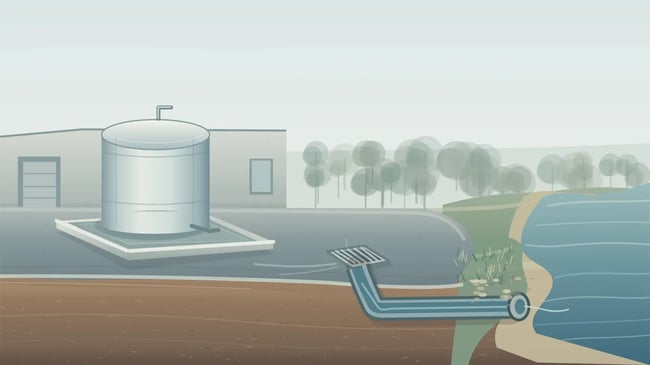
Think about what happens to a spill on a paved lot. Pavement doesn't absorb anything, so diesel from an overfilled tank or hydraulic oil from a ruptured hose spreads across the surface and follows the grade toward the lowest point. In most lots, the lowest point has a catch basin in it. From the inlet, the oil moves into a storm sewer pipe, and that pipe typically ends at an outfall on a stream, river, or drainage channel.
Take a lot in Harrisburg whose inlets lead toward Paxton Creek. Paxton Creek flows into the Susquehanna River, so oil that gets into that lot's storm drain has a path to water that never crosses anything you'd recognize as a stream until the outfall. The same logic applies to roadside ditches, swales, and trench drains in loading areas, and to floor drains inside a building if they connect to a storm sewer. It applies in any Pennsylvania town with pavement, pipes, and a creek somewhere downhill.
Distance doesn't enter into it. A creek that's a mile away by road is still reachable if the pipe runs there, which is why a facility that feels landlocked can still fall within the rule. EPA enforcement orders over the years, including ones from Region 3, have described facilities as SPCC-regulated because a storm drain or drainage system carried oil toward a nearby river, creek, or bay.
Why Don't Dikes and Containment Walls Take a Facility Out of SPCC?
A common response is that the tank has a dike, so the oil can't get out. The rule closes that door. When deciding whether a facility could reasonably be expected to discharge, the determination has to leave out manmade features such as dikes, equipment, and other structures that might restrain or contain a discharge (40 CFR 112.1(d)(1)(i)). Containment can fail, a valve can be left open, and an overfill can happen during a delivery while nobody's watching. The rule requires a plan because those things happen.
So containment doesn't take you out of SPCC. It becomes part of what the plan describes. Under 40 CFR 112.8(c)(2), secondary containment has to hold the entire capacity of the largest single container plus enough freeboard for precipitation, and our article on how big SPCC oil spill containment needs to be covers the sizing.
Drainage from that containment is where storm drains come back into the picture. Under 40 CFR 112.8(b), drain valves on diked areas have to be manual, open-and-closed valves, and flapper-type valves aren't allowed. If you drain uncontaminated rainwater from a dike into a storm drain, the bypass valve has to stay sealed closed, you have to inspect the retained water first, someone has to open and reseal the valve under supervision, and you have to keep records of each drainage event (112.8(c)(3)). Areas outside the dikes where a spill could happen, like a tank truck unloading spot, have to drain to a pond, lagoon, or catchment basin designed to retain oil. If your drainage isn't engineered that way, the final discharge of facility ditches needs a diversion system that would keep oil on site (112.8(b)(3) and (b)(4)).
SPCC also isn't the same thing as a stormwater pollution prevention plan, even though both involve what runs off your site. If you're sorting out which plan covers what, our article on the difference between an SPCC plan and a SWPPP is a good place to start.
How Do You Trace Your Facility's Drainage Path for an SPCC Plan?
You can do a solid first pass of the drainage trace yourself, and it's worth doing before anyone writes or updates a plan. The goal is simple: start where oil could be released and follow the water until you reach a named stream, river, or lake, or until you can show the path goes somewhere else.
Start at the Tanks and Transfer Points
List every place oil could get loose: tank fill ports, truck unloading spots, generator day tanks, drum storage, oil-filled transformers, piping runs, and anywhere you pour or transfer oil. Then watch the ground. If you can, walk the site during a steady rain, because water shows you the slope, the low spots, and the inlets that take flow. A dry-weather walk still helps. Look for staining near drains, which shows you where past drips have headed.
Follow the Pipe to the First Named Water Body
Count every inlet, floor drain, trench drain, and ditch within the area a spill could reach, then find out where each one goes. Your municipality or local sewer authority usually keeps storm sewer and sanitary sewer maps, and many can tell you whether your block is on a separate or combined system. If the maps are vague, ask whether they or a qualified contractor can confirm the connection with dye testing. Follow each path to its end, whether that's an outfall, a pond, a treatment device, or a pipe that joins the sewer going to a treatment plant. Then note the first named water body the path reaches and whether it flows year-round. The table below shows what to check at each type of feature and what belongs in your notes.
| Drainage Feature |
What to Confirm |
What to Record |
| Catch basins and yard inlets |
Where each inlet's pipe goes, and whether it ties to a storm sewer, a combined sewer, or an on-site basin |
Inlet locations on the site diagram, the receiving pipe, and the first named water body it reaches |
| Floor and trench drains |
Whether they connect to a storm sewer, a sanitary sewer, an oil/water separator, or a holding tank |
Where the drain leads, who owns the downstream pipe, and any valve or plug used to close it |
| Roadside and on-site ditches |
Direction of flow, whether they hold water year-round, and where they connect downstream |
Flow direction, conditions observed after rain, and the water body at the end of the path |
| Basins, ponds, and separators |
Whether they're designed to retain oil, who maintains them, and how they overflow |
Design details, inspection schedule, and the overflow path |
| Sewer connections |
Whether the municipality classifies your area as a combined or separate system |
Written confirmation or a map reference, with the date |
How Do Combined Sewers in Older Pennsylvania Cities Change SPCC Spill Risk?
Many older Pennsylvania cities were built with combined sewers, single pipes that carry both sanitary sewage and stormwater to a wastewater treatment plant. In dry weather, everything goes to treatment. When heavy rain overwhelms the pipes, the system is designed to overflow through outfalls directly into the nearest stream or river. Those releases are called combined sewer overflows, or CSOs. Capital Region Water reports that more than half of Harrisburg's sewer pipes are part of a combined system, and it operates 58 permitted CSO outfalls along the Susquehanna River and Paxton Creek. Pittsburgh and Philadelphia also have combined sections, so it's worth checking in any older urban area.
It's tempting to read that as good news. If the drain goes to a treatment plant, the oil never reaches a creek. EPA's SPCC guidance for inspectors doesn't accept that reasoning. It treats sanitary and storm drainage systems that could carry discharged oil toward navigable waters as pathways even when they lead to a publicly owned treatment works first, and it says the presence of a treatment plant can't be used to conclude that no discharge is reasonably expected. The Environmental Appeals Board reached a similar result in its 2000 decision in Pepperell Associates, where a floor drain led to a sewer conduit and oil from that conduit reached a brook through a combined sewer overflow. The Board held that the overflow path didn't rule out a reasonable expectation of discharge.
Separate storm sewers are simpler to trace, and they typically carry runoff to a stream without treatment. A sanitary connection isn't a disposal option either. Federal pretreatment rules bar sending petroleum oil to a treatment plant in amounts that cause interference or pass-through (40 CFR 403.5(b)(6)), and local sewer authorities set limits of their own, so a drain tied to the sewer is a path to evaluate, not a place to put oil.
Sewer systems also change. Cities under consent decrees or long-term control plans, Harrisburg among them, are working on collection system improvements and overflow controls over time. A drainage conclusion that was right when your plan was written can drift, which is one reason the plan's five-year review should include a fresh look at where your drains go.
How Does the Navigable Waters Definition Affect SPCC Drainage Analysis?
The SPCC rule applies to discharges into navigable waters, and EPA's rule at 40 CFR 112.2 ties that term to the definition of waters of the United States at 40 CFR 120.2. That definition has been moving for years. The Supreme Court's 2023 decision in Sackett v. EPA narrowed it, the agencies issued a conforming rule in September 2023, and they proposed a further revision in November 2025, followed by a supplemental proposal in 2026. As of this writing in October 2026, we haven't seen those proposals finalized, and which version of the rule applies has also depended on the state and ongoing litigation. We can't tell you where the final line will land, and you shouldn't build your plan around a guess.
In practice, the changes tend to bear on wetlands and on small, seasonal, or isolated features. A storm sewer that discharges to a year-round creek feeding the Susquehanna isn't likely to turn on those debates. The harder calls are things like a roadside ditch that's dry most of the year, a pipe that ends at a pond, or a swale that disappears into the ground. For those, the connection downstream is what you need to document.
Pennsylvania adds its own layer. The state's Clean Streams Law uses a broader term, waters of the Commonwealth, which covers streams, creeks, ditches, and storm sewers. So even if a narrower federal definition took a particular ditch out of SPCC's reach, an oil discharge into it could still be a problem under state law, and state reporting rules can apply to spills that threaten those waters. Check with DEP, or an environmental attorney, on the specifics for your situation.
Our approach is to treat close calls conservatively. Write down the water body, whether it flows year-round, what it connects to downstream, and your reasoning, and date it. The definition may change again, so revisit the analysis when it does.
Why Should the Drainage Analysis Be Documented in Your SPCC Plan?
Once you've traced the path, it belongs in the SPCC plan, in writing. The plan has to describe the physical layout of the facility with a diagram that marks fixed oil containers and storage areas, and it has to address discharge and drainage controls (40 CFR 112.7(a)(3)). Where experience shows a reasonable potential for equipment failure, such as overflows during loading and unloading, the plan has to predict the direction, rate of flow, and total quantity of oil that could be discharged (40 CFR 112.7(b)). Your drainage trace is what makes those predictions credible. Without it, the plan is a set of containment calculations that never explains what's being protected.
A good drainage write-up is short. It names the inlets, ditches, and drains near the oil, says where each one goes, identifies the first named water body, notes whether any part of the route is a combined sewer, and states your conclusion about reasonable expectation along with the reasoning. Dated photos and a copy of the municipal sewer map or written confirmation back it up. Whether the plan is self-certified or certified by a Professional Engineer, the analysis has to hold up. Our articles on the different types of SPCC plans and on professional engineers and SPCC requirements cover how that certification works.
Documentation also protects you later. The plan has to be amended when a change in facility design, construction, operation, or maintenance materially affects the potential for a discharge, and construction or demolition that alters secondary containment is one of the examples the rule gives (40 CFR 112.5(a)). It also has to be reviewed at least every five years (112.5(b)). Repaving, adding an inlet, moving a tank, or a city sewer project can each change your answer. Our article on SPCC plan 5-year reviews explains what that review involves.
If you're building or regrading a site, the drainage design and the construction-phase stormwater permits belong to your engineer and contractor, and RMA doesn't prepare construction permits or approvals. Once the facility is running, though, the SPCC plan has to match the drainage as it was built, and that's the part we help with. Staff who handle oil should also know where the drains are and how to close or block them. Routine walk-arounds are a natural place to check, and our guide to the top things to do during SPCC monthly inspections is a useful starting list. Our online environmental training library is one way to cover the training side.
How Can RMA Help With SPCC Drainage Analysis in Pennsylvania?
RMA is a family-run environmental consulting firm based in New Jersey, and we work with facilities across Pennsylvania. On SPCC projects, senior staff review your site layout, trace where your drains lead, and write that analysis into the plan, so the conclusion about reasonable expectation is documented and not left as an assumption. If you already have a plan, we can check whether its drainage description still matches what's on the ground.
If you're not sure your facility is subject to SPCC at all, or you've traced your drains and want a second opinion, you can call us, email us, or fill out the form on our website. There's no obligation, and if we think you don't need our help, we'll tell you. To get started, contact RMA whenever it suits you.