A Section-by-Section Guide to the PA DEP PAG-03 NOI, What Each Part Tells DEP, and Why Incomplete Applications Get Sent Back
If your Pennsylvania facility needs industrial stormwater permit coverage, you get it by filing a PAG-03 Notice of Intent, or NOI. PAG-03 is the general NPDES permit DEP uses for rain and snowmelt running off industrial sites, and the NOI is how you ask to be covered. It asks who runs the facility, what industrial work happens there (by SIC code), which stream your runoff reaches and how that stream is classified, where your outfalls are, and what your sampling shows. It comes with a site plan, a topographic map, a PPC Plan, proof you notified your municipality and county, a fee, and a responsible official's signature. Each item feeds a specific decision DEP makes about your site.
Below, we walk through the NOI the way a DEP reviewer reads it: what each part asks for and what DEP does with your answer. We'll also cover the most common reason NOIs stall, which is information that's missing or doesn't line up, and what happens when DEP finds a problem. If you'd like someone to look over your package before it goes in, feel free to reach out to RMA.
Table of Contents
TL;DR
The PAG-03 Notice of Intent is the application a Pennsylvania facility files with DEP to get covered under the state's general permit for industrial stormwater. It asks who's responsible for the site, what industry you're in, which stream your runoff reaches, where runoff leaves the property, and what your sampling shows, and it comes with maps, a spill and emergency plan, notices to your township and county, a $500 fee, and a company official's signature. Runoff that goes straight into one of the state's specially protected streams rules this permit out. A new application with significant gaps can be denied, with the fee kept, so a complete and consistent package is the fastest way to coverage.
What Is a PAG-03 Notice of Intent?
NPDES stands for the National Pollutant Discharge Elimination System, the federal Clean Water Act program that regulates what facilities send into rivers and streams. DEP runs it in Pennsylvania under the Clean Streams Law and 25 Pa. Code Chapter 92a. Facilities whose industrial activity is exposed to rain or snow generally need NPDES coverage for their runoff, and most get it through PAG-03, DEP's general permit for stormwater associated with industrial activity.
With a general permit, DEP writes the conditions once and facilities opt in by filing an NOI. You're telling DEP who you are, what you do, and where your water goes, and DEP decides whether you fit inside the standard permit. If you don't, you're looking at an individual permit (our guide to general, individual, and No Exposure permits compares the paths). The current PAG-03 runs from March 24, 2023 through March 23, 2028. The same form handles new coverage, renewals, and amendments, and it's also used to request a No Exposure Certification.
If you're building or expanding, construction-phase stormwater is a separate requirement, usually PAG-02 coverage and a Chapter 102 erosion and sediment control plan handled by your engineer or contractor. RMA doesn't prepare those, but we can help you figure out what the construction phase needs and handle the PAG-03 side once the facility is running.
PAG-03 NOI Sections at a Glance: What PA DEP Asks For and Why
Here's the whole package, based on DEP's NOI checklist and its review procedure for PAG-03 NOIs. Form layouts change between permit cycles, so always download the current NOI and instructions from DEP's eLibrary rather than reusing an old copy.
| NOI Item |
What It Is |
Why DEP Wants It |
| Facility and operator info |
Names, addresses, contacts, plus a General Information Form for new coverage |
Identifies who's legally responsible |
| SIC and NAICS codes |
Industry codes for your activities |
Sets your sector appendix and what you monitor |
| Receiving waters |
The water each outfall reaches |
Decides eligibility and impairment review |
| Outfalls |
Each discharge point, its location and drainage area |
Builds your permit record and sampling points |
| Topo map and site plan |
Maps of the facility, drainage, and outfalls |
Checks the form against the ground |
| Sampling data |
Results for your appendix pollutants (existing facilities) |
Shows whether runoff fits the general permit |
| PPC Plan |
Preparedness, Prevention and Contingency Plan |
Confirms pollutant sources, controls, and spill response |
| Act 14 notices |
Proof you notified municipality and county |
Gives local government a say |
| Fee and signature |
$500 for new or amended NOIs, signed by a responsible official |
Puts an accountable person behind the package |
The NOI goes to the DEP regional office serving your county: Southeast (Norristown), Northeast (Wilkes-Barre), Southcentral (Harrisburg), Northcentral (Williamsport), Southwest (Pittsburgh), or Northwest (Meadville). Facilities in Allegheny or Erie County or the Delaware River Basin also have a copy go to that county health department or the Delaware River Basin Commission.
Facility, Operator, and SIC Code Details on the PAG-03 NOI
The contact section answers one question: who's legally on the hook? The applicant should be whoever operates the facility and controls the activities creating the runoff, which isn't always the property owner. A tenant running a plant in a leased building is usually the right applicant. New applicants also file DEP's General Information Form, which sets up the records DEP tracks your facility under in eFACTS.
SIC stands for Standard Industrial Classification, a four-digit code describing what a business does, and the form also asks for NAICS codes. PAG-03 is built in layers: Parts A, B, and C apply to everyone, and sector appendices apply based on your codes. Your appendix sets which pollutants you sample for. If your site does more than one covered activity, more than one appendix can apply, and under the 2023 permit every sector also monitors total nitrogen and total phosphorus.
A wrong code means sampling for the wrong parameters, or applying for a permit you may not need. Trucking, bus, rail, and airport operations are covered only for their maintenance, equipment cleaning, fueling-related, or deicing areas. Steel service centers are often classified as wholesale and may not be covered. Facilities in covered categories that keep everything indoors usually still file a No Exposure Certification rather than nothing.
How Receiving Water Classification Affects PAG-03 NOI Eligibility
The receiving water is the stream, river, or lake your runoff ends up in, directly or through a ditch or storm sewer. Under 25 Pa. Code Chapter 93, some Pennsylvania waters are designated or recognized as High Quality (HQ) or Exceptional Value (EV) and get extra protection. If any of your discharges go directly to an HQ or EV water, DEP can't approve PAG-03 coverage or a No Exposure Certification, and you'll need an individual permit. DEP also considers a stream's existing use, not just its label.
DEP also checks whether your receiving water is impaired, meaning it's listed in the state's Integrated Water Quality Report as not meeting standards for some pollutant. If it is, DEP reviews your results for that pollutant. When an approved TMDL (a cleanup plan with a pollutant budget) gives your discharge its own allocation, DEP requires an individual permit. Without a TMDL, DEP's procedure treats results above four times the PAG-03 benchmark as potentially contributing to the impairment. Our article on TMDLs and impaired waters covers how these listings work.
If you drain to a municipal separate storm sewer system (MS4), you still name the stream it empties into, and a new discharge into an MS4 needs evidence the system's owner accepts it, usually a municipal letter. In older cities with combined sewers, runoff that goes to a treatment plant may be governed by the sewer authority instead of a DEP stormwater permit. Local rules vary, so confirm where your water goes first.
Outfalls, Site Plans, and Topographic Maps in the PAG-03 NOI
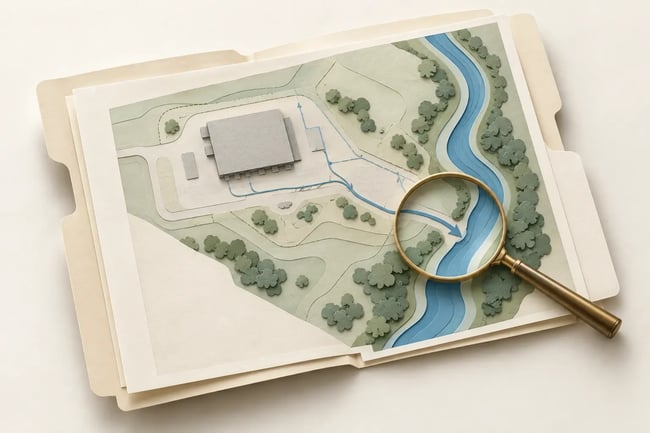
An outfall is any point where stormwater leaves your site: a pipe, a culvert, a swale, or the low corner of a lot. The NOI asks for each one's coordinates, what drains to it, and the treated and untreated impervious area in its drainage area. DEP creates a record for every outfall carrying industrial stormwater, so a missing outfall is a missing piece of your permit.
You'll also pick representative outfalls. If several outfalls drain areas with essentially the same activities, you may sample one and treat it as representative of the group. That saves time on large sites, but the choice sticks. Changing which outfalls you sample later takes an amendment NOI, approved before you start sampling the new ones.
The topographic map shows where the facility and discharge points sit relative to nearby land and streams. The site plan, which can be a drawing or a clear sketch, shows buildings, work and storage areas, drainage, and outfalls. DEP compares the NOI against both. Three outfalls on the form and four on the map is the kind of error DEP can treat as significant. If your site holds water, our post on sampling when water doesn't leave your site may help.
Stormwater Sampling Data and Non-Stormwater Discharges on the PAG-03 NOI
Existing facilities report sampling results by outfall. DEP's procedure calls for at least one result for every pollutant in your appendix, plus any pollutant causing impairment in your receiving water, so know your appendix and your stream's status before ordering lab work. Our guide to PAG-03 stormwater sampling walks through collecting a good sample.
Reviewers also compare results to PAG-03 benchmarks. Where values run more than four times a benchmark, DEP may consider an inspection, a review of your best management practices, or an individual permit. Benchmarks aren't effluent limits (see benchmark values vs. effluent limits), but high numbers at the application stage invite a closer look, so it's smart to find and fix the source before you file.
The NOI also asks about non-stormwater discharges. PAG-03 allows a short list, such as pavement wash water used without detergents where there's been no spill, plus a few others named in the permit or your appendix. Equipment wash water and process water aren't stormwater and need their own authorization. If you're unsure about a flow, start with our article on stormwater vs. process water.
What the PPC Plan Needs to Cover for a PAG-03 NOI
The Preparedness, Prevention and Contingency (PPC) Plan is Pennsylvania's counterpart to the SWPPP other states use, and it goes in with the NOI. DEP checks it against its Guidelines for the Development and Implementation of Environmental Emergency Response Plans and their NPDES stormwater supplement. Our comparison of SWPPPs and PPC Plans lays out the differences.
The plan describes your operations, inventories materials that could reach stormwater, identifies where runoff could pick them up, and lays out your controls. It also covers spill response, responsible people, emergency contacts, equipment, and training. DEP reviews it for technical adequacy, and it has to agree with the rest of the NOI: the same pollutant sources your codes imply, and the same outfalls and drainage areas as your site plan. A plan that reads like a template is a common reason reviewers push back.
Act 14 Notices, Fees, and the Responsible Official's Signature on a PAG-03 NOI
Act 14 requires applicants for many DEP permits to notify the municipality and county, giving them 30 days to comment. For a new PAG-03 discharge, you include proof of those notices with the NOI, such as copies of the letters and evidence they were received. No Exposure Certification applicants don't need them. It's an easy item to forget and an easy one for a reviewer to catch.
The filing fee is $500 for new and amendment NOIs, with no fee for renewals. Once covered, you'll pay an annual NOI installment ($500 under the current permit) every March 23, starting after you've had at least 12 months of coverage. The PAG-03 annual report is due the same day. Unpaid installments matter, since failing to pay is one of the reasons DEP can push an existing permittee to an individual permit.
Pennsylvania's NPDES rules follow the federal signatory requirements. For a corporation, a responsible corporate officer signs, such as a president, secretary, treasurer, or vice president over a principal business function, or a qualifying facility manager. Partnerships use a general partner, sole proprietors sign for themselves, and public agencies use a principal executive or ranking elected official. Delegation to an authorized representative has to be in writing. Your consultant can prepare the NOI but can't sign it, and since the signer certifies its accuracy under penalty of law, they should know what's in it.
Why Incomplete or Inconsistent PAG-03 NOIs Get Delayed or Denied
When a new NOI arrives, a reviewer checks it for completeness and technical adequacy. If it passes, DEP moves to preparing coverage without sending a completeness letter. If not, DEP sorts the problem into one of two buckets. A minor deficiency, one fixable within a business day, gets a phone call and a deadline of the end of the next business day. A significant deficiency, or a minor one not fixed in time, gets a new NOI denied. DEP keeps the $500 fee and charges a new one when you resubmit. Renewal NOIs get a deficiency letter instead, but problems left uncorrected past the renewal deadline can be referred for enforcement, at which point talking to an environmental attorney is wise. DEP also checks for unresolved violations tied to the applicant, which can hold up coverage.
| Common NOI Problem |
How to Prevent It |
| Outfall list doesn't match the site plan |
Walk the site in the rain and reconcile the form, map, and PPC Plan |
| Missing a required sampling parameter |
Confirm your appendix and stream impairments before lab work |
| HQ or EV stream overlooked |
Check the stream's Chapter 93 status first |
| No proof of Act 14 notices |
Send notices early and keep receipts |
| Generic PPC Plan or outdated form |
Build the plan from your site and use the current form |
| Wrong person signs |
Use a qualifying officer or a written delegation |
A clean first submission is the biggest schedule factor you control. Our post on how long PAG-03 coverage takes covers the full timeline.
What Does Help With a PAG-03 NOI Cost?
DEP's charges are modest: $500 with a new NOI and a $500 annual installment after that. The real cost is the work behind the form, including site evaluation, mapping, sampling, and the PPC Plan. For a relatively straightforward facility, professional help with the full application typically runs around $5,000 to $10,000, and ongoing compliance support may run $3,000 to $6,000 per year. Sites with many outfalls, several appendices, or impaired receiving waters cost more.
You don't have to hire anyone. Plenty of facilities handle it in-house, and our post on doing PAG-03 yourself covers when that makes sense, while how much a PAG-03 permit costs digs into the numbers. For a ballpark on RMA's help, use the free calculator below. No email or sales call required.
How RMA Helps With Your PAG-03 Notice of Intent
We're a family-run environmental consulting firm based in New Jersey, and we work with facilities across Pennsylvania on PAG-03 coverage, No Exposure Certifications, and individual permits. On an NOI, we confirm whether you need coverage and which appendix applies, evaluate how water moves across your site, check your receiving waters, build the maps and PPC Plan, and assemble a package where every piece agrees. We stay involved through DEP review and can help afterward with sampling, inspections, eDMR reporting, and plan updates. Senior staff do the work, and we don't use AI to write client deliverables.
If you're not sure where to start, or you've got an NOI half finished and want a second set of eyes, we're happy to talk it through with no obligation. If you can finish it yourself, we'll tell you. Call us at 888-RMA-0230, send us an email, or fill out the form on our website, or just contact RMA and tell us a little about your facility.


