How Your Oil Storage Capacity, Largest Container, and Spill History Decide Whether You Can Self-Certify or Need a Professional Engineer
If your Pennsylvania facility stores enough oil to need an SPCC (Spill Prevention, Control, and Countermeasure) plan, the next question is usually which kind of plan to write. The federal rule in 40 CFR Part 112 doesn't hand every facility the same document. It sorts facilities into three groups, and the group you land in decides who gets to sign the plan, how much of the rule you have to work through, and whether you can write the plan yourself or need a licensed professional engineer (PE) to review it and certify it.
The short answer is that three facts decide it: your total aboveground oil storage capacity, the size of your largest single container, and your spill history over the past three years. A facility with 10,000 gallons or less in total, a clean three-year record, and no container over 5,000 gallons can self-certify using EPA's Tier I template. A facility with the same total and the same clean record but at least one container over 5,000 gallons can self-certify a Tier II plan that someone writes for it. Everyone else needs a PE. Below we walk through a decision table, the spill history wording straight from the rule, how to count your gallons, and where Pennsylvania's own tank rules sit around all of it. If you'd rather have someone check your numbers, you can reach out to RMA at any point.
Table of Contents
TL;DR
Your SPCC plan type comes down to three facts: total aboveground oil storage, your largest single container, and your spill history over the last three years. With 10,000 gallons or less in total, a clean record, and no container over 5,000 gallons, you can self-certify using EPA's Tier I template, and with the same total and record but a container over 5,000 gallons, you can self-certify a Tier II plan. Over 10,000 gallons in total, or a record that fails the spill test, you need a PE-certified plan, and Tier I and Tier II facilities still need an engineer for any part of the plan that departs from the rule. Below the rule's storage thresholds, you may not need a plan at all.
What Are the Three Types of SPCC Plans?
The federal rule sorts facilities by size and track record. Facilities with 10,000 gallons or less of aboveground oil storage and a clean spill history are called qualified facilities, and the rule splits them into Tier I and Tier II. Everything else lands in the default group, where a licensed professional engineer has to review and certify the plan. All three versions come from 40 CFR Part 112, EPA Region 3 enforces the rule in Pennsylvania, and the plan types work the same way here as anywhere else in the country.
A Tier I qualified facility has 10,000 gallons or less in aggregate aboveground oil storage, a clean spill history, and no individual container over 5,000 gallons. The owner or operator can fill out EPA's Tier I template (Appendix G to Part 112), sign the self-certification, and finish without hiring an engineer. The template is streamlined on purpose, with simpler requirements for failure analysis, secondary containment, and overfill prevention. Tier I facilities aren't required to use it, though. They can write a full plan or have a PE certify one instead. Our article on the Tier I self-certified SPCC plan goes deeper on how the template works.
A Tier II qualified facility has the same 10,000 gallon ceiling and the same clean history, but at least one container over 5,000 gallons. There's no template for Tier II. Someone writes a complete plan that follows the general requirements of the rule, and the owner or operator self-certifies it. That someone can be your own staff or a consultant, but the certification is yours either way. Our explainer on the Tier II self-certified SPCC plan covers what goes into one. This Tier II has nothing to do with the annual EPCRA Tier II chemical inventory report. The name is the same, but it's a different program.
The third type is the plan certified by a professional engineer, and it's what you need if you don't meet the qualified facility criteria. The PE, or someone working for the PE, visits the facility, confirms the plan follows good engineering practice and the rule, and attests that inspection and testing procedures are in place and the plan fits the site. We cover what that involves in our articles on the PE-certified SPCC plan and on professional engineers and SPCC plan requirements, and our guide to the different types of SPCC plans compares all three side by side.
Which SPCC Plan Type Applies? A Tier I, Tier II, and PE-Certified Decision Table
Start at the top row of the table and move down until a row fits your facility. The order matters, because your spill history or your total storage can push you into a PE-certified plan no matter how small your individual containers are.
| If your facility has this |
You need this |
Who certifies it |
| Aboveground oil storage of 1,320 gallons or less (counting only containers of 55 gallons or more) and completely buried storage of 42,000 gallons or less |
No SPCC plan required, although EPA's Regional Administrator can still require one for a specific facility |
Not applicable |
| A spill history that fails the test (any size facility) |
Full PE-certified plan |
Licensed professional engineer |
| More than 10,000 gallons of aggregate aboveground storage |
Full PE-certified plan |
Licensed professional engineer |
| 10,000 gallons or less in total, a clean spill history, and no single container over 5,000 gallons |
Tier I qualified facility plan, using EPA's template or a longer plan |
You, as owner or operator |
| 10,000 gallons or less in total, a clean spill history, and at least one container over 5,000 gallons |
Tier II qualified facility plan (no template) |
You, as owner or operator |
| A qualifying facility that can't meet the standard rules, such as full secondary containment, and needs an alternative |
A Tier II style plan with a PE certifying each alternative, or a full PE-certified plan |
PE for the alternatives, or for the whole plan |
Capacity means what a container can hold, not what's in it today, so an empty 5,000 gallon tank still counts as 5,000 gallons. Qualified facilities can also choose the PE route instead of self-certifying, and some do because they'd rather have an engineer's second set of eyes on the design. Our guide to the four steps to figure out if you need an SPCC plan walks through the threshold question in more detail.
How Do Spill History and Storage Capacity Qualify a Facility for Self-Certification?
What Does the Spill History Rule Say?
Under 40 CFR 112.3(g)(2), a facility meets the spill history criteria if it has had no single discharge exceeding 1,000 gallons, and no two discharges each exceeding 42 gallons within any 12-month period, during the three years before the date you self-certify the plan. If you've operated for less than three years, the look-back runs from when you became subject to the rule. The rule's wording is "no single discharge ... or no two discharges," and the practical reading is that either event disqualifies you. Passing means neither one happened.
| Part of the test |
What the rule says |
| One large discharge |
A single discharge over 1,000 gallons disqualifies you |
| Repeat smaller discharges |
Two discharges, each over 42 gallons, within any 12-month period disqualify you |
| Look-back window |
The three years before the date you self-certify, or since you became subject to the rule if that's been less than three years |
| Left out of the count |
Discharges that resulted from natural disasters, acts of war, or terrorism |
Only discharges as described in 40 CFR 112.1(b) count toward the test. That means oil that reached navigable waters or adjoining shorelines in quantities that may be harmful, and the rule points to 40 CFR Part 110, which is where the sheen standard comes from. A spill that stayed inside secondary containment is a different situation from one that sheened a creek, and whether a given incident counts depends on where the oil went. Pull your incident reports, any reports to the National Response Center or DEP, and your own inspection logs, and measure each one against that definition. Because the window runs back from the date you sign, an older spill can age out of it. Our article on the sheen rule and oil spill reporting explains the reporting side. If a past spill came with an enforcement action, or you can't tell how it counts, an environmental attorney may be the right person to ask before you sign a self-certification.
How Do You Count Aggregate Capacity and Your Largest Container?
Aggregate capacity is the combined capacity of your aboveground oil containers of 55 gallons or more. Permanently closed containers are left out, and so are motive power containers, meaning the fuel tanks on your own vehicles and mobile equipment. Fuel trailers and skid tanks aren't motive power containers, so they count. Oil-filled equipment such as transformers and hydraulic systems counts, and so do animal fats and vegetable oils, which matters for restaurants and food processors. Propane and diesel exhaust fluid don't count. Bunkered and partially buried tanks are treated as aboveground containers, and completely buried tanks don't count toward the qualified facility limit, although the plan still has to address them. Our article on 55-gallon drums and SPCC plans covers the container-size cutoff.
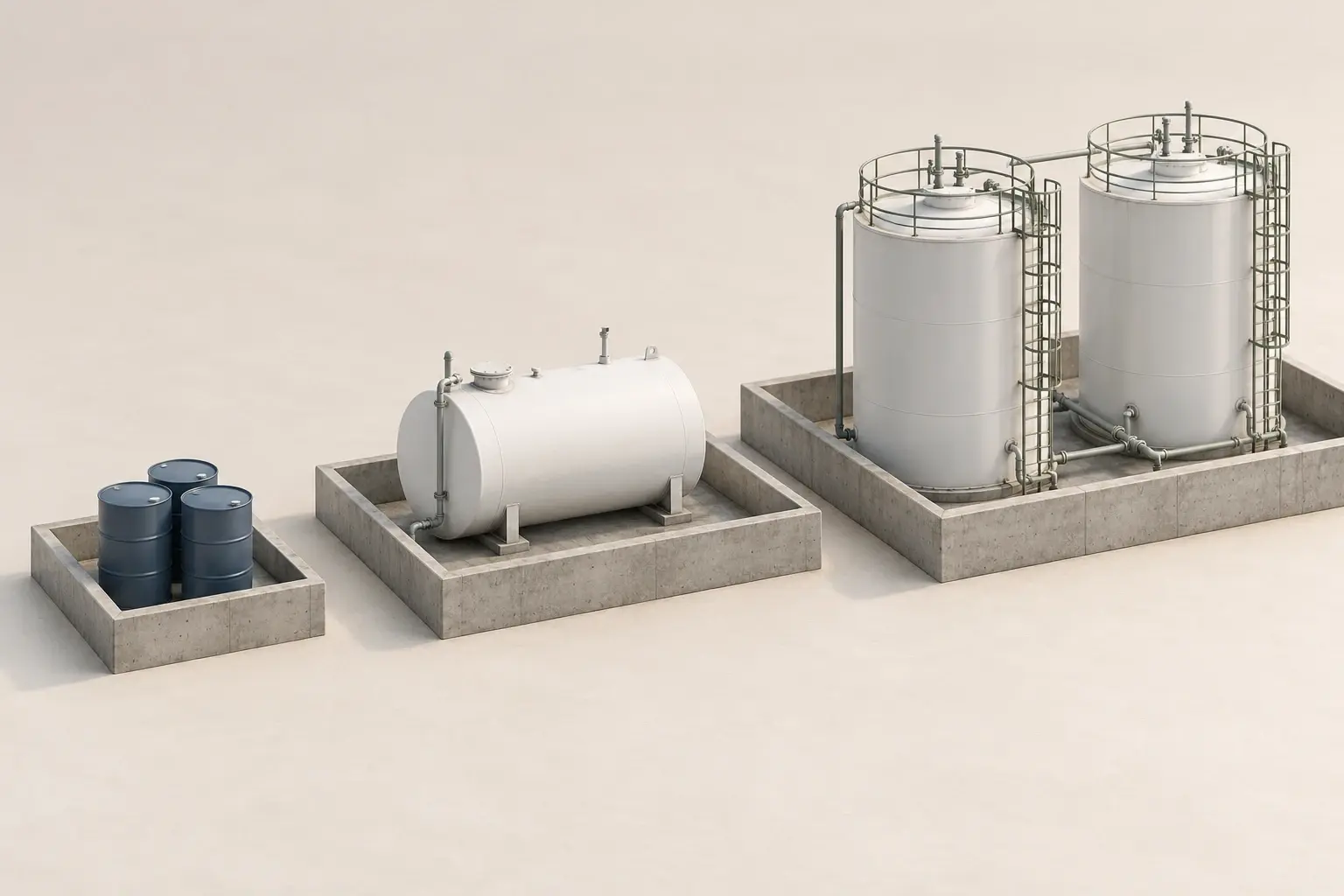
The largest single container is what separates Tier I from Tier II. A facility with a 4,000 gallon tank, a 3,000 gallon tank, and 800 gallons in drums totals 7,800 gallons with a largest container of 4,000, so it's a Tier I candidate. Swap that 4,000 gallon tank for a 6,000 gallon diesel tank and the same facility becomes Tier II. A facility with two 5,000 gallon tanks and 500 gallons in drums totals 10,500 gallons, which is over the ceiling, so it needs a PE-certified plan even though neither tank is large.
When Does a Tier I or Tier II Facility Still Need a Professional Engineer?
Qualifying for self-certification doesn't mean you never see an engineer. The rule lets you self-certify a plan that follows its standard requirements. It doesn't let you self-certify departures from them. Two kinds of departures come up most. One is environmental equivalence, where you protect the environment by a method other than the one the rule prescribes. The other is a determination that secondary containment is impracticable, where you explain why a dike or similar system isn't workable at the site and provide other measures instead. The Tier I template doesn't allow either one. A Tier II plan can include them, but a PE has to review and certify each one in writing. The engineer's certification covers only those measures, not the whole plan.
| |
Tier I template |
Tier II plan |
PE-certified plan |
| Who certifies |
Owner or operator |
Owner or operator, with a PE for any alternative measures |
Licensed PE |
| Format |
EPA's Appendix G template, or a longer plan if you prefer |
Complete written plan, no template |
Complete written plan, reviewed by the PE |
| Departures from the rule |
Not allowed in the template |
Allowed only with written PE certification of each one |
Allowed, covered by the PE's review |
| Bulk container secondary containment |
Entire capacity of the largest container plus room for precipitation |
Standard sizing rules, or PE-certified alternatives |
Standard sizing rules, or alternatives the engineer certifies |
Containment sizing is where many small facilities get stuck, because a plan can't be certified on containment that doesn't exist or doesn't hold enough. Our article on how big SPCC oil spill containment needs to be walks through the sizing math.
Your plan type can also change after you've written the plan. If a Tier I facility adds a container over 5,000 gallons, or any qualified facility passes 10,000 gallons in total, the rule gives you six months to move to the next plan type. A Tier I facility moves to a Tier II plan or a PE-certified plan, and a facility over 10,000 gallons moves to a PE-certified plan. Adding a tank is the usual trigger. RMA doesn't prepare construction-phase permits or approvals and doesn't install tanks, and in Pennsylvania DEP's rules require tank handling and inspection work to be done by DEP-certified individuals, so your tank contractor and engineer cover that side. We can help you work out what the construction phase will need and point you to the right people, and then help with the operational side once the tank is in service, starting with how the new tank changes your SPCC plan type. Whatever type you land on, the plan also has to be reviewed at least every five years, which our article on SPCC plan five-year reviews explains.
How Do Pennsylvania's DEP Tank Rules Fit Around Your SPCC Plan Type?
SPCC is a federal program, and Pennsylvania doesn't have its own versions of Tier I, Tier II, or the PE-certified plan. The three plan types and the criteria above apply the same way to a facility in Erie as to one in Philadelphia. EPA Region 3 enforces the rule in Pennsylvania, and our article on who enforces SPCC plans explains how that works. The plan carries a statement that your facility meets the qualification criteria, so an inspector can test that statement against your tank inventory and spill records. You don't file the plan with EPA. You keep it at the facility, or at the nearest field office if the site isn't staffed at least four hours a day, and have it available for on-site review.
Pennsylvania adds its own layer through DEP's storage tank program, which operates under the Storage Tank and Spill Prevention Act and 25 Pa. Code Chapter 245. That program covers things like tank registration and requires tank handling and inspection work to be done by DEP-certified individuals. Owners of what DEP's rules call large aboveground storage tank facilities also have to file a Spill Prevention Response Plan (SPRP), which is its own plan with its own content requirements, so an SPCC plan of any type doesn't replace it. Whether a particular tank needs DEP registration, or whether your tanks count as large under Chapter 245, depends on the tank's size, type, and use, so check yours against DEP's storage tank program. If you already maintain a Preparedness, Prevention and Contingency (PPC) Plan for another DEP program, tell whoever writes your SPCC plan, because the documents should agree with each other. Local fire code is a third layer, enforced by your municipality, and it varies from town to town. None of these layers changes which SPCC plan type you need, because that turns on the federal criteria.
What Does Each SPCC Plan Type Cost, and Who Should Write It?
SPCC plans from RMA run about $2,500 to $15,000. For an update to an existing, simple Tier I plan we're at about $1,500, and PE-certified complex updates start at $7,500. What moves a facility within those ranges is the total storage capacity, the number of containers and how spread out they are, whether a PE certification is needed, and whether the secondary containment has to be evaluated or sized. Our article on SPCC plan costs breaks those factors down further.
Whether you need a consultant at all depends on your plan type. A Tier I facility with a handful of containers and good containment can often complete EPA's template on its own, and if that's you, we'll say so. The risk with doing it yourself isn't the paperwork. When you self-certify, you're the one attesting that you've visited the site, that the facility meets the qualification criteria, and that you'll implement the plan, and a wrong answer on the spill history or the gallon count becomes your problem. A Tier II plan, and anything involving a PE, is more work to get right. We don't use AI to produce client deliverables, and we wouldn't self-certify a chatbot's draft either, which is something we tested in our article on whether ChatGPT or AI can write an SPCC plan. The pricing calculator below gives you a ballpark for RMA's help with your plan based on your facility.
How Can RMA Help You Pick the Right SPCC Plan Type?
The most useful thing we do on these projects is the first conversation. We take your tank inventory, your largest container, and your spill records, run them against the criteria above, and tell you which plan type you're in. Sometimes the answer is that you're under the thresholds and don't need a plan. Sometimes it's a Tier I template you can finish yourself, and sometimes it's a PE-certified plan we can write and coordinate. Our senior staff does the work, and we're based in New Jersey and work with facilities across Pennsylvania.
There's no obligation in asking. You can call us at 888-RMA-0230, send an email, or fill out the form on our website, and you can contact RMA whenever it suits you. If your team needs training on the plan once it's in place, our online environmental training library is there for that too.


