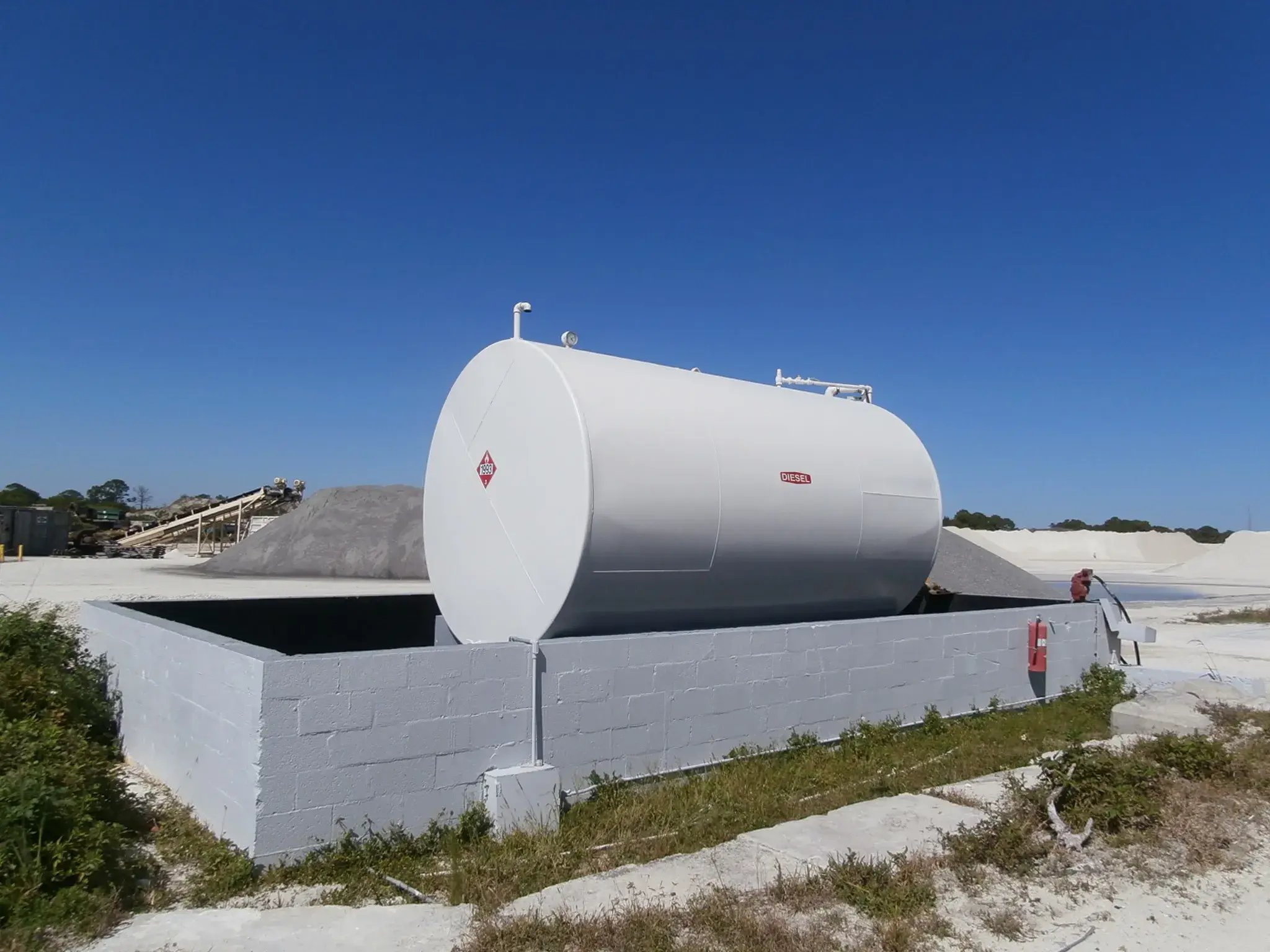
How Totes, Drums, Skid Tanks, and Fuel Trailers Count Toward Your Oil Storage Total, What Containment They Need, and How to Describe Them in a Pennsylvania Oil Spill Plan
Ask a facility manager how much oil they store and they'll usually point at the big tank out back. They don't point at the four hydraulic oil totes by the maintenance bay, the pallet of lube drums, the transfer tank bolted into a service truck, or the fuel trailer that moves around the yard. Those mobile and portable containers are one of the most common blind spots we see at Pennsylvania facilities, and the short answer is yes, they count. Under the federal oil spill prevention rule, every container that can hold 55 gallons or more counts toward your total storage capacity whether it moves or not, and the only mobile tanks that drop out are the ones that fuel the vehicle they're mounted on.
Below, we'll walk through how totes, drums, portable tanks, skid tanks, and fuel trailers count toward capacity, which ones are exempt, what spill containment they need, and how they should be written into your plan, including where they're stored. We'll also cover how Pennsylvania DEP's storage tank program treats portable tanks differently from EPA, with examples from contractor yards, farms, and manufacturing plants across the state. If you'd rather have someone walk your site and sort it out with you, reach out to RMA and we'll help you figure out where you stand.
Table of Contents
TL;DR
Totes, drums, portable tanks, skid tanks, and fuel trailers all count toward the federal oil spill plan threshold if they hold 55 gallons or more, based on how much they can hold, not how much is in them. The main exception is a fuel tank that powers the vehicle it's on. Most portable containers need containment big enough to hold the largest one plus rainwater if they're outside, while fuel trailers and tank trucks used only for fueling need general spill controls instead. Your plan has to show where mobile containers are kept and either list them or give a realistic estimate, and since Pennsylvania DEP's tank program mostly covers fixed tanks, portable containers are usually a federal issue more than a state one.
How Do Totes, Drums, and Portable Tanks Count Toward SPCC Oil Storage Capacity?
The federal rule here is EPA's Spill Prevention, Control, and Countermeasure rule at 40 CFR Part 112. It requires a written oil spill plan, called an SPCC Plan, at facilities that could reasonably spill oil into a creek, river, or storm sewer and that store more than 1,320 gallons of oil aboveground (or more than 42,000 gallons in completely buried tanks). In Pennsylvania, EPA Region 3 enforces it. The rule doesn't care whether a container is bolted down. A 275-gallon tote of hydraulic oil counts the same as a 275-gallon tank on a concrete pad.
Three counting rules trip people up with mobile equipment. Only containers of 55 gallons or more count, so pails and quart bottles stay out, but every 55-gallon drum goes in. You count shell capacity, meaning what the container can hold, so a half-empty 330-gallon tote is 330 gallons, and an empty tote that hasn't been permanently closed still counts. And "oil" means any kind of oil: diesel, gasoline, hydraulic oil, motor oil, used oil, cutting fluid concentrate, and even vegetable oil and animal fats. Propane and diesel exhaust fluid (DEF) don't count.
Portable containers add up fast. Five standard 275-gallon totes total 1,375 gallons, which is over the threshold with no fixed tank on site at all. If you're not sure where you land, our article on the four steps to figure out if you need an SPCC Plan walks through the full calculation.
| Container |
Typical size |
Counts toward the 1,320-gallon total? |
| Steel or poly drum |
55 gallons |
Yes, at full shell capacity |
| Tote (IBC) |
275 to 330 gallons |
Yes, even when partly full or empty |
| Pickup-bed transfer tank or skid tank |
100 to 1,000 gallons |
Yes, it stores fuel for other equipment |
| Fuel trailer or tank truck used on site |
500 gallons and up |
Yes |
| Portable generator with built-in fuel tank |
Varies |
Yes, if the tank is 55 gallons or more |
| Fuel tank on a truck, loader, or excavator |
Varies |
No, it's a motive power container |
| Pails, jugs, quart bottles |
Under 55 gallons |
No |
Which Mobile Oil Containers Are Exempt From the SPCC Count?
The exemption most people reach for is the motive power exemption, and it's narrow. A motive power container is a fuel tank onboard a vehicle that's used primarily to make that vehicle move, plus onboard oil-filled equipment like the hydraulic system on a backhoe. The saddle tanks on a dump truck and the fuel tank on a skid steer are exempt. The rule specifically says an onboard container used to store or transfer oil for distribution isn't a motive power container. So the transfer tank in your service pickup counts, and so does a fuel trailer, even though both are on wheels.
A few other exclusions show up at sites with portable equipment. Pesticide application equipment and its mix containers are excluded, which matters on farms and at landscaping operations. Milk containers, hot-mix asphalt containers, and containers that are permanently closed (drained, disconnected, locked, and signed with the closure date) also drop out. Everything else that holds oil and is 55 gallons or bigger goes into the total. One more wrinkle: a tank truck on a public highway falls under the U.S. Department of Transportation, but once it's parked at your facility to store fuel or refuel equipment, EPA treats it as part of your storage. If your trucks also move fuel between sites, have that line drawn carefully in your plan.
What Secondary Containment Do Mobile and Portable Oil Containers Need?
Secondary containment is the backup barrier that catches oil if the container fails. For mobile and portable containers, 40 CFR 112.8(c)(11) sets two requirements. You have to position or locate them so a spill won't reach water, and, with one exception, you have to provide containment big enough to hold the largest single container (or the largest compartment) plus extra room, called freeboard, for rainwater if the area is outdoors. This is called sized secondary containment, and unlike many other SPCC requirements, EPA doesn't let a plan swap it out for an "equivalent" alternative.
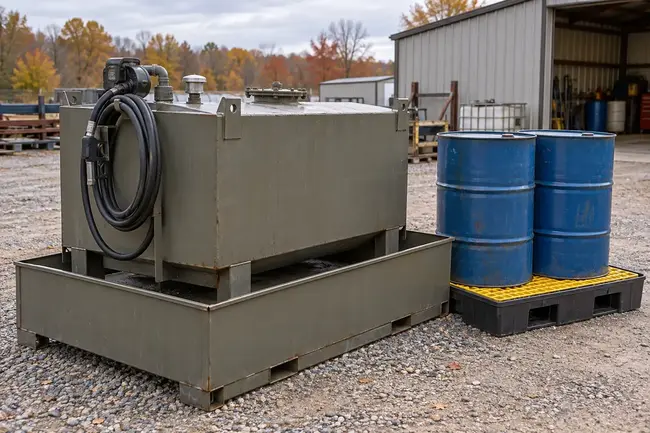
The exception is for mobile refuelers and other non-transportation-related tank trucks. A mobile refueler is a tank on a vehicle or trailer that's designed or used solely to store and move fuel for transfer into vehicles, equipment, or other tanks, which describes most fuel trailers and refueling trucks. They don't need sized containment, but they still need general secondary containment under 40 CFR 112.7(c). That standard is built around the most likely spill, like a hose that slips or a nozzle left open, not a full tank rupture. It can be passive, like parking the trailer in a curbed or graded area, or active, like spill kits, drain covers, and sorbent booms staged where fueling happens and staff trained to use them.
| Container type |
Containment standard |
Common ways to meet it |
| Drums and totes |
Sized: largest container plus rainwater freeboard if outdoors |
Spill pallets, containment sheds, curbed storage rooms |
| Portable and skid tanks used for storage |
Sized: largest container plus rainwater freeboard if outdoors |
Double-walled tanks, portable berms, concrete or steel containment |
| Mobile refuelers and on-site tank trucks |
General: the most likely spill during normal use |
Designated parking, drain covers, spill kits, sorbents, trained staff |
Indoor storage often makes this easier, because there's no rainwater to plan for and the building can help hold a spill. That only works if nothing leads out, so floor drains, trench drains, and doorways onto pavement all need a hard look. Outdoor spill pallets are where we see sizing mistakes most, usually a pallet rated for one tote with two totes sitting on it. Our guide on how big your SPCC oil spill containment needs to be covers the sizing math.
How Should Mobile Oil Containers Be Described in an SPCC Plan?
Mobile containers move, and the rule allows for that. Under 40 CFR 112.7(a)(3), the facility diagram has to mark the location and contents of each fixed container, but for mobile and portable containers it only needs to mark the storage area where they're kept. The plan text then has two options. You can list the type of oil and capacity of each mobile container, or you can estimate the potential number of mobile containers, the types of oil, and their expected capacities. For a plant that cycles through hydraulic oil totes every month, the estimate is usually the realistic choice, as long as it's honest and covers your busiest season.
Trouble starts when the plan describes one storage area and the totes live somewhere else. A plan that says drums are kept in the containment shed doesn't help when an inspector finds six drums on gravel next to a storm inlet. The plan should name every place mobile containers are routinely kept, including staging areas, the maintenance shop, and where the fuel trailer parks overnight, and the containment described for each area should match what's there. It should also cover how containers get moved and filled, since a lot of spills from portable containers happen during transfers.
Mobile containers also fall under the plan's inspection and training requirements. Every aboveground container needs integrity inspections on a schedule set by industry standards, and for most drums and totes that means regular visual checks for leaks, damage, and corrosion rather than formal testing. Those checks fit into your SPCC monthly inspections. Oil-handling employees need training, plus annual spill prevention briefings. If your mobile inventory changes in a way that affects your spill potential, like adding a fuel trailer or a new tote storage area, that may also call for a plan amendment.
How Does Pennsylvania DEP's Storage Tank Program Treat Portable Tanks?
Pennsylvania layers its own tank program on top of the federal rule. DEP runs it under the Storage Tank and Spill Prevention Act, passed in 1989 after the 1988 Floreffe tank collapse near Pittsburgh sent diesel into the Monongahela River, with the details in 25 Pa. Code Chapter 245. The program covers tank registration, DEP-certified installers and inspectors, and, for larger sites, a Spill Prevention Response Plan (SPRP). The key difference for this topic is that DEP's definition of an aboveground storage tank is built around stationary tanks larger than 250 gallons. Chapter 245 defines a stationary tank as one that's permanently affixed to the property, meaning it can't be moved by design or it's connected to the property by piping or another structure.
In practice, a tote on a spill pallet or a fuel trailer that comes and goes generally isn't a DEP-regulated aboveground tank, even though it counts fully under the federal rule. Skid tanks are where it gets blurry. One that's hard-piped to a dispenser or generator can start to look permanently affixed. Chapter 245 also excludes some tanks that matter here, including tanks of 1,100 gallons or less storing motor fuel for noncommercial use and farm tanks of 1,100 gallons or less used solely for farm production. Whether a particular tank needs DEP registration depends on its size, type, use, and how it's installed, so confirm borderline tanks against DEP's storage tank program.
DEP requires an SPRP at aboveground storage tank facilities with more than 21,000 gallons of regulated aboveground capacity, and that capacity comes from DEP-regulated tanks, not every portable container on site. Separately, facilities with certain DEP permits may need a Preparedness, Prevention, and Contingency (PPC) Plan, which generally looks at all pollutant storage, portable containers included. So portable containers are mostly a federal SPCC issue in Pennsylvania, but they don't disappear from the state picture entirely.
Mobile Fuel Tanks at Pennsylvania Contractor Yards and Job Sites
Picture a site work contractor in the Lehigh Valley. They've got a 1,000-gallon diesel skid tank they move between the yard and active jobs, two 500-gallon fuel trailers, three service pickups with 100-gallon transfer tanks, a few totes of hydraulic oil in the shop, and a rack of used oil drums. The fuel tanks on the excavators and dozers don't count, since those are motive power. Everything else does, and on a winter weekend when the equipment is home, the yard is well over 3,000 gallons.
Contractors usually run into two questions. The first is which facility the portable tanks belong to. The SPCC rule's definition of a facility includes mobile equipment, so when a skid tank or fuel trailer sits at a job site for weeks, that site can become its own regulated facility if the oil storage there crosses the threshold. The second is containment for fuel trailers, which usually means general containment through designated parking away from storm drains, spill kits on every trailer, and trained drivers. Skid tanks used as storage need sized containment, which is why a lot of contractors switch to double-walled units.
On the construction side, stormwater coverage (PAG-02), Chapter 102 erosion and sediment control, building and fire permits for permanent tank installs, and tank installation itself (which in Pennsylvania may require a DEP-certified installer) are handled by your engineer, contractor, or an erosion and sediment control specialist. RMA doesn't prepare those. We can help with the oil spill plan for temporary fuel storage on a job site, and with the operational plans your yard or a new facility needs once it's running.
Fuel Trailers, Nurse Tanks, and Totes on Pennsylvania Farms
On farms, mobile oil storage is the norm. A dairy or grain operation in Lancaster or York County might have a fuel trailer for refueling tractors in the field, a skid tank on a wagon, totes of hydraulic and gear oil in the shop, and drums of engine oil. Federal law treats farms a little differently. Under amendments Congress passed in 2014, farms get higher thresholds before an oil spill plan is required, and containers of 1,000 gallons or less on separate parcels don't count toward a farm's total. Farms with less than 2,500 gallons of aggregate aboveground capacity don't need a plan, and the tiers above that depend on capacity, the size of the largest tank, and spill history, so check EPA's current agriculture guidance against your own inventory.
Farms get caught with the mobile containers on the main farmstead parcel. The separate-parcel exclusion doesn't help with totes and drums next to the main shop, and fuel trailers count once they're used to store and distribute fuel. Pesticide sprayers and their mix containers are excluded, but the diesel nurse tank that rides alongside them isn't. Most farms that need a plan qualify for a self-certified version, which our article on Tier I self-certified SPCC Plans explains. The diagram usually marks the shop, the fuel trailer parking spot, and any seasonal staging areas.
Oil Totes and Drums at Pennsylvania Manufacturing Plants
At a metal fabricator in Erie or a plastics plant outside Harrisburg, mobile storage is usually a lot of totes and drums in a lot of places: hydraulic oil for presses, cutting fluid concentrate at the machining cells, quench oil, gear oil, and used oil waiting for pickup. Add oil-filled equipment like hydraulic presses and transformers, which also count toward capacity, and a plant with no bulk tank at all can easily need a plan.
In a plant, containers spread out. Totes start in a central storage room, move to the floor, and end up half-empty in a corner. The approach that works best is to designate a small number of contained storage areas, describe each one in the plan with realistic counts, and make "back to the storage area or on a spill pallet" part of the monthly inspection. Used oil containers deserve the same treatment, since used oil rules carry their own labeling and storage expectations. Our article on the top things to know about used oil regulations covers that side, and our online environmental training library is an easy way to get floor staff up to speed on handling and spill response.
How RMA Helps Pennsylvania Facilities With Mobile Oil Containers in SPCC Plans
We help Pennsylvania facilities get an honest count of their oil storage, including the totes, drums, and trailers that never made it into the old plan. From there we sort out which containers count, check whether your containment is sized right for what's sitting on it, and write your mobile container storage areas into the plan in a way that matches how your site works. If you're under the threshold, we'll tell you. If you're close, we'll talk through whether consolidating or closing out a few containers makes more sense than writing a plan. Our complete guide to SPCC Plans is a good place to start if you want the bigger picture first.
There's no pressure and no obligation. Give us a call, send us an email, or fill out the form on our website, and one of our senior staff will talk through your situation with you. When you're ready, contact RMA and we'll help you figure out the right next step for your facility.