Training Your Team to Run SPCC Compliance vs. Paying a Consultant Every Year: A New Jersey Comparison
If your facility stores oil, you've probably wondered how much of the Spill Prevention, Control, and Countermeasure (SPCC) rule your own people can handle and how much needs an outside consultant. Most of the routine, repeating work can be owned by trained staff at your facility, while a handful of technical tasks really do need a professional. Facilities that hand everything to a consultant every year usually overpay, and facilities that try to do everything themselves usually get caught on the technical pieces.
In this article we'll sort SPCC tasks into the ones your team can own and the ones that usually need outside help, compare the cost and risk of each approach, and explain why we're big fans of the train-the-trainer method. We'll also cover what New Jersey adds on top of the federal rule. If you'd rather talk it through for your own site, you can reach out to RMA anytime.
Table of Contents
TL;DR
Most routine SPCC work can be done by your own trained staff: monthly inspections, annual discharge prevention briefings, recordkeeping, and containment drainage logs. Plan certification by a Professional Engineer, formal tank integrity testing, and technical amendments usually need outside help. The cheapest approach for most facilities is to have a few key employees trained by professionals, have them train everyone else, and bring in a consultant only for the technical pieces. In New Jersey, facilities that also fall under the state's discharge prevention rules have extra recordkeeping to manage on top of the federal SPCC rule.
Can Your Facility Handle SPCC Compliance In-House or Does It Need a Consultant?
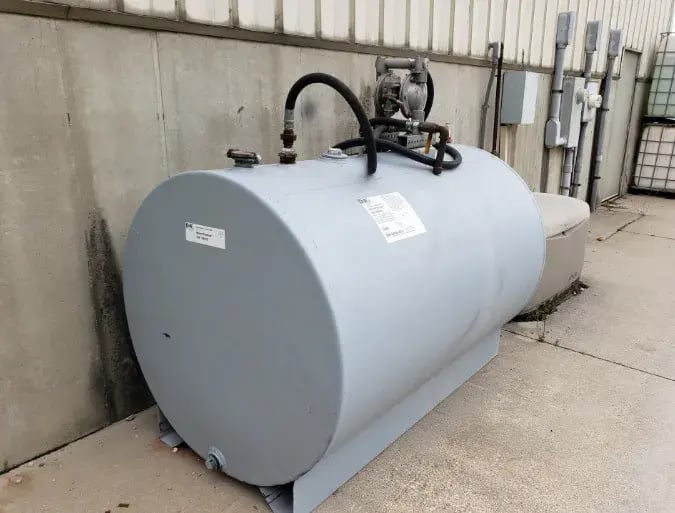
The SPCC rule is a federal EPA regulation under 40 CFR Part 112 that applies to facilities storing more than 1,320 gallons of oil aboveground, counting containers of 55 gallons or more. In New Jersey, EPA Region 2 is the agency that enforces it. The rule is built around a written plan, but a plan is only useful if the people at the facility follow it day to day. That's the part consultants can't do for you, no matter how much you pay them.
Think of SPCC compliance as two buckets. The first bucket is the repeating operational work: walking the tanks, logging inspections, training employees, and keeping records. Your own people are in the best position to do this because they're on site every day and they know what normal looks like. The second bucket is the technical work: engineering judgment, specialized testing, and certified documents. That bucket comes up occasionally, not monthly, and it's where an outside professional earns the fee. Paying a consultant every year to do bucket one is usually where facilities waste money.
Which SPCC Tasks Can Your Own Staff Own?
A trained employee can handle most of what the plan asks for on a routine basis. The rule requires you to keep written procedures and a signed record of inspections and tests for three years, and a trained staff member can keep those records without any outside involvement. Here's how the routine tasks break down.
Monthly inspections. Many facilities set up a monthly walk-through of tanks, drums, piping, containment areas, and loading areas, looking for leaks, corrosion, stained soil, damaged valves, and anything that's changed since last month. Our guide on what to look for during SPCC monthly inspections walks through the checklist. This task is a good fit for in-house staff, because a person who sees the same tanks every day will notice a problem a visiting consultant would miss.
Containment drainage logs. If you drain rainwater out of a diked area, the rule expects you to keep the bypass valve sealed closed, inspect the retained rainwater before draining to make sure it won't cause a discharge, reseal the valve afterward under responsible supervision, and keep adequate records of each drainage event. Your facility team can do all of that with a simple log. The rule also doesn't allow flapper-type drain valves on diked areas, so it's worth a quick look at your valves during your walk-through.
Records. Inspection logs, drainage logs, training logs, and a copy of the current plan all live on your side. Keeping them organized and signed is a habit, not a technical skill.
Annual training and briefings. Your own trained staff can run these, which is where the train-the-trainer approach we'll describe below comes in. Day-to-day ownership of all of this belongs inside your company.
What SPCC Training Do Your Oil-Handling Employees Need?
Under 40 CFR 112.7(f), you must train your oil-handling personnel in the operation and maintenance of equipment to prevent discharges, discharge procedure protocols, applicable pollution control laws, general facility operations, and the contents of your SPCC Plan. You also have to designate a person who's accountable for discharge prevention and reports to facility management. On top of that, you need to hold discharge prevention briefings for oil-handling personnel at least once a year. Those briefings are meant to cover known discharges or failures, malfunctioning components, and any recently developed precautionary measures.
EPA says "oil-handling personnel" is interpreted according to industry standards, but it includes employees engaged in operating and maintaining oil storage containers and related equipment, plus emergency response. Contractors who handle oil at your site generally belong in the training group too. For more detail on how often to train and what to cover, see our articles on whether annual SPCC training is required and what SPCC training should include.
Why Does RMA Recommend the Train-the-Trainer Method for SPCC Training?
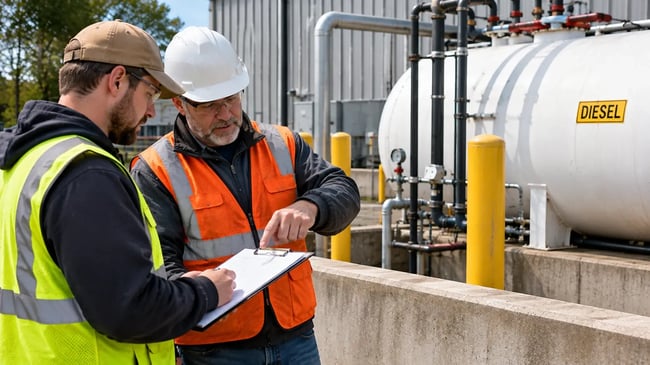
We're big fans of train-the-trainer, and we recommend it to most of our clients. The idea is simple. You send a few key staff members, such as your environmental manager, a shift supervisor, and the person responsible for discharge prevention, to be trained by professionals who work with the SPCC rule every day. Those people then bring the training back to the rest of your oil-handling employees.
There are a few reasons this works well. Everyone hears the same information, because it flows from one trained source instead of being retold differently by different supervisors. Your key people also gain a real understanding of the rule, which means they can answer questions when something comes up between annual briefings. And it's usually the most cost-efficient approach, because you pay professionals to train a small group instead of paying for an on-site session for every employee, every year. A new hire in June can be trained by someone in your building instead of waiting for the next outside session.
Train-the-trainer isn't a substitute for the facility-specific part, though. Your trainers need to walk the rest of the staff through your actual tanks, your actual containment, and your actual spill response steps. That's the content a generic course can't cover.
Where Does Online SPCC Training Fit In?
Online training is the other tool worth knowing about, and we offer it here at RMA through our online training library. All of your staff can take a course on their own time, which is a big help when you have multiple shifts, seasonal workers, or people spread across several sites. It's often cheaper than paying someone to come deliver on-site training, and it's far more flexible, since nobody has to line up a day when everyone can be in the same room.
Many facilities combine the two approaches. They use online courses to give every oil-handling employee the baseline, and they use trained in-house staff to cover the facility-specific details and run the annual briefing. If you're wondering whether this satisfies the rule, we cover that in our article on doing SPCC training online, and our post on how much SPCC training costs compares online and on-site pricing.
Which SPCC Tasks Usually Need Outside Help?
Some SPCC work needs credentials or technical judgment that training a staff member won't give you. We'd be doing you a disservice if we told you otherwise. These are the tasks that usually call for outside help.
Professional Engineer certification. A plan for a facility that doesn't qualify for self-certification has to be reviewed and certified by a licensed Professional Engineer. Even a self-certified plan needs a PE for certain deviations, such as environmental equivalence or impracticability determinations. Our article on Professional Engineers and SPCC plan requirements explains when a PE is required.
Technical amendments. When you change your facility's design, construction, operation, or maintenance in a way that affects its potential for a discharge, the plan has to be amended within six months and the amendment implemented within six months after that. For a plan certified by a PE, a PE has to certify technical amendments too. A qualified facility with a fully self-certified plan can self-certify its own amendments, but the call on what counts as a technical amendment is a judgment many facilities don't want to make alone. See when you should update your SPCC plan and whether you can do it yourself.
Integrity testing. The rule requires you to test or inspect each aboveground container for integrity on a regular schedule and whenever you make material repairs. Your staff can handle the visual inspection piece, but formal testing, such as ultrasonic or other nondestructive methods, is typically done by inspectors certified under an industry standard. Your plan will name the standard you follow, so check it before you decide who does what.
Containment sizing and five-year reviews. Calculating whether your secondary containment is big enough, especially with several tanks, rainfall allowances, and oil-filled equipment, is math and judgment together. The plan also has to be reviewed at least once every five years, and our post on SPCC plan five-year reviews covers what that review involves.
How Do the Cost and Risk of In-House SPCC Compliance Compare to Hiring a Consultant?
Here's the trade-off in plain terms. Doing the routine work in-house costs you staff time and a modest training investment, and it protects you from the most common finding in an inspection: missing records. Hiring a consultant to do all of it every year costs more and still leaves your employees responsible for the daily tasks. The mix that works best for most facilities is trained staff for the routine work and a consultant for the technical work, called in only when needed.
| Approach |
Cost Profile |
Main Risk |
| Trained staff handle routine tasks, consultant handles technical tasks |
Lowest ongoing cost. Staff time plus training, with consultant fees only when a technical task comes up. |
Staff turnover can break the routine, so keep backups trained. |
| Consultant handles everything every year |
Highest ongoing cost. You pay for tasks your own people could do. |
Your employees may still skip daily and monthly work because they assume the consultant has it covered. |
| Staff handle everything, including technical tasks |
Lowest upfront cost, but the savings can disappear fast. |
Uncertified plan changes, missed testing, and a plan that doesn't hold up in an inspection. |
On the consultant side, our published ranges give you a rough sense of scale. An SPCC plan generally runs from $2,500 to $15,000 depending on the facility. A simple Tier I update is about $1,500, while a complex PE-certified update runs $7,500 and up. Those are one-time or occasional costs, not annual fees, which is the main reason paying a consultant every single year rarely makes sense. Our article on SPCC plan costs breaks down what drives the number, and you can get a facility-specific estimate with the pricing calculator below. Training pricing depends on the format you choose, so our training cost article is the better reference there.
Cost isn't the only risk to weigh. The EPA can assess civil penalties for SPCC violations, and the maximum amounts are adjusted for inflation under 40 CFR Part 19, so check the current figures before you build a business case around any single number. Missing training records and missing inspection logs are among the easiest violations for an inspector to find. They're also the cheapest to prevent, which is why the in-house piece is worth doing well. If you're curious how RMA works with clients, see what it's like to hire an SPCC plan consultant.
If you'd like a ballpark for the technical side of the work, the pricing calculator below lets you put in your facility details and see what RMA would charge to help.
What Does New Jersey Add to SPCC Compliance for Your Facility?
The federal SPCC rule is the starting point, but New Jersey has its own layer. The state's Spill Compensation and Control Act, known as the Spill Act, covers discharges of hazardous substances as well as oil, and it carries its own reporting duties and liability. Facilities that the state treats as "major facilities" under N.J.A.C. 7:1E also have to prepare discharge prevention plans, called DPCC and DCR plans, which come with their own training, drill, and inspection expectations. Whether your facility counts as a major facility depends on its total storage capacity and what it stores, so check N.J.A.C. 7:1E against your own inventory.
For a major facility, the state's recordkeeping rules are more demanding than the federal SPCC rule's three-year baseline. Under N.J.A.C. 7:1E-2.15, records of employee training, discharge prevention drills, inspections of cleanup and removal equipment, and facility inventories are kept for three years, while certain aboveground tank inspection records are kept for up to 10 years or the life of the tank, whichever is shorter. That makes a trained in-house person even more useful in New Jersey, because the habit of keeping clean, dated records pays off across both programs. Our guide to SPCC plans in New Jersey goes deeper on the state picture, and our article on who enforces SPCC plans explains how EPA and state agencies split responsibility.
Because the state and federal programs overlap, it's a good idea to have one person at your facility who understands both, and to bring in outside help when you're unsure which program a change triggers. If a discharge ever does happen, an environmental attorney may be appropriate alongside your environmental consultant, since Spill Act liability is a legal question we can't answer for you.
How Can RMA Help With SPCC Training and Compliance?
We're a family-run firm based in New Jersey, and we've been helping facilities with SPCC for decades. Where it makes sense, we'd rather train your team to handle the routine work than keep you on an annual retainer you don't need. We can train your key staff for the train-the-trainer approach, point you to our online courses for everyone else, and step in for the technical pieces like plan development, PE certification, and amendments. If a simpler self-service route fits your facility, we'll tell you so.
If you want to talk through what your team can own and what you'd rather hand off, you can call us, email us, or fill out the form on our website. There's no pressure and no obligation, and we're happy to answer questions even if you're not ready to hire anyone. Just reach out to our team whenever you're ready.