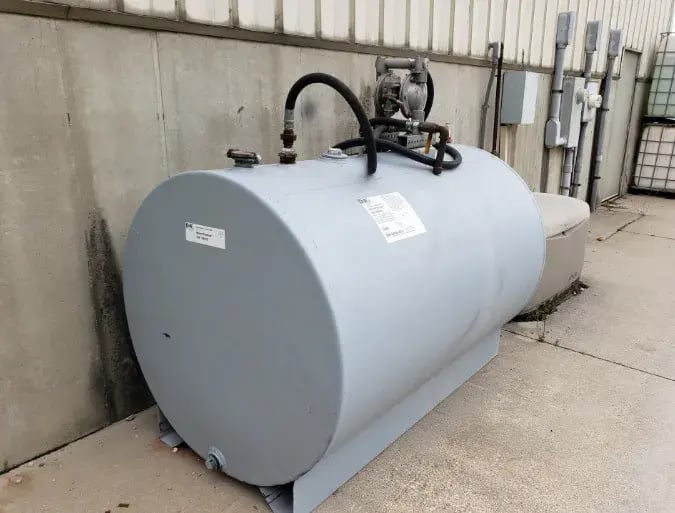
A Section-by-Section Walkthrough of a Typical Oil Spill Prevention Plan, What Each Part Is For, and What Makes It Hold Up
If you store oil at a New Jersey facility, someone may have told you that you need an SPCC Plan, short for Spill Prevention, Control, and Countermeasure Plan. In plain terms, it's a written oil spill prevention plan for your site. Many people picture a short form, but a real plan follows a set order, and each section answers a question an inspector, an insurer, or your own staff might ask. Knowing what each section is for makes it much easier to judge whether the plan you have, or the one you're about to pay for, is built properly.
This article walks through a typical plan from front to back, from the facility diagram to the final signatures, and explains what each section does and what separates a strong one from one that just fills pages. We also cover where New Jersey's own rules touch the plan. If you'd rather have someone look at your site with you, you can always reach out to RMA, and there's no obligation.
Table of Contents
TL;DR
A New Jersey SPCC Plan follows a set order: facility diagram, oil container inventory, discharge prediction, secondary containment, loading and unloading, inspections and records, security, training, spill response, and finally management approval and certification. Each section answers a question an inspector will ask, and the strong ones describe your actual site. New Jersey adds its own reporting and discharge prevention rules on top of the federal requirements.
How Is an SPCC Plan Organized Under the Federal Rule?
The federal oil pollution prevention rule is 40 CFR Part 112, and section 112.7 sets the general contents of a plan. It calls for a written plan prepared in accordance with good engineering practices, in a set sequence. You can organize it differently, but then you need an equivalent plan plus a cross-reference showing where each requirement lives. Most consultants follow the rule's order because it's easy for an inspector to check, and EPA Region 2 is the office that enforces SPCC for New Jersey facilities. For background, see what an SPCC plan is and everything about SPCC plans.
The plan also has to discuss how your facility conforms with each requirement. It describes what's physically on your site and what your people do, and an inspector will compare the two. This table maps the typical sections to the rule.
| Plan Section |
Question It Answers |
40 CFR Reference |
| Facility information and diagram |
What's on the site and where? |
112.7(a)(3) |
| Oil container inventory |
What oil is stored, and how much? |
112.7(a)(3)(i) |
| Discharge prediction |
If something fails, where does the oil go? |
112.7(b) |
| Secondary containment |
What keeps a spill on the site? |
112.7(c), (d) |
| Loading and unloading |
How do transfers happen without spills? |
112.7(a)(3)(ii), (h) |
| Inspections, tests, and records |
How do you catch problems early? |
112.7(e) |
| Security |
Who can reach the oil and the valves? |
112.7(g) |
| Personnel training |
Does your staff know the plan? |
112.7(f) |
| Spill response and notification |
What happens in the first hour? |
112.7(a)(3)(iv) to (vi), (a)(4), (a)(5) |
| Certification and management approval |
Who stands behind the plan? |
112.3(d), 112.6, 112.7 |
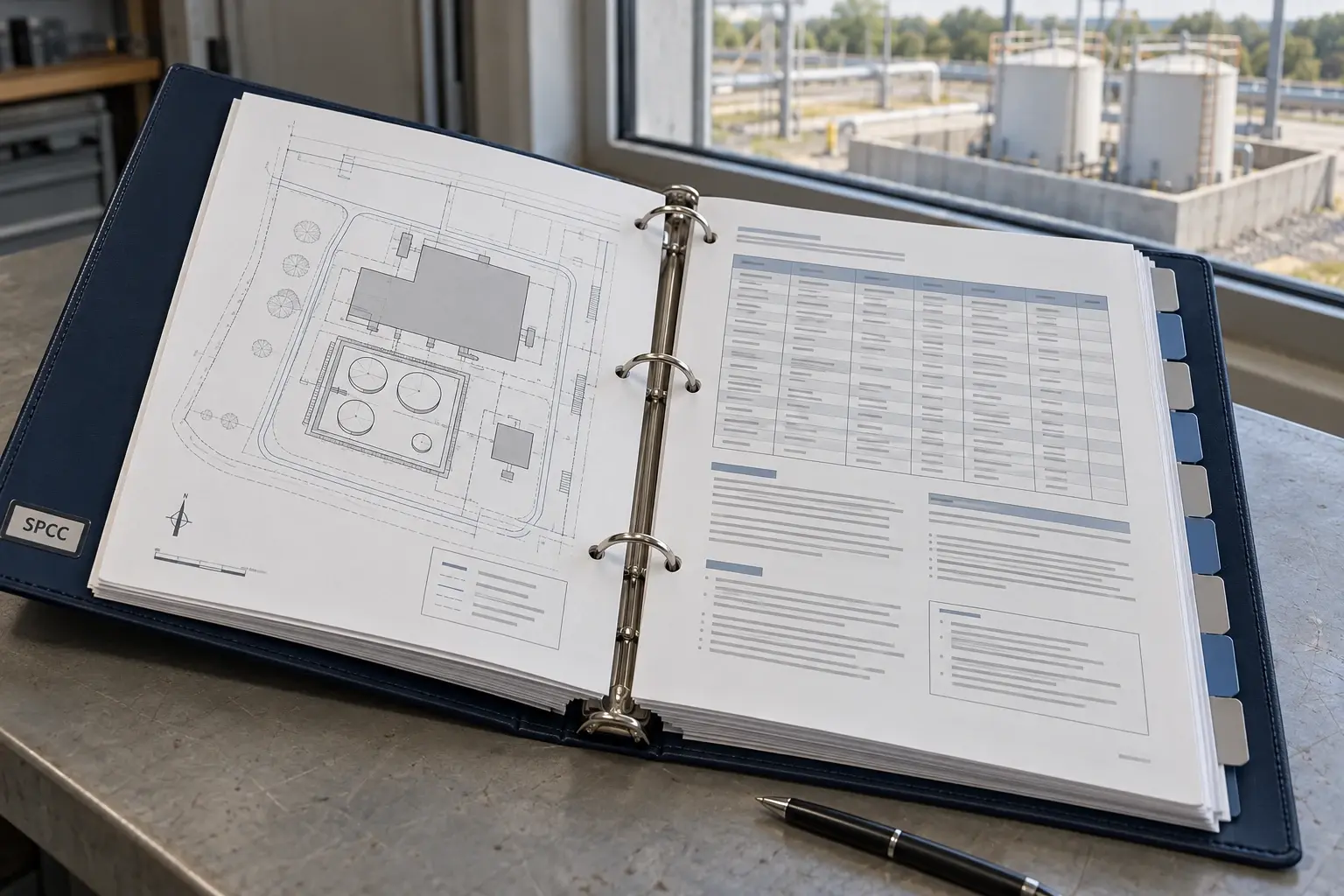
The opening section describes the site: owner and operator, address, what the facility does, and its physical layout. The rule requires a facility diagram that marks the location and contents of each fixed oil container and the storage area for mobile or portable containers. It also shows transfer stations and connecting piping, and it marks exempt underground tanks as "exempt."
A good diagram lets a stranger find every oil source on the property without a guide. It's drawn to the site as it exists today, with the containers, drains, loading areas, and the nearby storm inlet or waterway all visible. The common weak spot is a diagram that was accurate when the plan was written and never updated, so the new generator or the moved drum rack isn't on it. When the diagram doesn't match the yard, the rest of the plan starts to look unreliable too.
How Does the Oil Container Inventory Work in an SPCC Plan?
The inventory lists the type of oil in each fixed container and its storage capacity. For mobile or portable containers, you either list each one or estimate how many you'll typically have, what oils they hold, and their sizes. This section ties back to whether you need a plan at all: the trigger is more than 1,320 gallons of aboveground capacity, counting containers of 55 gallons or more. Capacity counts, not how full a container happens to be.
A solid inventory goes beyond fuel tanks. Hydraulic reservoirs, transformers and other oil-filled equipment, lube totes, used oil tanks, and vegetable oils all belong if they meet the size threshold. Propane doesn't count, and some items like motive power containers are exempt, but the plan should say so plainly instead of silently leaving them out. Inventories go wrong when someone counts only the tanks they think of as "the oil." Our article on 55-gallon drums covers one common point of confusion.
What Is Discharge Prediction and Why Does an SPCC Plan Need It?
Discharge prediction is where the plan thinks through what could go wrong. Where experience shows a reasonable potential for equipment failure, such as tank overflow, rupture, leakage, or loading equipment, the rule asks for a prediction of the direction, rate of flow, and total quantity of oil that could be discharged from each type of major equipment failure. If this tank cracked or this hose let go, how much would come out, how fast, and which way would it run?
A useful prediction is specific to your site. It follows the slope of the pavement, names the nearest storm drain, and identifies the ditch, wetland, or stream the oil would reach if nothing stopped it. A generic line saying a spill "could reach surface waters" helps no one. Many New Jersey sites sit near a creek or a storm sewer that discharges to a river, so this section often drives the containment and response decisions that follow.
How Should the SPCC Secondary Containment Section Be Written?
This section explains what keeps a spill from leaving the facility. The entire containment system, including walls and floor, has to be able to hold oil and be built so a discharge from a tank can't escape before cleanup happens. The rule lets you size for the typical failure mode and the most likely quantity of oil. Onshore options include dikes, berms, or retaining walls, curbing or drip pans, sumps and collection systems, drainage systems, weirs and booms, diversion or retention ponds, and sorbent materials, either active or passive.
A strong section states the actual sizing and construction for each container or area, and it covers drainage, since a bermed area with an open drain valve isn't containment. Sizing rules for bulk containers are covered in our article on how big secondary containment needs to be. When a containment measure isn't practicable, the rule lets you explain why, but then it requires more: periodic integrity testing of containers, integrity and leak testing of valves and piping, an oil spill contingency plan, and a written commitment of manpower, equipment, and materials. People drift onto that heavier path without realizing it.
What Should SPCC Loading and Unloading Procedures Cover?
Many spills happen during transfers, so the plan has to describe discharge prevention for routine handling, including loading, unloading, and facility transfers. In practice that means who's present during a delivery, how hoses and fill connections are checked, and what stops the transfer if something goes wrong.
If you have a tank truck or tank car rack, the rule gets specific. Rack drainage has to flow to a catchment basin or treatment facility designed for discharges, or you use a quick drainage system, and containment must hold at least the largest single compartment of the truck or car. You also need an interlocked warning light, barrier, signs, wheel chocks, or a brake interlock to keep vehicles from leaving before the lines are disconnected, and you inspect the lowermost drain and all outlets before a vehicle departs. A good section describes your real delivery routine and doesn't copy rack language for a site that only has a tank with a fill port.
How Do Inspections, Testing, and Recordkeeping Fit in an SPCC Plan?
This section keeps the plan alive after it's signed. Inspections and tests follow written procedures that you or the certifying engineer develop for the facility, and you keep those procedures and a signed record of each inspection and test with the plan for three years. Records kept under usual and customary business practice are accepted, so a checklist your team already uses can work if the right supervisor or inspector signs it.
The strongest versions name what gets checked, how often, and by whom, and match the equipment on your site. A site with steel tanks, a transformer pad, and a drum area needs a different checklist than one with a single day tank. Inspectors ask for the records, and a plan with polished procedures and an empty binder is a violation waiting to be written. See our guide to monthly SPCC inspections and our notes on the most overlooked SPCC requirements.
What Does the SPCC Plan Security Section Need to Say?
Security is short but specific. The plan describes how you control access to oil handling and storage areas, secure master flow and drain valves, prevent unauthorized access to pump starter controls, secure out-of-service and loading or unloading connections, and whether your security lighting helps prevent vandalism and spot discharges.
A good section reads like a description of your site: the fence and gate, locked containment drain valves, capped or locked fill connections, and the lights over the tank area. Where something isn't in place, the plan shouldn't claim it is. The rule allows deviations here if you explain why and describe equivalent protection, so honesty is easy, and a plan that overstates its security is exposed in a five-minute walk with an inspector.
What Does the SPCC Personnel Training Section Include?
This section covers who is trained, on what, and when. Oil-handling personnel need training in equipment operation and maintenance to prevent discharges, discharge procedure protocols, applicable pollution control laws, general facility operations, and the contents of the plan. You also designate a person accountable for discharge prevention who reports to facility management, and you hold discharge prevention briefings at least once a year that cover known discharges, failures, and new precautions.
A good section names the accountable person by role and describes a briefing that really happens, with a sign-in sheet to prove it. We go deeper on what SPCC training should include, and our online training library can cover the basics for a whole team. The plan should also say where training records are kept, since inspectors like to ask for them.
How Should an SPCC Plan Handle Spill Response and Notification?
People reach for this section in an emergency, so it has to work in one. The rule asks for countermeasures for discovery, response, and cleanup (both your own capability and a contractor's), methods for disposing of recovered material, and a contact list for your response coordinator, the National Response Center, cleanup contractors, and the agencies to call. The reporting information has to let the caller give the exact location, the date and time, the material and estimated quantity, the source, the affected media, the cause, any injuries or damage, actions underway, whether an evacuation may be needed, and who else has been contacted.
In New Jersey this section carries extra weight because of the Spill Compensation and Control Act, usually called the Spill Act. NJDEP runs a 24-hour hotline at 1-877-WARNDEP (1-877-927-6337), and the National Response Center takes federal reports at 1-800-424-8802. Whether a release has to be reported to the state, and how fast, depends on the material, the amount, and where it went, and some small releases that are cleaned up promptly are treated differently. Don't try to sort that out mid-incident. Put both numbers in the plan, tell staff to call when unsure, and read about the sheen rule. Spill Act liability is strict, so after a real discharge it's reasonable to talk with an environmental attorney.
How Do SPCC Plan Certification and Management Approval Work?
The last part is where someone signs. The plan needs the full approval of management at a level of authority to commit the resources to implement it, so the signer should be someone who can approve spending on containment repairs and training. Most plans also have to be certified by a licensed Professional Engineer who attests they're familiar with Part 112, have visited the facility, and consider the plan adequate. Some smaller facilities that meet the qualified facility criteria can self-certify, depending on size and spill history. Our articles on types of SPCC plans and Professional Engineer certification explain the paths.
Good approval pages are dated, signed, and current. The plan also needs a review at least every five years under 112.5(b), with any amendments made within six months, and technical amendments when the facility changes in a way that affects discharge potential. We cover the choices in our piece on the five-year review.
Where Do New Jersey Rules Fit Into an SPCC Plan?
The federal rule asks the plan to discuss conformance with other effective discharge prevention procedures and any applicable more stringent state rules. That's why a New Jersey plan often reads differently than one written in another state. The Spill Act's reporting and cleanup duties belong in the response section.
New Jersey also has a separate program for "major facilities" under N.J.A.C. 7:1E, with its own discharge prevention plans known as DPCC and DCR plans. Whether your facility counts as a major facility depends on its total storage capacity and what it stores, so check the rule against your own inventory. If it applies, the state plans and your SPCC Plan overlap, and the documents should agree. If you're building or expanding, tank installation permits, soil erosion approvals, and construction stormwater coverage are handled by your engineer and contractor, and RMA doesn't prepare them. Once the site is running, the operational plans in this article are where we help. See SPCC plans in New Jersey and who enforces SPCC plans.
How Can RMA Help With Your New Jersey SPCC Plan?
We're a New Jersey firm and we've been writing and reviewing SPCC Plans since 1992. Senior staff do the work, and we don't use AI to produce client deliverables. If you already have a plan, we'll compare it against the sections above and tell you plainly what's solid and what's missing, and sometimes the honest answer is that you can handle a small update yourself. If you need a new plan or a rewrite, we'll walk through your situation and give you a real price.
There's no pressure and no obligation. You can call or email us, or fill out the form on our website, and someone on our team will get back to you.