A Step-by-Step Walkthrough of the Opening Conference, Records Review, Site Walkthrough, and What Comes After
If your facility stores enough oil, federal rules require a written oil spill plan called an SPCC Plan (short for Spill Prevention, Control, and Countermeasure), and EPA can show up to check that you wrote it and that you're following it. The inspector comes from EPA Region 3, and sometimes there's no phone call ahead of time. Plenty of facility managers learn how an inspection works while one is already happening, which is a stressful way to find out.
This article walks through the typical flow in order: the opening conference, the document review, the site walkthrough, and the closing discussion. We'll also cover what inspectors tend to find and how to get ready before anyone arrives. If you want a second set of eyes on your plan and records before an inspector sees them, or you're not sure the rule applies to you at all, you can reach out to RMA any time. If you turn out to be under the threshold, we'll tell you that too.
Table of Contents
TL;DR
EPA Region 3 inspectors visit Pennsylvania facilities that store oil, sometimes without notice. A visit usually has four parts: an opening conference, a review of your SPCC Plan and records, a walkthrough of your tanks and containment, and a closing talk about what the inspector found. The most common problems are an outdated or uncertified plan, missing or unsigned inspection records, weak secondary containment, and no documented training. The best preparation is a current plan, three years of signed records, and a site that matches what the plan says.
How Does an EPA SPCC Inspection in Pennsylvania Work From Start to Finish?
EPA runs the SPCC program in Pennsylvania directly. It isn't delegated to the state, so the inspector who shows up works for EPA Region 3 in Philadelphia, which also covers Delaware, Maryland, Virginia, West Virginia, and Washington, D.C. In some Pennsylvania cases, DEP staff have joined EPA on site and the Commonwealth has been notified of the findings afterward. DEP has its own storage tank rules under the Storage Tank and Spill Prevention Act, and we're leaving those out here so we can stay on the federal inspection itself. If you want the broader picture of who has authority over what, our article on who enforces SPCC plans covers it.
You usually won't be told why your facility was picked. What you can count on is that the visit follows a familiar pattern, even though the order can shift depending on the inspector and the site.
| Stage |
What Happens |
What the Inspector Wants |
| Arrival |
Inspector shows credentials at the gate or front desk |
Someone with authority who can start the visit |
| Opening conference |
Introductions, purpose of the visit, a talk about your operations |
A picture of what oil you store and how you handle it |
| Document review |
Plan, certification, inspection and testing records, training records |
A plan that's current, signed, and being followed |
| Site walkthrough |
Tanks, containment, loading areas, piping, drainage, photos and notes |
A site that matches the plan on paper |
| Closing conference |
Inspector reviews preliminary findings with you |
Answers to open questions and a point of contact |
| Written follow-up |
Findings, a compliance letter, or a proposed settlement, sent some time later |
A response and corrections from you |
The length of the visit depends on how many tanks you have, how spread out the site is, and how quickly you can put your hands on records. A small facility with a few tanks and an organized binder is a much shorter day than a large site where the plan is in one person's email and the inspection logs are in another person's truck.
What Happens at the Opening Conference of an SPCC Inspection?
The inspector starts by showing EPA credentials, and you're entitled to look at them closely. Ask for a business card while you're at it. Tell whoever sits at your front desk or guard shack in advance that an inspector may arrive, who to call, and that nobody should wave the person through or turn them away without making that call first. A receptionist who panics can turn a routine visit into a bad first impression.
Once the right people are in the room, the inspector explains why they're there and what the visit will cover, then asks about your operations. Expect questions like what kinds of oil you store, in which containers, where deliveries and transfers happen, whether you've had any spills, and whether anything has changed since the plan was written. The inspector is trying to build a picture of the site before looking at it, and your answers shape where they spend their time.
Bring three kinds of people if you can: someone who knows daily operations, someone who knows the plan and the records, and someone with enough authority to make decisions. Answer what you're asked, and if you don't know something, say so and offer to find out. A guess that turns out wrong looks worse than a short delay. If any part of your facility involves confidential business information, say so at the start so it can be handled the right way. Keep a simple log of what you hand over and what the inspector photographs, because you'll want that list later.
Which SPCC Plan Documents and Records Will the EPA Inspector Review?
Most of the findings in an SPCC inspection come from paperwork rather than from anything leaking. EPA looked at 120 SPCC facilities in a review covering fiscal years 2018 and 2019 and found an average of four plan deficiencies at each one. The five most common were plan content, general secondary containment, integrity testing, sized secondary containment, and drainage. Plan content, certification, and reviews topped EPA's own ranking of problem areas.
| What They Ask For |
What They're Checking |
Rule |
| The SPCC Plan |
It exists, covers every container, includes a facility diagram, and has management approval |
40 CFR 112.3 and 112.7 |
| Certification |
A Professional Engineer's certification, or a valid self-certification if you qualify |
40 CFR 112.3(d) and 112.6 |
| Five-year review and amendments |
A signed, dated review, and updates after changes to tanks or operations |
40 CFR 112.5 |
| Routine inspection records |
Written procedures, signed and dated records, kept for three years |
40 CFR 112.7(e) |
| Integrity testing records |
Container testing done to the industry standard your plan names |
40 CFR 112.8(c)(6) |
| Training records |
Oil-handling staff trained, and discharge prevention briefings held at least once a year |
40 CFR 112.7(f) |
| Drainage records |
A log of rainwater drained from containment areas |
40 CFR 112.8(c)(3) |
A few of these deserve a closer look. On certification, an inspector checks whether the plan was certified by a Professional Engineer or self-certified, and if it was self-certified, whether the facility really qualified. That depends on total storage and on your discharge history, so a facility that grew or had a spill since the plan was written can lose eligibility without anyone noticing. Our guide to the different types of SPCC plans explains the tiers, and our piece on professional engineers and SPCC plan requirements covers when a PE is needed.
Inspection records are where gaps show up fastest. The rule calls for signed records kept for three years, so a missing month or an unsigned form is easy to spot. Most facilities handle this with monthly visual rounds, and we lay out what to check in our list of the top 10 things to do during your SPCC plan monthly inspections. The five-year review is another common miss, and our article on SPCC plan five-year reviews explains what counts as a real one.
If the inspector asks for your plan and you don't have one, that's a violation on its own, and it's hard to talk your way around it once it's on paper. A plan that exists but describes a different facility than the one the inspector is standing in is nearly as bad, since it shows the plan isn't being followed.
What Does the Inspector Look At During the SPCC Site Walkthrough?
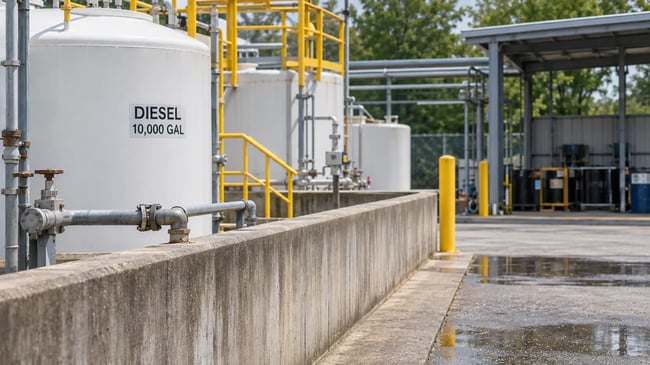
After the paperwork, the inspector walks the site to see whether what's on the ground matches what your plan says. They usually take photos and notes as they go. This is where an extra tank that was never added to the plan, or a containment area described as one thing and built as another, gets noticed. Having someone from your team walk alongside the inspector, answer questions, and take notes of their own is a good habit.
| Area |
What the Inspector Checks |
What Commonly Gets Written Up |
| Tanks and containers |
Corrosion, leaks, coating failure, supports and foundations, overfill protection |
Containers missing from the plan, no integrity testing program |
| Secondary containment |
Cracks, rainwater, vegetation, burrows in earthen berms, drain valves |
Open or unsecured drain valves, no containment at all, undersized containment |
| Loading and unloading areas |
Drip pans, curbing, spill kits, procedures for deliveries |
No general containment where oil is transferred |
| Drums, totes, and portable containers |
Storage location, condition, whether they're counted in the plan |
Containers stored outside with no containment |
| Piping, valves, and fuel dispensers |
Leaks, supports, damage from vehicles, lockable valves |
No documented inspection or testing of piping |
| Oil-filled equipment and generators |
Transformers, hydraulic equipment, day tanks, and where leaks would go |
Equipment never added to the plan |
| Security and drainage |
Locks, lighting, and how a spill could reach a storm drain or stream |
Unlocked valves, no consideration of nearby drains |
Secondary containment gets the most attention, and the problems are often small and physical: cracks in concrete walls, rusting steel basins, rodent holes in a berm, weeds growing through the floor, or a drain valve left open after someone emptied rainwater and forgot to close it. If you're not sure your containment is big enough for the largest tank inside it, our article on how big SPCC oil spill containment needs to be walks through the sizing rule. We've also written about the most overlooked SPCC plan requirements, which tend to show up here.
What Happens at the SPCC Inspection Closing Conference and Afterward?
The inspector finishes with a closing conference, going over what they saw and any preliminary findings. In Region 3, the documentation that follows an inspection is often called an inspection findings form that lists the alleged violations. Use the closing conference to ask what the findings are, whether anything looks like an immediate risk, who your contact is, and when to expect something in writing. Take notes. The findings you hear on site aren't always the final word, and what arrives in the mail can differ.
What happens next varies. Here are the paths we see described in EPA Region 3 enforcement records.
| Outcome |
What It Looks Like |
| No significant findings |
No formal action, or a letter noting minor items to fix |
| Findings with corrective actions |
A written list of deficiencies and a deadline to correct them |
| Expedited Settlement Agreement |
A proposed penalty for the violations found, which you can accept or decline |
| Formal enforcement |
A complaint and consent agreement with a larger penalty and required corrections |
Penalties come from Section 311 of the Clean Water Act. EPA can assess a Class I penalty of up to about $23,600 per violation, capped near $59,000, or a Class II penalty of up to about $23,600 per day of violation, capped near $295,000. Those figures are adjusted for inflation every year in 40 CFR Part 19, and federal court penalties can run higher. Actual settlements vary widely. One 2021 Region 3 settlement involving a petroleum storage facility came to $67,856 for plan problems, incomplete inspection records, and bulk storage container violations. Our article on top SPCC plan violations and fines goes through the common ones in more detail.
Cooperation and speed at correcting problems tend to matter when EPA sets a penalty. If you receive findings, a proposed settlement, or a formal information request, it's reasonable to talk with an environmental attorney before you respond or sign anything, since we're consultants and not lawyers. Whatever else you do, start fixing what you can right away and keep records of the fixes, because EPA will want proof.
How Do You Prepare for an EPA SPCC Inspection in Pennsylvania?
Start by figuring out whether the rule applies to you. SPCC covers facilities with more than 1,320 gallons of aboveground oil storage capacity, counting only containers of 55 gallons or more, or more than 42,000 gallons of completely buried capacity. It's capacity that counts, not how full the tanks are, and oil means more than diesel: hydraulic oil, lubricants, transformer oil, and animal fat or vegetable oil all count. If you're over the line and don't have a plan, getting one should come before everything else on this list, because an inspector who finds no plan has little to discuss other than that. If you're under it, SPCC inspectors have no reason to be at your door, though other state and local rules may still apply to your tanks.
If you do have a plan, preparation mostly means making sure paper and site agree. A few habits cover most of it:
- Keep the current plan, certification, five-year review, and amendments together in one place that anyone on the team can find.
- Complete and sign monthly inspection records on schedule, and keep at least three years of them.
- File integrity testing reports for every container, with the next test dates noted.
- Hold documented training for oil-handling staff, including the annual discharge prevention briefing.
- Walk your own containment looking for cracks, standing water, vegetation, and drain valves left open.
- Update the plan when you add a tank, move equipment, or change how oil is handled, and tell the front desk what to do if an inspector arrives.
Training is its own line item that inspectors ask about. Our articles on annual SPCC training and what SPCC training should include explain what to cover, and our online environmental training library has courses you can buy if you'd rather not build your own. For a deeper look at the plan itself, see our overview of what an SPCC plan is.
One more step is worth doing once a year: a mock inspection. Have someone who didn't write the plan walk through your site with the plan in hand, the way an inspector would, and write down every mismatch. It's cheaper to find a missing signature or a rusted valve yourself than to have EPA find it for you.
How Can RMA Help You Get Ready for an SPCC Inspection?
We're a family-run firm, and a lot of what we do is help facilities find out where they stand before an inspector does. We can review your current plan, records, and site against the same items an inspector checks, tell you plainly what's out of date or missing, and help you fix it. If the plan needs to be rewritten, we'll say so, and we typically don't update another firm's plan, usually rebuilding from scratch instead, because patching a plan we didn't write rarely holds up. When a plan needs a Professional Engineer's certification, we work with an outside PE. Initial SPCC training is free with a new RMA plan. For a sense of what a plan costs, see our breakdown of SPCC plan costs.
There's no obligation in a conversation. You can call us, email us, or fill out the form on our website, and we'll help you work out whether the rule applies and what to do next. If you don't need us, we'll tell you. When you're ready, contact RMA and we'll take it from there.


