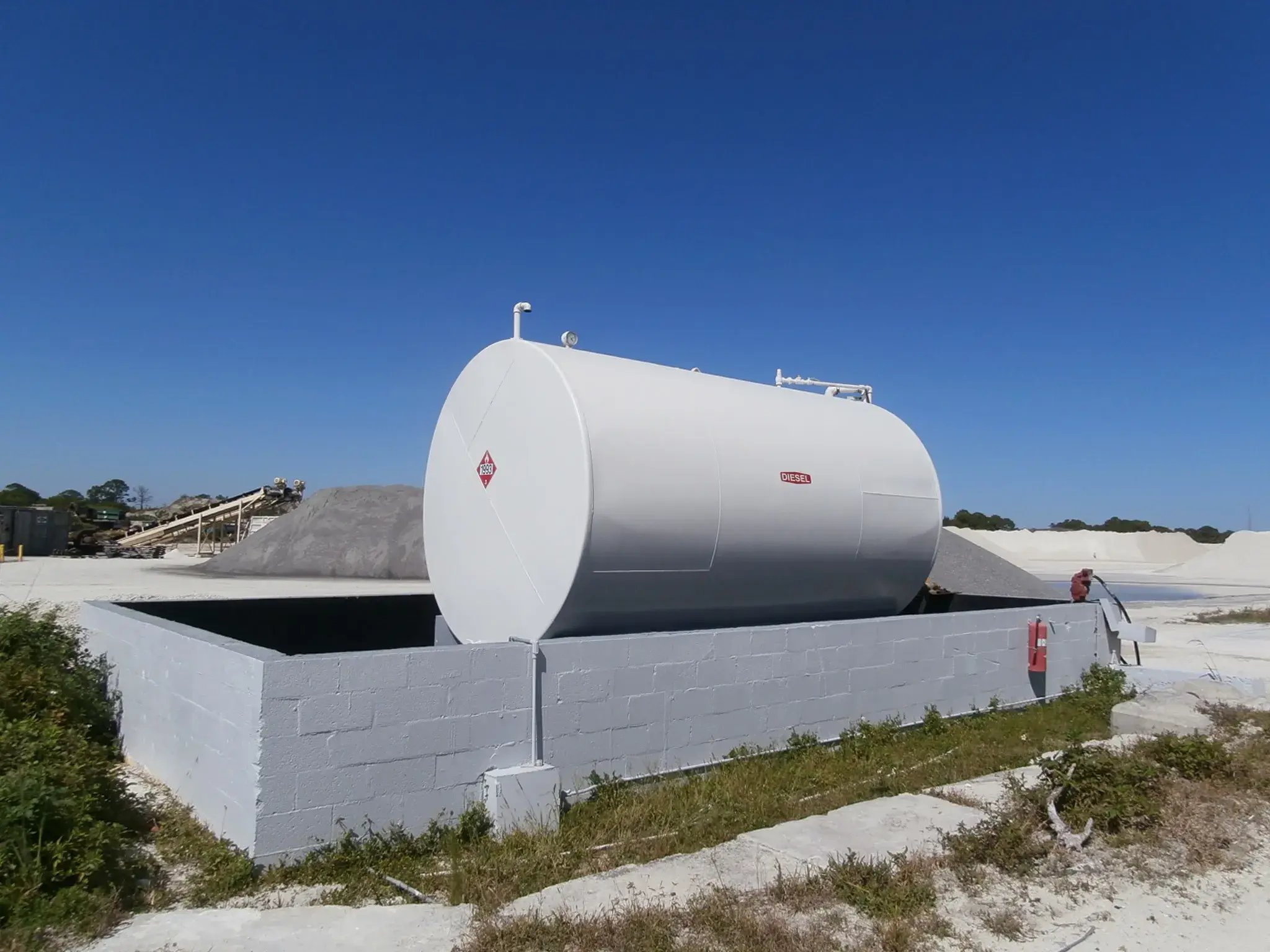
Found a DEP Tank Registration Letter or Invoice in Your Files? Here's What Pennsylvania's Storage Tank Program Requires and How It Connects to Your Oil Spill Plan
Maybe you're a new facility manager going through a predecessor's filing cabinet, or maybe an invoice from the Pennsylvania Department of Environmental Protection just landed on your desk asking for $50 or $125 a tank. Either way, you're holding a document that lists tanks by sequence number, gallons, and substance, and nobody on site can tell you what it means. In short, it means DEP considers one or more of your tanks "regulated" under Pennsylvania's storage tank program. Regulated tanks have to stay registered every year, carry an annual fee, and follow state rules for how they're installed, inspected, and eventually closed.
That registration is a state requirement, and it's completely separate from the federal oil spill plan (called an SPCC Plan) that many of the same facilities also need. Having a current DEP certificate doesn't mean you have, or don't need, that federal plan. In this article we'll walk through what the letter is, which tanks have to be registered, what registration costs and requires, how it differs from SPCC, and what to do once you've found it. If you'd rather talk it through with someone who works with these rules every day, feel free to reach out to RMA.
Table of Contents
TL;DR
A DEP tank registration certificate or invoice means Pennsylvania treats one or more of your tanks as regulated. In general that's aboveground tanks over 250 gallons and underground tanks over 110 gallons holding petroleum or certain hazardous substances, unless an exemption applies. Registered tanks need an annual fee, updates within 30 days of changes, and state-certified people for installation, inspection, and closure. None of that replaces the federal oil spill plan, which has its own trigger based on total oil storage, so check both separately.
What Is a Pennsylvania DEP Tank Registration Certificate?
Pennsylvania has run its own storage tank program since the Storage Tank and Spill Prevention Act took effect in August 1989. The law came together quickly after the January 1988 Floreffe disaster, when a newly reassembled Ashland Oil tank near Pittsburgh split open and sent diesel fuel into the Monongahela River, cutting off drinking water for communities downstream. The rules that came out of it live in 25 Pa. Code Chapter 245, and DEP's Division of Storage Tanks runs the program along with the department's six regional offices.
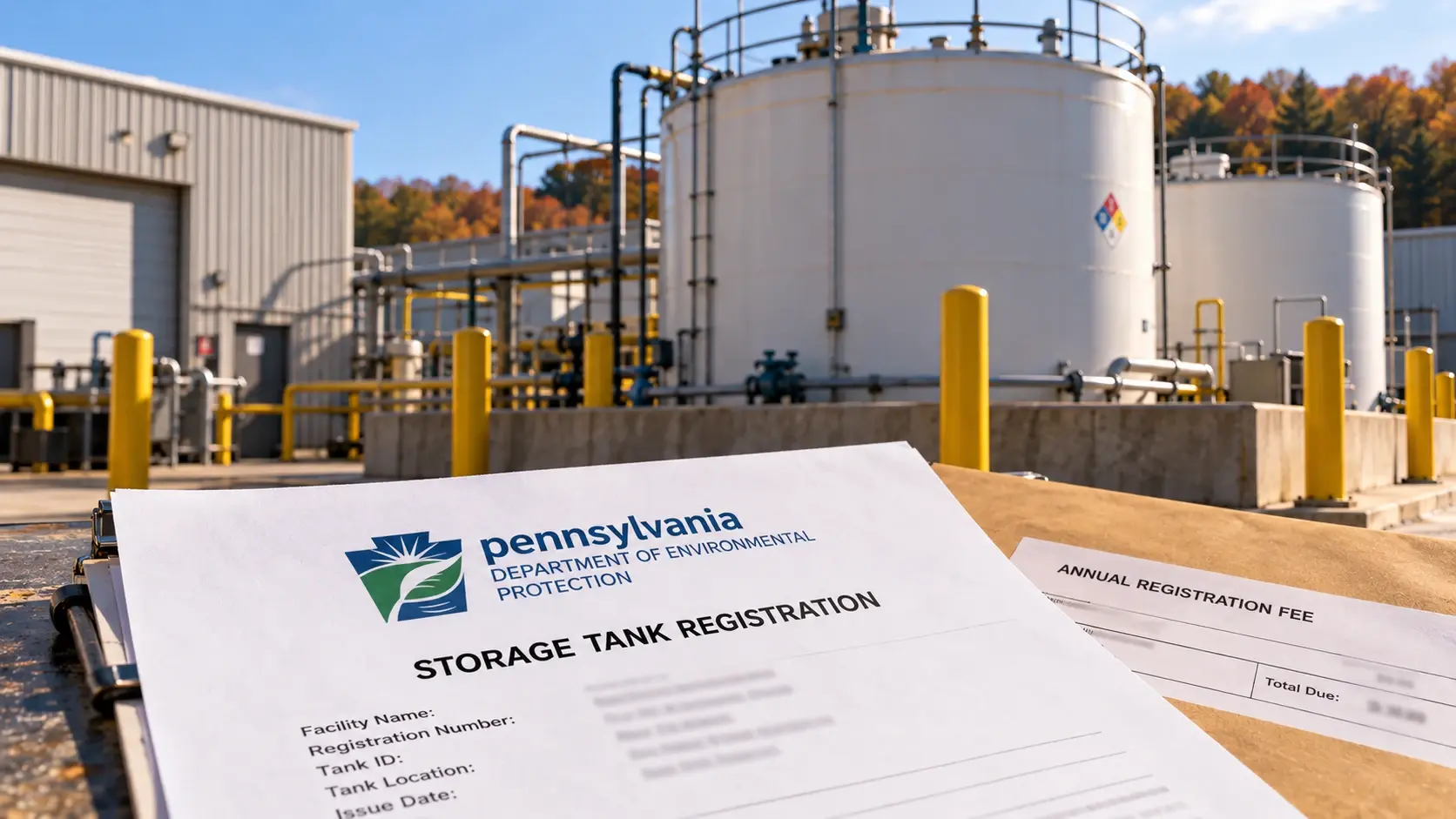
Under those rules, the owner of every regulated tank has to register it with DEP. When you do, DEP issues a certificate of registration that carries an expiration date and shows the permit type and status for each tank. The registration form also serves as the tank's operating permit application, and without an approved operating permit, a regulated tank isn't supposed to receive, store, or dispense product at all. After the first registration, DEP sends the owner an invoice every year for the upcoming year, which is usually the piece of paper that makes people start asking questions.
If you want to see what DEP has on file, its online Storage Tank Search lists registered facilities and their tanks. Each tank shows a sequence number, whether it's aboveground or underground, the install date, capacity, the substance stored, and the date of its last inspection. Comparing that list to what's physically sitting on your property is one of the most useful things you can do with the letter in your hand, and we'll come back to it later.
Which Tanks Need Pennsylvania DEP Storage Tank Registration?
A tank falls under the state program when it holds a "regulated substance" and crosses a size line. Regulated substances include petroleum products like gasoline, diesel, kerosene, and used oil, plus anything listed as a hazardous substance under the federal Superfund law. That second category grows over time. When EPA designated PFOA and PFOS as hazardous substances in 2024, tanks holding more than trace amounts of them became regulated in Pennsylvania too, and owners had to register them.
The size lines are different for aboveground and underground tanks. A regulated aboveground storage tank (AST) is a stationary tank with a capacity over 250 gallons. A regulated underground storage tank (UST) has a capacity over 110 gallons with at least 10 percent of its volume below ground. DEP counts each compartment of a split tank as its own tank, with its own registration and its own fee, unless the compartments are plumbed to fill and operate as one unit.
There's a long list of exemptions, roughly 19 for each tank type, and the details matter. A few common ones:
- Heating oil tanks used to heat the building where they sit. For aboveground tanks, DEP's definition of this "consumptive use" exemption applies to tanks of 30,000 gallons or less.
- Small motor fuel tanks of 1,100 gallons or less used for noncommercial purposes.
- Flow-through process tanks, such as pressure vessels and oil/water separators. A tank that stores the oil collected from a separator is not exempt, though.
- Portable containers like drums and totes, since the definition only covers stationary tanks.
Because the exemptions are narrow, it's easy to get a tank's status wrong in either direction. DEP can ask for supporting documentation when a tank changes from regulated to exempt status, so if you believe a tank on your certificate shouldn't be there, plan on showing why.
What Does Pennsylvania Tank Registration Cost and Require Each Year?
The fees themselves are modest. DEP bills per tank, and aboveground fees step up with tank size:
| Tank type and size |
Annual DEP registration fee |
| Underground storage tank (any regulated size) |
$50 per tank |
| Aboveground tank, 5,000 gallons or less |
$50 per tank |
| Aboveground tank, 5,001 to 50,000 gallons |
$125 per tank |
| Aboveground tank, over 50,000 gallons |
$300 per tank |
Volunteer fire companies and volunteer EMS organizations don't pay the annual fee on their underground tanks, though they still have to register them. Underground tank owners also pay separate fees into the Underground Storage Tank Indemnification Fund (USTIF), a state-run fund that helps pay for cleanups when a UST leaks. That's billed apart from the DEP registration fee, so it's common to see two different charges for the same tank. UST owners also have to name their trained Class A and Class B operators when they register.
The bigger obligation is keeping the registration accurate. Owners have to file an amended registration within 30 days of any of these changes:
- A change of tank ownership or operator
- Installing a new or replacement tank
- Closing, removing, or relocating a tank, or taking one out of service
- Changing what's stored in a tank, or switching it to an unregulated use
- Changing the facility contact, mailing address, or phone number
A tank taken out of service still needs a valid registration until it's properly closed or removed. And anyone selling a property with a regulated tank on it is supposed to tell the buyer, in writing, about the registration obligations. If you bought a site and the certificate is still in the previous owner's name, that's an amendment that's overdue.
Letting this slide has a practical consequence. Fuel distributors aren't allowed to deliver to a tank without a valid registration and operating permit, and tanks with suspended, withheld, or withdrawn permits show up on DEP's delivery prohibition list. A lapsed registration can turn into a fuel truck that won't fill your tank.
PA Storage Tank Inspections, Certified Installers, and Tank Closure
Registration is the front door to a broader set of technical rules. In Pennsylvania, "tank handling" work on a regulated tank (installing it, modifying it, or removing it) generally has to be done by a DEP-certified installer, and required inspections have to be done by a DEP-certified inspector. DEP keeps a searchable list of certified companies by region, county, and certification type. Routine maintenance is the main thing you can handle without a certified person.
Inspection requirements scale with tank size. Large aboveground tanks, meaning a single tank over 21,000 gallons, are inspected by a certified inspector at installation and then get periodic in-service inspections, generally at least every five years, along with out-of-service integrity inspections on a longer cycle. Smaller aboveground tanks follow a simplified program, though larger oil tanks in that group, those over 5,000 gallons, still need periodic in-service inspections. Underground tanks bring their own requirements, including release detection, testing of spill and overfill equipment, and operator training.
Facilities with a single aboveground tank over 21,000 gallons, or more than 21,000 gallons of regulated aboveground storage in total, also need a Spill Prevention Response Plan (SPRP). This is Pennsylvania's own spill plan, written to the requirements of the storage tank law and kept on file with DEP. It covers similar ground to the federal oil spill plan, and many facilities coordinate the two documents, but they're separate requirements with separate triggers. Many Pennsylvania facilities also keep a Preparedness, Prevention, and Contingency (PPC) Plan, which DEP often requires through other permits and which can pull these pieces together.
When a tank reaches the end of its life, it has to be closed or removed properly, which in Pennsylvania means certified tank handlers and an amended registration within 30 days. RMA doesn't install, remove, or close tanks, and we don't prepare the construction-phase permits that go with that work. Your tank contractor and a DEP-certified installer handle that side. Where we come in is the operating side: the oil spill plan, inspections and recordkeeping under that plan, and training once the tank is in service.
How Is DEP Tank Registration Different From an SPCC Plan?
The federal side of oil storage is the Spill Prevention, Control, and Countermeasure (SPCC) rule at 40 CFR Part 112. An SPCC Plan is a written oil spill plan that lays out how a facility prevents oil from reaching water, how it contains spills, and how it responds if one happens. In Pennsylvania, it's enforced by EPA Region 3, not DEP. If you're new to the federal rule, our overview of what an SPCC Plan is covers the basics, and our article on who enforces SPCC Plans explains the federal and state roles.
People mix the two programs up because they often touch the same tanks. Here's how they compare side by side:
| |
PA DEP tank registration |
Federal SPCC Plan |
| Who runs it |
PA DEP Division of Storage Tanks and regional offices |
U.S. EPA, Region 3 in Pennsylvania |
| The rule |
Storage Tank and Spill Prevention Act, 25 Pa. Code Chapter 245 |
Clean Water Act, 40 CFR Part 112 |
| What it looks at |
Individual tanks: ASTs over 250 gallons, USTs over 110 gallons |
The whole facility: total oil storage over 1,320 gallons aboveground or 42,000 gallons buried |
| What's covered |
Petroleum and federally listed hazardous substances |
Oil of any kind, including animal fats and vegetable oils |
| Drums and totes |
Not covered (stationary tanks only) |
Count toward the total if 55 gallons or larger |
| Paperwork |
Filed with DEP, renewed every year by invoice |
Kept on site, not filed with EPA, reviewed at least every five years |
| Government fee |
$50 to $300 per tank per year |
None |
| Who signs off |
DEP-certified installers and inspectors for tank work and required inspections |
The owner (Tier I and Tier II qualified facilities) or a Professional Engineer |
The practical takeaway is that each program can apply without the other. A facility can be fully paid up with DEP and still be missing a required SPCC Plan, and that's a gap we run into regularly. It can also go the other way: a facility with a solid SPCC Plan can have a tank that was never registered with the state.
Does a Registered Tank in Pennsylvania Mean You Need an SPCC Plan?
Not automatically. The federal rule applies when a facility has more than 1,320 gallons of aboveground oil storage capacity, counting only containers of 55 gallons or more, or more than 42,000 gallons of completely buried capacity, and could reasonably be expected to discharge oil to a waterway. That last test is about geography, things like slope, drainage, and nearby streams, and you can't count berms, curbs, or other manmade structures to argue your way out of it.
A few counting rules trip people up. It's capacity that counts, not how much is in the tank, so a half-full or empty tank counts at its full size. Permanently closed containers don't count. Oil-filled equipment like transformers and hydraulic systems does count, and so do cooking oils and other animal fats and vegetable oils. Propane and diesel exhaust fluid don't. Vehicle fuel tanks used to run the vehicle are exempt, but fuel trailers and skid tanks aren't. Completely buried tanks that are subject to the federal UST rules are left out of the SPCC count entirely, which means a registered underground tank often won't push you over the line.
Here's how that plays out. Say your DEP certificate lists one 1,000-gallon aboveground diesel tank, and you've got four 55-gallon drums of hydraulic oil in the maintenance shop. That's 1,220 gallons, under the threshold. Add a 500-gallon used oil tank and you're at 1,720 gallons, which is over. Now flip it: a 2,000-gallon heating oil tank that heats your building may be exempt from DEP registration, so it won't appear on your certificate at all, yet it counts in full toward SPCC. Your DEP certificate is a decent starting inventory, but it's never the whole picture. Our guide to the four steps to figure out if you need an SPCC Plan walks through the full count, and if drums are a big part of your storage, our article on whether 55-gallon drums are included in SPCC Plans is worth a look.
If you do need a plan, the type depends on how much oil you store and your spill history. Smaller facilities often qualify to self-certify a Tier I or Tier II plan, while larger ones need a Professional Engineer to certify it. Our breakdown of the different types of SPCC Plans explains where the lines fall. If you're comfortably under 1,320 gallons, you likely don't need an SPCC Plan at all, and you don't need to hire anyone to tell you that. Just recount when you add storage.
What to Do After Finding a DEP Tank Registration Letter
Once you know what the letter is, the next step depends on what you find when you compare it to your site and your records. These are the situations we see most often:
| What you find |
What it usually means |
What to do |
| Current certificate, and the tanks match what's on site |
Your state registration is in good shape |
Pay the annual invoice on time, then confirm your SPCC status separately |
| An unpaid or past-due invoice |
Registration may lapse, which can affect fuel deliveries |
Pay it, and check the tank's permit status in DEP's Storage Tank Search |
| A tank on the certificate that's gone or no longer used |
It was removed or abandoned without an amended registration |
Find out whether it was properly closed by a certified handler, then file the amendment |
| A tank on site that isn't on the certificate |
It's either exempt or was never registered |
Check its size, contents, and exemptions, and register it if it's regulated |
| The certificate is in a previous owner's name |
An ownership change was never reported |
File an amended registration showing the new owner |
| No SPCC Plan anywhere in the files |
One may be required, or you may be under the threshold |
Count every oil container 55 gallons and up, plus oil-filled equipment |
DEP's online ePermitting system handles new registrations, ownership changes, and amendments, and plenty of facility managers take care of those on their own. If you do find an SPCC Plan, check its date. Plans need a review at least every five years, and our article on SPCC Plan five-year reviews explains when a review turns into a rewrite. Don't forget your people, either. SPCC requires annual briefings for oil-handling staff, and our online environmental training library is an easy way to cover that.
What Does It Cost to Get PA Tank Registration and SPCC in Order?
The DEP registration fee is usually the smallest number in the picture. The real costs come from the work around the tanks: certified inspections, any repairs or upgrades they turn up, installer work when tanks are added or closed, and the federal oil spill plan. Inspection and installer pricing comes from the certified companies that do that work and depends heavily on the tank and the site, so get quotes directly from them.
On the SPCC side, we publish our pricing openly. A new SPCC Plan from RMA generally runs $2,500 to $15,000, depending on how many containers you have, how complex the site is, and whether the plan needs a Professional Engineer's certification. A simple Tier I update runs about $1,500, while a PE-certified update on a complex facility can be $7,500 or more. Our article on SPCC Plan costs breaks down what moves the price. It's also worth weighing those numbers against what happens when a plan is missing or out of date, which we cover in the most common SPCC violations and fines. For a quick estimate of what RMA's help with your plan would cost, use the calculator below.
How RMA Helps Pennsylvania Facilities With Tank Registration and SPCC Compliance
We're a family-run environmental consulting firm based in New Jersey, and we work with facilities across Pennsylvania on the federal oil spill side of tank compliance. That means figuring out whether your facility needs an SPCC Plan, writing or updating it, sorting out how it fits with your DEP registration and any SPRP or PPC Plan you already have, and training your team. Senior staff do the work, and we'll tell you plainly if you're under the threshold and don't need us. The state registration paperwork is something many owners handle themselves through DEP, and tank installation, removal, and inspections belong with DEP-certified contractors. We're happy to help you figure out who you need for that part.
If you've just found a DEP certificate and aren't sure where you stand, give us a call at 888-RMA-0230, send us an email, or fill out the form on our website. There's no obligation, and a quick conversation is usually enough to tell whether you have a problem, a to-do list, or nothing to worry about. When you're ready, contact RMA and we'll take it from there.