Pennsylvania's Preparedness, Prevention and Contingency Plan Explained: What It Is, Why PAG-03 Requires One, and How to Keep It Current
If you've just taken over a Pennsylvania facility, or you're applying for PAG-03 stormwater coverage for the first time, you've probably run into a document called a PPC Plan and wondered whether it's the same thing as the SWPPP you had in another state. Here's the short answer. A Preparedness, Prevention and Contingency (PPC) Plan is a written plan, built on PA DEP guidelines, that describes how your facility keeps spills and pollution from happening, how you'll respond when something does go wrong, and how you manage the materials on site. DEP requires one for facilities covered under PAG-03, Pennsylvania's general permit for industrial stormwater, where it does the job a SWPPP does in most other states. Several other DEP programs require one too.
Below, we'll walk through where the PPC Plan requirement comes from, how it fits with PAG-03, which other DEP programs use it, what goes inside one, how it relates to an SPCC Plan, and when you have to update it. We'll also cover the mistakes we see most often and what it typically costs to get one done right. If you'd rather talk through your own facility, feel free to reach out to RMA and we'll help you figure out what you need.
Table of Contents
TL;DR
A PPC Plan is Pennsylvania's written plan for preventing spills and pollution at a facility, responding to them when they happen, and managing the materials on site. If your facility has PAG-03 industrial stormwater coverage, DEP requires one, and it fills the role a SWPPP plays in other states. Several other DEP programs, including waste and wastewater programs, require one too. It covers your pollutant sources, spill prevention and response, inspections, training, stormwater controls, and a site map, and you have to review it at least once a year and update it whenever the facility, its equipment, or its emergency contacts change.
What Is a PPC Plan Under Pennsylvania DEP Rules?
PPC stands for Preparedness, Prevention and Contingency, and each word describes one part of the plan's job. Preparedness means your people, equipment, and contacts are ready before anything happens. Prevention means the daily practices that keep oil, chemicals, sediment, and waste out of stormwater. Contingency means knowing what to do when prevention fails, from a leaking drum to a tank failure or fire.
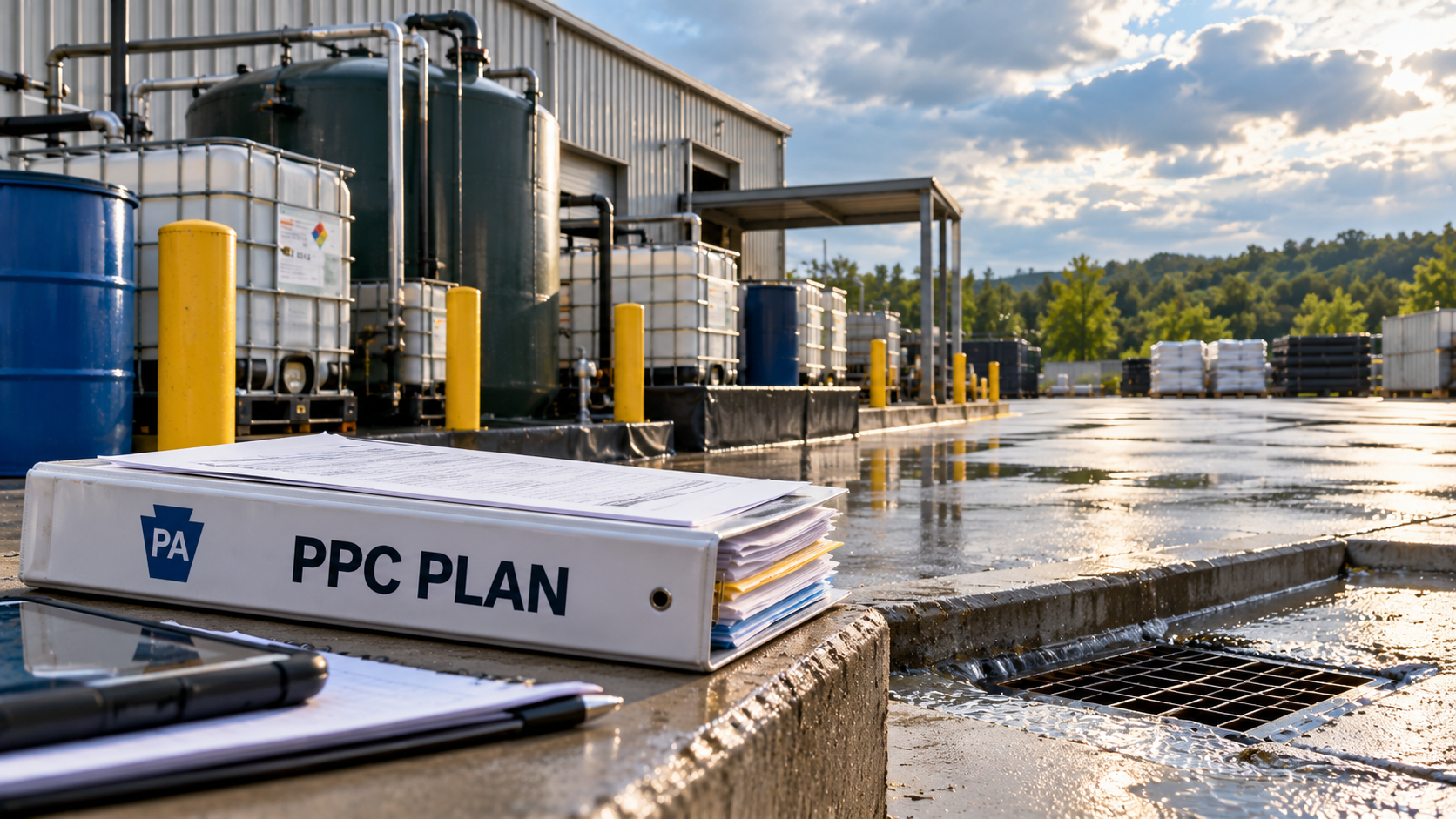
In practice, a PPC Plan is a binder (or a digital file) that describes your facility, lists the materials you handle and where they're stored, identifies where pollution could come from, and lays out how you prevent and respond to releases. It names your emergency coordinators, lists your spill equipment, and spells out who gets called and when. DEP expects it to be a working document that your team uses, not something written once for the permit application and left on a shelf.
The PPC Plan is a Pennsylvania creation. You won't find it in federal EPA rules, which is why managers who've worked in other states are often confused the first time they see it. If you've maintained a SWPPP or an SPCC Plan before, most of the concepts will look familiar. The structure and terminology are what change.
Where Does Pennsylvania's PPC Plan Requirement Come From?
The legal foundation is Pennsylvania's Clean Streams Law and 25 Pa. Code § 91.34, which requires anyone using or storing materials that could pollute the waters of the Commonwealth to take measures to keep them out of surface water and groundwater. The PPC Plan is how DEP expects many facilities to document those measures.
The details come from a DEP guidance document titled Guidelines for the Development and Implementation of Environmental Emergency Response Plans, document number 400-2200-001. DEP first published it in 2001 and updated it in 2005. It was written as a one-stop format, so a single plan can cover the emergency planning requirements of several state and federal programs instead of one plan per permit. It lays out a section-by-section structure covering things like existing emergency plans, a materials and waste inventory, pollution incident history, spill prevention and response, emergency equipment, arrangements with local responders and hospitals, and an emergency notification list.
Individual permits then add their own minimum requirements on top of that guidance. The PAG-03 permit tells you to follow the DEP guidelines and its NPDES-specific addendum, and then lists specific items your PPC Plan must include. If the guidance and your permit ever seem to disagree, the permit language is what DEP will hold you to.
Why Does PAG-03 Require a PPC Plan Instead of a SWPPP?
PAG-03 is Pennsylvania's NPDES general permit for stormwater associated with industrial activity. In most states, and under EPA's Multi-Sector General Permit, industrial stormwater permittees write a Stormwater Pollution Prevention Plan, or SWPPP. Pennsylvania went a different way. DEP folded the stormwater planning requirements into the PPC Plan format it already used for spill and emergency planning. Part C of the PAG-03 permit requires every permittee to develop and implement a PPC Plan, and that plan is where your stormwater controls, inspections, and training get documented.
If you're coming from another state, think of the PPC Plan as Pennsylvania's SWPPP with a heavier emphasis on emergency response. It covers routine pollutants in runoff, but it also expects you to be ready for spills, fires, and other incidents that could reach a stream. If you want a side-by-side look at the two formats, we've covered that in detail in our post on Pennsylvania SWPPPs vs. PPC Plans for PAG-03. For background on the federal-style plan itself, see what a SWPPP is and how it works.
The PPC Plan is also part of getting covered. The site evaluation, outfalls, and pollutant sources you identify for your PAG-03 Notice of Intent (NOI) all feed into it, and DEP expects the plan in place as part of your application package. Existing permittees also had to submit their current PPC Plan with their renewal NOI when the current PAG-03 took effect in March 2023. A facility that qualifies for a No Exposure Certification instead of PAG-03 coverage doesn't need a PAG-03 PPC Plan, though another DEP program may still require one.
Which Other PA DEP Programs Require a PPC Plan?
The PPC Plan isn't only a stormwater document, which adds to the confusion. Because the guidelines are a common format, PPC Plans show up across several programs. Facilities with individual NPDES permits for industrial wastewater discharges are generally required to have one. Municipal and residual waste processing and disposal facilities use the same guidelines, and DEP lists the guidance right alongside its residual waste permit forms. Certain hazardous waste generators and other facilities handling large quantities of polluting materials may also need one, depending on their permits.
Oil and gas well sites follow their own DEP contingency planning guidance, which builds on the same guidelines. Construction projects can also require a PPC Plan as part of earth disturbance permitting under Chapter 102. We don't prepare construction-phase permits or plans, so if you're building or expanding, that piece is usually handled by your engineer, contractor, or an erosion and sediment control specialist. Once the facility is up and running, though, it often needs an operational PPC Plan under PAG-03, and that's the part we help with.
Because of that shared format, one well-organized PPC Plan can often satisfy more than one program. If you already have a PPC Plan for a waste permit or a wastewater discharge, you may be able to expand it to cover PAG-03 rather than starting a second document, depending on what each permit requires.
What's Inside a Pennsylvania PPC Plan?
Every PPC Plan is built around its facility, so no two look exactly alike. The PAG-03 permit sets the minimum elements every stormwater PPC Plan must address, and the DEP guidelines fill in the structure around them.
| PPC Plan Element |
What It Covers |
| Facility description and site map |
Operations, structures, impervious surfaces, control measures, receiving waters, stormwater conveyances, monitoring points, and any non-stormwater discharge locations. |
| Materials inventory and pollutant sources |
Every material and waste on site that could reasonably affect stormwater, where it's stored, and how it's handled. |
| Prevention measures and BMPs |
The practices and controls that keep pollutants out of stormwater during routine operations and spills. |
| Spill and incident response |
What your team does when a spill or other pollution incident happens, who's in charge, what equipment is available, and who gets notified. |
| Erosion control |
Areas prone to soil erosion and the measures used to limit it. |
| Security |
Measures that prevent accidental or intentional entry that could cause a release. |
| Training |
How employees and contractors are trained on pollution prevention, BMPs, and emergency response. |
| Water Priority Chemicals (if applicable) |
For facilities subject to EPCRA Section 313 (TRI), releases of Water Priority Chemicals in the past three years and an evaluation of activities that could discharge them. |
Spill Prevention and Response in a PPC Plan
This is the heart of the plan and the part inspectors tend to test. PAG-03 expects labeled containers, secondary containment or barriers between storage and traffic areas, spill kits near likely spill spots, and dry cleanup with absorbents. Your response procedures also have to match the permit's reporting rules. Under PAG-03, an incident that causes or threatens pollution has to be reported to DEP by phone as soon as possible and no later than four hours after you become aware of it, and releases at or above a federal reportable quantity also have to be reported to the National Response Center at (800) 424-8802. A good PPC Plan puts those numbers and timeframes where the person on the forklift can find them.
Inspections, Training, and Stormwater Controls
The PPC Plan also ties into your ongoing PAG-03 obligations. The permit requires routine visual inspections at least twice a year, covering exposed industrial areas, the pollutant sources identified in your PPC Plan, areas where spills or leaks happened in the past three years, your outfalls, and your physical stormwater BMPs. At least one of those inspections each year has to happen during a qualifying storm while stormwater is discharging. Training on spill response and pollution prevention has to happen at least once a year and be documented in your Annual Report. If you're wondering how formal that training needs to be, our post on whether stormwater training is required walks through it.
How Do PPC Plans and SPCC Plans Work Together?
Many Pennsylvania facilities that need a PPC Plan also store enough oil to need a federal Spill Prevention, Control, and Countermeasure (SPCC) Plan. The two overlap heavily, since both deal with preventing and responding to releases, but they aren't the same document and they answer to different agencies.
| |
PPC Plan |
SPCC Plan |
| Who requires it |
PA DEP, through permits like PAG-03 |
U.S. EPA, under 40 CFR Part 112 |
| What it covers |
All materials that could pollute stormwater or waters of the Commonwealth, plus stormwater controls |
Oil only |
| What triggers it |
Holding a permit or approval that requires one |
Oil storage above federal thresholds with a reasonable chance of reaching navigable waters |
| Minimum review under PAG-03 or SPCC rules |
At least annually, plus event-based updates |
At least every five years, plus amendments after certain changes |
The PAG-03 permit specifically allows an SPCC Plan to be used to meet the PPC Plan requirements, as long as all of the PPC Plan's minimum elements are addressed. In practice, that usually means building one integrated document, or keeping both plans in one binder with the non-oil materials, stormwater BMPs, erosion control, and training pieces added to cover what the SPCC Plan doesn't. Our post on keeping stormwater and SPCC plans in one book covers the pros and cons of combining, and the same thinking applies to PPC Plans. For a broader comparison, see the difference between an SPCC Plan and a SWPPP.
One more difference trips people up. Some SPCC Plans have to be certified by a Professional Engineer. Older versions of PAG-03 and the DEP guidelines called for PE certification of the PPC Plan at certain facilities, but current PAG-03 doesn't include a PE certification requirement for the PPC Plan itself. If your plan was written years ago and still references annual PE recertification, it's a sign the plan hasn't kept up with the permit.
When Does a Pennsylvania PPC Plan Need to Be Updated?
A PPC Plan describes your facility as it exists today, so it has to change when your facility changes. Under PAG-03, you have to review the plan at least once a year and update it if needed. On top of that annual review, certain events require you to revisit the plan right away.
| Update Trigger Under PAG-03 |
Real-World Example |
| DEP or federal regulations change, or the permit is revised |
PAG-03 is reissued with new monitoring or BMP requirements. |
| The plan fails in an emergency |
A spill reaches a storm drain because the response steps didn't work as written. |
| Facility design, process, or operations change in a way that raises release risk or changes the emergency response |
You add a new chemical, a new outdoor storage area, a new tank, or a new production line. |
| Emergency coordinators or equipment change |
Your plant manager leaves, or you relocate the spill trailer. |
| DEP notifies you in writing |
An inspector finds gaps and requires revisions. |
Updates have to be kept on site, made available to DEP on request, and documented in your PAG-03 Annual Report. Keep in mind that some changes do more than trigger a plan update. Adding new impervious surfaces, new exposed bulk materials, a new outfall, or a change in industrial activity can also require notifying DEP or amending your PAG-03 coverage with a new NOI. When a facility change is on the horizon, it's worth checking both the plan and the permit at the same time.
Common PPC Plan Mistakes at Pennsylvania Facilities
Most PPC Plan problems we see aren't missing chapters. They're plans that stopped matching the facility. The most common is a stale emergency contact list, where the person listed as emergency coordinator left two years ago. Close behind is an outdated site map that doesn't show the new storage pad, the relocated dumpsters, or the outfall that was added during a paving project.
Another frequent issue is a plan that was clearly written from a template. It lists materials the facility doesn't use and misses the ones it does, or it describes BMPs that were never installed. Inspectors notice quickly when the plan says there's a covered drum storage area and the drums are sitting in the yard. That gap between paper and reality is what turns a routine visit into a list of findings. If you want to know what DEP inspectors typically look at, our post on what happens during a PA DEP stormwater inspection walks through it.
Finally, we see plenty of facilities that do the work but don't document it. Annual training happened, but there's no sign-in sheet. Inspections happened, but nobody wrote them down. The annual plan review happened in someone's head. Under PAG-03, training, inspections, and plan updates all have to be documented in the Annual Report, so undocumented work is treated the same as work that never happened.
How Much Does a PPC Plan Cost in Pennsylvania?
For PAG-03 facilities, the PPC Plan is usually prepared as part of the full permit package rather than as a standalone project, because the same site evaluation, drainage mapping, and pollutant source inventory feed both the plan and the NOI. DEP's own fees for PAG-03 are a $500 NOI fee and a $500 annual fee. Professional help with the full application, including the PPC Plan and site maps, typically runs around $5,000 to $10,000 for a relatively straightforward facility. Ongoing compliance support, including annual plan reviews, inspections, training, and reporting help, typically runs another $3,000 to $6,000 a year, depending on how much your team handles in-house.
Some facilities can handle a lot of this themselves, especially smaller sites with simple operations and someone on staff who has time to own it. If you're weighing that option, our post on getting a PAG-03 permit yourself lays out the tradeoffs, and our guide to PAG-03 permit costs in Pennsylvania breaks the numbers down further. If you'd like a quick estimate of what our help would cost for your facility, use the free calculator below. There's no email required and no sales call.
How RMA Helps With Pennsylvania PPC Plans
We've been helping facilities with stormwater and spill planning since 1992, and we work with facilities across Pennsylvania on PAG-03 coverage, PPC Plans, and the ongoing compliance that comes after. When we write a PPC Plan, we start by walking your site, tracing how stormwater moves across it, and identifying the real pollutant sources, then build the plan around what your facility does. Senior staff do the work, and we don't use AI to write client deliverables. If you already have a PPC Plan, we can review it against the current PAG-03 permit, update it for changes at your facility, or fold it together with your SPCC Plan so your team has one document to work from. We can also help with the annual training your plan requires, and our online environmental training library is an option for teams that want to handle some of it on their own schedule.
If you're not sure whether your facility needs a PPC Plan, or whether the one you have would hold up to a DEP inspection, we're happy to talk it through with no pressure and no obligation. Sometimes the answer is that you can handle it yourself, and we'll tell you that. You can call us at 888-RMA-0230, email us, or fill out the form on our website, or simply contact RMA here and we'll get back to you.


