What a Professional Engineer Reviews, Signs Off On, and Leaves to You When Certifying a Pennsylvania SPCC Plan
If your Pennsylvania facility needs a full SPCC plan, a licensed Professional Engineer (PE) has to put their name behind it. Most facility managers have seen the certification page at the front of the plan, but few have a clear picture of what the engineer did before signing. Did they walk the site? Check the containment math? Question the inspection procedures? Or sign a document a consultant handed them? The stamp is only as good as the work behind it, and you're the one who lives with the result.
In this article, we walk through what the PE does, what the certification covers and what it doesn't, why the site visit is built into the rule, how containment and spill procedures get reviewed, and what to expect as your plan moves through the process. If you'd rather talk through your own facility, you can reach out to RMA any time, and we'll tell you straight whether you need a PE at all.
Table of Contents
TL;DR
When a PE certifies an SPCC plan, they're stating that they know the federal rule, that they or an agent visited and examined your facility, that the plan follows good engineering practice and the rule, that inspection and testing procedures are set up, and that the plan fits your site. They aren't promising you'll never have a spill, and they aren't taking over your duty to carry out the plan, which stays with you as the owner or operator. Expect a site visit, a hard look at containment and procedures, possible fixes before anyone signs, and a certified plan you'll review every five years.
What Does a Professional Engineer Do for a Pennsylvania SPCC Plan?
A PE's job on an SPCC plan is to review the plan against the federal oil spill rule, 40 CFR Part 112, and against good engineering practice, make sure the facility has been visited and examined, and then certify the plan in writing. Under the rule, a plan that needs PE certification isn't effective without it. That makes the engineer's review a legal piece of the plan, not a formality tacked on at the end.
Not every facility needs one. A facility can self-certify as a Tier I or Tier II qualified facility when its total aboveground oil storage is 10,000 gallons or less and it hasn't had a single discharge over 1,000 gallons, or two discharges over 42 gallons each within any twelve months, during the past three years. Tier I also requires that no single container be larger than 5,000 gallons. Go past those limits and a PE has to certify the plan. A qualified facility that wants to deviate from the rule, for example with an alternative to standard secondary containment, brings in a PE for that piece, and EPA lets any facility choose PE certification voluntarily. Our articles on what a PE-certified plan is and the different types of SPCC plans cover the dividing lines, and we cover when you need a PE at all, including how state engineering boards weigh in, in a separate piece.
In Pennsylvania, EPA Region 3 enforces the SPCC rule, and the PE's certification speaks to that federal rule. Pennsylvania's own tank requirements run through DEP's storage tank program, which we'll cover below because the two layers get mixed up often.
What Is the PE Vouching For When They Certify an SPCC Plan?
Section 112.3(d) of the rule lists what the PE attests to. In plain words, each item is a statement the engineer is putting their license behind.
| What the PE attests |
What it means in plain words |
| They're familiar with the requirements of Part 112 |
They know the rule itself, not just a template. |
| They or their agent visited and examined the facility |
A qualified person looked at your real site. |
| The plan follows good engineering practice, including industry standards, and the rule |
The design choices, like containment and overfill protection, hold up technically. |
| Procedures for required inspections and testing have been established |
The plan spells out what gets inspected and tested, and how. |
| The plan is adequate for the facility |
It fits your site, not a generic one. |
What the PE Isn't Vouching For in an SPCC Plan
The rule is explicit that certification doesn't relieve the owner or operator of the duty to prepare and fully implement the plan. The engineer attests that inspection and testing procedures have been established, which isn't the same as saying someone is following them. Monthly inspections, record keeping, and the annual discharge prevention briefings for oil-handling staff all belong to you. Our guide to SPCC monthly inspections and our online environmental training library can help with the day-to-day side.
The certification also isn't a promise that you'll never have a spill, and it isn't an EPA sign-off. An EPA inspector can still compare your plan against what's sitting in your yard, and our article on who enforces SPCC plans explains how that works.
Why Does the PE Site Visit Matter for an SPCC Plan?
The rule requires that the PE or an agent of the PE has visited and examined the facility. EPA's guidance says an agent can be an engineering technician, technologist, graduate engineer, or another qualified person, as long as the visit is consistent with good engineering practice. EPA also says the PE has to make sure the certification reflects good engineering judgment, and if that takes the PE's own eyes on the site, the PE needs to go. So the question isn't whether a visit happens. It's who goes and whether they know what to look for.
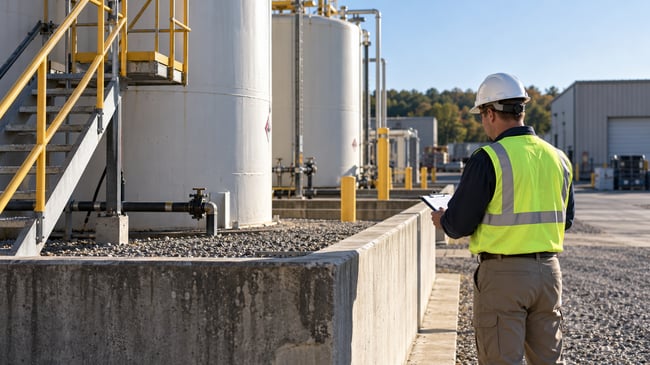
A visit finds what paperwork can't. Containers that never made the inventory, like drums, skid tanks, generator tanks, and oil-filled equipment. A containment wall with cracks or a drain valve left open. A floor drain or catch basin sitting in the path of a spill. Piping that runs where a forklift can reach it. A loading area where drivers park with nothing under the connection. A plan built from a questionnaire only knows what the person filling it out remembered to mention.
Cheap certifications often skip this step. If a provider offers a PE-certified plan without anyone examining your site, ask who visited, when, and what they looked at, because the rule says someone did. Photos and facility details can support the work, and our article on getting an SPCC plan online covers what to know before you go that route. You're the one on the hook if an inspector walks your site and finds a plan that describes a different facility.
How Does the PE Review SPCC Secondary Containment and Spill Procedures?
Once someone has walked the site, the PE tests the plan against what they found. Secondary containment gets checked first. Is there a dike, wall, curb, or other containment around each container, and does it hold the entire capacity of the largest container plus room for rainfall? The PE looks at the construction and condition of that containment too, since a wall that can't hold liquid is just a wall. Our article on how big SPCC containment needs to be walks through the sizing.
From there, the review covers overfill protection on tanks, how piping and valves are arranged, transfer and loading areas, drainage paths toward storm drains and streams, tank condition and the inspection and testing schedule for each container, site security, and the spill response procedures staff would follow. The PE is also checking that the plan describes the facility the way it really is, because a plan that says one thing while the site does another isn't adequate.
In Pennsylvania, the SPCC certification sits alongside separate state tank rules. DEP's storage tank program and 25 Pa. Code Chapter 245 apply to some tanks depending on their size, type, and use, and some tank installation and inspection work can require DEP-certified installers or inspectors. A PE's SPCC certification speaks to the federal rule and doesn't stand in for any of that, so confirm your tanks against DEP's storage tank program. Local fire code for tank installations is enforced at the municipal level and varies, so check with your local fire official too.
What Happens If the PE Finds a Gap in Your SPCC Plan?
A PE can't certify a plan that calls containment adequate when it isn't. When a gap turns up, you generally have a few paths. You can fix the problem, for example by adding containment or changing how a container is set up. You can document an alternative that gives equal environmental protection, which the PE reviews as part of certifying the plan. Or, where secondary containment really isn't practicable, the plan can explain why and add an oil spill contingency plan, and EPA says PE certification is required for a plan that includes one.
If the fix means building new containment, moving a tank, or replacing one, that's work for your contractor and engineer, and any construction permits or approvals tied to it are theirs to handle. We don't prepare those. What we help with is the operational side once the work is done, starting with the plan amendment. The rule gives you six months to prepare an amendment after a change that materially affects your spill potential, and up to six more months to implement it. When a technical change affects a PE-certified plan, a PE has to certify the amendment, and EPA says that certification applies only to the amended portion of the plan.
What Should You Expect From the SPCC Plan Certification Process?
The steps vary by facility, but a PE-certified SPCC plan usually moves through the same stages.
| Stage |
What happens |
What you bring |
| Inventory and records |
Containers, capacities, oil types, equipment, and spill history get collected and checked against the qualification criteria. |
Tank and equipment list, any existing plan, spill records, inspection records. |
| Site visit |
A PE or qualified agent examines the facility, containment, drainage, piping, and transfer areas. |
Someone who knows the site, can open gates, and can point out recent changes. |
| Plan preparation and PE review |
The plan is written or updated, and the PE reviews it against the rule and good engineering practice. |
Answers to follow-up questions and approval of the procedures the plan commits you to. |
| Gap fixes |
Containment, overfill, or procedure gaps get corrected or documented through an acceptable alternative. |
Decisions on fixes and the contractors to carry them out. |
| Certification and delivery |
The PE certifies, and you receive the plan to put into practice. |
Copies where staff can reach them and a schedule for inspections and training. |
Having your inventory ready before anyone arrives is the quickest way to shorten the process. Count every aboveground container of 55 gallons or more, include oil-filled equipment, and note what's in each one. Timing depends on how many sites you have, how complete your records are, and whether gaps need fixing before the PE signs, so any provider who promises a date before seeing your inventory is guessing.
Once the plan is certified, you keep a complete copy at the facility if it's normally attended at least four hours a day, and you have it available for EPA review during normal working hours. Every five years you review and evaluate the plan and sign a statement saying whether you'll amend it. That review is yours to do. The PE comes back in when the review, or any change at the site, leads to a technical amendment. Our articles on five-year SPCC plan reviews and when to update your SPCC plan cover how that plays out.
How Do You Choose a Professional Engineer for an SPCC Plan in Pennsylvania?
A few questions will tell you quickly whether an engineer does real work. Start with the license. EPA says the federal rule doesn't require the PE to be licensed in the same state as the facility, but it also notes that state regulations may stop a PE from applying a seal in a state where they aren't licensed. For a Pennsylvania facility, ask whether the PE holds a Pennsylvania license, and check with the state's licensing board if you're unsure.
Then ask about SPCC experience. The rule has details, like how capacity gets counted, what qualifies as an alternative measure, and how containment gets sized, and an engineer who doesn't do SPCC work regularly can miss them. Ask who will visit your site, what the visit covers, and what happens if a gap turns up. A good answer describes fixes and alternatives. A bad answer is a signature and an invoice.
The cheapest certification usually comes from a process that skips the visit or skips the review, and the rule is clear that you still own the plan and its implementation. If the plan doesn't hold up, you're the one explaining it to an inspector. Our article on top SPCC plan violations and fines covers what trips facilities up.
What Affects the Cost of a PE-Certified SPCC Plan?
RMA's published range for SPCC plans runs from $2,500 to $15,000, and a complex PE-certified update starts around $7,500. The spread is wide because the PE work scales with the facility. The number of containers and their sizes, how many locations the plan covers, whether containment needs to be measured and evaluated, how much site documentation already exists, and whether the plan includes alternative measures that need their own PE statements all move the price. A single-location facility with a few tanks and solid containment tends to land toward the low end. A multi-tank site with a messy history and a containment gap that needs engineering lands near the top.
Our SPCC plan costs article goes deeper on pricing. For a ballpark on your own facility, our pricing calculator is below. It shows what RMA's help with your SPCC plan would cost, not the price of tanks, containment, or any construction work.
How Can RMA Help With a PE-Certified SPCC Plan in Pennsylvania?
RMA is based in New Jersey and works with facilities across Pennsylvania on SPCC plans, from first-time plans to updates and five-year reviews. We work with licensed Professional Engineers when a plan needs certification, and we tell you up front whether yours does. If your facility qualifies to self-certify and you'd rather handle it yourself, we'll say so, because a simpler path that fits is better than a bigger project that doesn't. If you do need a PE, we help with the inventory, the site work, the plan, and the fixes that come up along the way, and we're upfront about the pieces we don't handle, like construction permits for new containment or tank work.
If you have questions, you can call or email us, or fill out the form on our website. There's no pressure and no obligation. You can contact us whenever it suits you, and we'll talk through where your facility stands.


