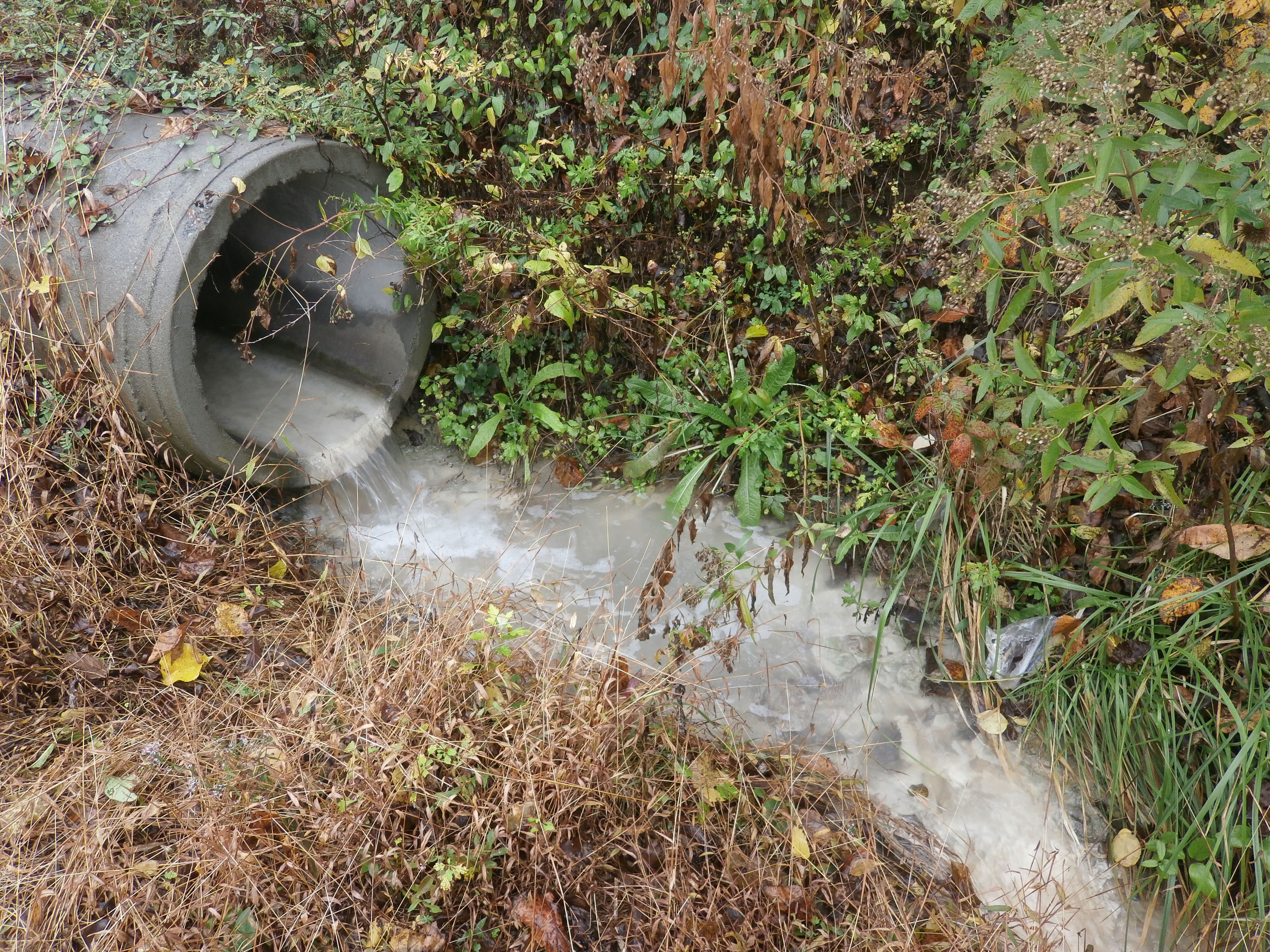
What a Pennsylvania Stormwater Permit Looks Like, How to Find Out If You Have One, and What to Do If You Don't
The email from your landlord or property manager is short and polite: please send a copy of your stormwater permit for our files. If you're like a lot of tenants, your first reaction is that you're not sure what that is, and your second is that you're not sure whether you have one. Maybe a previous manager handled it, maybe the landlord took care of it, or maybe nobody ever thought about it. It's an easy request to set aside, and an uncomfortable one to ignore for long.
Here's the short version. Your landlord is asking because their lender, insurer, or own compliance review wants proof that tenants doing industrial work have the stormwater coverage PA DEP expects. In Pennsylvania that document is usually a PAG-03 coverage approval, a No Exposure Certification, or an individual NPDES permit. Not every tenant needs one, since it depends on your type of business and whether your industrial activity is exposed to rain and snow. In this article we'll explain why landlords ask, what the document looks like, how to check DEP's eFACTS for your facility, what it means if nothing turns up, and what to tell your landlord while you sort it out. If you'd like help figuring out where you stand, reach out to RMA.
Table of Contents
TL;DR
Landlords usually ask for a tenant's stormwater permit because a lender, insurer, or compliance review wants proof that industrial tenants have the coverage DEP expects. In Pennsylvania that's typically a PAG-03 coverage approval, a No Exposure Certification, or an individual NPDES permit, and you can search DEP's eFACTS to see if your business has one. Many tenants don't need any of these, since it depends on your type of business and whether industrial activity is exposed to rain. If you do need coverage and don't have it, start the process now and tell your landlord where things stand.
Why Landlords Ask Tenants for a Copy of Their Stormwater Permit
A landlord asking for your stormwater permit doesn't mean anyone thinks you did something wrong. In most cases the request is coming from someone behind the landlord. A lender refinancing the property may want to know that tenants are in compliance, since an enforcement action against a tenant can turn into a headache for the owner. An insurer renewing a property policy may ask similar questions. Large property managers often run annual compliance reviews where they collect permits, certificates, and inspection records from every industrial tenant.
Property sales are another common trigger. A buyer's due diligence team may ask the seller for a list of environmental permits at the site, and the seller turns around and asks each tenant. Sometimes the landlord has its own reasons, too. If the property's storm drains, basins, or outfalls carry runoff from several tenants, the landlord wants to know who's covered and who isn't, because a DEP inspector looking at a dirty outfall will start by asking who's responsible for it.
The request usually lands with whoever is easiest to reach, like an office manager or controller, not the person who knows the operations. That's why it often sits in an inbox for a few weeks. Answer it anyway, and answer it accurately. A vague reply now can create bigger questions later.
What Is a Stormwater Permit, and Does Your Business Need One?
A stormwater permit, in this context, is an NPDES permit. NPDES stands for National Pollutant Discharge Elimination System, the Clean Water Act program that controls what goes into rivers and streams. In Pennsylvania, DEP runs it under the Clean Streams Law and 25 Pa. Code Chapter 92a. Most industrial facilities get covered under the PAG-03 General Permit, which is a standard permit that eligible facilities sign up for by filing a Notice of Intent, instead of getting a permit written just for them. The current PAG-03 took effect March 24, 2023, for a five-year term. Our article on the difference between an NPDES permit and a stormwater permit explains the terms.
Whether you need coverage depends on three things. The first is your type of business, identified by SIC code, since federal rules list the industrial categories that need coverage. The second is whether your industrial materials and activities are exposed to rain and snow. The third is where your runoff goes. Our guides on who needs a stormwater permit and stormwater associated with industrial activity cover the categories in detail.
Plenty of tenants don't need a stormwater permit at all. General warehouses, body shops, dealerships, quick-lubes, and most contractors usually fall outside the covered categories. Trucking and bus operations are covered only for their vehicle maintenance, equipment cleaning, and fueling-related areas. Steel service centers are often classified as wholesale and aren't covered. On the other hand, a manufacturer in a covered category that keeps everything indoors usually still needs to file a No Exposure Certification, even though it doesn't need full permit coverage. "We're inside" isn't the same as "we don't need anything."
One more wrinkle. In older cities with combined sewers, like Philadelphia and Pittsburgh, some site runoff goes to a sewage treatment plant instead of a stream. Where that's the case, the sewer authority's rules may apply instead of, or alongside, DEP coverage. Local requirements vary, so check with your sewer authority before assuming either way.
What a Pennsylvania Stormwater Permit Document Looks Like
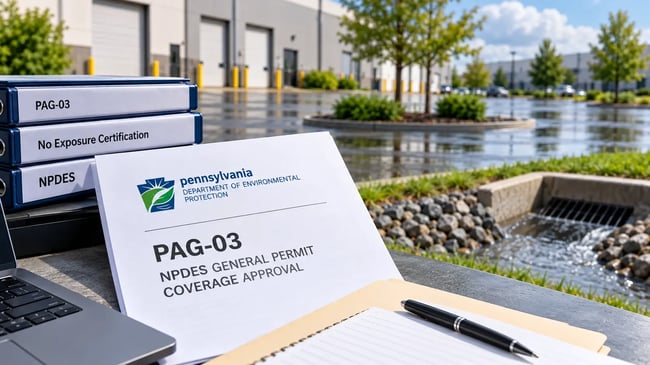
If your business has stormwater coverage, there should be a document from DEP in your name, not your landlord's. There are three kinds you might find, and they look different. Our article on general, individual, and No Exposure permits explains how they compare.
| Document |
What It Is |
What to Look For |
| PAG-03 coverage approval |
DEP's approval of your Notice of Intent for coverage under the PAG-03 General Permit |
Your company as permittee, a coverage number, the facility address, the PAG-03 appendix that applies, and effective dates |
| No Exposure Certification |
DEP's approval confirming your industrial materials and activities aren't exposed to stormwater |
Your company as facility operator, a certification number, and effective and expiration dates |
| Individual NPDES permit |
A permit written for one facility, often because it isn't eligible for PAG-03 |
A permit number usually starting with "PA," facility-specific limits and monitoring, and an expiration date |
PAG-03 coverage comes with a PPC Plan (Preparedness, Prevention and Contingency Plan), which is Pennsylvania's version of a stormwater pollution prevention plan. The plan isn't the permit, but the two go together, and a landlord may ask for both. If you find a PPC Plan in a binder but no approval letter, that's a clue you probably had coverage at some point. Our comparison of SWPPPs and PPC Plans for PAG-03 explains what's in one.
A few other documents get confused with a stormwater permit. A township land development or stormwater management approval from when the building was built isn't an industrial stormwater permit. Neither is a construction stormwater permit (PAG-02) from site work, or a sewer authority discharge permit for process wastewater. Those may be real and current, but they don't answer your landlord's question.
How to Check eFACTS for Your Facility's Stormwater Permit
If you can't find a document in your files, DEP's eFACTS database is the next stop. eFACTS is DEP's public record of permits, inspections, and enforcement, and you can search it for free without an account. Start with a client search using your company's legal name, and try variations, since a parent company or old business name may hold the record. You can also search for your site or facility name, or search sites by county and municipality and scan for your address.
When you find your company or site, open the record and look at the authorizations. Industrial stormwater coverage shows up as an NPDES authorization, and the record should show the permit or coverage number, the status, and key dates. If you find one, check that it's in your company's name and that it's current. DEP's eDMR system is another clue, since PAG-03 permittees submit sampling results electronically. If someone at your company has been filing eDMRs, you almost certainly have coverage. Our guide to Pennsylvania eDMR reporting explains how that system works.
eFACTS isn't perfect. Names and addresses are entered inconsistently, and recent approvals can take time to show up. If your search is a mess, you can call the DEP regional office that covers your county and ask the clean water program whether your facility has coverage.
What It Means If You Can't Find a Stormwater Permit
An empty search doesn't automatically mean you're out of compliance. It means you need to figure out which of three situations you're in.
| Situation |
What It Means |
Next Step |
| Your business isn't in a covered category |
You likely don't need a stormwater permit |
Document why, and tell your landlord in writing |
| Covered category, but everything's indoors |
You probably need a No Exposure Certification, not full coverage |
Confirm eligibility and file the certification |
| Covered category with outdoor exposure |
You likely need PAG-03 coverage or an individual permit |
Start the application and PPC Plan now |
If you're in the first group, the answer to your landlord is simple: your operations don't require industrial stormwater coverage, and here's why. Put it in writing with your SIC code and a short description of what you do. If you're in the second or third group, you have work to do, but it's manageable. The worst move is to say nothing and hope the request goes away.
Watch for one common misunderstanding. Coverage held by your landlord, a neighboring tenant, or the business that used to occupy your space usually doesn't cover you. Industrial stormwater coverage generally follows whoever runs the industrial activity, not the building. If the previous tenant had PAG-03 coverage and you took over the same operation, the coverage may have needed a formal transfer through DEP.
If you discover you've been operating without coverage you needed, take it seriously but don't panic. DEP can bring enforcement for unpermitted discharges, and how you respond matters. Depending on how long it's been and what's on the site, it may be worth talking with an environmental attorney before you decide how to approach DEP. Our article on what happens during a PA DEP stormwater inspection gives a sense of what inspectors look for.
How to Get PAG-03 Coverage or a No Exposure Certification
If you need full PAG-03 coverage, the work starts with your site. Someone has to walk the property, identify industrial activities and materials exposed to rain, figure out how stormwater drains and where it leaves the site, and map the outfalls. That information goes into a site map and a PPC Plan built around your operations. Then you submit a Notice of Intent to DEP with the required attachments, and DEP reviews it before approving coverage. After approval, the permit comes with ongoing requirements like inspections, sampling, eDMR reporting, employee training, and keeping the PPC Plan current. Our article on how long it takes to get PAG-03 coverage walks through a realistic timeline.
A No Exposure Certification is a lighter lift, but it isn't a formality. Every qualifying industrial material and activity has to be indoors or under appropriate cover across the whole site, including things like dumpsters, loading docks, and pallets of raw material. The certification has to be submitted to and approved by DEP, renewed every five years, and it isn't available for discharges to High Quality or Exceptional Value waters. If operations change and something ends up outside, you may need PAG-03 coverage instead. Our article on what No Exposure means goes into the details.
Can you do this yourself? Some businesses do, especially for a simple No Exposure Certification. PAG-03 applications take more time and judgment, particularly with shared drainage in a multi-tenant building. Our article on whether you can get a PAG-03 permit yourself is an honest look at when DIY makes sense.
What to Tell Your Landlord While You Sort Out Your Stormwater Permit
You don't need to have everything resolved before you reply. A short, accurate answer now is better than a complete one in three months. Landlords mostly want to know that you understand the request and have a plan. Here's how we'd approach each situation.
If you have coverage, send a copy of the approval letter or certification and, if they ask, the cover page of your PPC Plan. If you've confirmed you don't need coverage, send a brief letter explaining that your operations aren't in a category that requires industrial stormwater coverage, with your SIC code. If you're still figuring it out, say so. Something like: "We're reviewing whether our operations require industrial stormwater coverage under DEP's PAG-03 General Permit and will follow up by [date]." If you've determined you need coverage, tell them you're preparing the application and give a realistic timeline.
Don't overstate where you are. Saying "we're covered" when you aren't, or sending a document that belongs to someone else, can come back on you, especially if the request is tied to a sale or refinancing. And don't send your landlord a long explanation of a possible violation before you understand your situation. If there's a real compliance gap, sort out the facts first, and talk with an environmental attorney if you're concerned about exposure.
Ask the landlord a question or two in return. Find out who's asking (lender, insurer, buyer) and whether there's a deadline, since that helps you prioritize. If you share drainage with other tenants, ask whether the landlord has a site drainage plan, because you'll need it for a PPC Plan anyway.
What Help With a Pennsylvania Stormwater Permit Costs
The DEP fees for PAG-03 coverage are $500 to apply and $500 per year. The bigger cost is preparing what the permit requires, like the site evaluation, mapping, PPC Plan, and application. For a relatively straightforward facility, professional help with the full application typically runs about $5,000 to $10,000, and ongoing compliance support usually runs about $3,000 to $6,000 per year, depending on the site and how much help you want. An individual permit costs more.
Our article on how much a PAG-03 permit costs in Pennsylvania breaks this down further. For a number specific to your facility, our free calculator below estimates what RMA's help with stormwater permitting would cost, with no email or sales call required.
How RMA Helps When Your Landlord Asks for Your Stormwater Permit
We're a family-run environmental consulting firm based in New Jersey, and we work with facilities across Pennsylvania on industrial stormwater. When a landlord's request lands on your desk, we can help you figure out whether you need PAG-03 coverage, a No Exposure Certification, or nothing at all. If you do need coverage, we can evaluate your site, prepare the PPC Plan and application, work through DEP's review, and help with the inspections, sampling, and eDMR reporting that follow. Senior staff do the work, and if it turns out you don't need us, we'll tell you so.
There's no pressure and no obligation. Call us, send an email, or fill out the form on our website, and we'll talk through what your landlord asked for and what makes sense for your facility. If you're staring at that email and not sure where to start, get in touch with RMA.