Why Pennsylvania Facilities Need Oil Spill Prevention Plans Before Anything Spills, and What the 1988 Floreffe Tank Collapse Taught Everyone
If you store diesel, hydraulic oil, or any other oil at your Pennsylvania facility, the federal government may expect you to have a written oil spill prevention plan, even if you've never lost a drop. EPA calls it an SPCC Plan, short for Spill Prevention, Control, and Countermeasure. A lot of owners push back on this, and the pushback usually sounds the same: "We've never had a spill, so why do I need a plan for something that hasn't happened?" It's a fair question, and the answer comes down to what the rule is built to do. It applies to the oil you store, not the oil you've spilled, and its whole purpose is to stop a spill before it exists, because oil that reaches water is expensive and slow to undo.
This article explains the logic behind that, what Pennsylvania learned from the 1988 Floreffe tank collapse, and how a plan pays off in practical ways like lower cleanup risk and smoother inspections. It also covers what a plan costs and when you probably don't need one at all. If you're not sure where your facility lands, you can reach out to RMA and we'll tell you straight.
Table of Contents
TL;DR
You may need an SPCC Plan because of how much oil you store and where it could go, not because of your spill history. The rule exists because oil that reaches a river or stream is hard to clean up, and the 1988 Floreffe tank collapse put diesel into the drinking water of about a million people. A plan sets up containment, inspections, and training before anything fails, which lowers your cleanup risk and makes EPA inspections easier. If your oil storage is under the federal thresholds, you probably don't need one.
Why Does the Oil Spill Rule Apply Even If We've Never Had a Spill?
Think about how most safety rules work. Fire codes don't wait for a fire, and building inspectors don't wait for a collapse. The SPCC rule works the same way. It was first issued in 1973 under the Clean Water Act, and its job is to keep oil from reaching navigable waters and adjoining shorelines. That's why the trigger is storage, not history. You may need a plan when your aboveground oil storage capacity is over 1,320 gallons, counting only containers of 55 gallons or more, or your buried capacity is over 42,000 gallons, and a spill from your site could reasonably reach a waterway.
Capacity is what counts, so an empty tank counts and a permanently closed one doesn't. Oil-filled equipment counts too, and so do animal fats and vegetable oils, which surprises restaurants and food producers (our article on SPCC plans for cooking oil covers that one). Propane and DEF don't count. And the check on whether a spill could reasonably reach water looks at your site's geography and location, not at your dikes and berms, so a good containment setup doesn't take you out of the rule. A decade without a spill doesn't change any of it, because the rule is judging what could happen.
"We've never had a spill" is also less reassuring than it sounds. A tank that's held up for twenty years has been in service for twenty years, and that's all it tells you. Gaskets dry out, valves wear, hoses crack, steel corrodes where nobody's looking, and someone can walk away from a delivery at the wrong moment. Most of those problems stay invisible until the day they don't. A clean record usually means things have gone right so far, and a plan is how you keep them going right. The same logic applies if you already have a plan: it has to be reviewed at least every five years and kept current when your site changes.
If you're not sure whether you're over the threshold, our article on the best 4 steps to figure out if you need an SPCC plan walks through the math, and our overview of what an SPCC plan is covers the basics. If the numbers say you're under, you probably don't need a plan, and we'll say so.
How Bad Can an Oil Spill Get Once It Reaches Water?
Oil on your own property is a cleanup job. Oil in moving water is a different problem. It travels with the current, spreads thin, and leaves your property line behind within minutes, which means the cleanup stops being about your site. Downstream drinking water intakes, wildlife, neighboring properties, and anyone who makes a living on the water can all end up in the picture, and the facility that released the oil is generally the one answering for it. Crews can boom and vacuum, but they usually recover only part of what went in. Floreffe, covered next, is the Pennsylvania example.
What Do Oil Spill Penalties Look Like?
On top of cleanup and damage claims, the Clean Water Act carries penalties for oil discharges to waters. The table shows the current inflation-adjusted maximums from 40 CFR Part 19, which EPA updates periodically, so check the current figures before you rely on them. State agencies can add their own enforcement, and none of this includes your cleanup bill.
| Penalty Route |
Maximum Under 40 CFR 19.4 (Assessed On or After January 8, 2025) |
| Administrative, Class I |
$23,647 per violation, up to $59,114 total |
| Administrative, Class II |
$23,647 per day of violation, up to $295,564 total |
| Civil penalty for an oil discharge |
$59,114 per day of violation or $2,364 per barrel discharged |
If a spill ever does lead to an information request, a notice of violation, or a penalty discussion, bring in an environmental attorney before you send anything beyond the required notifications. We can help with the technical side, but legal strategy isn't our lane. For how those findings tend to play out on the SPCC side, see our article on the top SPCC plan violations and fines.
What Did the 1988 Floreffe Tank Collapse Teach Pennsylvania?
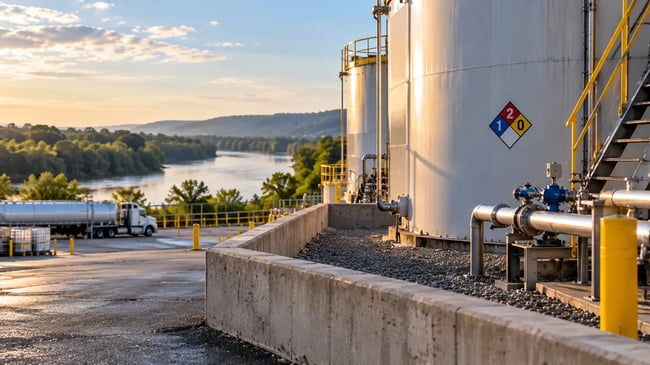
In January 1988, a four-million-gallon storage tank owned by Ashland Oil split apart and collapsed at its Floreffe facility, next to the Monongahela River upstream of Pittsburgh. Diesel spilled over the containment dikes, crossed a parking lot on the neighboring property, and ran into an uncapped storm drain that emptied directly into the river. According to EPA, the slick traveled miles downriver within minutes, washed over two dam locks, and spread into the Ohio River. Drinking water for an estimated one million people in three states was temporarily contaminated. Wildlife was killed, private property was damaged, and local businesses were hurt.
The cleanup is the part that sticks with people. With EPA Region 3 running the response, Ashland's contractors used booms, vacuum trucks, and other equipment and still recovered only about 20 percent of the oil. EPA's own review of the response pointed to shortages of containment and monitoring equipment and to communication problems. A federal grand jury indicted Ashland that September for negligently discharging oil into the river, and EPA followed up with compliance and SPCC plan inspections. Pennsylvania's Storage Tank and Spill Prevention Act took effect in August 1989, and DEP's storage tank program under 25 Pa. Code Chapter 245 still runs under that law today.
Most Pennsylvania facilities store a tiny fraction of what Ashland did, but the pattern scales down. Oil gets past containment, finds a drain, and ends up in a creek. The lesson isn't that your tank looks like theirs. It's that the unglamorous parts of a plan, like whether containment can hold what's in the tank and whether anything nearby drains to water, are what stand between a tank failure and a river.
What Does an SPCC Plan Make You Do Before a Spill Happens?
An SPCC Plan is a written, site-specific description of how you store oil and how you'll keep it from reaching water, and it's also a set of commitments you carry out. A plan typically covers containment around your tanks and loading areas, overfill protection for the deliveries and transfers where many spills start, regular inspections and integrity testing of containers, how drains and valves are kept secured, training for the people who handle oil, and what to do if something does go wrong. Each of those is cheaper to put in place now than to wish you had later. A spill that stays inside containment is a cleanup job. A spill that gets past it can become something much bigger.
That's the practical meaning of lower cleanup risk. You're not betting that nothing will ever fail. You're arranging things so a failure stays small. Our articles on how big your SPCC oil spill containment needs to be, what to check during monthly SPCC inspections, and annual SPCC training go deeper on each piece. Smaller facilities can sometimes use a simpler self-certified plan, while larger or more complex ones need certification by a licensed professional engineer, and our guide to the different types of SPCC plans explains which is which.
How Does an SPCC Plan Make EPA Inspections Smoother?
EPA Region 3 enforces the SPCC rule in Pennsylvania, and inspections aren't limited to facilities that have had spills. When an inspector shows up, the first questions are whether you have a plan, whether it matches what's on the site, and whether your records show you're following it. If the answer to all three is yes, an inspection tends to be a conversation about details. If you don't have a plan and you're over the threshold, the missing plan is itself a violation before anyone looks at a tank. Our article on who enforces SPCC plans explains how that works.
A plan helps outside of inspections too. Insurance companies sometimes ask to see one, and our article on SPCC plans and insurance companies covers why. If you ever do have a discharge, having a plan with inspection records behind it gives you something concrete to show: that you took reasonable steps, that your staff were trained, and that the problem wasn't ignored. The difference between a bad day and a bad year can come down to what you can document.
What Does an SPCC Plan Cost Compared With an Oil Spill?
We publish our pricing, so here are real numbers. A simpler Tier I SPCC Plan from RMA runs about $1,500 to $4,000, and our overall SPCC range is about $1,500 to $15,000. Where you land depends on your total storage capacity, how many containers you have, whether the plan needs a professional engineer's certification, and whether your secondary containment needs to be evaluated. Compare that to the penalty table above, and then add cleanup and damage claims you can't price in advance. Our article on how much an SPCC plan costs breaks down each factor, and the pricing calculator below shows what RMA's help would cost for your facility.
How Can RMA Help Pennsylvania Facilities With Oil Spill Prevention Plans?
The first thing we do is tell people whether they need us at all. If your storage is under the thresholds, you probably don't need a plan, and we'll say so. If you're over, we help you figure out what kind of plan fits, build it around how your site runs day to day, and train your oil-handling staff (initial SPCC training is free with a new RMA plan). When a plan needs a professional engineer's certification, we work with an outside engineer to get it done. If you already have a plan that's out of date, we usually rebuild from scratch instead of patching another firm's work, because a plan that matches your site is worth more than one that looks complete on paper.
There's no pressure and no obligation. You can call or email us, or fill out the form on our website, and if you'd like to talk through your oil storage, reach out to RMA and we'll start with what you have on site today. If you'd rather keep reading first, our SPCC Resources page collects everything we've written on the topic.


