A Ready-to-Use, Printable Agenda and Attendance Sheet for Pennsylvania Facilities With an SPCC Plan
If your facility has an SPCC Plan, the federal rule requires you to run a discharge prevention briefing for your oil-handling personnel at least once a year. The rule doesn't hand you an agenda, a form, or a meeting length, so a lot of facilities end up with a quick huddle and a sign-in sheet, or they let the date slip and hope nobody asks. An SPCC Plan is the written oil spill prevention plan EPA requires when a facility has more than 1,320 gallons of oil in aboveground containers of 55 gallons or more, or more than 42,000 gallons in buried containers. If you're not sure whether that describes you, our guide, What Is an SPCC Plan? walks through how the thresholds work, and if you do have a plan, this briefing is one of the things it requires.
Below, we cover what the rule requires, how to gather the facts before you meet, a printable agenda you can run in about 40 minutes, an attendance sheet, and what to do when the briefing turns up changes that affect your plan. You can run the whole thing yourself, and if you'd rather have someone walk your team through it, you can reach out to RMA any time.
Table of Contents
TL;DR
The SPCC rule requires you to brief your oil-handling personnel at least once a year, and the briefing has to cover known discharges, equipment failures and malfunctioning components, and any new precautions you've put in place. The rule doesn't set a format, so the agenda in this article adds near-misses, facility changes, response roles, and a quick plan refresher to help people understand the plan. Record the date, who attended, who ran it, and what you covered, and keep that record with your plan. If the briefing turns up changes to the facility, your plan may need an amendment, and the rule gives you six months to prepare it.
What Does the SPCC Rule Require for Annual Discharge Prevention Briefings?
The requirement sits in 40 CFR 112.7(f), under the heading for personnel, training, and discharge prevention procedures. It has three parts. You train your oil-handling personnel, you designate one person at the facility who's accountable for discharge prevention and reports to facility management, and you schedule and conduct discharge prevention briefings at least once a year so people understand the SPCC Plan for that facility. The rule says those briefings must highlight and describe known discharges, failures, malfunctioning components, and any recently developed precautionary measures. That's the full list. It doesn't set a length, a format, an attendee list, or a form. Strictly speaking, "known discharges" points at the kind that reach or threaten waterways, the ones covered under 112.1(b), but we'd walk through every spill, including small ones that stayed in containment, because they show where your handling practices need work.
The requirement applies whatever type of plan you have. Tier I and Tier II qualified facilities that self-certify their plans carry the same briefing requirement as a facility with a PE-certified plan. In Pennsylvania, SPCC is a federal program enforced by EPA Region 3, so the briefing rule is the same in Allegheny County as it's in Erie or Philadelphia. DEP's storage tank program adds its own rules for registered tanks, but the annual briefing comes from the federal rule. If you're curious how inspections and enforcement work, we cover who enforces SPCC Plans in a separate article.
Who Should Attend the Annual SPCC Briefing?
The rule says "oil-handling personnel" and doesn't define the term, so use a practical test: anyone who transfers, fuels, delivers, inspects, maintains, or cleans up oil or oil-filled equipment at your facility. That usually covers operators, maintenance techs, yard and loader operators, drivers on your payroll who fuel or fill, and the supervisors who direct them, along with the designated person. Contractors who work around your tanks and containers, such as a vendor who services a generator, belong in the room too, or at least on your sign-in sheet for a shorter version. If you run more than one shift, brief each shift. Someone who's out that week needs a make-up session, and that session should be recorded the same way.
How Is a Briefing Different From SPCC Training?
Training is the broader education the rule requires for oil-handling personnel: how to operate and maintain equipment to prevent discharges, discharge procedure protocols, applicable pollution control laws, general facility operations, and the contents of your SPCC Plan. The briefing is the annual, facility-specific update that keeps that knowledge current by talking through what's happened and what's changed since last time. Many facilities hold both in the same sitting, which works as long as the briefing topics are covered and recorded. Our articles on whether you need annual SPCC training and what SPCC training should include go deeper on the training side.
How Do You Prepare for an Annual SPCC Discharge Prevention Briefing?
A good briefing is built from facts about your own site, so most of the work happens before the meeting. Pick a fixed month on the calendar, name who's presenting (usually the designated person), and set aside an hour or two to pull the material together. The table shows what to gather, where it usually lives, and which part of the briefing it feeds.
| What to pull |
Where it usually lives |
What it feeds |
| Spill and release log, incident reports, and shift notes |
Safety or environmental files, operator logs |
Recent spills and near-misses |
| Inspection and test records (the rule says to keep these, and the written procedures behind them, with the plan for three years) |
The plan binder or its electronic folder |
Failures and repeat trouble spots |
| Maintenance work orders on tanks, valves, pumps, hoses, gauges, and alarms |
Maintenance system or work order file |
Malfunctioning equipment |
| New, moved, or removed containers, piping changes, new products, new equipment, construction, new contractors |
Purchasing, engineering, operations |
Facility changes and possible plan amendments |
| Overfill alarms, delivery problems, and close calls |
Driver reports, operator notes |
Near-misses and new precautions |
| Current SPCC Plan, facility diagram, contact list, and notification numbers |
Plan binder, posted at the site |
Response roles and the plan refresher |
Your inspection records are the best source of known failures, and if they're thin, what to look for during your SPCC inspections is a useful reference for what a good record should capture. Keep the spill recap factual: date, material, estimated quantity, where it went, cause, and what changed afterward. The same log helps you spot a federal reporting trigger. If a facility discharges more than 1,000 gallons to a waterway in a single event, or more than 42 gallons in each of two events within any 12-month period, the owner has to send information to the EPA Regional Administrator within 60 days, with a copy to the state agency in charge of oil pollution control. If a spill is already part of an open agency inquiry or enforcement matter, check with your environmental attorney before it becomes a group discussion topic.
What Goes in a Ready-to-Use SPCC Discharge Prevention Briefing Agenda?
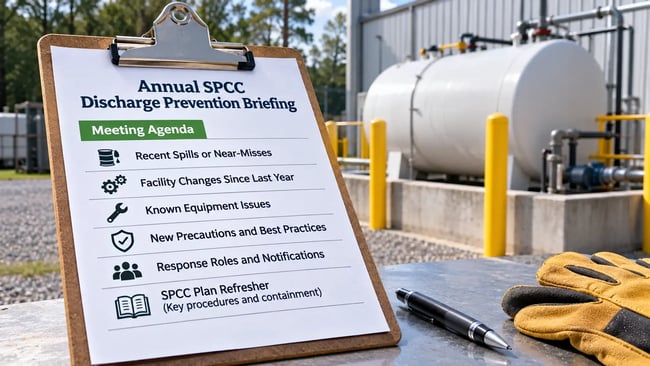
Here's the agenda we'd use, built to run about 40 minutes. The last column separates what the rule spells out from what we recommend adding. Print it, tick off each item as you go, and keep the completed copy with your attendance sheet.
| Done |
Agenda item |
Minutes |
What to cover |
Basis |
| ☐ |
1. Welcome and purpose |
3 |
State why you're holding the briefing, introduce the designated person accountable for discharge prevention, and pass around the sign-in sheet. |
Recommended |
| ☐ |
2. Recent spills and near-misses |
8 |
Review each discharge since the last briefing: date, material, quantity, where it went, cause, and what changed. Add near-misses such as overfill alarms, hose failures, and close calls during deliveries. If there were none, say so. |
Spills are required. Near-misses are our addition. |
| ☐ |
3. Failures and malfunctioning equipment |
6 |
Cover anything that failed, leaked, stuck, or alarmed: valves, hoses, gauges, high-level alarms, pumps, containment drains, and loading area barriers. Review open work orders and ask operators what they've noticed. |
Required |
| ☐ |
4. Changes at the facility |
5 |
Containers added, moved, or removed, piping changes, new products, new equipment, construction, new shifts or contractors. Say whether the plan has been or will be amended. |
Recommended. Feeds plan amendments. |
| ☐ |
5. New precautions |
5 |
Anything put in place since last time: revised transfer or overfill procedures, new or relocated spill kits, added containment, signage, locks, lighting, and lessons from other sites. |
Required |
| ☐ |
6. Response roles and notifications |
7 |
Run a what-if. Who's first on scene, who stops the source, who contains it, who calls the National Response Center, DEP, and the cleanup contractor, and where the spill kits are. |
Recommended. Supports the plan's response procedures. |
| ☐ |
7. Quick plan refresher |
5 |
Where the plan lives, the facility diagram, the container list and capacities, secondary containment and drain valve procedures, inspection schedule, security measures, and the next five-year review date. |
Required. The rule says briefings assure understanding of the plan. |
| ☐ |
8. Questions and sign-off |
3 |
Take questions, confirm everyone signed, schedule make-up sessions for absentees, and have the presenter sign and date the record. |
Recommended |
| |
Total |
42 |
About 40 minutes, longer if you walk the site as part of items 3 and 7. |
|
How Should You Run the Spill, Failure, and Near-Miss Segments?
Walk through each event in the same order: what happened, what was released, where it went, how it was found, what stopped it, and what's different now. If nothing happened this year, say so out loud and note it on the record. For equipment, go through anything that failed, tripped, leaked, stuck, or alarmed since the last briefing, then ask the operators what they've noticed that never made it onto a work order. They usually know which drain valve sticks long before it shows up in an inspection. Near-misses belong here too. An overfill alarm that sounded during a delivery, or a hose that was nearly driven over, is a free lesson.
What Should the Response Roles Segment Cover?
Don't just read the contact list. Run a short what-if: a transfer hose splits at the diesel tank on a rainy afternoon. Who's first on scene, who stops the flow, who calls whom, where's the spill kit, and where does the water go if it reaches a drain? If anyone is in danger, or there's fire or injury, call 911 first. A discharge that reaches or threatens a waterway, including one that leaves a sheen, goes to the National Response Center at 800-424-8802, which is staffed around the clock. In Pennsylvania, DEP also runs a 24-hour environmental emergency line at 1-800-541-2050. Whether and when a given spill has to be reported to DEP depends on the material, the quantity, and where it went, so your plan's contact list should say who decides and who makes the calls. Our article on the sheen rule explains the federal trigger in more detail.
For the plan refresher, resist reading the document aloud. Pull out the facility diagram, post it where everyone can see it, and point to the containers, secondary containment, drain valves, loading areas, and spill kits. Then ask people to name where the plan is kept and who the designated person is. If a few can't, you've learned something about how well the plan is understood on your floor, which is exactly what the briefing is for. Our quick guide to SPCC regulations for general staff makes a good handout.
How Do You Document SPCC Briefing Attendance?
The rule doesn't prescribe a form for briefing records, and it doesn't set a retention period for them. The three-year requirement in 112.7(e) covers inspection and test records and the written procedures behind them. Still, if an inspector asks whether you've held your annual briefing, you'll want something dated and signed to hand over, and EPA's Tier I template includes a log for oil-handling personnel training and briefings, so a sign-in sheet isn't unusual. Each year, we'd record the date, location, presenter, and designated person, the printed name, job title, shift, and signature of each attendee, whether each is an employee or a contractor, the specific spills, failures, and new precautions you discussed, the plan date or version you reviewed, who was absent and when they were briefed, and a copy of any handouts.
Keep the completed sheet with the plan. We'd hold on to at least three years of briefing records so they line up with your inspection records, and we'd keep them through your next five-year review, since that's when you'll be looking back over the whole period. The sheet below is built to print on one or two pages. Fill in the top section, the attendee list, and a line or two for each topic.
| Briefing record |
Details |
| Facility name |
|
| Date, time, and location |
|
| Presenter |
|
| Designated person accountable for discharge prevention |
|
| SPCC Plan date or version reviewed |
|
| Printed name |
Job title and shift |
Employee or contractor |
Signature |
| |
|
|
|
| |
|
|
|
| |
|
|
|
| |
|
|
|
| |
|
|
|
| |
|
|
|
| |
|
|
|
| |
|
|
|
| |
|
|
|
| |
|
|
|
| Topic or sign-off |
What was covered |
| Recent spills and near-misses |
|
| Failures and malfunctioning equipment |
|
| Changes at the facility |
|
| New precautions |
|
| Response roles and notifications |
|
| Plan refresher |
|
| Absent employees and make-up date |
|
| Presenter signature and date |
|
| Designated person review and date |
|
What SPCC Briefing Mistakes Should You Avoid?
The most common problem is a sign-in sheet with no content record behind it. A page of signatures shows people were in a room, not that anyone heard about the spills, failures, and new precautions the rule says the briefing has to highlight. Write down what you covered, even if it's two lines per topic.
The second is recycling last year's briefing. If the same slides come out every January, people tune out, and a recycled deck can't cover the precautions you've added since the last session. Start from this year's facts. Third is who's in the room. A briefing that includes only managers, or only the day shift, misses the people who fuel equipment and transfer oil, and contractors and seasonal staff are easy to skip.
Fourth is holding the briefing and never acting on what comes out of it. If operators tell you a containment drain valve won't close or a tank gauge has been unreliable for months, the briefing has just created a record that you knew. Fix it, or document the plan to fix it. Last, don't let the date drift. "At least once a year" means a briefing in every twelve-month stretch, and a date that slides later each year will eventually leave a gap. Fixing a month on the calendar avoids that. If you want to see how these gaps turn into findings, we've written up the SPCC violations we see most often.
When Should an SPCC Briefing Lead to a Plan Update?
The facility changes segment is where a briefing most often turns up paperwork. Under 112.5(a), you have to amend the SPCC Plan when a change in facility design, construction, operation, or maintenance materially affects the potential for a discharge. The rule's own examples include commissioning or decommissioning containers, replacing, rebuilding, or moving containers, new or reworked piping, construction or demolition that alters secondary containment, changes of product or service, and revisions to standard operating or maintenance procedures. The amendment has to be prepared within six months, and implemented as soon as possible, but no later than six months after it's prepared.
If your plan was certified by a professional engineer, technical amendments generally need PE certification as well, while self-certified Tier I and Tier II plans follow their own certification rules in 112.6. Separately, the plan has to be reviewed at least every five years, and the review has to be documented with a signed statement saying whether you'll amend it. If your last review is getting old, the briefing is a good prompt to check the date. Our articles on 5-year reviews and when to update your plan walk through the options. And if you don't have a plan yet, a change like adding a fuel tank can push your aboveground oil storage past 1,320 gallons. If it does, you'll need an SPCC Plan in place, and the annual briefing comes with it.
A note on construction. The building work itself, and any permits or approvals it needs, are for your engineer and contractor. We don't prepare construction-phase permits, but once the work changes what's on your site, we can help with the SPCC Plan side.
How Can RMA Help With Your SPCC Briefing and Training?
You can run this briefing yourself with the agenda above, and plenty of facilities do. Where we help is when the plan behind the briefing needs work, when nobody on staff wants to lead the session, or when you're not sure your facility is covered at all. We're a family-run firm, our senior staff do the work themselves instead of handing it off, and we'd rather tell you that you don't need us than sell you something you don't need. If we prepare your SPCC Plan, initial SPCC training comes at no charge. For ongoing training, our online training library is there, and our SPCC library collects everything we've written on SPCC in one place. If your plan was written by another firm and needs more than a small edit, we usually rebuild rather than update it, and we'll tell you that up front.
If you'd like to talk it through, call us at 888-RMA-0230, email us, or fill out the form on our website, or contact RMA directly. There's no obligation, and a short conversation is often enough to tell you whether your briefing and plan are in good shape.