How an NJDEP Stormwater Inspection Typically Unfolds, What the Inspector Looks At, and How New Jersey's Grace Period Can Help With Minor Violations
A neighbor, a passerby, or a former employee calls the New Jersey Department of Environmental Protection (NJDEP) about rainwater running off your property, and a few days later you hear that someone from the state may be stopping by. If you've never been through an inspection, the questions come fast. What will the inspector want to see? What should we fix right now? Is this going to cost us?
The short version is that NJDEP typically sends an inspector, often without advance notice, to look at your site and your records. If something is out of line, the usual first step is a Notice of Violation with a deadline to correct it, and New Jersey's grace period rules can keep a penalty off the table for minor problems you fix in time. This article covers what the inspector looks at, what to do in the first few days, how the grace period works, and what happens when a situation turns more serious. We can't predict how it will go at your site, but if you'd like a second set of eyes, you're welcome to reach out to RMA.
Table of Contents
TL;DR
After a neighbor's complaint, NJDEP typically sends an inspector, often unannounced, who walks your site, checks how rain leaves it, and reviews your stormwater plan and records. If the inspector finds a minor problem, you'll usually get a Notice of Violation with a deadline instead of an immediate penalty, and New Jersey's Grace Period Law can protect you from a penalty if you fix it and certify the fix in time. Walk your site now, correct the obvious issues, gather your paperwork, and cooperate with the inspector. We can't predict the outcome at any particular site.
What Happens First When a Neighbor Complains to NJDEP About Stormwater Runoff?
NJDEP runs a 24-hour hotline, 1-877-WARNDEP, that takes reports of environmental problems, and its Water Compliance and Enforcement program investigates complaints and conducts inspections for the state's water programs. Anyone can call, and what gets reported is usually whatever someone could see from the street or the property line: muddy water in the road, a sheen in a ditch, sediment washing off a yard, or a storm drain running an odd color after a downpour. A complaint is a tip, not a finding. Nobody has decided anything about your site yet.
NJDEP's own inspection guide says inspections that come from a citizen complaint are more likely to be unannounced and can happen outside normal business hours. Before heading out, the inspector typically builds a pre-inspection report from your past inspections and permits, and may pull aerial photos and maps of the area. Your town can get involved too, since municipalities run their own stormwater programs, so a call from local public works or code enforcement wouldn't be unusual. We can't tell you how quickly NJDEP will respond. That depends on what was reported and how it looked to whoever took the call.
Whether the complaint becomes a problem for you depends on where your facility sits in New Jersey's permit system. NJDEP regulates rainwater that touches industrial activity through NJPDES, the New Jersey Pollutant Discharge Elimination System, which is the state's permit program for discharges to water. Many industrial facilities need coverage under the Basic Industrial Stormwater General Permit (called 5G2), an industry-specific general permit, or an individual permit. Others qualify for a no exposure exclusion because nothing is left out in the rain, and plenty of businesses, like many warehouses and body shops, don't need a permit at all. Our guides on NJPDES stormwater permit requirements and which NPDES permit you need help you work out which of those categories applies, and our article on the 5G2 Basic Industrial Stormwater Permit covers the most common one.
One distinction is worth making up front. If the water your neighbor saw was coming off a construction site, such as a building addition or a regrading project, different rules apply, including New Jersey's construction stormwater general permit (5G3) and soil erosion and sediment control certification through the local soil conservation district. RMA doesn't prepare those construction-phase approvals, so that piece is a conversation for your engineer, contractor, or a soil erosion specialist. We work on the operational side, meaning the permits and plans a facility needs once it's up and running, and that's what the rest of this article covers.
What Does an NJDEP Inspector Look at During a Stormwater Complaint Inspection?
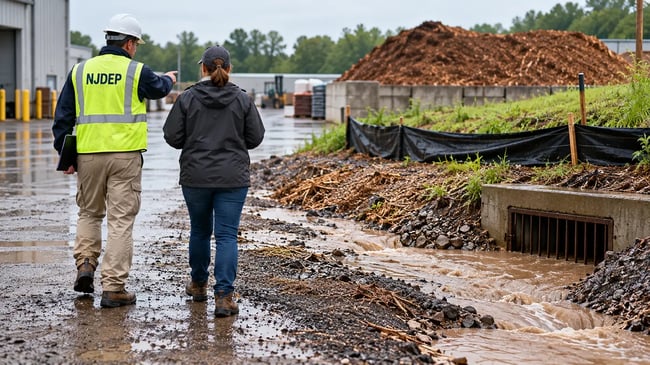
A typical NJDEP inspection has three parts: an opening conference, the walk-through, and a closing conference. During the walk-through, the inspector can observe your operations, review records, take samples, take photographs, or do all of those. At the opening conference, the inspector may ask about your operations down to the process level, along with employee training, environmental management, and anything tied to your permit, and will tell you which records they want to see.
For a runoff complaint, attention usually lands on the outdoor parts of your site and on your stormwater pollution prevention plan (sometimes called an SPPP, an SP3, or just a stormwater plan, and we'll use SWPPP here). If you want the background on that document first, our article on what a SWPPP is covers it.
| What the inspector may check |
What it tells them |
| Outdoor storage, equipment, and waste areas |
Whether materials can come into contact with rain and wash off the site |
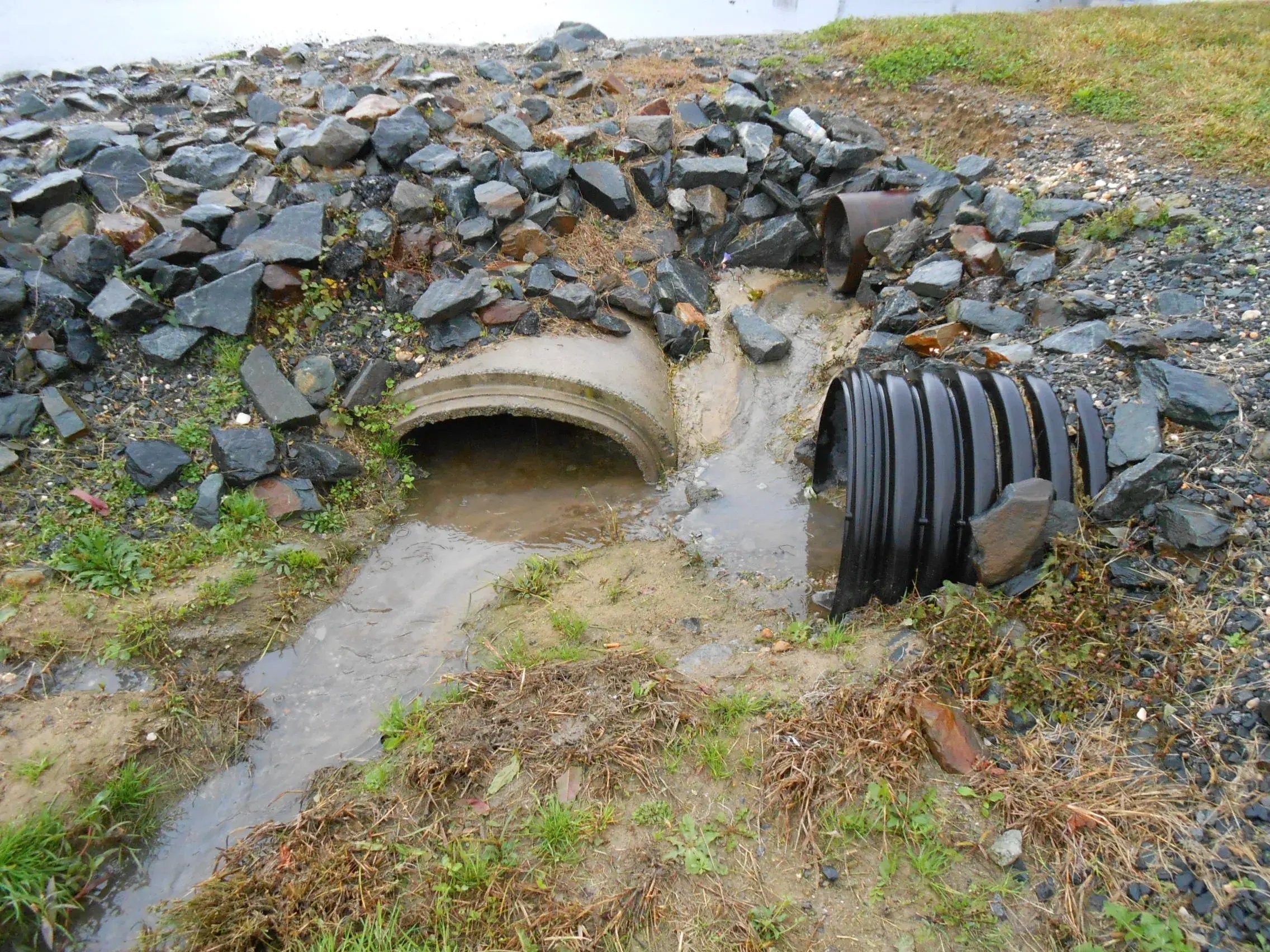
| Drains, ditches, outfalls, and the path water takes off the property |
Where runoff leaves your site and where it ends up |
| Housekeeping and best management practices (sweeping, covers, berms, spill kits) |
Whether your controls are in place and kept up |
| Your SWPPP |
Whether a plan exists, is current, and matches how the site operates today |
| Annual inspection and certification records |
Whether you've done the yearly review your permit calls for |
| Facility inspection reports, logbooks, sampling reports, and training records |
Whether you're following the monitoring and recordkeeping your permit requires |
NJDEP's guide lists the water quality violations inspectors cite most often, and several of them apply to runoff: failing to submit SPPP information (the guide notes this accounts for a significant share of all water violations written), not following every condition of a permit, discharging stormwater to state waters without a valid NJPDES permit, not implementing best management practices, and not doing required monitoring. Most of those are paperwork and housekeeping problems, not dramatic releases. Our article on common NPDES permit problems covers how those get fixed.
If the inspector takes water samples, the guide says they follow chain-of-custody procedures, and you can collect split or duplicate samples at the same time and send them to a certified lab of your choice to compare against the state's results. That's optional, and you'd supply the containers and pay for the analysis, so it's worth deciding before the inspector shows up whether you'd want to.
What Should You Do Right Away After a Stormwater Runoff Complaint?
If anything is actively leaking or discharging, deal with that before anything else. Stop it if you can do so safely, call 911 for an emergency, and report the release to the NJDEP hotline immediately. Everything below assumes there's no active spill.
Next, walk the site the way the water does. Start where rain lands, whether that's a roof, a stockpile, or a parking area, and follow it to the storm drain, ditch, or property line. Look for stained pavement, sediment trails, leaking containers, uncovered piles, clogged inlets, overflowing dumpsters, and material tracked out by trucks. A fresh set of eyes helps, so bring someone who doesn't walk that route every day. Our guide to doing a stormwater visual inspection lays out a method you can follow.
Then fix what's obvious. Sweep up sediment, cover or move stockpiles, put leaking containers inside secondary containment, clean out inlets, restock spill kits, and tighten up anything outside that doesn't need to be there. Take dated photos before and after. NJDEP weighs how quickly and effectively a facility corrects a problem when it decides on penalties, and photos with dates are the simplest way to show what you did and when. Our overview of stormwater best management practices has ideas for controls that hold up over time.
Finally, pull your paperwork together so you can find it in minutes. The inspector decides what to ask for, but this is the set most facilities should have ready.
| Paperwork to have ready |
Notes |
| Your permit authorization, or your no exposure certification |
Whichever one covers your site, with any renewal letters |
| Current SWPPP with any updates |
Check that the site map and activities match what's on the ground |
| Annual inspection and certification records |
Include the signed certification if your permit calls for one |
| Routine inspection logs and maintenance records |
Sweeping, inlet cleaning, repairs, and housekeeping checks |
| Sampling results and reports, if your permit requires them |
Requirements vary by permit category, and some permits require none |
| Training records |
Who's trained on the plan and when |
| Spill reports and waste manifests |
Anything showing how materials and wastes leave the site |
One firm rule here: never backdate a log or fill in missed inspections after the fact. If a record is missing, leave the gap, start doing it correctly today, and tell the inspector plainly what you've changed. Falsified paperwork turns a fixable problem into a much more serious one.
How Should You Handle the NJDEP Stormwater Inspection Itself?
When the inspector arrives, they'll identify themselves, show photo identification, and ask for the owner or operator. NJDEP's guidance to facilities is simple: be cooperative and courteous, and don't panic. The stated purpose of the visit is to check compliance and, where possible, provide compliance assistance, not to shut you down. Have a knowledgeable person ready to walk with the inspector, someone who knows the site, the plan, and where the records live.
Answer questions accurately, and if you don't know something, say you'll find out and follow up instead of guessing. The inspector will take notes throughout, so don't read anything into the writing. Keep your own notes too, including what was asked, what was photographed, and which records were taken or copied. If a record contains something proprietary, raise a confidentiality request at the opening conference or when the photos are taken, since the guide says that's when it gets documented. You can technically refuse an inspection, but the guide warns that refusal can bring administrative penalties, with each day treated as a separate offense, and that inspectors tend to come back with a warrant. Cooperating is almost always the better path.
If the inspector spots something easy to correct, such as a missing label or an uncovered pile, fixing it on the spot is worth doing. You may still receive a Notice of Violation, but NJDEP's guide says the inspection report will note that you achieved compliance during the inspection. At the closing conference, ask what the inspector found, what additional information they need and by when, and when the results will be entered into NJDEP's compliance system. Once they're entered, the guide says you can look them up online.
What Happens After NJDEP Finds a Stormwater Violation?
The inspector's findings go into NJDEP's compliance database and become part of your facility's enforcement history. If you're in compliance, no further action follows. If the inspector finds a violation, NJDEP decides whether it's minor or non-minor under the grace period rules for that program, and then prepares an enforcement document. For a minor violation, that's usually a Notice of Violation (NOV) describing the problem, what you need to do to correct it, and the date it's due. A follow-up inspection typically checks whether you fixed it.
An NOV doesn't carry a penalty on its own, and it can't be appealed, although NJDEP can rescind one if the basis for it turns out to be wrong. It does go on your record, and it can serve as the foundation for further enforcement if the problem isn't fixed. NJDEP's guide also says an NOV puts you on formal notice, so continuing the same problem afterward can be treated as knowing conduct when penalties are decided. The documents you might see, from least to most serious, look like this.
| Enforcement document |
What it does |
Penalty? |
Can you contest it? |
| Notice of Violation (NOV) |
Describes the violation and sets a compliance due date |
No, not on its own |
No appeal, but it can be rescinded if wrong |
| Administrative Order (AO) |
Orders compliance on a set schedule, usually after an NOV wasn't resolved or for a non-minor violation |
Not by itself |
Yes, by requesting a hearing |
| Notice of Civil Administrative Penalty Assessment (NOCAPA) |
Assesses a penalty, often where correction isn't possible or has already happened |
Yes |
Yes, by requesting a hearing |
| Administrative Order and Notice of Civil Administrative Penalty Assessment (AONOCAPA) |
Orders compliance and assesses a penalty together |
Yes |
Yes, by requesting a hearing |
For non-minor violations, NJDEP can issue an Administrative Order with or without a penalty, enter into an Administrative Consent Order, seek judicial relief, or make a criminal referral to the Attorney General. Which route it takes depends on factors like how severe the violation is, the harm or potential harm, the facility's compliance history, and whether the violation was willful. Our article on reporting bad stormwater results is a useful read if monitoring data is part of your situation.
How Does New Jersey's Grace Period Law Work for Minor Stormwater Violations?
New Jersey's Grace Period Law (N.J.S.A. 13:1D-125 and following) was written so that businesses can correct minor environmental violations without being penalized for them. NJDEP carries it out program by program. For water violations, the procedure sits in the Water Pollution Control Act rules at N.J.A.C. 7:14-8.4A, and a table in those rules marks each listed violation as minor or non-minor and sets the length of the grace period for the minor ones. Non-minor violations don't get a grace period at all.
Even a violation labeled minor only qualifies if the facts line up. Among other conditions, the violation can't be the result of purposeful, knowing, reckless, or criminally negligent conduct, the problem can't have existed for 12 months or more before NJDEP found it, you can't have been cited for the same requirement of the same permit within the previous 12 months, and it can't be part of a pattern of violations. That last point is a good reason to fix the root cause of a problem rather than patching the symptom, because a repeat of the same permit requirement within a year takes the grace period away.
When a violation qualifies, the process works like this:
- NJDEP issues a Notice of Violation that identifies the condition and the requirement violated, and states that a penalty may be imposed unless you correct the violation within the grace period.
- You correct the problem and, before the grace period ends, submit written information, certified to be true and signed by the responsible person, describing what you did.
- If you've corrected the violation and shown it in time, NJDEP doesn't impose a penalty for it.
- If you need more time, you can request one extension in writing, signed and certified, and NJDEP must receive it at least a week before the grace period ends. NJDEP can approve an extension of up to 90 days at its discretion, and it looks at whether you've moved quickly, whether the delay was outside your control, and whether the delay creates risk.
- If you miss the deadline, NJDEP can impose a penalty that reaches back to the date the Notice of Violation was issued.
Rules get amended, and the length of your grace period depends on the violation, so treat your NOV as the final word on the deadline that applies to you. Put the date on the calendar the day it arrives, send your certified response early instead of on the last day, and keep proof of the fix, such as photos, receipts, and any revised SWPPP pages.
What If NJDEP Issues an Administrative Order or Penalty for Stormwater Runoff?
Many NOVs don't end in a penalty. NJDEP's inspection guide says many facilities that received an NOV never got a monetary penalty because they corrected problems that didn't have significant effects, and timely correction is one of the factors the state weighs. When a penalty is assessed, NJDEP starts from a base amount and adjusts it using case-specific factors, including how willful the violation was, any actual harm to the environment or public health, cleanup and restoration costs, how close the site is to waters or populated areas, whether it's part of a recurring pattern, any economic benefit from not complying, and how quickly and effectively you corrected it. A single factor can be enough to justify a high penalty, and not all factors carry equal weight. We can't tell you where a particular site would land.
If you receive an Administrative Order or a penalty assessment, you can contest it by requesting a hearing, and the document includes a checklist and form for doing that. The deadline is short, the request has to include specific information, and a late request can be denied, so read the document the day it arrives. NJDEP also offers a voluntary, no-cost dispute resolution process after a hearing request is granted, and a settlement reached there or at the Office of Administrative Law is final. NJDEP also has a self-disclosure policy that can reduce or eliminate penalties on a case-by-case basis for violations a facility finds, reports, and corrects on its own, though whether it fits your situation depends on timing and facts.
Anything involving penalties, orders, or legal exposure is the point where an environmental attorney is appropriate. An attorney can advise you on hearing requests, settlement, and what to say in writing to the state. We can work on the technical side alongside your counsel, which means walking the site, correcting the conditions that led to the violation, and tightening your SWPPP and records.
How Do You Keep Your SWPPP and Site Ready for the Next Stormwater Complaint?
The facilities that get through inspections without much drama usually had their basics in place before anyone called. That starts with a SWPPP that matches the site as it operates today. If you've added storage, moved a pile, changed a loading area, or started a new activity outside, the plan needs to reflect it. NJDEP's guide specifically reminds facilities with a stormwater permit to send in their annual SPPP re-certification, and an annual inspection is part of what supports that certification. Our article on the best ways to get and stay in stormwater permit compliance goes through the habits that keep a program on track.
Day-to-day housekeeping does more to head off complaints than any document. Regular sweeping, covered materials, working inlet protection, and containers kept in good shape are the things neighbors can see, and they're the things that turn into hotline calls when they slip. It also helps when the people on your site know why those habits exist. Training takes the plan off the shelf and puts it into practice, and our online training library and our article on whether stormwater training is required are good places to start. If your permit calls for sampling, taking your own stormwater samples keeps you close to your own data. And if a neighbor ever asks about something they've seen on your property, a friendly conversation costs a lot less than a hotline call.
How Can RMA Help With NJDEP Stormwater Complaints and Inspections?
RMA is a family-run environmental consulting firm based in New Jersey, and we've been helping facilities with environmental compliance since 1992. If you're staring at a complaint and aren't sure what to do first, we can walk your site with you, point out what an inspector is likely to notice, review your SWPPP and records, and help your team get ready for the visit. Once you're permitted, we also offer annual support that includes reminders, help interpreting results, SWPPP and annual reporting updates, and inspection prep, and it can be as hands-on or hands-off as you want. We train your people to take their own samples instead of sending someone out ourselves, because they know your facility and storm windows are hard to staff from outside.
We'll also tell you when we're not the right fit. If you need engineering design or construction of a treatment system, or construction-phase permits, you'll want an engineering firm or construction specialist for that. We're a small firm with senior staff doing the work, so we're not always the cheapest option, and we'll be upfront about timelines when a deadline is tight. If you'd like to talk through your situation, you can call us, send an email, or fill out the form on our website. There's no pressure and no obligation, and we'll tell you honestly whether you need us. You're welcome to contact RMA whenever you're ready.