Why the Clock Usually Starts When Water Begins Discharging From Your Outfall, Not When the First Drops Hit the Ground
Your stormwater permit says to collect a grab sample within the first 30 minutes. It's raining, the radar looks ugly, and somebody asks the obvious question: 30 minutes from when? A lot of facilities guess. For most industrial NPDES stormwater permits, the clock starts when stormwater begins discharging from your outfall, and that can happen a few minutes or several hours after the rain begins.
A client asked us this exact question in June, and it's an easy one to get tangled up in. Permit language is dense, weather is messy, and plenty of people who work around stormwater use "start of the storm" and "start of discharge" as if they mean the same thing. They don't. This article covers how the two differ, why permits care about early discharge, how to work out when your clock started, what to write down, and what to do when you can't make the window. If your facility has sampling obligations and you're not sure when your clock starts, reach out to RMA before the next storm, because 30 minutes doesn't leave much room to figure it out while standing in the rain.
Table of Contents
TL;DR
For most industrial NPDES stormwater permits, the 30-minute sampling window starts when stormwater first discharges from your outfall, not when it starts raining. The two can be hours apart, and a weather app won't tell you when a specific outfall started flowing, so your own field notes carry the weight. If you can't make the window, many permits allow a late sample as long as you document why. Your permit's exact wording controls, so read it before the storm, not during it.
Does the 30-Minute Stormwater Sampling Window Start When the Rain Starts?
Usually, no. A rain event begins when precipitation starts falling at your facility. A stormwater discharge begins when accumulated stormwater reaches an outfall or another permitted discharge point and starts leaving the site. In between, the water has work to do. It lands on roofs, parking lots, loading areas, storage yards, and access roads, then puddles, runs across pavement, drops into catch basins, travels through underground pipe, passes through a detention system, or follows a ditch before it reaches the outfall you sample.
Here's how that plays out. Say rain starts at 12:00 p.m. and stays light for the first hour. Water slowly collects across the property. The rain picks up in the afternoon, and flow finally reaches your monitored outfall at 3:00 p.m. If your permit calls for a grab sample within the first 30 minutes of discharge, your window runs from about 3:00 to 3:30 p.m. The stretch from 12:00 to 12:30 isn't your window.
It's easy to nod along with that example and still see the mix-up on a real storm day. Someone notes rain at noon, and by the time anyone checks the outfall, half the people on site think the window closed hours ago. Or nobody samples because the outfall wasn't flowing yet and nobody went back to look.
Why Do Stormwater Permits Focus on the Start of Discharge and the First Flush?
The timing rule isn't arbitrary. It's built to catch the early runoff, which people often call the first flush. Between storms, material builds up on exposed surfaces at an industrial site: sediment, oil and grease, metals, dust, debris, chemical residue, nutrients, and leftovers from whatever your operation handles outdoors. When water finally starts moving across those surfaces, it picks that material up and carries it toward the outfall.
The first runoff can carry higher pollutant concentrations because it's washing off everything that accumulated since the last storm. Later runoff may be more diluted once the surfaces have been rinsed. That pattern isn't guaranteed at every facility or in every storm, and a site with ongoing leaks or constant outdoor activity can keep producing pollutants all the way through the event. Still, the early discharge is the part of the storm most likely to show the worst of what your site sends downstream.
That's the reasoning behind asking for a sample near the start of the discharge. EPA's industrial stormwater sampling guidance describes it the same way, recommending that samples be collected within the first 30 minutes of discharge so they reflect initial stormwater quality. A sample taken three hours after the outfall started flowing tells you something, but it doesn't tell you what left your site when the runoff was at its dirtiest. Grab samples are the usual tool for this job, and we cover the difference between them and composite samples in our article on grab samples versus composite samples.
What Affects How Long Rain Takes to Become a Stormwater Discharge at Your Outfall?
At some facilities, rain and discharge show up almost together. A small paved property with steep slopes and a direct path to a nearby outfall can start flowing within minutes of the first real rainfall. At another facility, the drainage area is broad and fairly flat. Rainwater has to fill low spots, cross long stretches of pavement, enter several catch basins, and move through a big underground system before anything reaches the outfall. That site might not discharge until well after the rain starts, and a light storm might never produce flow at all.
A number of things shape that delay:
- Rainfall intensity and duration
- How wet the ground already is from earlier storms
- Surface slope, and how much of the site is pavement or roof
- Soil infiltration
- Low spots where water ponds before it moves
- Detention or retention structures
- The length and size of drainage piping, and how far each drainage area sits from its outfall
- Blocked or restricted inlets
- Pumps, gates, or valves that change how water moves
This is why a weather app or a nearby rain gauge only gets you part of the way. Weather data can tell you when precipitation started, how much fell, and whether the storm met your permit's criteria. If you need a source for that, our article on where to get rainfall data for your stormwater permit report covers the options. What weather data usually can't tell you is the moment water began flowing out of one specific outfall at your facility. Somebody has to be at the site, looking.
Learn How Your Site Behaves in Wet Weather
You can't manage a 30-minute window well unless you know how stormwater behaves on your property. That means knowing where water comes from, which areas drain to which outfall, where it collects, and roughly how long different kinds of storms take to produce flow. EPA's monitoring guidance recommends walking the facility during wet weather to see where stormwater leaves the site, and settling on sampling locations before monitoring is required.
The questions worth answering are simple ones. Which outfalls start flowing first? Which need heavier rain before they discharge at all? Does the answer change when the ground is already saturated? Can your sampler reach every outfall inside the window, and are any of them unsafe or hard to get to? You won't predict the exact start of discharge in every storm, and facilities change over time. But if your sampling plan amounts to "someone will go outside when it rains and try to find water," the site isn't ready.
How Do You Document the Start of Discharge for Stormwater Sampling?
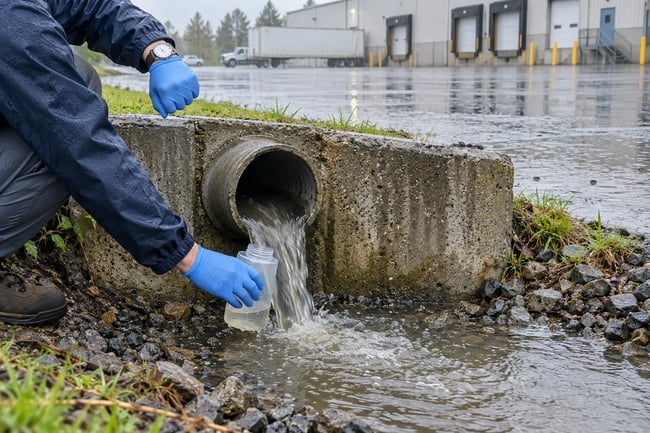
Rain start times come from gauges, airports, weather stations, or commercial weather data. The start of discharge at a private industrial outfall usually isn't recorded by anyone unless you've installed monitoring equipment, which means it often comes down to what your own people observed. That doesn't give anyone permission to pick a convenient time. It means you need a consistent, defensible way of working out the time and writing it down.
Your field notes should capture when the rain began, when each outfall was checked, when flow was first seen, and when the sample was collected. If the start of discharge was estimated rather than watched, say so in the note. A good one reads like this:
Rain began at approximately 12:05 p.m. The south outfall was checked at 1:00 p.m. and no discharge was observed. Flow was first observed on the next check at 1:15 p.m. The grab sample was collected at 1:25 p.m. The start of discharge is estimated to have occurred between 1:00 p.m. and 1:15 p.m.
Compare that with a log entry that says "sample collected within 30 minutes." The first one shows your reasoning and lets a reviewer follow it. The second asks them to take your word for it.
Regulators can line up your sampling records against precipitation data, inspection logs, lab reports, discharge monitoring reports, and photographs. If the timeline doesn't hold together, you'll be answering questions later that a few extra lines of notes would have settled. Beyond the times, record the outfall ID, who collected the sample, the weather, any visual observations, and the reason for any delay. Write the notes as if someone who has never seen your facility will have to understand the event three years from now, because that can happen.
What Happens If You Can't Collect the Stormwater Sample Within 30 Minutes?
Sometimes the window just can't be met. An outfall may be blocked or flooded. Lightning or high water may make sampling unsafe. Discharge may begin at 2:00 a.m. when nobody trained is on site, or the storm may build faster than the forecast suggested. Many permits account for this. They ask for the sample within the first 30 minutes if practicable, and if it isn't, they allow a later sample as long as you document why it couldn't be collected in the window.
Most of the weight sits on the documentation, and "we missed it" doesn't cover it. A useful explanation answers a few plain questions. When did the rain begin? When did discharge begin, or when was it first seen? When was the sample collected? Why couldn't it be collected sooner, and was the cause safety, access, staffing, or a late heads-up? What did the facility do to keep the delay short? And does anything need to change before the next storm?
Here's what a solid explanation can look like: Discharge was first observed at 2:42 a.m. during an overnight storm. Trained sampling personnel weren't on site when discharge began. The sample was collected at 6:35 a.m. when qualified personnel arrived. The facility is evaluating whether additional employees should be trained to support after-hours sampling.
An explanation like that doesn't automatically make a late sample acceptable. Your permit and your permitting authority decide what's allowed. What it does is show that you saw the problem, wrote down what happened, and started thinking about a fix. The same excuse over and over is a different story. If you keep missing the window for the same avoidable reason, such as nobody trained being available overnight, you'll have a hard time defending it on the third or fourth storm.
A storm that never produces discharge at your outfall is a separate situation. We cover how to report it in our article on reporting no discharge (NODI) on your DMRs, and where to sample when water doesn't leave your site in this guide to sampling locations.
Why Does Your Specific Stormwater Permit Control the Sampling Window?
The first-30-minutes-of-discharge idea is common, but don't assume every permit words it the same way. Industrial stormwater permits are issued by EPA or by an authorized state agency. EPA's multi-sector general permit only applies where EPA is the permitting authority, and in many states your coverage comes from a state-issued permit that can differ from the federal one. Requirements can vary by state, industrial sector, outfall, monitoring type, and permit version.
Some permits use a different timeframe. Others spell out what counts as a qualifying storm, a minimum dry period, rainfall thresholds, or sector-specific exceptions. Benchmark monitoring and effluent limit monitoring can each carry their own rules, and our article on benchmark values versus effluent limits explains how those differ. If you're not sure which type of permit covers your facility, our guide to NPDES permit types is a good place to start.
Before storm season, sit down with the permit and confirm which outfalls you have to monitor, what sample type is required, which parameters get analyzed, what qualifies as an eligible storm, when the sampling window starts and how long it stays open, whether any exceptions apply, what records you need to keep, and where and how results get reported. Permits get renewed, and a sampling plan written for an old permit may no longer match the current one.
Your monitoring procedures also belong in your stormwater plan. If you're not sure what that document should contain, we explain it in what a SWPPP is and what goes in it.
How Do You Prepare Your Facility for the 30-Minute Stormwater Sampling Window?
You can't prepare once the outfall starts flowing. Before the next eligible storm, you want trained people, clean sampling equipment, bottles from your lab, preservatives when your methods call for them, chain-of-custody forms, coolers and ice, protective gear, access keys, outfall maps, and written procedures all sitting in one place and ready to go. EPA's sampling guidance recommends a checklist for exactly this reason. Sampling usually isn't part of anyone's everyday job, and a checklist keeps a missing bottle from becoming a problem once the clock is running.
Your team should also know who does what. Someone watches the forecast, someone decides whether a storm qualifies, someone checks each outfall, someone collects the samples, someone calls the lab, and someone reviews the results afterward. A good written procedure is specific enough that a trained backup employee could follow it without guessing. It should cover:
- Where each sample is collected, and how to get to that spot safely
- What discharge looks like at that location
- How the start of discharge gets determined and recorded
- Which bottles go with which parameters, and whether they hold preservatives
- How samples are handled and cooled, and the holding times that apply
- What information gets recorded
- Who gets notified if a sample is late or missed
Training is part of the same picture. A procedure only works if the person holding the bottle has practiced it, and if you're building up your team's skills, our article on whether stormwater training is required and our online training library are good starting points. Our tips for taking good stormwater samples belong in the sampling kit, and what to do with samples after collecting them covers the handoff to the lab.
Plenty of facilities handle all of this on their own, and we'd rather you did it well in-house than pay us for something you can do yourselves. We lay out the reasoning in why you should take your own stormwater samples. The 30-minute window is tight, but it's manageable when the site is ready.
How Can RMA Help With Stormwater Sampling Procedures and Permit Compliance?
If your permit is clear, your people are trained, and your sampling plan has been tested on a real storm, you may not need us. If you're less sure, we can help in a few practical ways. We read your permit with you and pin down what your sampling window requires. We walk the site to look at drainage, identify sampling locations, and figure out which outfalls flow first. We write sampling procedures a backup employee can follow and train your people on them.
There's no pressure and no obligation. You can call us, email us, or fill out the form on our website, and we'll tell you whether you need outside help. If you'd like a second set of eyes on your sampling plan before the next storm, contact RMA and we'll take it from there. For the bigger picture on how stormwater permits work, our guide to everything you need to know about NPDES stormwater permits is a good companion to this article.

