Buying or Selling a Facility With Oil Tanks: What New Jersey Buyers and Sellers Need to Know About SPCC Plans, Tank Registrations, and Spill Liability
When a facility with oil tanks changes hands, the paperwork doesn't follow along neatly. The SPCC Plan, short for Spill Prevention, Control, and Countermeasure Plan, is the federal oil spill prevention plan required for facilities that store more than 1,320 gallons of oil aboveground, counting containers of 55 gallons or more. It's written for a specific owner, a specific set of tanks, and a specific management team, and by closing day at least one of those has changed. The new owner or operator is responsible for having a plan that's current and reflects who's running the place.
This article covers what happens to the plan in a sale, what a new owner does about it, what New Jersey's tank registration, discharge prevention, ISRA, and Spill Act rules add, and what buyers and sellers should check before closing. Forms and deadlines change, so where something depends on a current agency form or filing window, we say so and point you to the agency. If you're in the middle of a deal and want a second set of eyes on the tank side, reach out to RMA.
Table of Contents
TL;DR
An SPCC Plan doesn't disappear in a sale, but it doesn't carry over cleanly either. The new owner has to make sure the plan names the right people, carries current management approval, and still matches the tanks on site, and an engineer has to certify any technical changes. In New Jersey, underground tank registrations don't transfer on their own, state discharge prevention plans need updating at larger facilities, and the state's transaction-triggered cleanup law can apply to the sale itself. Buyers should check the plan, the tanks, the spill history, and the registrations before closing.
Does an SPCC Plan Transfer When a Facility Changes Hands?
Not cleanly. EPA's position is that if nothing about operations changes in a sale, the new owner may be able to keep working from the existing plan, as long as it's revised to show the new owner and company names. If the sale changes how the facility operates or is maintained in a way that materially affects the chance of a discharge, the plan has to be amended within six months, and technical amendments to a full plan need certification by a professional engineer (PE). A buyer who adds tanks, switches products, removes containment, or moves the loading area has made a technical change no matter who signed the old plan.
The duty sits with the owner or operator, not the document. A plan with the seller's name and the seller's management approval isn't doing its job for the buyer, even when every tank matches the diagram. A name change is a non-technical amendment and doesn't need a PE, but the plan still needs sign-off from someone at the new company with authority to commit resources. In New Jersey, EPA Region 2 enforces the SPCC rule, and a plan naming the previous owner is easy for an inspector to spot (see who enforces SPCC Plans). A buyer shouldn't lean on a seller's self-certification either, so our guide to the different types of SPCC Plans is worth a look.
What Steps Does a New Owner Take to Bring an SPCC Plan Current?
Start by getting a complete copy of the plan, not a cover page. A facility staffed at least four hours a day is expected to keep the plan on site, so if it isn't there at closing, that's your first finding. Then walk the property with the plan's tank inventory in hand and count every oil container of 55 gallons or more, including drums, totes, and oil-filled equipment like transformers. Our articles on whether 55-gallon drums count toward SPCC and sizing SPCC secondary containment help if the numbers or the containment look off.
Next comes the administrative update: owner and company names, facility contact, emergency coordinator, phone numbers, and a new management approval signed by someone at the buyer. Check the five-year review too. Every plan must be reviewed at least once every five years and the review documented, so an older review is an overdue obligation the buyer inherits. Our post on plans that are over five years old lays out the options.
After that, compare the plan with the site. Any technical change gets amended within six months and, for a full plan, certified by a PE, and some firms have an engineer on staff while others work with a trusted outside PE. Our guides on whether a plan can be updated and Professional Engineers and SPCC requirements help separate a simple update from a rewrite. Then start the buyer's own routine: monthly inspections from day one (see what to cover in monthly SPCC inspections), the seller's records for the file, and a briefing for employees who handle oil, which our online training library can support.
What Do New Jersey's Tank and Spill Rules Require After an Ownership Change?
New Jersey layers its own rules on top of the federal plan, and they cover more than oil. Three come up in almost every sale: registration rules for underground storage tanks (USTs), Discharge Prevention, Containment and Countermeasure (DPCC) and Discharge Cleanup and Removal (DCR) plans for larger "major facilities," and the Spill Act, the state's main law on discharges and cleanup costs. Our post on SPCC Plans in New Jersey covers the basics.
| Program |
What it covers |
What changes at a sale |
| UST registration (N.J.A.C. 7:14B) |
NJDEP registration for regulated underground tanks |
The registration certificate isn't transferable. The new owner and operator notify NJDEP to amend it, and the current rule sets a 30 day window. |
| DPCC and DCR plans (N.J.A.C. 7:1E) |
State discharge prevention and cleanup plans for major facilities |
NJDEP's guidance treats an ownership change as a plan amendment, not a minor page swap. |
| Spill Act (N.J.S.A. 58:10-23.11 et seq.) |
Liability for discharges and cleanup costs, including hazardous substances beyond oil |
Nothing gets filed at closing, but responsibility follows whoever owns or operates the site. |
Underground Storage Tank Registrations After a Sale
Under N.J.A.C. 7:14B-2.3, a UST registration certificate isn't transferable. After acquiring the facility, the new owner and operator notify NJDEP so the registration can be amended, and the rule as written calls for that within 30 days of an ownership change, including a sale of part of it. Not every underground tank is regulated, so check N.J.A.C. 7:14B against your own tank inventory and confirm current forms and timing with NJDEP's UST program before closing. Tank installation, repair, and closure work goes through NJDEP-certified contractors.
DPCC and DCR Plans at Major Facilities
Whether a facility counts as a major facility under N.J.A.C. 7:1E depends on its total storage capacity and what it stores, so check the rule against your own inventory. If it does, the buyer inherits the duty to keep NJDEP-approved plans accurate. NJDEP's plan guidance treats a change of ownership as an amendment, while a renumbered street or a new employee name is a minor change, and the rule generally allows 30 days from a modification that requires a plan change. Ask NJDEP's Bureau of Release Prevention how it wants the ownership change handled before closing.
Spill reporting doesn't wait for paperwork. From the day the buyer operates the tanks, a release is theirs to report. Check NJDEP's website for the current discharge hotline instead of copying a number from an old plan, and see when an oil spill has to be reported for the federal side.
Does ISRA Apply When a New Jersey Facility With Oil Tanks Is Sold?
ISRA, the Industrial Site Recovery Act, is New Jersey's law tying certain property sales and business closures to environmental investigation and, where needed, cleanup. It applies to "industrial establishments," meaning businesses with an industry code (NAICS number) listed in the ISRA rule at N.J.A.C. 7:26B that have operated in New Jersey since December 31, 1983 and use or store hazardous substances, a category that includes petroleum. Many offices and retail sites fall outside it, while manufacturers and many industrial sites fall inside it.
ISRA is triggered by a transaction, not by a problem. Typical triggers are the sale of the business or its real property, a transfer of operations, or closing operations, and mergers, stock transfers, and foreclosures can count too. Compliance is due at the triggering event, which can be as early as signing the agreement of sale, and before closing. NJDEP's General Information Notice (GIN) instructions currently describe a notification window of just days after the trigger, so don't wait for closing week to ask whether ISRA applies. The rule includes exemptions and alternate routes, and which fits depends on the deal.
NJDEP no longer issues letters confirming that ISRA doesn't apply, so the parties usually decide that with their environmental attorney and a Licensed Site Remediation Professional (LSRP), the state-licensed professional who oversees cleanups. A sale that triggers ISRA can add time and cost, so raise the tank and storage questions at the start of a deal.
How Does Spill Act Liability Affect Buyers and Sellers of Facilities With Oil Tanks?
The Spill Act makes anyone who discharged a hazardous substance, or who is "in any way responsible" for one, liable for cleanup and removal costs without regard to fault. Courts have described that liability as strict, and as joint and several, meaning one responsible party can be pursued for the whole cost and left to seek contribution from the others. The Spill Act covers hazardous substances beyond oil, so a facility that stores chemicals alongside its oil has more to think about.
For buyers, ownership alone can create exposure. New Jersey courts have held that a current owner can be liable for contamination that predates its purchase if it can't qualify for the statutory innocent purchaser defense. That defense generally turns on whether the buyer made appropriate inquiry into the property's past before buying and had no reason to know of a discharge. A Phase I Environmental Site Assessment is the usual way to document that inquiry, and a current SPCC Plan is no substitute because it doesn't show the soil is clean.
For sellers, a sale doesn't automatically end exposure for discharges on their watch. Purchase agreements commonly allocate environmental responsibility, but a contract can shift cost between the parties without changing what the state can pursue. How the Spill Act applies to a specific deal is a legal question, so bring in an environmental attorney.
What Should Buyers Check About Oil Tanks and SPCC Compliance Before Closing?
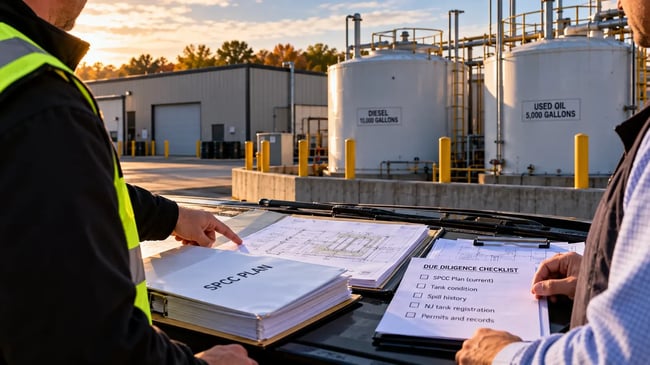
Due diligence on oil tanks is mostly a records request and a site walk. The table below shows what to ask for and what each item tells you. Lenders and insurers sometimes ask for the same documents, which we cover in our post on insurance companies and SPCC Plans.
| What to Review |
What to Ask For |
What It Tells You |
| The SPCC Plan |
A complete copy, certification, management approval, and the five-year review record |
Whether a plan exists, who stands behind it, and whether it's current |
| Tanks vs. the plan |
A site walk counting every container of 55 gallons or more and any oil-filled equipment |
Whether the plan matches the facility |
| Condition and records |
Inspection logs, integrity testing, training records, and a look at the containment |
Deferred maintenance and whether the program is real or only on paper |
| Spill history |
Discharge logs and correspondence with NJDEP or EPA Region 2 |
Open issues and prior releases |
| UST registrations and DPCC/DCR plans |
Registration certificate, NJDEP-approved plans, approval letters, closure records |
Whether tanks are registered, whether the site is a major facility, and what the buyer inherits |
| Prior environmental reports |
Phase I reports, soil or groundwater reports, any ISRA filings |
Known or suspected contamination and cleanup history |
Findings usually become negotiating points rather than reasons to walk away. A missing plan, an overdue review, or worn containment can be priced into the deal, covered by an escrow, or made a condition of closing.
If you're buying to build or expand, the construction phase has its own approvals: construction stormwater coverage, soil erosion and sediment control certification, building and fire permits for tank installation, and NJDEP-certified contractors for underground tanks. RMA doesn't prepare construction-phase permits or approvals, and most buyers handle that piece with their engineer, contractor, or a soil erosion specialist. A new or expanded facility almost always needs operational permits and plans once it's running, such as an SPCC Plan or amendment, DPCC and DCR plans if it's a major facility, spill procedures, inspections, and training. That's where we help, and we can point you toward the right construction professionals.
What Should Sellers Do to Hand Over a Facility With Oil Tanks Cleanly?
Sellers who prepare before listing give buyers fewer reasons to renegotiate. Pull the SPCC Plan, check its five-year review date, certification, and management approval, and fix anything stale while you still control the site. An old plan updated before marketing is a small line item, and one found in a buyer's due diligence tends to become a price conversation.
Gather the records a buyer will ask for, including inspection and training logs, tank registrations, DPCC and DCR approvals, and spill history, and be upfront about past releases. Buyers tend to find them anyway. Ask your attorney whether ISRA applies before the agreement of sale is signed, since the filing clock can start at signing, and read the ownership change provisions in N.J.A.C. 7:14B if you have regulated underground tanks. After closing, keep a copy of the plan and records as they stood on the closing date, because agencies can ask about the period when you owned the facility.
What Does SPCC Plan Help Cost During a Facility Sale?
Costs depend on the number of tanks, the container types, whether a PE certification is needed, and whether secondary containment needs evaluating. As a rough guide, our SPCC Plans run from $2,500 to $15,000. We generally don't take over a plan someone else wrote, because we need to be able to stand behind it. If the plan is outdated or doesn't match the tanks on site, we usually rebuild it from a fresh site review, so a buyer should price the work as a new plan rather than a quick update. Our SPCC pricing calculator below gives you a ballpark for having us handle the SPCC side, and our post on what SPCC Plans cost explains what moves the number.
The SPCC Plan is one line in the budget of a facility sale. A Phase I ESA typically runs $4,000 to $6,500, while DPCC and DCR plans, underground tank work, and ISRA or cleanup depend on the facility and what the investigation finds, so we don't quote ranges for those here. NJDEP's agency fees change, so check its current fee schedules directly.
How Can RMA Help With SPCC Plans During a Facility Purchase or Sale?
We're based in New Jersey, so NJDEP's programs and the way the state layers its rules on top of the federal SPCC rule are familiar ground. Before closing, we can review a facility's plan and tell you whether it's current, what updating it would involve, and which state programs probably apply to the tanks on site. After closing, we can prepare a plan the new owner can rely on, which for an older plan we didn't write usually means rebuilding it so we can stand behind it, and we can train the people who handle the oil.
We'll also tell you when you don't need us. If the plan is sound and the only change is the owner's name and a new signature, a buyer may be able to handle that without a consultant. ISRA and Spill Act questions belong with an environmental attorney. If you want a second opinion on the tank side, there's no obligation. You can call us, email us, or fill out the form on our website, and contact RMA about your facility sale.