If Your SPCC Plan Is Past Due, Don't Panic. But Don't Ignore It Either.
We see this all the time. Someone pulls their SPCC Plan out during an inspection, a management transition, or a random internal review, and notices the date on the cover is old. Five years old. Seven years old. Maybe older than the person currently running the facility.
The next question is always the same: are we in trouble? Maybe, maybe not. But either way, this is one of those compliance issues that's a lot cheaper and easier to deal with now than after an inspection or a spill forces the conversation. The good news is that an outdated SPCC Plan is usually very fixable, and in a lot of cases you don't need to throw the whole document out and start over. If you'd rather just find out where your plan actually stands, you can reach out to RMA directly.
Table of Contents
TL;DR
EPA requires SPCC Plans to be reviewed at least once every five years under 40 CFR 112.5(b), and amended within six months if the review turns anything up. That review doesn't automatically mean a full rewrite. If the plan is still fundamentally sound, it often just needs updated contacts, current tank data, refreshed maps, and a documented review. Older, heavily outdated plans are a different story, where rebuilding is often faster and cheaper than patching. Either way, an overdue plan is fixable, and it's a much better problem to solve on your own timeline than on an inspector's.
Why SPCC Plans Have a 5-Year Review Requirement
EPA's SPCC regulations require facilities subject to the rule to review and evaluate their SPCC Plan at least once every five years, under 40 CFR 112.5(b). That review isn't optional, and it isn't just a formality. It's meant to confirm the plan still reflects current facility conditions, current regulations, and current spill prevention practices, and if the review turns up something that would meaningfully improve spill prevention, the plan has to be amended within six months.
Think about how much can genuinely change at a facility in five years. Tanks get replaced. Equipment gets relocated. Drainage patterns shift. Personnel change, and the emergency contacts on page three quietly stop being accurate. Regulations evolve. Site maps stop matching what's actually built. Secondary containment ages. An SPCC Plan isn't supposed to sit untouched on a shelf for half a decade. It's meant to be a living document describing how the site currently manages oil storage and spill prevention, not a snapshot of how it managed those things once.
It's also worth knowing that the review itself doesn't automatically require a Professional Engineer. Under 40 CFR 112.5(b), the owner or operator can conduct and document the review, and a PE only needs to get involved if the review leads to a technical amendment. Plenty of facilities assume every five-year milestone means calling an engineer, when in a lot of cases the review is something that can be documented internally, with a PE brought in only for the parts that actually change.
And honestly, if a facility is already doing the routine inspections and reviews SPCC regulations already call for, the five-year review shouldn't come as a surprise at all. That's the part a lot of facilities skip past.
Monthly Inspections Should Catch This Early
SPCC compliance typically involves routine monthly inspections of oil storage areas, tanks, containment systems, and related equipment. The exact obligations vary by facility and tank type, but the broader point holds everywhere: the plan itself should be part of those recurring checks, not just the physical equipment.
Nobody needs a line-by-line engineering review every month. That would be overkill. But basic documentation checks should be happening as a matter of habit. Is the plan accessible? Is the listed contact information still correct? Have any tanks changed? Are inspection logs current? Are the facility diagrams still accurate? Is the plan approaching or past its five-year review date? These are small questions, and asking them monthly is exactly the kind of habit that prevents a much bigger headache down the road. If someone's already walking tanks every month and reviewing the paperwork while they're at it, it's genuinely hard for a plan to quietly age past five years without anyone noticing.
Annual Reviews Are More Than Checking a Box
Yet it happens constantly anyway. Usually it's not because anyone intentionally ignored the requirement. More often, compliance responsibilities gradually shifted between employees, or inspections drifted toward physical equipment and away from the paperwork behind it. Once documentation maintenance falls a little behind, it tends to snowball rather than correct itself.
Facilities often have annual compliance activities tied to SPCC implementation on top of the monthly checks, and that annual pass is where a more thorough review of the plan should happen. It doesn't need to mean rebuilding the whole document every year, but it's a smart moment to seriously compare the plan against actual site conditions and ask whether it still accurately describes the facility. Sometimes the answer becomes obvious the moment someone actually reads the document again. We've reviewed plans that reference tanks removed years earlier, emergency contacts for people who retired, and site maps showing buildings that no longer exist. One of the more common things we hear is some version of "well, nobody's really looked at the plan in a while," and that's exactly how a facility ends up discovering its plan expired two years ago.
The annual review is also a good moment to check whether operational changes have triggered technical amendments that need Professional Engineer certification. Added oil storage capacity, new tanks, containment changes, modified transfer procedures, facility expansions, and drainage changes can all qualify. These aren't just administrative details. Under 40 CFR 112.5(c), a PE only has to certify the amended portion of the plan, not the entire document, but the amendment itself still has to happen, and some of these changes genuinely affect spill risk in ways worth catching early rather than at the five-year mark.
How SPCC Plans Accidentally Become Outdated
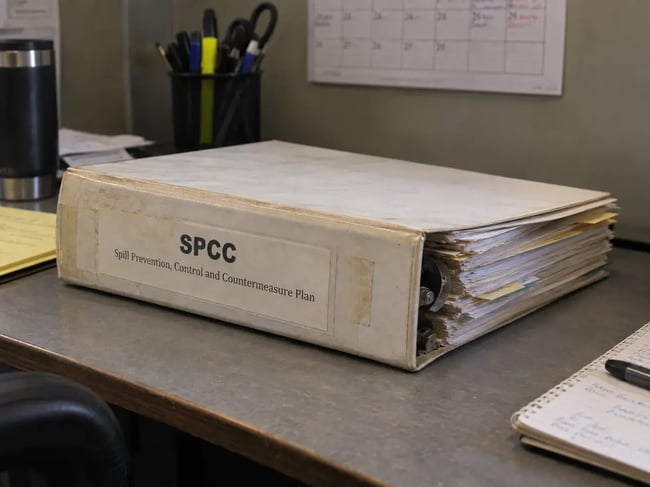
Nobody wakes up and decides to quietly violate SPCC regulations for a few years. It's almost always operational drift. The environmental manager leaves. Responsibilities get reassigned to someone with five other things on their plate. Operations get busy. The inspection checklist gets rushed. The binder stays in the cabinet. Eventually someone notices the review date and realizes it passed a while ago.
We see this especially often at manufacturing facilities, municipal operations, transportation yards, construction support facilities, older industrial sites, and multi-site operations where compliance management is spread across several people instead of owned by one. Another common pattern is assuming the SPCC Plan only matters during an EPA inspection. That's backwards. The plan is supposed to guide the inspections, operations, and spill prevention practices happening year-round, not sit in a drawer waiting to be pulled out when regulators show up.
Multi-site operations deserve a specific mention here, since they tend to be where this slips through most easily. When compliance responsibility is spread across five facility managers instead of centralized with one person, it's genuinely common for two or three sites to quietly drift out of review while the others stay current, and nobody notices until someone runs a companywide audit and compares dates side by side.
Do You Need a Full Rewrite, or Just an Update?
This depends heavily on the condition and age of the existing plan. If it's reasonably modern, organized, and mostly accurate, there's often no reason to start over. We tell clients this constantly: don't reinvent the wheel if you don't have to.
A good review should be able to identify the gaps, update the necessary sections, refresh the documentation, and get the plan moving again without disrupting everything else. That often means updating tank inventories, revising contact information, refreshing site maps, updating inspection procedures and containment descriptions, incorporating newer regulatory language, adding missing records, and correcting inconsistencies, along with a fresh PE certification if the amendments call for one. In a lot of cases this approach saves time and money, and facilities tend to appreciate keeping a plan structure their employees already understand rather than learning a brand-new document from scratch.
A helpful way to think about it: an update treats the plan as fundamentally sound with some outdated details, while a rewrite treats the plan as no longer a reliable foundation to build on. Most plans under five or six years past their review land in the first category. Plans that have drifted for a decade or more usually land in the second, which is exactly what the next section gets into.
If you're trying to get a sense of what this kind of project runs before reaching out, use the pricing calculator below.
What If Your Plan Is Extremely Old?
This is where things can change. We sometimes review plans that haven't been meaningfully updated in ten, fifteen, even twenty years. At that point there's a decent chance the regulations, the facility's operations, and the technical standards have all evolved enough that patching the old document becomes more work than it's worth.
There are some reliable signs a plan has crossed into rebuild territory: badly outdated formatting, missing required elements, handwritten edits scattered throughout, facility diagrams that don't match reality, tanks that no longer exist, obsolete regulations cited by name, no real amendment history, and generic template language that clearly wasn't written for this specific site. At some point, continuing to patch a document like that costs more effort than building a cleaner one, and there's real value in starting fresh when a plan has gotten that fragmented.
A properly rebuilt plan gives you a document you actually know has been checked against current regulations and current site conditions, and that confidence matters most during an inspection, an incident, an acquisition, or a management transition, which is exactly when you least want to be reading your SPCC Plan for the first time in years.
Why Keeping It Current Makes Life Easier, Not Just Compliant
A current SPCC Plan doesn't just satisfy a regulation. It makes day-to-day operations smoother. Inspections get easier. Training gets clearer, since the plan actually describes what employees are supposed to do. Spill response gets faster because the procedures match the equipment that's actually there. Documentation retrieval stops being a scavenger hunt, and audits get a lot less stressful when the paperwork tells a story that matches reality.
An outdated plan creates the opposite: uncertainty, and uncertainty tends to be expensive. One of the bigger risks with an old plan isn't really the document itself, it's what it reveals about the broader compliance program. If nobody's touched the SPCC Plan in years, an inspector may reasonably start wondering whether inspections were actually happening, whether annual reviews were documented, whether containment was maintained, and whether operational changes were ever evaluated at all. The paperwork tells the story of the compliance program, for better or worse, and staying current is almost always easier than trying to reconstruct that story after the fact. Who actually enforces SPCC plans is worth a look if you're wondering how seriously any of this gets taken in practice.
None of this is meant to scare anyone into panic mode. Most facilities that discover an overdue plan aren't facing an active enforcement action, they're facing a gap they get to close on their own terms. The facilities that end up in real trouble are usually the ones that found the problem and then sat on it anyway.
How RMA Helps
At RMA, we help facilities evaluate existing SPCC Plans, figure out whether an update or a full rewrite makes more sense, and take a confusing regulatory process off your plate either way. If you're not sure which category your plan falls into, when to update your SPCC plan, and whether you can do it yourself is a good next read.
If your SPCC Plan is outdated, questionable, or just overdue for a look, now's a good time to deal with it before it becomes a bigger problem. Call us, email us, or fill out the form on our contact page. There's no pressure and no obligation. We'll help you figure out where you stand, and you can decide what to do from there.

