What AI Can Help With When You're Drafting a Stormwater Plan, and What You'll Still Need to Verify Yourself
AI tools get more capable every month, so it's a fair question. If ChatGPT can draft a cover letter, summarize a regulation, and write working code, why couldn't it write the stormwater pollution prevention plan for your New Jersey facility? The plan is called a SWPPP in most places, an SPPP in NJDEP's permits, and you'll also hear SP3 or just the stormwater plan. It's a long document full of standard sections, which is exactly what these tools are good at producing.
Our answer is that you can use AI to help with pieces of the work, but we'd strongly advise against letting it write the plan. We've tried it, and we weren't impressed. In this article we'll cover where AI is useful, where it goes wrong, which NJDEP requirements and site conditions you have to check yourself, and what we think about where this is headed. If you'd rather talk it through, you can reach out to RMA, and we'll tell you plainly whether you need us.
Table of Contents
TL;DR
AI can help with outlines, wording, and checklists, but we advise against letting it write your New Jersey SWPPP. It can't see your site, it can invent features that don't exist, and it can mix up New Jersey's requirements with another state's. A SWPPP only works if it describes your real facility, and someone who has walked the property has to verify that. Use AI as a helper if you like, but the facts in the plan have to come from you and your permit.
What Can AI Do Well When Drafting a New Jersey SWPPP?
Credit where it's due. AI tools are good at language and structure, and a SWPPP has plenty of both. If you're starting from a blank page, an AI tool can suggest an outline, explain a regulatory term in plain English, or turn your rough notes into clean paragraphs. It can also take a messy list of inspection findings and tidy it into something readable, or rewrite a stiff procedure so your crew will follow it.
It's also handy for the supporting work around the plan. Drafting a one-page training handout, building a checklist from a procedure you already wrote, or summarizing a long guidance document you've already read are all reasonable uses. In each case you hand it facts you already have and ask it to organize them. The tool is working with what you gave it, so there's less room to invent things.
Where Does AI Go Wrong When Writing a New Jersey SWPPP?
The trouble starts when you ask the tool to supply facts instead of organize them. A SWPPP is a description of one specific facility: what's stored where, how water moves across the ground, which controls exist, and who's responsible for them. An AI tool has never seen your property. When you ask it to write that description anyway, it fills the gaps with whatever sounds plausible for a facility like yours, and plausible isn't the same as true.
That produces a few predictable problems. The tool can describe site features that don't exist, such as a containment berm, a covered storage area, or an oil/water separator that your facility doesn't have. It can reach for generic stormwater language that fits a federal permit or another state's program instead of New Jersey's. It can use the wrong permit name, since New Jersey has the Basic Industrial Stormwater General Permit (5G2), industry-specific general permits, and individual permits, and each has its own requirements. And it delivers all of this in a confident, polished tone, which makes the mistakes harder to spot than they'd be in a rough draft written by a person.
The last problem is the quietest one. A tool that's agreeable by design will tend to tell you what you want to hear. If you describe your yard as having no exposure when it plainly does, it's more likely to write that up smoothly than to question it. A plan needs someone willing to say the opposite.
What Happened When We Tried Using AI for SWPPP Writing?
We've tried it, and we were very unimpressed. The output looked professional on the first read, with the right section headings and a confident voice. Once we compared it against what a real SWPPP has to say about a real site, it fell apart. It couldn't know the facility, so it described a generic one, and parts of what it wrote about the site simply weren't true.
That matters to us for a practical reason. We don't use AI to produce client deliverables, and this is a big part of why. Our clients hire us because a senior person has looked at their site, asked the awkward questions, and written a plan that matches what's out there. A document that reads well but describes a different facility doesn't do that job. If you want to see what the real process looks like, our explainer on what a SWPPP is shows what goes into one.
Which NJDEP SWPPP Requirements Do You Have to Verify Yourself?
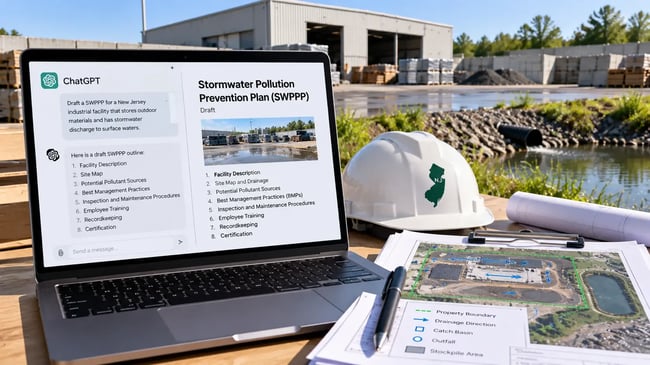
Whatever tool helps you draft, the regulatory content has to be checked against the source. New Jersey's rules differ by permit category, and NJDEP updates permits over time, so a summary from an AI tool, or from anywhere else, may be out of date or may describe a different permit than yours. The table lists what to confirm and where to look.
| What to Verify |
Why AI Can Get It Wrong |
Where to Check |
| Which permit you're under (5G2, an industry permit, an individual permit, or no exposure) |
Coverage depends on your activity, exposure, and where water goes, which the tool can't see |
Your NJDEP authorization and the current permit document |
| What your permit says the plan must contain |
Plan contents differ across permits and change when permits are reissued |
The plan section of your current permit and NJDEP's guidance for it |
| Sampling, reporting, and inspection duties |
Some permits require sampling and some don't, and the tool may borrow from another state |
Your permit's monitoring and reporting sections |
| Required forms and terminology |
New Jersey uses its own plan name and forms, and tools often default to federal or other states' versions |
NJDEP's current forms and guidance documents |
| Deadlines and update triggers |
Timelines are tied to your authorization date and permit renewals |
Your authorization and NJDEP's current permit notices |
| Citations and quotes |
AI tools can produce citations that look real and aren't |
The actual rule or permit text |
If you want a plain-language view of the New Jersey side, our guides to NJPDES stormwater permit requirements and the 5G2 Basic Industrial Stormwater Permit are good places to start. Treat any summary as a pointer, and read your own permit before you rely on it.
Which SWPPP Site Conditions Can Only Be Verified in Person?
Regulations are the part you can look up. Site conditions are the part nobody can look up, because they're only visible when you're standing on the property. This is where AI has the least to offer, since it's working with no information at all unless you describe everything in detail, and even then it's trusting your description.
NJDEP's guidance for the basic permit expects a site map showing buildings, paved areas, drainage patterns, discharge points, and every location where source materials are used, stored, or handled. It also expects an inventory of activities and materials, a list of any non-stormwater discharges, and an honest assessment of the controls already in place. Each of those depends on someone looking at the ground. Which way does the lot slope? Where does that downspout go? Is that drum really empty? Is the berm intact or cracked? A tool can't answer any of it, and a tool that answers anyway is guessing.
The best preparation is a real walk around the facility, ideally during or just after rain. Our guide to doing a stormwater visual inspection shows how to look at a site the way an inspector would, and our overview of stormwater BMPs explains the controls you'll be recording.
What Are the Risks of Submitting an AI-Written SWPPP?
The plan is the document an inspector asks to see, and it's supposed to match what they find when they walk outside. NJDEP's guidance for the basic permit describes an annual self-inspection meant to confirm that the description of materials and activities in the plan is correct and that the controls it lists are in place and working. A plan that describes a berm you don't have, or leaves out a drum storage area you do have, fails that test before anyone from the agency shows up.
There's a second risk that gets less attention. A plan that looks complete can give your team false comfort. If the document says the right things, people assume the right things are happening, and the gaps stay hidden until an inspection, a spill, or a sample result exposes them. A rough plan that's honest about its holes is more useful than a polished one that isn't.
There's also the matter of what you paste into a public AI tool. Site layouts, chemical inventories, and facility details can be sensitive, and many companies have policies about what can go into outside services. Check yours before you share anything about your operations. For questions about legal exposure from an inaccurate plan, an environmental attorney is the right person to ask, and we'd rather you did than guessed.
How Can You Use AI Safely Around Your SWPPP?
None of this means you should avoid AI entirely. It means giving it jobs where a mistake is easy to catch and the facts come from you. The table splits the work into the jobs that suit a tool and the ones that don't.
| Reasonable Uses (You Supply the Facts) |
Uses to Avoid |
| Suggesting an outline for notes you've already gathered |
Describing your site, drainage, or materials for you |
| Rewriting your own procedures in plainer language |
Stating what your permit requires |
| Turning inspection notes into a readable log |
Deciding which permit or exclusion applies to you |
| Drafting a training handout from an approved procedure |
Supplying citations, deadlines, or form names |
| Explaining a term you don't understand, then checking it against the permit |
Producing a site map or inventory you haven't confirmed on the ground |
Whatever it produces, read every sentence as if a stranger wrote it, because one did. Check each factual statement against your permit or your own eyes, and delete anything you can't confirm. If you'd like your team to understand stormwater basics before anyone touches the plan, our online environmental training library is a good starting point.
Will AI Be Able to Write a Reliable SWPPP Someday?
Maybe. These tools improve quickly, and it's possible that a future version, connected to the right site data and checked by a qualified person, could do much more of this work. We're not saying it never will. Only time will tell whether the technology can build a full stormwater plan you'd be comfortable relying on.
We just don't think it's there today, and the cost of being wrong falls on you, not on the software. Until a tool can see your site, know your permit, and be held accountable for what it writes, it makes a better assistant than an author. If that changes, we'll say so here.
How Does RMA Help With New Jersey SWPPPs?
Many facilities can write their own plan, and if yours is simple, you may not need us at all. Our article on whether you can write your own SWPPP helps you decide. When you'd like help, we're a New Jersey-based firm that's worked with NJDEP permits and New Jersey facilities for a long time. Senior staff do the work, and we don't use AI to produce client deliverables. We look at your site, write the plan to match it, and train your team to keep it current.
We also offer annual support after you're permitted, from reminders and inspection prep to plan updates, and you can keep it as hands-on or hands-off as you like. We're not the right fit for every job, and we'll say so if yours needs engineering design or a treatment system. If you'd like to talk it through, you can call us, email us, or fill out the form on our website with no obligation. Just contact RMA and we'll give you a straight answer about whether we can help.