Where Truck and Equipment Wash Water Can and Can't Go Under PAG-03, and What Pennsylvania Facilities Do Instead
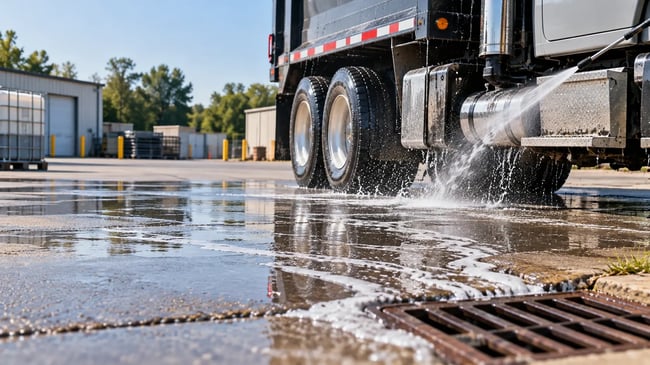
Pulling a dump truck or a loader out onto the lot and hosing it down feels about as harmless as yard work gets. It's water, the truck's dirty, and the storm drain is right there. But once that water hits the truck, it isn't rain anymore. It picks up degreaser, soap, oil, diesel film, brake dust, road salt, and whatever the truck hauled last week, then runs across your pavement toward an inlet that leads to a creek. Plenty of Pennsylvania facilities with a stormwater permit assume washing is covered because "it's just water." Usually, it isn't.
The short answer is that truck and equipment wash water generally can't go to a storm drain, ditch, or stream under Pennsylvania's PAG-03 industrial stormwater permit. Wash water isn't stormwater, and it isn't on the permit's short list of allowed non-stormwater discharges. Your realistic options are sending it to the sanitary sewer with the sewer authority's permission, capturing and recycling it, washing at a commercial wash facility, or in some cases getting a separate DEP approval. Below, we'll walk through what PAG-03 says, what DEP inspectors look for, and how each option works in practice. Every site is different, so if you're sorting out your own wash area, feel free to reach out to RMA and we'll talk it through.
Table of Contents
TL;DR
Water from washing trucks and equipment isn't stormwater, and Pennsylvania's PAG-03 stormwater permit doesn't list it as an allowed discharge, so you generally can't let it run to a storm drain, ditch, or stream. The usual fixes are the sanitary sewer with the sewer authority's permission, a contained wash pad with a recycling system, a commercial truck wash, or in some cases a separate DEP permit. Suds, sheen, and wet trails leading to storm inlets are easy for inspectors to spot. The right answer depends on your site, your sewer authority, and the current permit language.
Is Truck Wash Water Considered Stormwater in Pennsylvania?
No. Pennsylvania's regulations define stormwater as runoff from precipitation, snowmelt, and surface runoff and drainage. Water that comes out of a hose or a pressure washer doesn't fit that definition, no matter where it ends up. Regulators call it a non-stormwater discharge, and it's treated separately from the rain that falls on your yard.
A couple of quick definitions. NPDES is the federal Clean Water Act program for permitting discharges to surface waters, which DEP runs in Pennsylvania under the Clean Streams Law. PAG-03 is DEP's general permit for stormwater associated with industrial activity, used by manufacturers, recyclers, concrete plants, trucking terminals with maintenance areas, and many other facilities. It covers stormwater plus a narrow list of other discharges. Everything else needs its own path.
A typical truck wash carries detergents or degreasers, oil and grease, fuel residue, metals like copper and zinc from brake and tire wear, road salt in winter, sediment, and residue from whatever the truck hauled. That's closer to industrial wastewater than to rain, which is why it helps to understand the difference between stormwater and process water before deciding how your wash water gets handled.
What Non-Stormwater Discharges Does PAG-03 Allow?
The current PAG-03 general permit took effect on March 24, 2023, and expires on March 23, 2028. Part C of the permit lists the non-stormwater discharges a permittee can send out its outfalls alongside stormwater. The list is short, and vehicle and equipment washing isn't on it.
| Authorized Non-Stormwater Discharge |
Key Condition in PAG-03 |
| Emergency fire-fighting water |
Unplanned fire-fighting only |
| Potable water line, hydrant, and fire system flushing |
No measurable chlorine, with controls for solids |
| Air conditioner, cooler, and compressor condensate |
Uncontaminated |
| Irrigation drainage and landscape water |
No pesticides, herbicides, or fertilizers |
| Pavement wash water |
No detergents, no contact with oil, grease, or industrial pollutant sources |
| External building washdown and power washing |
No detergents or hazardous cleaners |
| Uncontaminated groundwater, spring water, and foundation drains |
Not contaminated with process materials |
| Incidental cooling tower mist |
Windblown mist only |
| Truck and equipment wash water |
Not on the list |
Each industry appendix can add sector-specific non-stormwater discharges, so read the appendix that applies to your facility. But the general rule runs the other way. PAG-03 says it doesn't authorize non-stormwater discharges, or stormwater carrying pollutants, that the permittee intentionally introduces, unless DEP approves them in writing. Washing a truck over a storm inlet is about as intentional as it gets. We cover the broader question in what you can discharge under an NPDES stormwater permit.
Why a Plain-Water Truck Rinse Usually Doesn't Fit PAG-03 Either
Skipping the soap helps, but it rarely gets you onto the list. The pavement wash allowance requires that the water not touch oil and grease or industrial pollutant sources, and a truck's undercarriage, wheels, and engine area are exactly that. The building washdown allowance covers buildings, not rolling stock. A detergent-free rinse is still wash water carrying oil, metals, and sediment off a vehicle.
What PAG-03 Requires for Truck and Equipment Washing Areas
PAG-03 doesn't just leave vehicle washing off the list. It also tells you how to run it. Under the pollution prevention BMPs that apply to every permittee, vehicle and equipment cleaning has to happen indoors, under cover, or in bermed areas that prevent runoff and run-on and capture overspray. The good housekeeping section adds that you can't hose down an area if it sends pollutants into a storm sewer without proper treatment, and that floor drain connections to storm sewers have to be eliminated.
So an outdoor wash spot on open pavement, draining to a storm inlet, doesn't meet the permit even before you get to where the water goes. A compliant wash area is contained. The water stays on a pad, gets collected in a sump or trench, and goes somewhere other than your stormwater system. Rain falling on that pad needs a plan too, which is one reason many facilities put a roof over the wash bay.
The wash area can also affect whether you need a permit at all. For trucking, bus, and similar transportation operations, stormwater permit coverage only applies to vehicle maintenance, equipment cleaning, and fueling areas. A terminal that sends every truck to a commercial wash and does maintenance indoors may not need PAG-03 coverage, while the same terminal with an outdoor wash rack might. Our guides on stormwater associated with industrial activity and general permits, individual permits, and No Exposure walk through how that call gets made.
What DEP Inspectors Notice When Truck Wash Water Reaches a Storm Drain
Wash water problems are some of the easiest things for a DEP inspector to find, because they leave a trail. Common signs include suds in a storm inlet, an oily sheen in a catch basin or at an outfall, a stained path from the wash spot to the nearest drain, a fan of fine sediment around an inlet grate, and an outfall flowing on a dry day.
Several of those signs are direct permit problems. PAG-03 prohibits discharging floating solids, sheen, foam, and substances that visibly change the receiving water. Your routine inspections are supposed to cover spots where non-stormwater could mix with stormwater, and your annual report has to document any unauthorized non-stormwater discharges. An inspector who finds wash water at an outfall your records never mention has two issues to write up instead of one. We describe the full visit in what happens during a PA DEP stormwater inspection.
Wash water also skews your sampling. Residual oil, zinc, and suspended solids can push results over benchmark values, and two consecutive monitoring periods over a benchmark at the same outfall trigger a corrective action plan. On the legal side, the Clean Streams Law prohibits discharging industrial waste to waters of the Commonwealth without a permit, and civil penalties can reach $10,000 per day for each violation. If DEP has already cited your facility, it's worth talking to an environmental attorney alongside your compliance help.
Sending Truck Wash Water to the Sanitary Sewer in Pennsylvania
For facilities on public sewer, routing the wash bay to the sanitary sewer is often the most practical fix. The key word is permission. Your local sewer authority or municipal treatment plant decides whether it will accept wash water and under what conditions. Plumbing a wash pad into a sanitary line without approval just trades a stormwater violation for a sewer use violation.
Authorities handle this differently. Some approve it with a simple letter. Others require an industrial user permit, a grit trap and oil/water separator ahead of the connection, periodic sampling, flow limits, or extra fees. Ask before you design the wash bay, because their conditions often decide what equipment you need. Once a separator is in, it has to be pumped and maintained, or it stops working and the authority will notice.
Some older Pennsylvania cities, including Philadelphia and Pittsburgh, have combined sewers in parts of town, where stormwater and sewage share pipes that flow to a treatment plant. At a site like that, the sewer authority may govern your runoff instead of a DEP stormwater permit, and local rules may differ from what we've described here. Don't assume either way. Confirm with the authority and your municipality how your site drains and what they require. Two more cautions apply everywhere. Wash water shouldn't go into an on-site septic system, and many Pennsylvania municipal stormwater ordinances prohibit wash water in the municipal storm sewer on their own terms.
Using a Wash Water Recycling System for Trucks and Equipment
For facilities without sewer access, or with a sewer authority that won't take the volume, a closed-loop recycling system is the next common answer. The wash pad drains to a collection sump, the water runs through settling, oil separation, and filtration, and then it gets reused for the next wash. Done well, nothing leaves the pad as a discharge.
Recycling still creates obligations. The sludge, oily solids, and spent filters that build up are wastes that need to be characterized and disposed of properly. Many end up managed as residual waste, and some can test hazardous depending on what's washed off. Recycled water eventually gets too dirty to reuse, so you'll need a plan for periodic disposal through a hauler or an approved sewer connection. Rain is the other design question. An uncovered pad collects precipitation along with wash residue, and an undersized system can overflow in a heavy storm. A covered pad, or a system sized for rainfall, avoids that. Any vendor should be able to explain how their system handles rain, sludge, and spent water at your volume.
Washing Trucks at a Commercial Truck Wash Instead of On Site
Sometimes the simplest answer is not washing on site at all. A commercial truck wash already has the drainage, treatment, and approvals for its discharge, so the wash water stops being your problem when the truck leaves your gate. For a small fleet, paying per wash plus some drive time can easily cost less than building and maintaining a compliant wash bay. A lot of facilities don't need a consultant for this piece. The trade-offs are scheduling, downtime, and whether a nearby wash can handle your equipment, since concrete mixers, dump bodies, and heavy equipment don't fit every bay.
Mobile wash contractors are a different story. If a mobile service washes your fleet in your parking lot, the runoff is still leaving your site and reaching your storm drains. Ask how they contain and collect the water and where they take it, and put those expectations in the contract. A contractor who just sprays and leaves can still get you cited.
When a Separate DEP Permit for Truck Wash Water Makes Sense
In some cases, a facility can seek DEP approval to discharge treated wash water to surface water. That usually means an individual NPDES permit for the wash water as an industrial wastewater discharge, with effluent limits and monitoring written for your site. It's a much bigger undertaking than PAG-03, with more application work, a longer review, and ongoing treatment and sampling.
There are knock-on effects too. PAG-03 states that a facility with an individual NPDES permit for non-stormwater discharges can't use PAG-03 for its stormwater, because the stormwater gets folded into the individual permit. PAG-03 also doesn't authorize building or modifying treatment facilities, so a treatment system may need its own DEP approval. This route tends to make sense only for large, continuous wash operations where the other options don't work. And letting wash water soak into gravel or the ground isn't a loophole. The Clean Streams Law protects groundwater as waters of the Commonwealth, and infiltrating wash water without approval can create its own problem.
Comparing Truck Wash Water Options for Pennsylvania Facilities
Here's how the options stack up. None of them is right for every site, and plenty of facilities combine two, such as a contained bay for quick rinses and a commercial wash for heavy cleaning.
| Option |
Who Approves It |
Usually Fits |
Watch Out For |
| Sanitary sewer |
Local sewer authority |
Sites on public sewer |
Pretreatment conditions, separator upkeep, fees |
| Recycling system |
None for discharge if truly closed loop |
Sites without sewer or with high volume |
Sludge disposal, rain on open pads |
| Commercial truck wash |
The wash facility |
Small fleets with a wash nearby |
Downtime, oversized equipment |
| Separate DEP permit |
PA DEP regional office |
Large, continuous operations |
Effluent limits, losing PAG-03 eligibility |
Concrete trucks deserve a separate mention. Washing out a mixer drum creates high-pH water full of cement fines, and it's handled differently from washing a truck's exterior. Ready-mix plants usually manage washout through settling pits and reclaim systems as process water, which we cover in our producer's guide to concrete plants and stormwater permits.
How Truck Washing Fits Into Your PPC Plan, Inspections, and Training
Whatever route you choose should show up in your paperwork. Pennsylvania's stormwater plan is the Preparedness, Prevention, and Contingency (PPC) Plan, and PAG-03 requires it to identify potential pollutant sources and the BMPs that control them. Your wash area belongs in it, along with how the water is collected and where it goes, and the plan's site map has to show non-stormwater discharge locations. Our comparison of SWPPPs and PPC Plans for PAG-03 explains how the plan comes together.
Your semiannual inspections should include the wash area and the nearest storm inlets, using the approach in our guide to doing a stormwater visual inspection the right way. PAG-03 also requires notice to DEP before planned physical changes that could significantly change pollutant discharges, so check a new wash pad against that requirement. Training ties it together. PAG-03 requires pollution prevention training at least once a year, and the person holding the pressure washer decides where the water goes on a busy afternoon. Our online environmental training library is one place to start, and our overview of stormwater BMPs shows how washing controls fit with everything else on site.
How RMA Helps Pennsylvania Facilities Manage Truck Wash Water
We're a family-run environmental consulting firm based in New Jersey, and we work with facilities across Pennsylvania on PAG-03 coverage, No Exposure Certifications, PPC Plans, and the inspections and sampling that come with them. When wash water is part of the picture, we can look at how your site drains, figure out which options are realistic for your operation, check how washing affects your permit coverage, and build your approach into your PPC Plan and training. If the honest answer is that you just need to send your trucks to a commercial wash, we'll tell you that too.
There's no pressure and no obligation. Give us a call, send us an email, or fill out the form on our website, and we'll talk through what's going on at your facility. If a second set of eyes on your wash area would help before DEP's next visit, get in touch with RMA and we'll help you sort out the next step.


