Writing a New Jersey Stormwater Plan Without a Consultant: What Your Staff Can Handle and Where Your Permit or Facility Calls for Help
If your New Jersey facility needs an industrial stormwater permit, you've probably looked at the paperwork and wondered whether someone on your staff could just write the plan. New Jersey's rules call it a Stormwater Pollution Prevention Plan, or SPPP, and you'll also hear it called an SP3 or simply the stormwater plan. Most of the industry says SWPPP, so that's the term we'll use here. The plan is the core document under your NJPDES permit (the New Jersey Pollutant Discharge Elimination System, the state's version of the federal NPDES program, run by the New Jersey Department of Environmental Protection, or NJDEP), and NJDEP inspectors read it closely.
The short answer is yes, you can write it yourself. New Jersey doesn't require a consultant, and the Basic Industrial Stormwater General Permit (5G2) doesn't call for a professional engineer to prepare or stamp the plan. Whether you should is a different question, and it comes down to which permit covers you and what your site looks like. A facility that works entirely indoors can often get through the job with NJDEP's forms and a patient staff member. A scrap yard, a quarry, or a plant with outdoor storage and sampling duties is a different animal. Below, we walk through what a New Jersey SWPPP has to contain, what your team can do on its own, and where it makes sense to reach out to RMA.
Table of Contents
TL;DR
Yes. New Jersey doesn't require a consultant or any special credential to write a SWPPP, and the Basic Industrial Stormwater permit (5G2) doesn't require an engineer to prepare it. A facility that keeps everything indoors, with someone who can handle monthly inspections and annual training, can usually write the plan from NJDEP's forms. The job gets harder with an industry-specific permit, outdoor operations, sampling, process wastewater, or a drainage setup nobody has mapped. Those are the cases where an experienced second set of eyes saves time and heads off violations.
Can You Legally Write Your Own SWPPP in New Jersey?
Nothing in New Jersey's stormwater rules requires a license, a certification, or a consultant to write a SWPPP. The permit asks for a plan, not for a particular kind of author. If your facility is covered by the 5G2, the plan doesn't need a professional engineer's stamp either. Industry-specific permits and individual permits can add conditions of their own, so the permit in your hands is always the final word. If you want the basics first, our explainer on what a SWPPP is covers them.
Writing it yourself doesn't move the responsibility anywhere. You're the permittee, so a plan that doesn't match your facility is your problem whether a staff member wrote it or a consultant did. The plan and your inspection records stay on site, and NJDEP can ask to review them when an inspector visits. That's the test for any SWPPP: would it hold up if someone walked your yard with it in hand? We cover the general, all-states version of this question in our take on creating your own SWPPP. This article is the New Jersey version.
What Does a New Jersey SWPPP Have to Include?
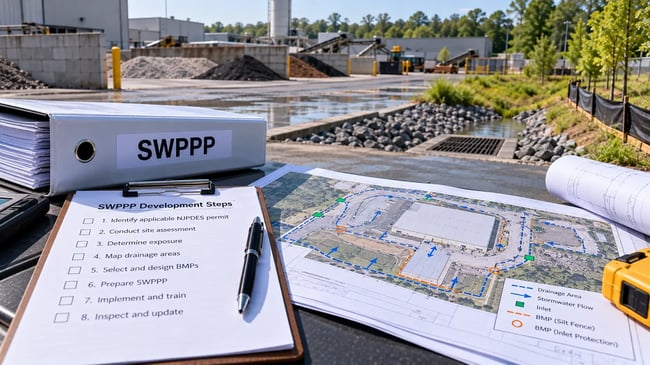
The Basic permit's content requirements fall into a handful of pieces. They call for a named Stormwater Pollution Prevention Team with a leader who has the authority to make decisions, a preventative maintenance program, a schedule for regular inspections with the records kept on site, and a method for evaluating the plan each year ahead of the annual certification. NJDEP also publishes SPPP forms that walk through the rest, including the inventory of activities and materials, the site map, and the best management practices (BMPs), which are the physical and procedural controls that keep pollutants away from rain. The table below shows which pieces staff usually handle well.
| Plan piece |
What it covers |
Who usually handles it well |
| Stormwater Pollution Prevention Team |
Named people, a team leader, and each person's responsibilities |
Staff |
| Activities and materials inventory |
What you do, what materials you handle, and any non-stormwater discharges |
Staff, if someone knows the whole operation |
| Site map |
Buildings, paved areas, drainage paths, discharge points, and where materials are used or stored |
Staff on a simple site, help on a complex one |
| Best management practices |
Covers, indoor storage, housekeeping, spill response, and similar controls |
Staff for simple fixes, help for choosing and sizing controls |
| Inspections and preventative maintenance |
A maintenance schedule, monthly inspections, and an annual comprehensive inspection, all documented |
Staff |
| Employee training |
Annual training for the people who work in exposed areas or run the program |
Staff, with training materials from outside |
Industry-specific permits add their own requirements on top of this skeleton, so read the plan contents section of your own permit instead of assuming the Basic list covers you.
Which NJPDES Permit Does Your SWPPP Have to Follow?
New Jersey doesn't have one industrial stormwater permit, and that's the first thing to settle because the plan has to follow the permit you're under. Writing a 5G2 plan from a quarry's permit, or the reverse, is a quick way to end up with a plan that misses what your permit asks for. We go through the choice in which NPDES permit you need and in our guide to NJPDES stormwater permit requirements. Here's the short version.
| Coverage |
Who it generally fits |
What it means for writing the plan |
| No exposure certification |
Industrial facilities where nothing is exposed to rain or snowmelt |
No stormwater permit to write a plan for, but the bar is high and the facility has to stay that way |
| Basic Industrial Stormwater General Permit (5G2) |
Industrial facilities that aren't covered by an industry-specific permit and keep their materials and activities indoors or under cover |
The simplest plan in the state, and the 5G2 doesn't require stormwater sampling |
| Industry-specific general permits |
Concrete Products Manufacturing (CPM), Hot Mix Asphalt (R4), Mining and Quarrying (R13), Sand and Gravel (RSG), Scrap Metal (SM and SM2), Vehicle Recycling (RVR), and Wood Waste Recycling and Leaf Composting (WRC) |
Plan contents and monitoring vary by permit, so the plan has to be built from your specific permit |
| Individual NJPDES permit |
Facilities that don't fit any of the above |
Requirements are written for your site, which is where outside help pays off most |
The industry-specific permits exist because those operations work outdoors and can't realistically move inside. If you're a scrap metal facility, our guide to the SM2 scrap metal permit shows how different that plan gets, and concrete producers can look at our guide to concrete plants and stormwater permits. For the 5G2, start with our walkthrough of the 5G2 Basic Industrial Stormwater permit. If you can't tell which row you're in, settle that before anyone starts writing, because the answer changes the whole plan. Our posts on no exposure and individual permits cover the two ends of the range.
Where Can Staff Write a New Jersey SWPPP on Their Own?
For a facility on the 5G2, the plan is mostly a record of how you keep materials indoors or covered and how you check that you're doing it. A careful staff member can do that work. The simpler the operation, the less a consultant adds to the plan itself, and we'd rather tell you that than sell you something you don't need.
Your team is in good shape to write its own SWPPP when most of these are true. Your permit is the 5G2, or you're certifying no exposure. Your materials and activities really are indoors or under cover. There's one obvious path stormwater takes off the site. Someone on staff knows every corner of the operation. And that person has time for monthly inspections, an annual comprehensive inspection, and annual training for as long as the permit lasts. The writing is a one-time job. The inspections and records keep going, so pick someone who'll still own them in three years.
How Do Staff Handle Monthly and Annual SWPPP Inspections?
The monthly inspection is a walk around the areas exposed to rain and snowmelt, looking for trash buildup, uncovered materials or dumpsters, leaks or spills outside, the discharge point, and the condition of the building exterior. Write down what you saw and what you fixed. Once a year, you repeat the walk with more rigor and add a review of the plan, your inspection records, and your training records. Our guide to doing a stormwater visual inspection shows what a good one looks like.
Annual training can take many forms, from a webinar to a classroom session to a team discussion, as long as you document who attended, what you covered, and who ran it. If you'd rather not build the content yourself, you can read how 5G2 training works online or look through our online training library. If everything in this section describes your facility, you may not need us for the plan at all.
Where Do Permit Complexity and Facility Conditions Call for SWPPP Help?
None of these situations make it illegal to write your own plan. They make it easier to get wrong, and the cost shows up at the next inspection. The table below lists the ones we see most.
| Situation |
Why it complicates the SWPPP |
| An industry-specific or individual permit |
Plan contents, monitoring, and reporting differ from the Basic permit, and the permit text is longer and denser |
| Outdoor storage and operations |
Choosing BMPs that work and are affordable takes experience, and a poor choice means paying twice |
| Process water or wash water on site |
Stormwater permits generally don't cover it, so the plan has to show where it goes and what authorizes that |
| Unclear drainage |
Multiple outfalls, discharges to groundwater, run-on from a neighbor, or runoff that goes to a sewerage authority instead of a stream all change what the plan has to say |
| Oil storage on site |
The SWPPP and an SPCC plan overlap, and the two need to agree with each other |
| A prior violation or a recent inspection |
NJDEP will read the plan closely, and the fix has to be right the first time |
| A facility you just bought or took over |
The old plan may describe operations that no longer exist, or leave out ones that do |
Where your runoff ends up changes what the permit expects, so a site near sensitive waters or draining to a combined sewer deserves a closer read. If your site drains to a sewerage authority, the authority's rules may apply instead of, or alongside, an NJPDES stormwater permit, and we'd tell you to confirm that directly with the authority. Our guide to SPCC plans versus SWPPPs explains how the two documents fit together, and the post on stormwater versus process water covers the wastewater question.
A plan that describes a tidier facility than the one an inspector walks into is one of the easier ways to pick up a violation. Our list of common NPDES permit problems shows what that looks like in practice. And if what your site needs is engineering, such as a treatment system or regrading, that's work for an engineering firm, not for us or for a template.
How Do Sampling and Process Water Change a New Jersey SWPPP?
Sampling requirements vary by permit category in New Jersey, and some permits require none. The 5G2 doesn't require stormwater sampling, which is a big part of why it's the easiest permit to handle in-house. Where a permit does require sampling, the lab generally has to be certified in New Jersey, and results go to NJDEP on discharge monitoring reports (DMRs). That adds a second job on top of the plan: collecting samples during storms, getting them to the lab in time, and reporting results correctly.
We don't send someone to collect your samples. Storm windows are short and unpredictable, and your people know the facility better than we do, so we train your team to sample correctly instead. Our posts on why you need to take your own stormwater samples and on whether you can take your own samples go through the reasoning.
Process water is the other place plans go wrong. Stormwater permits generally don't authorize process wastewater, wash water, non-contact cooling water, or sewage, and NJDEP's guidance has long said that discharging them without separate authorization can violate the state's Water Pollution Control Act and NJPDES rules. Concrete plants, vehicle wash areas, and anywhere equipment gets rinsed outdoors should get a careful look.
What Does a New Jersey SWPPP Cost to Write Yourself Versus Hiring Help?
Writing it yourself costs staff time instead of cash. The permit's annual agency fee is the same either way, and the amount changes over time, so check NJDEP for the current number. The other cost is whatever the plan makes you fix. A new covered storage area, a fully enclosed dumpster, or a regular sweeping contractor are typical examples, and you'll pay for them whoever writes the plan. What DIY saves is the writing hours, and on a simple plan that can be a meaningful amount.
On 5G2 projects, a site visit to confirm the permit fits, the application, the plan, and training for your team have typically run us about $1,500 to $5,000, depending on how complex the facility is. Industry-specific and individual permits tend to cost more because the plans and requirements carry more work. We're not the cheapest option, and we don't try to be. Senior staff do the work, and the lowest bid is usually a template with your company name pasted in. Our NPDES permit cost guide breaks down the rest of the numbers, and the pricing calculator below gives you a ballpark for what RMA's help with your New Jersey stormwater work would cost.
What About Construction Stormwater and Your New Jersey SWPPP?
People use "SWPPP" for construction projects too, and in New Jersey that's a separate track from the industrial plan this article covers. Construction stormwater coverage under the 5G3 general permit, soil erosion and sediment control certification through the Soil Conservation District, stormwater management design for major development under N.J.A.C. 7:8, and municipal site plan approvals all belong to the building phase. RMA doesn't prepare any of them. Those usually go through your engineer, your contractor, or a soil erosion specialist, and we're glad to help you work out what the construction phase needs and point you to the right people.
Once the building is up and running, though, a new or expanded facility almost always needs operational permits and plans. That means the right NJPDES industrial permit or a no exposure exclusion, a SWPPP, inspections, annual certification, training, sampling where the permit requires it, and often an SPCC plan or Community Right to Know reporting. That's where we help.
How Does RMA Help With a New Jersey SWPPP?
We're a family-run firm based in New Jersey, and we've been doing environmental compliance work since 1992. If you want help, we can write the plan, train your team on it, and support you after the permit is in place with reminders, help reading results, plan and annual reporting updates, and inspection prep. If you want to write it yourself, tell us where you're stuck and we'll say so plainly when you don't need us. Our guide to using your new stormwater plan helps either way.
We're also honest about fit. We're a small firm with senior staff doing the work, so we're sometimes pricier than other consultants and we can only sometimes meet very tight timelines. We don't do engineering design, treatment system construction, or large construction stormwater projects, and a very large portfolio of facilities may be more than we can take on. If you'd like to talk through your situation, you can call us at 888-RMA-0230, email info@rmagreen.com, or fill out the form on our website. There's no pressure and no obligation, and you're welcome to contact RMA with questions at any stage.