Why the Stream Near Your New Jersey Business Might Matter, and Where Category One Protections Do and Don't Reach
If you run a business in New Jersey, there's a decent chance a stream, creek, or drainage ditch sits somewhere near your property. There's a smaller chance that someone has recently called it "Category One." It might have come from your engineer during a site review, from a town planner when you asked about an expansion, or from a purchase or lease document. Most facility managers have never heard the term, and the name doesn't tell you whether it's good news, bad news, or something you can ignore.
Category One, often shortened to C1, is a higher tier of protection that the New Jersey Department of Environmental Protection (NJDEP) gives to certain streams, lakes, and reservoirs. The designation mostly reaches new building near the water and new or expanded wastewater discharges into it. It doesn't, by itself, decide whether an existing facility needs a stormwater permit. This article covers what C1 means, which rules attach to it, how to check a stream near your site, and how to tell real impact on your facility from background noise. If you'd rather talk it through with someone, you can reach out to RMA at any point.
Table of Contents
TL;DR
Category One (C1) is NJDEP's higher level of water quality protection for streams, lakes, and reservoirs with exceptional ecological, recreational, water supply, or fisheries value. It mostly affects new development, through a 300-foot buffer along the stream under the state's flood hazard and stormwater rules, and new or expanded wastewater discharges, through stricter limits meant to keep the water as clean as it is today. It doesn't by itself decide whether an existing facility needs a stormwater permit, but it's worth checking a nearby stream's status before you expand, buy, or lease a site.
What Are Category One Waters in New Jersey?
NJDEP sorts every surface water in the state into one of three tiers of what it calls antidegradation protection. Antidegradation is a long word for a simple idea: the better the water is, the less NJDEP lets anyone lower its quality. At the top are Outstanding National Resource Waters, which include the state's FW1 waters and Pinelands waters. Category One is the middle tier, and Category Two is the default for everything else. In Category Two waters, NJDEP may allow some lowering of existing water quality when there's a social or economic justification. Category One waters are protected from any measurable change in their existing water quality.
A stream doesn't land in Category One by default. NJDEP designates each one through rulemaking in its Surface Water Quality Standards (N.J.A.C. 7:9B), and the water has to qualify for at least one of four reasons: exceptional ecological significance, exceptional fisheries resources, exceptional water supply significance, or exceptional recreational significance. In practice, an ecological designation usually means suitable habitat and documented occurrences of aquatic species that are threatened or endangered, such as bog turtles and dwarf wedge mussels. A fisheries designation covers trout production waters and waters approved for unrestricted shellfish harvest. A water supply designation covers systems serving more than 100,000 people, including the reservoirs and the streams that flow into them. NJDEP has added to the list over the years, including a large round of upgrades that took effect in April 2020, so a stream that wasn't Category One when your site was developed may be Category One today.
Category One isn't a pollution label. A C1 stream is often one of the cleanest in its area, and the designation exists to keep it that way. It's also a different thing from the impaired waters list and TMDLs, which track waters that already fail water quality standards. The two lists answer different questions, so a stream's status on one doesn't tell you its status on the other.
What Extra Protections Apply to Category One Waters?
The C1 designation works as a trigger. NJDEP and many towns write other rules that key off it, and those rules land on different people. The one that governs discharges is the New Jersey Pollutant Discharge Elimination System (NJPDES), NJDEP's permit program for anything that goes into the state's waters, including regulated stormwater. The ones that govern land are the flood hazard rules and the stormwater management rules. Here's how they line up.
| Rule set |
What it does for Category One waters |
Who feels it most |
| NJPDES rules (N.J.A.C. 7:14A) |
New or expanded wastewater discharges must maintain existing water quality. A discharge upstream of a C1 segment has to meet a "no measurable change" standard at the C1 boundary. |
Facilities with process water or treated wastewater discharges |
| Flood Hazard Area Control Act rules (N.J.A.C. 7:13) |
A 300-foot riparian zone on each side of the water, extended to upstream tributaries in the same HUC 14 watershed. |
Anyone building, clearing, grading, or filling near the stream |
| Stormwater management rules (N.J.A.C. 7:8) |
A 300-foot special water resource protection area for major development. |
Owners and developers of larger projects |
| Municipal riparian ordinances |
Some towns have adopted their own buffer rules that mirror the state's. |
Anyone needing local approvals |
A riparian zone is simply the land and vegetation along a stream. For waters that aren't Category One, the state's riparian zones are generally narrower, 150 feet for certain trout-related waters and 50 feet for most others, so 300 feet is a big step up. HUC 14 is NJDEP's name for a small watershed unit, and the practical point is that the buffer follows tributaries. A small feeder stream can carry the same 300-foot zone as the named C1 stream it flows into.
Why Do Category One Waters Matter for New Development and Expansions?
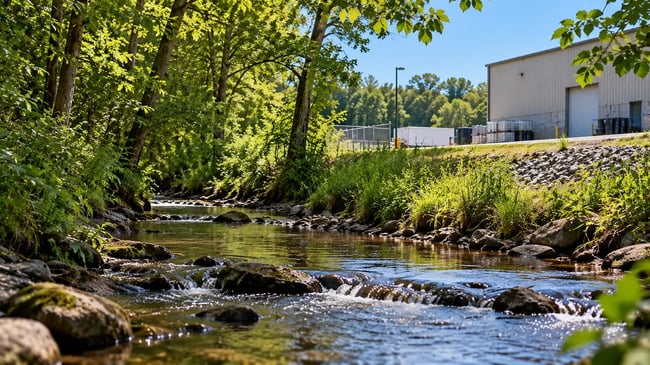
The 300-foot riparian zone is where most businesses run into Category One. It's measured outward from the top of the stream bank on both sides, or from the centerline of the stream where the bank isn't well defined. NJDEP regulates activities like clearing vegetation, grading, filling, and building inside the zone, generally through Flood Hazard Area permits. For individual permits, NJDEP's own FAQ says applicants have to show that development or redevelopment within 150 feet of the water is unavoidable, minimized, and in the public interest. That's a hard case to make for a convenience expansion, like a bigger storage yard.
The stormwater management rules add a second layer for larger projects. Major development, generally projects that disturb an acre or more of land, with exact thresholds (including thresholds for new paved or roofed area) set out in N.J.A.C. 7:8, has to preserve a special water resource protection area along C1 waters and along perennial or intermittent streams that drain into them. As the rule is written, encroachment is allowed only in limited cases where the applicant shows the area's function and overall condition will be maintained to the maximum extent practicable, and the remaining protected area can't be reduced below 150 feet.
For a business owner, this means a lot that looks buildable on a site plan can have a big slice of it sitting inside a buffer. It affects a new building, a larger truck court, added paving, a new stormwater basin, or even regrading along a back fence. It's worth checking before you buy or lease, because the buffer follows the land and not the owner.
A word on where we fit. Flood Hazard Area approvals, major development stormwater design, soil erosion and sediment control certification, construction stormwater coverage, and municipal site plan approvals all belong to the construction and design phase, and RMA doesn't prepare any of them. Those usually run through your engineer, your contractor, and land use professionals. What we do handle is what a facility needs once it's running: the right NJPDES industrial stormwater permit or a no exposure exclusion (for facilities whose materials and activities are fully sheltered from rain), a stormwater pollution prevention plan (SWPPP, sometimes called an SPPP, an SP3, or just a stormwater plan), inspections and annual certifications, sampling where the permit calls for it, and often SPCC plans or Community Right to Know reporting. We can also help you figure out which construction-phase questions to ask and point you toward the right people.
Does Category One Change NJPDES Stormwater Permit Requirements for Existing Facilities?
For most existing facilities, a Category One stream next door doesn't change whether you need an NJPDES stormwater permit. Coverage turns on your industry, whether your materials and activities are exposed to rain, which permit category fits, and where your water goes. New Jersey uses the Basic Industrial Stormwater general permit (5G2), several industry-specific general permits, individual permits, and a no exposure exclusion, and our guides on the 5G2 basic industrial stormwater permit and on when an individual NJPDES industrial permit applies walk through how to tell them apart. Nothing in the NJDEP Category One materials we reviewed turns a nearby C1 stream into a stormwater permit trigger on its own. Permit conditions can differ by category, though, so read the one that applies to you.
Where C1 can matter to an existing operation is wastewater. If your facility discharges process water or treated wastewater to a water that's designated C1, or to a stream above a C1 segment, the antidegradation rules apply. New or expanded discharges have to maintain existing water quality, and an existing permitted discharger may see tighter limits when its permit is renewed or modified after a stream is upgraded. That's one more reason to keep stormwater and process water straight, because they're handled under different permit terms.
Existing buildings and pavement are a separate question. The riparian zone rules generally regulate new activity, like construction, clearing, and fill, and they don't order you to tear out what's lawfully in place. Expansions, reconstruction, and clearing trees are where the buffer starts to bite. Here's how the common situations break down.
| Your situation |
What Category One may mean |
Who to talk to |
| Existing facility, stormwater only, no changes planned |
The designation doesn't by itself decide permit coverage. Keep your stormwater plan accurate. |
Your stormwater consultant |
| Existing facility with a process water or wastewater discharge to a C1 water |
Antidegradation limits may apply at permit renewal or modification. New or expanded discharges must maintain existing water quality. |
Your permit consultant and engineer |
| Expansion, new building, or new paving near the stream |
The 300-foot riparian zone and special water resource protection area may limit where you can build. |
Your engineer, land use professionals, and NJDEP land use staff |
| Buying or leasing a site |
Buffers can take usable acreage off the table before you sign. |
Your engineer and attorney, early |
One practical habit helps in every row. When your SWPPP describes where site water goes, it should name the receiving stream correctly and match what NJDEP's current maps show. Plans written years ago sometimes carry an outdated stream name or an old classification, and that's easy to fix at the next annual review.
How Do You Check Whether a Stream Near Your Facility Is a Category One Water?
NJDEP offers free tools for this, and you don't need a consultant to use them. NJ-GeoWeb has map layers for Category One waters and for surface water quality classifications, and NJDEP updated them to reflect the April 2020 rule changes. The Category One Waters Story Map lets you type in an address, see nearby C1 waters, and click a stream to read why it was designated. The official lists live in the Surface Water Quality Standards at N.J.A.C. 7:9B-1.15, and NJDEP's Category One waters page links to the maps and fact sheets.
Small streams take a little more care. Unnamed or unlisted streams generally take the classification of the water they flow into, and the rules have extra steps for working out whether an unlisted stream could be Category One, so confirm with NJDEP or your engineer if your stream isn't named on the map. Remember too that the 300-foot buffer follows upstream tributaries in the same HUC 14 watershed, so a ditch well away from the named C1 stream can still carry one. Your town may also have its own riparian ordinance, and maps sometimes lag behind rulemaking, so check the date on whatever you're looking at. If the answer affects a purchase, a lease, or a building plan, get a written determination from the people who'll be signing off on the work.
How Does RMA Help New Jersey Facilities Near Category One Waters?
If your only question is whether a nearby stream is Category One, the NJDEP tools above will answer it for free, and you don't need us. Where we help is the part that comes after: working out which NJPDES stormwater permit your facility fits (5G2, an industry-specific permit, an individual permit, or no exposure), getting your SWPPP into shape, training your team to take their own samples correctly, and planning the operational permits and plans a facility needs once an expansion is finished. We're a family-run firm based in New Jersey, we work with NJDEP's permit programs all the time, and senior staff do the work themselves.
We don't prepare construction-phase approvals or engineering design, and we'll say so up front if your question belongs with someone else. If you'd like to talk through your site, you can call, email, or fill out the form on our website, and there's no pressure or obligation. Just contact us and tell us what you're dealing with, and we'll let you know whether we're the right fit.