How New Jersey Scrap Yards Reduce Stormwater Exposure With Covers, Covered Storage, Paving, and Drainage Improvements
If your yard has an NJPDES stormwater permit, or should have one, you've probably wondered whether covering scrap piles and processing areas is worth the money. The short answer is yes for the materials that do the most damage to your runoff, meaning oily and fluid-coated scrap, turnings, fines, batteries, and anything leaking at the processing equipment. A roof over the entire yard rarely pays off. The right answer depends on where your pollutants come from and where your water goes.
This article walks through the permit that applies to New Jersey scrap yards, the cover and containment options for each part of the site, how paving and drainage fit in, and how to weigh the costs against what you get back. It also covers what to check before you build. Every yard is different, so if you want a second set of eyes on yours, feel free to reach out to RMA.
Table of Contents
TL;DR
Yes, cover the materials and areas that contribute the most pollution: oily scrap, fluids, batteries, turnings, fines, and the equipment that leaks. NJDEP expects fluid storage and draining to happen on sealed, covered surfaces, and it's inspecting scrap yards. Most yards get the best return from covered containers, sealed storage pads, sweeping, and drainage control before they spend money on roofs or repaving. A full-yard roof rarely pays off, and building anything brings approvals outside RMA's scope that your engineer or contractor handles.
Why Does Covering Scrap Piles and Processing Areas Matter for NJ Stormwater Compliance?
Rain doesn't care what's in your yard. It lands on a pile of mixed ferrous, an open shear, a stack of oily engine blocks, and a puddle under a leaking hydraulic hose, and then it runs toward whatever drain or low spot is nearest. Everything it picks up on the way becomes your discharge. Covering piles and processing areas works because it attacks the problem before the water is dirty. Keeping rain off a pollutant is almost always cheaper than cleaning up the water afterward.
New Jersey's Department of Environmental Protection (NJDEP) has been clear that it's watching this sector. A recent NJDEP compliance advisory for scrap metal and vehicle recycling operations says its Division of Water Enforcement will inspect all permitted scrap metal and vehicle recycling facilities. If an inspector finds problems, the typical first step is a Notice of Violation with corrective actions. Serious or uncorrected items can move to formal enforcement, which may include penalties. The same advisory says facilities that should have a permit and don't are exposed to enforcement too. If you've already received a notice, an environmental attorney is worth a call alongside any consultant.
The good news is that most yards don't need to roof the whole property. The goal is to find the handful of areas and materials that do the most damage to your runoff and deal with those first. The sections below walk through the permit that applies, the cover and containment options for each part of a yard, what they cost, and what to check before you build anything.
Which NJPDES Stormwater Permit Applies to a New Jersey Scrap Yard?
New Jersey regulates rainwater that runs off industrial sites through the New Jersey Pollutant Discharge Elimination System, or NJPDES. For most scrap yards, the permit that fits is the Scrap Metal general permit, known as SM2. NJDEP lists the older SM permit as expired and no longer available. Yards that also dismantle vehicles and sell used parts may fall under the Vehicle Recycling general permit, known as RVR, depending on what they do. NJDEP's advisory treats both groups together, and it says some operations need an individual permit instead. We cover how those categories compare in our guide to the SM2 scrap metal permit and in our article on general, individual, and no-exposure options.
Here's the part that matters for covering. Under SM2, NJDEP's advisory says facilities must sample stormwater discharges quarterly and submit the results, inspect the facility at least quarterly and keep a detailed log, and develop a Stormwater Pollution Prevention Plan (SPPP) and keep a copy on site. The SPPP is New Jersey's name for the written plan describing how you keep pollutants out of runoff. Sampling and reporting details differ between permit categories, so confirm them against the current permit document for your category before you rely on a summary, including ours.
Some readers ask whether covering everything gets them out of the permit through the no exposure exclusion. Rarely. That exclusion generally requires that industrial materials and activities are protected from rain, snow, and runoff, and a yard that processes scrap outdoors usually can't get there. Whether a specific site qualifies depends on the layout, the activities, and where the water goes. Where it drains matters too. Water that goes to a surface water body, to groundwater, or to a sewerage authority can bring different rules, so confirm where your site's drains really lead before you plan any capital project.
How Do You Reduce Stormwater Exposure at a Scrap Yard Processing Area?
Processing areas, meaning the shears, balers, torch cutting stations, and any place you break down or sort material, tend to be the dirtiest parts of the yard per square foot. EPA's industry fact sheet for scrap recycling lists leaks from hydraulic reservoirs, hose and fitting connections, worn gaskets, and fuel tanks among the typical sources, along with residue from the scrap itself. Those leaks drip onto the ground and sit there until the next storm moves them.
The strongest fix is a roof or canopy over the equipment, paired with a sealed surface underneath that contains drips and spills. It keeps rain off the work area and gives you a place to catch and clean up releases before they reach a drain. When a permanent cover isn't practical, the next best step is moving the dirtiest activity under cover and leaving the rest of the yard open.
For scrap piles themselves, the trade association guidance for scrap recyclers recommends covering material when feasible, including ahead of expected storms, and layering several controls rather than relying on one. In practice that means tarps or covers on piles of material that are oily or fluid-coated, covered roll-off containers for the cleaner streams, and a plan for who covers what when the forecast turns. Tie the task to a person and a trigger, like a rain forecast above a set chance, and write it into the SPPP so inspectors see it's part of how you operate.
The table below compares the common options by what each one handles and how the costs generally compare. We're using relative cost on purpose, because actual prices swing widely with site conditions, materials, and contractor availability.
| Option |
Best for |
Relative cost |
Main tradeoff |
| Tarps or covers on piles |
Oily or fluid-coated piles that are stored for a while |
Low |
Labor every time you add or remove material, and they wear out |
| Covered roll-offs and bins |
Turnings, fines, small parts, sweepings |
Low to moderate |
Needs a leak-tight container and regular hauling |
| Canopy over processing equipment |
Shears, balers, cutting areas, fluid draining |
Moderate to high |
Construction approvals, crane and loader clearance |
| Covered, sealed storage area |
Batteries, fluids, oily parts |
Moderate |
Fire and ventilation questions, especially for lithium batteries |
| Paving, curbing, and grading |
Controlling where water goes across the yard |
High |
Construction approvals and more runoff volume from added hard surface |
| Sweeping and housekeeping |
Dust, fines, and tracked-out debris |
Low, ongoing |
Only works if it's scheduled and logged |
| Drain inserts and treatment |
Catching what covers and cleanup miss |
Low to high |
Treats the problem instead of preventing it, and needs maintenance |
How Should Turnings and Fines Be Managed to Keep Them Out of Runoff?
Turnings, the curly metal chips from machining, are a headache because they're often coated in cutting oil and they're small enough to wash or blow anywhere. Fines are the dust, grit, and small fragments that build up around loading, sorting, and processing. Both are easy to overlook because they don't look like a pile. They look like the ground, and the ground is exactly what the next storm rinses.
For turnings, the cleanest approach is to keep them in covered, leak-tight containers or under a roof on a sealed pad with a way to catch any oil that drains out. Letting them sit in an open pile on bare ground or cracked pavement is the situation that tends to show up in oily, metal-heavy samples.
For fines, sweeping is the control that pays for itself fastest. A scheduled sweep, with a mechanical or vacuum sweeper where the site allows, takes the material off the surface before rain can move it, and it leaves a record you can show an inspector. Sweep before forecast storms, not only on a calendar. Don't hose fines toward a drain to get rid of them, and keep sweepings out of catch basins. What you do with the collected material depends on what it contains, so characterize it before you decide where it goes. Residue from shredding operations has its own solid waste rules, so if that's part of your operation, check how it's handled separately from the stormwater permit.
These materials are also a good place to use your visual inspection. Walk the drainage paths after a storm and look for sheen, staining, and fines that have collected at drains. Those spots tell you where a cover, a container, or a berm will do the most good.
How Do You Store Batteries and Fluids Under Cover at a Scrap Yard?
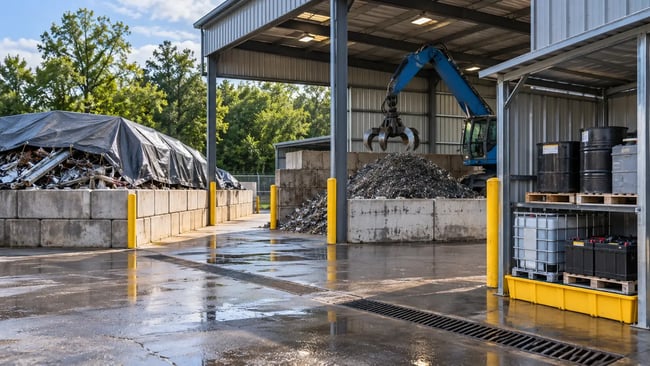
Fluids and batteries are where cover matters most and costs least. NJDEP's advisory lists several practices it expects at these facilities. Fluid storage, vehicle parts with oily or coolant residues, and oily scrap belong on sealed, covered surfaces that contain spills. Draining and dismantling of fluid-containing parts should happen indoors or under cover on sealed surfaces, unless the stormwater from that area is collected for proper disposal. Processed vehicles should be kept with their hoods closed so rain doesn't run through the engine bay. All fluids other than those in sealed units should be drained and disposed of properly.
The advisory also covers the people side. Keep spill kits where work happens, train every employee on spill response each year, respond to spills right away, and dispose of used absorbent properly.
Batteries follow the same logic. Store them under cover, in containers suited to the battery type, and keep damaged ones separate. In New Jersey, batteries are generally managed under the state's universal waste rules, which have their own requirements for containers, labeling, and how long material can accumulate, so check those alongside your stormwater plan. Lithium-ion batteries add a fire consideration. Before you put them under a roof or inside a building, talk with your local fire official and your insurer about separation, spacing, and ventilation. A cover that solves a stormwater problem and creates a fire problem isn't a good trade.
If you store enough oil in tanks and containers above ground, an SPCC plan may also apply. Spill Prevention, Control, and Countermeasure plans cover oil storage and spill response, and they overlap with stormwater controls at fluid storage areas.
What Paving and Drainage Improvements Reduce Scrap Yard Stormwater Pollution?
Covers and containers reduce what's on the ground. Paving and drainage decide where the water goes when it rains anyway. A yard with cracked, pitted surfaces and no clear flow path sends runoff wherever gravity and old ruts take it. A yard with sealed work areas, defined grades, and known discharge points lets you control and, if necessary, treat what leaves.
The first step costs almost nothing: map every drain, swale, low spot, and outfall. The SM2 permit has asked scrap yards to document where their runoff goes through a drainage control plan, and the plan only works if the map matches what's really on the ground.
From there, the usual improvements fall into a few groups. Sealed, graded pads under the processing, fluid draining, and dirty storage areas keep spills from soaking in and direct them to a collection point. Curbs and berms around those areas hold water back and keep clean runoff from the rest of the yard from mixing with it. Catch basin inserts and filters trap sediment and some oil at the inlet, and they're cheap enough to try early, though they need regular cleaning to keep working. Treatment systems such as oil and water separators sit at the end of the line. They have a place, but they treat contamination you've already created, and they come with maintenance and monitoring costs of their own.
One tradeoff deserves a mention. Adding pavement increases the volume and speed of runoff, which can create new problems downstream and may bring its own review requirements. Plan paving with the whole drainage picture in view, not as a fix for one dusty corner.
What Does Covering Scrap Piles Cost Compared to Not Covering Them?
There's no universal price for a canopy, a paved pad, or a covered storage bay, because the numbers depend on size, soil, utilities, local approvals, and the market on the day you bid. What we can lay out is how to weigh them, so you can put your own contractor quotes into the comparison.
On the cost side, count the structure or surface itself, site work and drainage changes that come with it, ongoing maintenance and replacement, and the operating drag. Covers that have to be put on and taken off cost labor every time. Roofs can limit crane and loader access. Enclosed storage can bring fire code and insurance questions.
On the benefit side, start with the stormwater permit itself. Cleaner runoff means fewer sampling results that miss the permit's design criteria, and every miss carries follow-up, with extra BMPs or treatment if NJDEP's advisory language on this is any guide. We've published a ballpark of roughly $2,000 to $3,000 or more per year for sampling and testing under SM2, and that number grows when you're resampling and investigating. Less contamination also means a smaller treatment system, or none, and less sediment cleanup around drains. And it lowers the odds that an inspection ends in a Notice of Violation and corrective action order.
The practical method is to rank each area by how much pollutant it contributes compared with what it costs to control. Housekeeping, covered containers, and a battery and fluid storage pad usually come first, because they're cheap and they address the worst materials. Roofing a processing area and repaving come next, when your sampling or inspections show a persistent problem those smaller steps haven't fixed. Whole-yard roofs rarely make sense. Be careful with promises, too. No cover guarantees a passing sample, and a poorly maintained one can fail as badly as no cover at all. What we help facilities do is match the control to the problem, so you don't pay for a building when a bin and a broom would have done it. Our NPDES pricing calculator below gives a ballpark for RMA's help with the permit and plan side of this work. It isn't an estimate of what the roofs and paving will cost, and for what a permit itself runs, see our guide on what an NPDES permit costs.
If your sampling results are already coming back high, start with what's in the samples and where they were taken. Our article on high sampling results walks through that process, and it usually points to one or two areas where a cover will have an outsized effect.
What Should You Check Before Building Covers or Paving at a New Jersey Yard?
Building anything at a yard brings approvals that sit outside the stormwater permit. Roofs and canopies usually need local building and zoning approval. Grading or paving that disturbs enough ground can trigger soil erosion and sediment control certification through your county's Soil Conservation District. Adding enough new hard surface can also bring stormwater management review under N.J.A.C. 7:8, the state's stormwater management rules. Which of these apply, and at what thresholds, depends on the size and type of the project, so ask your engineer or contractor early.
We want to be plain about our role here. RMA doesn't prepare construction-phase permits or approvals, including soil erosion and sediment control certification, major development stormwater management design, or municipal site plan approvals. Your engineer, contractor, or a soil erosion specialist handles those. We can help you work out what the stormwater permit side needs from a project, which areas are worth building for, and who to bring in for the construction piece.
Once the work is done, the operational side kicks in. Update your drainage map and your SPPP to show the new covers, pads, and drains. Train the people who use them, add them to your quarterly inspections, and watch your next sampling results to see whether the change did what you expected. A new canopy that isn't in the plan won't count for much when an inspector asks how you control exposure, and our online training library can help with staff training on the permit side.
How Does RMA Help New Jersey Scrap Yards Reduce Stormwater Exposure?
We're a family-run firm based in New Jersey, and our senior staff do the work themselves. For scrap yards, that usually means walking the site with you, mapping drainage, identifying the areas contributing most to your runoff, and helping you build or update the SPPP, inspection routine, and sampling plan around controls you can afford to keep up. We'll also tell you when a cheaper fix will do the job. If a few covered containers and a sweeping schedule solve your problem, you don't need a consultant to tell you to build a roof.
If you'd like to talk it through, there's no pressure and no obligation. You can call, email, or contact us through the website and tell us what your yard looks like and what NJDEP or your sampling results have been saying. We'll give you a straight read on where to start.