Why a Storm Drain at Your Property Line Doesn't Get You Out of Pennsylvania's Industrial Stormwater Rules, and When a Combined Sewer Changes the Answer
A lot of facility managers assume that if site runoff drops into a storm drain instead of running straight into a creek, it becomes the town's problem. The thinking makes sense on the surface. The pipe belongs to the municipality, the municipality has its own state permit, so surely your runoff is covered by someone else's paperwork. In most cases, that isn't how Pennsylvania DEP sees it.
This article walks through why a discharge to a municipal storm sewer is still a discharge to a stream as far as the industrial stormwater rules go, what DEP expects from facilities that drain this way, and how to tell whether your site is even in the program. We also cover the one situation where the answer really does change: a site that drains to a combined sewer that runs to a sewage treatment plant, which you'll find in parts of some older cities. If you'd like a second set of eyes on where your drains go, you're welcome to reach out to RMA, and we'll tell you straight if you don't need us.
Table of Contents
TL;DR
In most cases, yes, you still need DEP coverage. If your site is in a category the industrial stormwater program covers, DEP says a discharge to a municipal storm sewer or a private storm sewer still requires PAG-03 coverage or a No Exposure Certification, and the town's own permit doesn't cover you. The exception is a site that drains to a sewer that's part of a public sewage treatment plant, such as a combined sewer in an older city, where the sewer authority's rules can take the place of a DEP stormwater permit. Because that varies from site to site, the first job is finding out where your drains really go.
Does Discharging to a Municipal Storm Sewer Still Count as a Discharge to Waters?
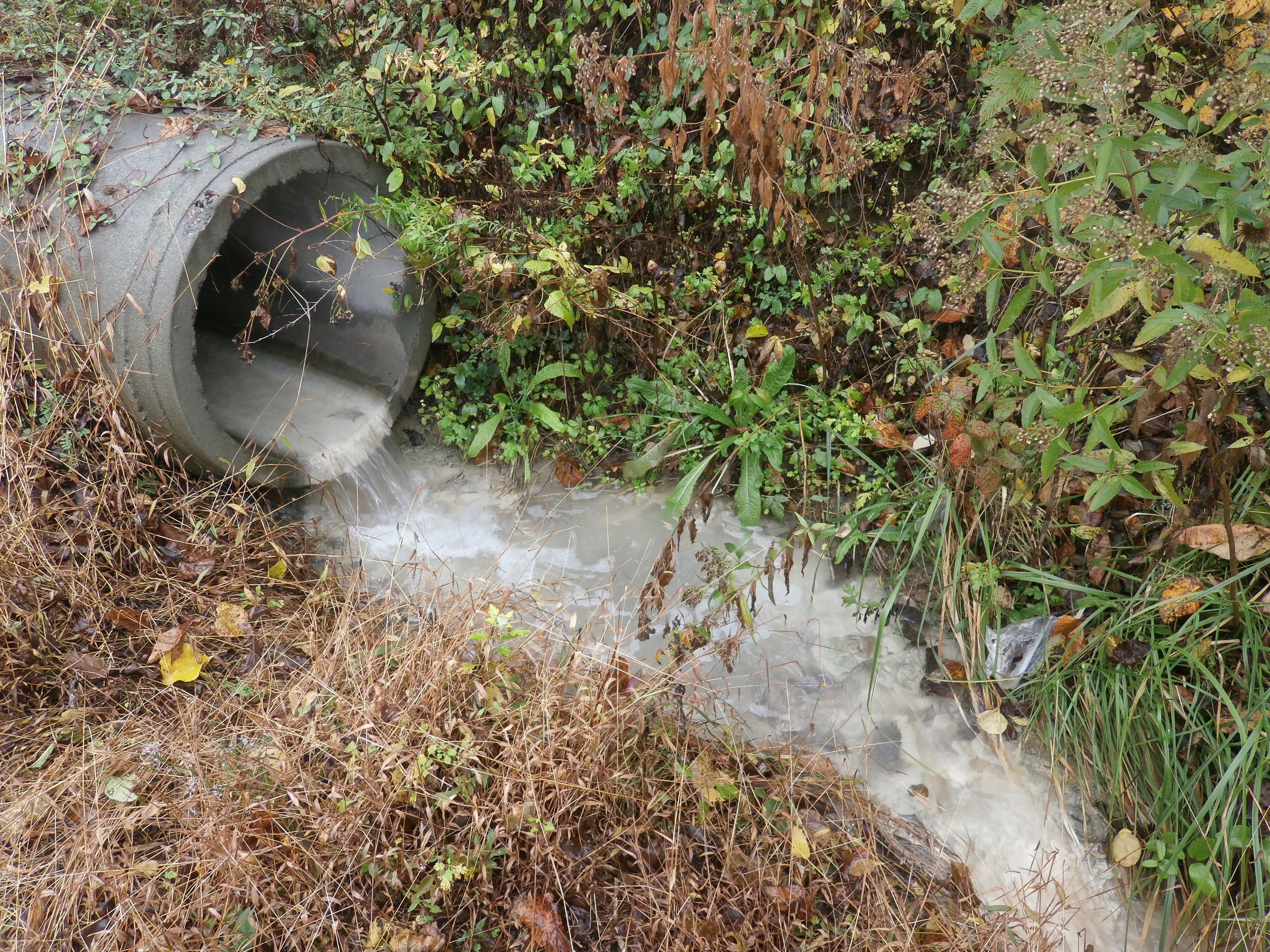
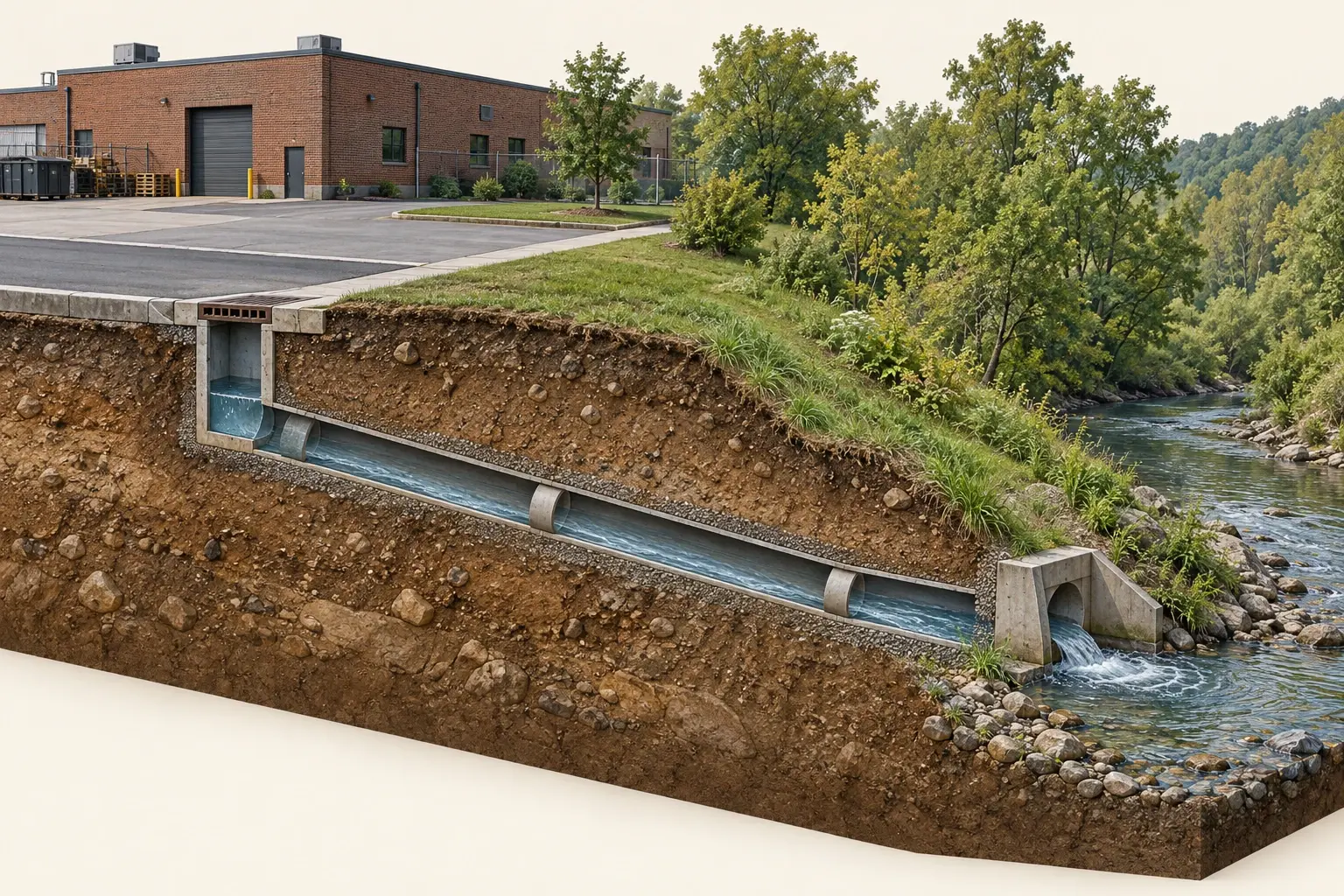
Yes, in most cases it does. Under the federal rules that Pennsylvania follows, stormwater that runs off covered industrial areas and into a municipal storm sewer is still a discharge to the streams and rivers that sewer empties into. The storm sewer is only a conveyance. It's a set of inlets, pipes and ditches that carries your runoff, usually untreated, to the nearest waterway. DEP's own industrial stormwater FAQ answers this head on: every facility in the covered categories that discharges to a municipal separate storm sewer system or a private storm sewer has to apply for permit coverage or a No Exposure Certification.
A few terms come up in that answer, so here they are in plain words. NPDES stands for National Pollutant Discharge Elimination System, the permit program under the federal Clean Water Act that DEP runs in Pennsylvania. PAG-03 is DEP's general permit for stormwater from industrial sites. A general permit is a standard permit that many similar facilities can sign onto by filing a form, instead of getting a custom permit written for each one. A No Exposure Certification, which people shorten to NEC, is a way for qualifying facilities to stay out of the permit by showing that nothing industrial is exposed to rain or snow.
The part that surprises people is the town's permit. Municipalities that own a storm sewer system usually hold their own NPDES permit for it. DEP's instructions for the PAG-03 notice of intent state that an industrial facility discharging to a DEP-permitted storm sewer can't claim the municipality's permit covers its runoff. The industrial site needs its own coverage. The town is responsible for its system, and you're responsible for what you put into it.
What Is an MS4, and How Is It Different From a Private Storm Sewer?
MS4 is short for municipal separate storm sewer system. It's a system of storm drains, pipes and ditches owned by a public entity such as a borough, township, county or PennDOT, built to carry stormwater to a stream. Two things keep a system from being an MS4. It can't be a combined sewer, and it can't be part of a publicly owned sewage treatment plant. If a pipe carries only runoff and ends at a creek, and a public body owns it, you're looking at an MS4.
A private storm sewer is the same kind of system with a different owner, such as a business park, a landlord or your own company. DEP treats both the same way for permitting. Industrial sites that fall into a covered category need coverage whether their runoff enters a public pipe or a private one. If you're a tenant in an industrial park, DEP's guidance says the park owner can apply for a single permit or the tenants can apply together as co-permittees, and DEP will accept separate filings from each tenant if that's the only workable route.
Basins work the same way. If your runoff goes to a retention basin that only overflows in big storms, DEP still expects coverage or an NEC when any discharge is possible. The definition of stormwater associated with industrial activity decides which parts of your property count.
How Do PAG-03 and No Exposure Certification Work When You Drain to an MS4?
The process is the same as for any other PAG-03 facility, with a few extra steps tied to the storm sewer. On the notice of intent, which is the form you file with DEP to request coverage, you state whether your outfalls discharge to a storm sewer and whether it's an MS4. You name the owner or operator and list the outfalls that feed it. If you can't tell whether it's an MS4, DEP's instructions say to ask the municipality. DEP also expects the MS4 operator to be told about your discharge, and an NEC application includes evidence of that notification.
The operator stays in the loop after you're covered. A permittee that discharges to an MS4 sends a copy of each annual report to the operator, and if a spill or pollution incident happens, the operator gets the same notice DEP does.
Beyond those steps, the usual PAG-03 duties apply. You need a Preparedness, Prevention and Contingency Plan, which DEP calls a PPC Plan and which plays the role a SWPPP plays in other states. You inspect the site, train employees at least once a year, sample stormwater twice a year at representative outfalls, and report results through DEP's eDMR system. Our guides to PAG-03 and stormwater sampling, PPC Plans and eDMR reporting cover each in detail.
If every industrial material and activity at your site is under a storm-resistant shelter, a No Exposure Certification may let you skip PAG-03. You still file with DEP, and DEP has to approve it, so you aren't simply exempt. DEP charges a $500 fee every five years for an NEC and no annual fee, and the certification isn't available to sites that discharge to High Quality or Exceptional Value waters. Our explanation of what no exposure means goes through what DEP looks for. PAG-03 has the same limit, so if your storm sewer ultimately empties into one of those streams, confirm your options with DEP first.
Does Your Facility Even Need Industrial Stormwater Coverage From DEP?
Plenty of facilities don't, and we'd rather you hear that from us than pay for a permit you don't need. The program covers sites whose primary industrial activity or primary SIC code is listed in the federal regulations at 40 CFR 122.26(b)(14). An SIC code is the Standard Industrial Classification number that describes what a business does, and DEP decides your primary one by which activity brings in the most revenue. If only a secondary activity is on the list, you generally don't need coverage unless DEP determines that pollutants in your runoff make it necessary.
The covered list includes many kinds of manufacturing, recycling and certain waste operations. Transportation businesses such as trucking, bus and rail operations are covered only for their vehicle maintenance, equipment cleaning and fueling areas. Warehouses, body shops, dealerships, quick-lube shops and most contractors often fall outside the list, though that depends on the SIC code and on what happens outdoors at the site. Indoor-only facilities in covered categories usually still file an NEC rather than doing nothing.
DEP also keeps the authority under Pennsylvania's Clean Streams Law to require a permit from any facility whose runoff carries pollutants, whether or not the facility is on the federal list. If you're unsure where you land, start with our guides on who needs a stormwater permit and which NPDES permit applies. Local rules can differ too, since municipalities and sewer authorities sometimes add their own requirements and fees.
What Changes If Your Site Drains to a Combined Sewer?
A combined sewer carries stormwater and sanitary sewage together in a single pipe, usually to a sewage treatment plant. These systems were common when older cities were built, and parts of some Pennsylvania cities, Philadelphia and Pittsburgh among them, still have them. Because the water goes to a treatment plant instead of a stream, DEP handles it differently. According to DEP's industrial stormwater FAQ, if runoff from a covered site flows into a separate sanitary sewer or a combined sewer that's part of a publicly owned treatment works, permit coverage or an NEC isn't required.
That isn't the same as having no rules. The FAQ says those discharges are still subject to the federal pretreatment regulations in 40 CFR Part 403, and that the treatment plant should be notified of any discharge to its system. In practice, the sewer authority sets the conditions. Depending on the authority, that can mean a connection approval, limits on what goes down the drain, fees, or a refusal to take new stormwater flow. DEP says directly that stormwater to separate sanitary sewers and new or increased stormwater to combined sewers is highly discouraged. What a particular authority allows varies by authority and by pipe.
There's a second catch. If the combined or sanitary sewer isn't part of a publicly owned treatment works, DEP says coverage or an NEC is required. A single site can also drain several ways at once, with a parking yard going to a creek through a municipal storm sewer while a loading dock ties into the sanitary side. Each drainage area has its own answer, so don't assume the whole property follows one rule.
How Do You Find Out Where Your Storm Drains Go?
Start with paper and finish with a site walk. Pull the site plans, as-built drawings and any utility maps you have, then walk the property, ideally during or right after a rain, and mark every inlet, roof leader, trench drain and outfall. Look for where the water leaves the site, and follow it as far as you can see. Two drains that look identical can lead to a stream and a treatment plant.
Then ask the people who own the pipe. The municipality's public works department can usually tell you whether the storm sewer in front of your property is a separate system that discharges to a stream, and the local sewer authority can tell you whether a sanitary line is combined and whether it feeds a treatment plant. If drawings and neighbors can't settle it, an engineer or plumber can run a dye test or camera inspection to trace a line. Write down what you learn, because DEP's forms ask for it and the answer shapes everything else.
Here's how the common destinations break down under DEP's published guidance.
| Where your drain goes |
DEP coverage for a covered industrial site |
What else to check |
| Directly to a stream, ditch or by sheet flow |
PAG-03, an individual permit, or an NEC |
Whether the stream is High Quality or Exceptional Value |
| Municipal separate storm sewer (MS4) |
PAG-03, an individual permit, or an NEC |
Notifying the MS4 operator, and sending it annual reports |
| Private storm sewer |
PAG-03, an individual permit, or an NEC |
Who owns it, and whether tenants share one permit |
| Sanitary or combined sewer that is part of a public treatment plant |
Not required, per DEP's FAQ |
Pretreatment rules, notifying the plant, and the authority's own conditions |
| Sanitary or combined sewer that is not part of a public treatment plant |
PAG-03, an individual permit, or an NEC |
Who operates the system and where it ends up |
What Does PAG-03 Coverage Cost for a Site That Drains to an MS4?
Draining to a storm sewer doesn't change DEP's fees. PAG-03 coverage carries a $500 notice of intent filing fee for new coverage, plus a $500 annual installment that's due each March 23 once you've had a full year of coverage. An NEC carries the $500 five-year fee mentioned earlier and no annual charge. The current PAG-03 runs through March 23, 2028.
The larger cost is the work that sits behind the application. Someone has to walk the site, map the drainage and outfalls, write the PPC Plan, arrange sampling for the application, assemble the package and, after approval, keep up with sampling, inspections, training, eDMR and annual reports. What drives the price is the number of outfalls, the size and complexity of the site, whether a plan already exists, and how much sampling the permit appendix for your industry calls for. Our article on what a PAG-03 permit costs in Pennsylvania breaks these factors down. If you'd like a number for your own situation, the pricing calculator below gives an instant estimate of what RMA's help with NPDES and stormwater permitting would run.
How Can RMA Help Figure Out Your Stormwater Discharge Path?
We're based in New Jersey and work with facilities across Pennsylvania on PAG-03 coverage, individual NPDES permits and No Exposure Certifications. When a facility isn't sure where its drains go, we start there. We review your site, work out which outfalls feed a storm sewer, a stream or a sanitary line, and tell you what that means for your permit options. If your runoff goes to a public treatment plant and DEP coverage isn't required, we'll say so and point you to the sewer authority. If you do need coverage, we can prepare the PPC Plan, the maps and the application, and stay with you through DEP's review and the sampling and reporting that follow.
There's no pressure and no obligation. You can call us, send an email, or fill out the form on our website, and a member of our team will talk through your situation and tell you honestly whether we're the right fit. When you're ready, contact RMA and we'll point you in the right direction.