How to Check Federal SPCC Requirements and Pennsylvania PPC Requirements Separately, and Where One Oil Spill Plan Can Cover Both
Facilities that store oil in Pennsylvania often hear from one person that they need an SPCC Plan and from someone else that they need a PPC Plan, and nobody can say whether those are the same document. They aren't. An SPCC Plan (Spill Prevention, Control, and Countermeasure Plan) is a federal oil spill prevention plan required under 40 CFR Part 112, and EPA Region 3 enforces it in Pennsylvania. A PPC Plan (Preparedness, Prevention, and Contingency Plan) is a DEP document tied to permits and activities that involve pollutants, most often industrial stormwater coverage under PAG-03. The short answer is that you need both only when your facility meets the federal oil storage threshold and also holds a Pennsylvania permit or program that calls for a PPC Plan.
This article shows how to run each test on its own, where the two plans overlap, and whether combining them into one document makes sense. If you'd rather have someone look at your site and tell you what applies, you can reach out to RMA and we'll help you sort it out.
Table of Contents
TL;DR
You need an SPCC Plan if your facility stores more than 1,320 gallons of oil aboveground, counting only containers of 55 gallons or more, and a spill could reasonably reach a waterway. You need a Pennsylvania PPC Plan if a permit or DEP program calls for one, most often PAG-03 industrial stormwater coverage. Many facilities need only one of the two, and some need both. When both apply, the plans cover much of the same ground and can be combined, but the SPCC portion keeps its own certification rules, and a combined plan submitted to DEP can be reviewed by DEP.
What Is the Difference Between an SPCC Plan and a Pennsylvania PPC Plan?
The two plans come from different places and answer to different agencies. An SPCC Plan covers oil only. A PPC Plan is a Pennsylvania document that covers every pollutant at the facility, including fuels, oils, chemicals, and wastes. DEP's requirements trace back to 25 Pa. Code § 91.34, which applies to activities that store or use pollutants and lets DEP require a plan, and DEP's guidance on environmental emergency response plans explains what the plan should contain.
Pennsylvania's storage tank program adds a third plan, the Spill Prevention Response Plan (SPRP), for larger aboveground tank facilities. Here's how the three compare.
| Plan |
What triggers it |
Who enforces it |
Filed with an agency? |
| SPCC Plan |
More than 1,320 gallons of aboveground oil in containers of 55 gallons or more (or more than 42,000 gallons completely buried), plus a reasonable expectation of a discharge to navigable waters or adjoining shorelines |
EPA, Region 3 in Pennsylvania |
No, kept on site |
| PPC Plan |
A permit or program that calls for one, such as NPDES permits (including PAG-03), certain waste facilities, and some hazardous waste generators |
Pennsylvania DEP |
Attached to a PAG-03 application. Other programs vary. |
| SPRP |
Regulated aboveground tank capacity over 21,000 gallons under 25 Pa. Code Chapter 245 |
Pennsylvania DEP |
Yes, filed with DEP |
How Do You Know Whether Your Facility Needs an SPCC Plan?
Three questions decide whether the federal rule applies, and all three have to be yes. First, is your facility non-transportation-related? A fixed site like a plant, yard, shop, or data center is, while storage that's part of regulated transportation falls under DOT or Coast Guard rules. Second, does your aboveground oil storage capacity exceed 1,320 gallons, counting only containers of 55 gallons or more, or does your completely buried capacity exceed 42,000 gallons? Third, could a spill reasonably be expected to reach navigable waters or adjoining shorelines? That answer comes from geography alone, like slope, distance to a stream, and where drainage leads, and EPA doesn't let you count man-made features like dikes or containment. Our guide on figuring out whether you need an SPCC Plan walks through the same test.
What Counts Toward the 1,320 Gallon SPCC Threshold?
Most of the confusion is in the counting. EPA counts capacity, not contents, so an empty 5,000 gallon tank counts in full while a permanently closed one doesn't.
| Counts toward the 1,320 gallons |
Does not count |
| Diesel, gasoline, hydraulic oil, lube oil, and used oil in containers of 55 gallons or more |
Containers smaller than 55 gallons |
| Oil-filled equipment such as transformers and hydraulic systems |
Permanently closed containers |
| Animal fats and vegetable oils, including cooking oil and used cooking oil |
Fuel tanks that power the vehicle or equipment they're mounted on |
| Empty tanks, because capacity is what counts |
Propane and DEF |
| Fuel trailers and skid tanks |
Completely buried tanks subject to the federal UST rules |
If you do cross the line, the next question is who certifies the plan. A facility with 10,000 gallons or less of aboveground oil can qualify to self-certify if, in the prior three years, it has had no single discharge over 1,000 gallons to navigable waters and no two discharges over 42 gallons each within 12 months. With no container over 5,000 gallons, it's a Tier I qualified facility and can use EPA's streamlined template. With a larger container, it's a Tier II qualified facility and writes a full self-certified plan. Everyone else needs a PE-certified plan. Our articles on the different types of SPCC Plans and professional engineer requirements cover the details. When a plan needs a PE, we work with an outside professional engineer who reviews and seals it, which adds time and cost.
Whichever type you have, the plan needs a review at least every five years and an amendment when your facility changes, which our article on SPCC Plan 5-year reviews explains. In Pennsylvania, EPA Region 3 enforces the rule (see who enforces SPCC Plans), and our complete SPCC Plan overview is the place to start if the federal rule is new to you.
How Do You Know Whether Your Facility Needs a Pennsylvania PPC Plan?
There's no gallon threshold for a PPC Plan. The question is whether a permit, a program, or a DEP request puts you in the position of needing one. The most common trigger we see is industrial stormwater. Facilities covered by the PAG-03 General Permit submit a PPC Plan to DEP with their Notice of Intent, and facilities pursuing an individual NPDES permit are generally in the same position. PPC Plans are also required for certain waste disposal facilities and some hazardous waste generators.
To test this, list every DEP permit, general permit coverage, and authorization your facility holds or needs, and read what each one says about preparedness, prevention, and contingency planning. PAG-03 coverage means a PPC Plan requirement. If you hold none of those and no program calls for one, you may not have a PPC requirement at all, though DEP's rules let it ask for a plan from facilities that store or use pollutants, so confirm against your permit terms before assuming you're clear. Our article comparing SWPPPs and PPC Plans for PAG-03 shows how the plan fits with your stormwater documents, and our Pennsylvania NPDES and stormwater services page covers how we handle PAG-03 applications.
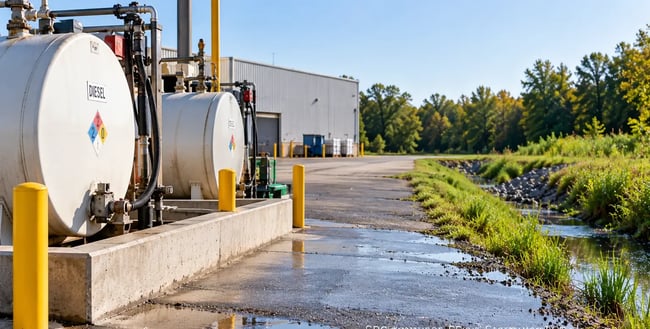
Does Pennsylvania's Storage Tank Program Add an SPRP on Top of SPCC and PPC?
Pennsylvania's Storage Tank and Spill Prevention Act and 25 Pa. Code Chapter 245 regulate aboveground storage tanks separately from either plan. In general, aboveground tanks over 250 gallons are regulated, with exclusions for things like certain heating oil tanks and oil-filled operational equipment, and regulated tanks can carry requirements for registration, DEP-certified installers and inspectors, and periodic inspections. Whether a particular tank is regulated depends on its size, type, and use, so check yours against DEP's storage tank program.
The SPRP is where this layer connects to the plan question. A facility with a single regulated tank over 21,000 gallons, or aggregate regulated aboveground capacity over 21,000 gallons, files a Spill Prevention Response Plan with DEP. Its elements look a lot like an SPCC Plan, plus downstream notification of municipalities and water users. DEP allows a facility that already keeps a PPC Plan to build the downstream notification requirements into it, which covers both plans in one document. The exact notification list and timing are in Chapter 245 and DEP's guidance.
Where Do SPCC Plans and PPC Plans Overlap?
On paper, the two plans cover a lot of the same ground: an inventory of what's stored and where, a site diagram, containment and spill controls, inspections, training, and a spill response procedure with contacts. One site visit and inventory can feed both plans, but the differences are in the details.
| Topic |
SPCC Plan |
PPC Plan |
| Materials covered |
Oil only |
All pollutants, including oil, chemicals, and wastes |
| Containment |
Specific secondary containment and sizing rules apply |
Described in the plan, with controls matched to the site |
| Training |
Discharge prevention briefings for oil-handling staff at least once a year |
Employee training program |
| Certification |
PE-certified, or self-certified for qualified facilities |
No PE required under DEP's guidance |
| Review |
At least every five years, and an amendment when the facility changes |
Set by your permit or program |
| Where it goes |
Kept on site |
Attached to a PAG-03 application, other programs vary |
The differences are where combined plans go wrong. SPCC has rule-specific content that a PPC outline won't prompt you to write, like container integrity testing and properly sized secondary containment, which we cover in how big your SPCC containment needs to be. A PPC Plan covers chemicals and wastes that an SPCC outline never touches.
Spill history crosses over too. A reportable discharge can cost you qualified facility status, and a PAG-03 application asks about past spills as well. Our article on the sheen rule and oil spill reporting explains when to report, and an environmental attorney may be worth calling before you file anything.
Can One Combined Plan Cover Both SPCC and PPC Requirements?
In many cases, yes. DEP has expressed a preference for permittees to combine their PPC, SPRP, and SPCC elements, and the federal rule lets you write an SPCC Plan in an equivalent format as long as you add a section cross-referencing where each requirement is addressed. That leaves two workable structures: one integrated document, or two documents that point to each other. Our article on the difference between an SPCC Plan and a SWPPP covers a similar decision for stormwater plans.
| Factor |
One combined document |
Two cross-referenced documents |
| Agency review |
If you submit it to DEP, the SPCC elements become reviewable by DEP |
Only the PPC Plan goes to DEP, and the SPCC Plan stays on site |
| PE certification |
The SPCC portion still needs it where required, and the engineer works from the combined document |
The engineer reviews only the SPCC document |
The right pick depends on whether you'll submit the PPC Plan to DEP, how often your permits and site change, and who maintains the documents. If another firm wrote your existing SPCC Plan, we typically rebuild it rather than update it, and that's often the natural point to decide how the two plans should fit together.
What Should a New or Expanding Facility Plan For With SPCC and PPC Plans?
A new facility needs its SPCC Plan prepared and implemented before oil storage begins operating, and an expansion that changes your design or pushes capacity over a threshold calls for an amendment, generally within six months of the change. PPC Plans usually come together with the permit application, so a new facility that needs PAG-03 coverage builds its PPC Plan as part of that package.
Building or expanding also brings construction-phase requirements that we don't handle: construction stormwater (PAG-02), Chapter 102 erosion and sediment control, building and fire permits for tank installation, and the tank installation itself, which can require a DEP-certified installer. Those belong to your engineer, contractor, or a soil erosion specialist, and we don't prepare or file any of them. We come in on the operational side once the facility is running: the SPCC Plan or amendment, the PPC Plan, DEP tank program follow-through, inspections, training, and Tier II reporting where it applies. We can also help you work out what the construction phase will need and point you toward the right professionals. Temporary fuel tanks on a construction site can trigger SPCC on their own, and that's a plan we can help with, though not the construction permits around it.
How Much Does an SPCC Plan Cost When You Also Need a PPC Plan?
| Plan |
Typical range |
What moves the price |
| Tier I SPCC Plan (self-certified) |
About $1,500 to $4,000 |
Number of containers, total capacity, and site complexity |
| SPCC Plans overall |
About $1,500 to $15,000 |
Storage capacity, number of containers, whether PE certification is needed, and whether secondary containment needs evaluating |
| PPC Plan as part of a PAG-03 application |
About $5,000 to $10,000 for a relatively straightforward facility |
Site evaluation, drainage and outfall mapping, and the application package. This range covers the full PAG-03 package, not the PPC Plan alone. |
On the SPCC side, PE certification is the biggest swing, since a plan that needs an outside engineer's review costs more and takes longer than a self-certified one. We're not the cheapest option for either plan, and a low quote that skips the site visit usually costs more later, when an inspector finds the plan doesn't match the site. Our SPCC cost guide breaks the SPCC range down further.
The SPCC pricing calculator below shows what our help with the SPCC side would run for your facility. For the PPC piece, reach out and we'll quote it alongside, since it depends on your permits.
How Can RMA Help With SPCC Plans and PPC Plans in Pennsylvania?
If you're not sure which plans apply, we can walk through the same tests covered here and tell you plainly what you need and what you don't. On the SPCC side, we evaluate your oil storage, write the plan (working with an outside professional engineer when certification is required), and cover the inspections and training that come with it. Initial SPCC training is free with a new RMA plan, and our online environmental training library is there for ongoing training. On the PPC side, we build PPC Plans as part of PAG-03 and individual NPDES work, and we can structure SPCC and PPC as one document or two cross-referenced ones. You can read more about our Pennsylvania SPCC Plan services on our website.
There's no pressure and no obligation in asking, and if you don't need a plan, we'll tell you. You can call us at 888-RMA-0230, email us, or fill out the form on our website, or you can contact RMA directly, and we'll help you figure out the right next step.


