Jet Fuel Tanks, Mobile Refuelers, and Fueling Areas: What the Oil Spill Rules Expect From Airports and FBOs
A fuel farm with Jet A and avgas tanks, a handful of refueler trucks, a standby generator, and a drum of used oil from the ground equipment shop. For most airports and fixed-base operators (FBOs), that's a normal day. It's also exactly the kind of oil storage that triggers a written oil spill plan under federal and New Jersey rules, and plenty of airport managers and FBO owners have never been told that.
The short answer is yes, in nearly every case where a field stores fuel in bulk. The federal version is called a Spill Prevention, Control, and Countermeasure (SPCC) Plan, and New Jersey adds its own layer on top for the largest facilities. The harder questions are specific to aviation: how refuelers are treated, how fueling areas are handled, and who on a shared airfield owns the plan. We cover each one below, and if you'd like a second set of eyes on your own field, you can reach out to RMA at any point.
Table of Contents
TL;DR
Almost every New Jersey airport and FBO that stores fuel in bulk needs a written oil spill plan, because the federal threshold is only 1,320 gallons of oil in aboveground containers and refuelers count toward it. Fuel farm tanks need containment sized to the largest tank. Mobile refuelers are exempt from that sizing rule but still need general spill containment and protection during fueling. Who carries the plan on a shared field depends on who owns and operates each tank, so the lease matters as much as the rule. New Jersey adds Spill Act duties and, for the largest facilities, state discharge prevention plans.
Do Airports and FBOs Need an SPCC Oil Spill Plan in New Jersey?
In plain terms, a facility needs an oil spill plan when it stores more than 1,320 gallons of oil in aboveground containers, counting every container of 55 gallons or larger, and could reasonably be expected to send a spill into a waterway or onto its shoreline. The measure is a container's capacity, not how full it is. Jet fuel, avgas, diesel, lube oil, hydraulic oil, and used oil all count as oil. The rule is the federal SPCC rule, found in 40 CFR Part 112, and in New Jersey it's enforced by EPA Region 2.
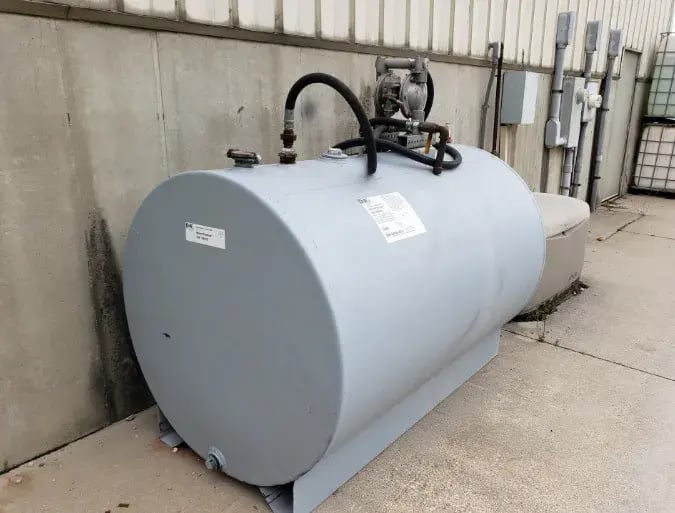
One Jet A tank clears 1,320 gallons by itself in most cases, and refuelers count too. A typical refueler carries thousands of gallons and is treated as a bulk storage container, so an FBO with a couple of trucks and no fuel farm can still cross the line. Fuel inside an aircraft's own tanks, and in the vehicles and ground equipment that burn it to move, is treated as motive power fuel and doesn't count. Fuel sitting in a refueler does.
Aviation adds one wrinkle. The rule covers non-transportation-related facilities, and an appendix to Part 112 explains how EPA and the Department of Transportation divide jurisdiction. Fuel storage and fueling operations on an airfield are generally handled as regulated oil storage, but the dividing line can get gray for particular equipment and activities, so we'd have it confirmed for your specific operation instead of assuming an exemption. Readers who are new to all of this can start with our guide to SPCC plans in New Jersey.
How Does SPCC Treat Jet Fuel and Avgas Bulk Storage Tanks?
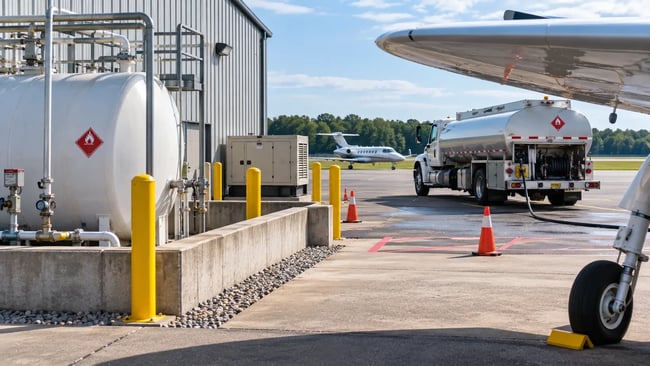
Fuel farm tanks are the core of most airport plans, and they get the most detailed requirements in the rule. Each aboveground tank needs secondary containment sized to hold the full capacity of the largest tank in the containment area, plus extra room for rainfall. That's usually a dike or concrete containment around the tank, or in some cases a double-walled tank engineered for the purpose. If you've ever wondered how the sizing math works, our article on how big your SPCC oil spill containment needs to be walks through it. Containment areas also need a plan for rainwater, because a dike that fills up and never gets drained properly becomes its own problem.
Beyond containment, the plan covers the practical items inspectors look at: overfill prevention on tanks, regular inspection and testing of tanks and piping against industry standards, written inspection records, security for valves and pumps, and lighting. Aviation fuel handling also has its own safety and quality standards, and FAA-certificated airports and local fire officials may have rules of their own. Those operate alongside the SPCC rule and not in place of it, so a fire code approval doesn't mean your spill plan is done.
Underground tanks and hydrant fuel systems follow a different track. Federal underground tank rules and New Jersey's own underground storage tank rules govern many of them, and whether an underground tank counts toward your SPCC total depends on how those rules treat it. If your field has a hydrant system or buried tanks, that's a conversation to have with your engineer early, and we touch on the New Jersey side below.
How Are Mobile Refuelers Handled Under SPCC?
Mobile refuelers cause more debate on the ramp than any other piece of airport fueling. In the early 2000s, some EPA regions began citing operators for parking refuelers without containment sized to the largest compartment, even though most spills happen during fueling and not while a truck sits parked. The industry pushed back, and EPA responded in its 2006 SPCC amendments by exempting mobile refuelers from the sized secondary containment requirements that still apply to other bulk storage containers.
The exemption is narrower than it sounds. General secondary containment under section 112.7(c) still applies, which means the plan has to describe how a spill from a refueler gets stopped before it reaches water. Containment for transfer activity applies too, and so does the integrity testing that other bulk containers go through. In practice, plans rely on a mix of measures: spill kits and absorbents staged at fueling locations, drain covers near storm drains, trained operators who stay with the truck during fueling, and parking refuelers inside existing fuel farm containment when they're out of service. The rule allows active measures, meaning people and equipment ready to respond, when passive structures like dikes aren't practical on an operating ramp.
A few details trip operators up. The exemption doesn't extend to a refueler that's parked permanently and used as a storage tank instead of moving fuel. It also doesn't reach other mobile or portable containers like skid tanks, totes, and drums, which still need sized secondary containment when they sit unattended. The facility diagram in your plan has to show your refuelers, though they can be shown at their normal parking spot, with a range if the number of trucks changes. How a given EPA region and inspector view containment around a specific ramp can vary, so we'd have the approach you choose written into the plan along with the reasoning behind it.
What About Fueling Areas, Generators, and Used Oil at an Airport?
Fueling and loading areas get their own attention in the rule. Wherever fuel moves between a truck and a tank, or between a tank and a refueler, the plan has to address how a spill during that transfer gets contained. For a facility with a true loading rack, a fixed structure with arms, piping, and valves used to fill tank trucks, the rule calls for containment sized to the largest compartment of the truck plus room for rain. Most airports have simpler loading areas, like a fill stand or a paved pad, and those usually fall under the general containment requirement. Whether a particular setup counts as a rack is a judgment call for the engineer who certifies your plan.
The smaller items count too. Standby generators carry fuel tanks that add to your capacity total, and our overview of environmental permits for emergency backup generators covers how those fit with other programs. Used oil from ground support equipment piles up in drums, and any container of 55 gallons or more is counted. Our articles on 55-gallon drums and SPCC plans and used oil regulations explain where those land. Oil-filled electrical equipment such as transformers counts as well. The table below shows how the common pieces of airport equipment are typically handled.
| Equipment |
How the SPCC rule typically treats it |
| Jet A and avgas fuel farm tanks |
Bulk storage containers. Sized secondary containment, inspection and testing, and overfill prevention apply. |
| Mobile refuelers |
Bulk storage containers, but exempt from sized containment. General containment, transfer protection, and integrity testing still apply. |
| Drums, totes, and skid tanks of 55 gallons or more |
Count toward capacity. Sized secondary containment applies when they sit stationary and unattended. |
| Standby generator fuel tanks |
Usually treated as bulk storage containers, so containment, inspection, and overfill measures apply. |
| Used oil containers |
Count toward capacity at 55 gallons or more, with containment when stationary. |
| Fill stands and loading areas |
Transfer area containment. Full rack containment applies where a true loading rack exists. |
| Fuel in aircraft and ground vehicle tanks |
Motive power fuel. Generally doesn't count toward your total. |
Who Is Responsible for the SPCC Plan: Airport Authority, FBO, or Tenant?
The rule puts the duty on the owner or operator of the facility, and on a shared airfield that phrase can point at more than one party. Some airports own the fuel farm and lease it to an FBO who runs it. Some FBOs own their tanks on ground leased from the airport. Tenants like flight schools, charter operators, and maintenance shops often own small tanks or run their own refuelers. Each arrangement shifts who has to prepare, certify, and carry out the plan.
There isn't one answer that fits every airfield. EPA's definition of a facility is flexible, and a tenant's operation can be treated as its own facility, separate from the airport. In that setup, a tenant with a small amount of oil, below the threshold, may not need its own plan and wouldn't have to be written into the airport's. Other airports choose one plan that covers every tank on the field and hold tenants to it through lease terms. Both approaches are used, and which one fits depends on how the airport is organized, how many parties handle fuel, and what the lease says.
A division that tends to make practical sense puts the shared infrastructure with the airport authority, things like the fuel farm, containment, and stormwater outfalls, while the FBO takes on refuelers, fueling procedures, inspections, and employee training. Whoever employs the people handling oil carries the training duty, and our online environmental training library is one way to cover it. Whatever split you choose, write it into the lease or operating agreement and into the plan itself, so an inspector, a lender, or a new manager can see who does what. An agency cares about who owns and operates the equipment, and our article on who enforces SPCC plans explains how that plays out.
Most airport and FBO plans need a Professional Engineer to review and certify them. Smaller operations, with under 10,000 gallons of total aboveground storage and no single container over 5,000 gallons, can self-certify and may qualify to use EPA's template, though some conditions apply. Our articles on the different types of SPCC plans and professional engineers and SPCC plan requirements explain where each one fits.
What Does New Jersey Add: Spill Act, DPCC and DCR Plans, and UST Rules?
New Jersey doesn't stop at the federal rule. The Spill Compensation and Control Act, usually called the Spill Act, makes it unlawful to discharge petroleum and other hazardous substances, requires discharges to be reported to NJDEP, and puts cleanup and removal costs on the responsible parties, with liability that can be strict and joint and several. In plain terms, you can end up responsible for cleanup costs tied to property or equipment you own or operate, even when you didn't cause the spill. Current reporting rules and the NJDEP hotline are on the agency's website. For federal reporting of spills that reach water, see our article on when you have to report an oil spill.
The larger step applies to what New Jersey calls a major facility. Under N.J.A.C. 7:1E, that's a facility with total storage capacity of 200,000 gallons or more of hazardous substances, petroleum included, or 20,000 gallons or more of hazardous substances other than petroleum. Major facilities prepare a Discharge Prevention, Containment and Countermeasure (DPCC) plan and a Discharge Cleanup and Removal (DCR) plan, certified and submitted to NJDEP for approval, and they have to meet the rule's design standards for things like tanks, loading areas, and drainage. Storage capacity for this purpose leaves out out-of-service tanks and containers of five gallons or less. A large commercial or cargo airport fuel farm could reach that level, while smaller operations often fall below it. Where the line falls on a leased airfield depends on how capacity gets added up across the facility, so check the rule against your own inventory.
If your field uses underground tanks or a hydrant system, New Jersey's underground storage tank rules at N.J.A.C. 7:14B come into play. They include a section specific to airport hydrant systems and field-constructed tanks, with design requirements for new systems like secondary containment and leak monitoring. NJDEP certifies the contractors who do this work, and the details depend on tank size and age, so confirm them with a qualified contractor or NJDEP's UST program.
If you're building or expanding fuel storage, the construction side, including construction and fire code permits and installation by certified tank contractors, is a job for your engineer and contractor, and RMA doesn't prepare those approvals. What we do handle is what comes after: the SPCC plan or amendment, spill reporting procedures, inspections, and training your facility needs once the tanks are running, and we're glad to point you toward the right construction people. If a discharge has already happened, an environmental attorney is worth a call early, and cleanups involving soil or groundwater typically need a Licensed Site Remediation Professional (LSRP).
How Much Does an Airport or FBO SPCC Plan Cost?
Our SPCC plans run from $2,500 to $15,000, and where an airport or FBO lands in that range comes down to complexity, not the industry label. The factors that move the price are total storage capacity, the number and type of containers, how many refuelers and tanks sit on the site, whether secondary containment around the fuel farm needs to be evaluated, the review and certification a PE-certified plan involves, and how many transfer areas the plan has to cover. A small FBO with a couple of refuelers and one tank sits at a very different point than a field with several fuel farms and a crowd of tenants. Facilities that also fall under New Jersey's major facility rules need planning work beyond a standard SPCC Plan, so ask us for a quote in that case.
You can see how these factors fit together in our article on how much an SPCC plan costs, and the pricing calculator below gives you a number for RMA's help with your plan.
How Can RMA Help Airports and FBOs With Oil Spill Plans?
We're a family-run firm based in New Jersey, so NJDEP's rules and EPA Region 2's expectations are familiar ground. For an airport or FBO, we start by walking through what you store, where it sits, and how fuel moves on your field, then build the plan around that: bulk tanks, refuelers, transfer areas, generators, and used oil. A licensed PE reviews and approves the plan before it's final, our senior staff do the work themselves instead of handing it to a junior team, and we don't use AI to produce plan deliverables. If you're a small operator under the self-certification limits, we'll tell you so, and you may not need us at all. If your field is shared, we can help you sort out who owns which piece so the plan matches the lease.
You're welcome to call, email, or fill out the form on our website, with no obligation. A short conversation usually tells you where you stand, and if you'd like to talk it through, reach out to RMA whenever it suits you.