Locomotive Fuel, Loading Racks, and the EPA vs. DOT Line: How SPCC Plans Apply to New Jersey Rail Facilities
If you run a rail yard or a transload facility in New Jersey, you probably have more oil on site than you'd guess. There's a bulk diesel tank for fueling, lube oil in the shop, used oil in drums, oil-filled electrical equipment, and maybe a loading rack that moves petroleum products between tank trucks and rail cars. Federal law requires many facilities that store that much oil to have a written oil spill plan, called a Spill Prevention, Control, and Countermeasure (SPCC) plan. Rail operations add a wrinkle most industries never deal with, because the rules split rail activity into a part EPA regulates and a part the Department of Transportation (DOT) regulates.
The short answer is that many New Jersey rail yards and transload facilities do need an SPCC plan, but only for the non-transportation-related side of the operation. In this article we'll walk through what that phrase means, which tanks, racks, and hoses fall on which side, what good fueling procedures look like, and what New Jersey's own spill rules add on top of the federal rule. We'll also be upfront about where the answer depends on your specific yard. If you'd like someone to look at your site and tell you where you stand, you can reach out to RMA.
Table of Contents
TL;DR
Many New Jersey rail yards and transload facilities need an oil spill plan, but only for the non-transportation-related side of the operation: fixed fuel and lube oil tanks, drums, oil-filled equipment, and the racks and hoses used to load and unload oil. Rail cars moving in commerce and locomotive fueling equipment sit on the transportation side under an agreement between EPA and DOT, though how that applies to a particular yard takes a site-specific look. If your yard stores more than 1,320 gallons of oil aboveground and a spill could reach water, plan on needing an SPCC plan, and expect New Jersey's own spill rules to apply either way.
What Is an SPCC Plan and Why Would a Rail Facility Need One?
An SPCC plan is a written oil spill prevention plan required by EPA under 40 CFR Part 112. It describes what oil you store, how each container is contained, how you inspect everything, how transfers are handled, and what your people do if something leaks. The rule applies when a facility stores more than 1,320 gallons of oil in aboveground containers, counting only containers of 55 gallons or more, and when a spill could reasonably be expected to reach navigable waters or adjoining shorelines. The count is based on container capacity, not on how full the tanks are. Oil-filled equipment and vegetable oils count, and propane doesn't. In New Jersey, EPA Region 2 is the agency that enforces the rule. If you want the basics in more detail, our overview of what an SPCC plan is covers them, and our guide to how 55-gallon drums are counted helps with the math.
Rail yards cross the threshold quickly. A single aboveground diesel tank at a fueling area can exceed 1,320 gallons by itself, and lube oil, hydraulic oil, used oil, and transformers add to the total. The second test, whether a spill could reach water, is easier to meet than many managers expect. EPA looks at pathways like storm drains, ditches, swales, and sewers, and the evaluation can't count on man-made structures like curbs or dikes to stop oil. Much of New Jersey sits close to a river, tidal marsh, or drainage system that leads to one, so a yard with no visible stream on the property can still meet the test.
How Does SPCC Treat Transportation-Related vs. Non-Transportation-Related Rail Activity?
The SPCC rule only covers non-transportation-related facilities. A 1971 agreement between EPA and DOT sets the definitions, and the text now sits in Appendix A to Part 112. In plain terms, EPA handles oil storage and handling that isn't part of moving something from one place to another, and DOT handles the transportation itself. A facility with both kinds of activity is regulated by both agencies, which EPA calls a complex facility. Many active rail yards fit that description to some degree, because they combine fixed storage with trains moving through.
The agreement lists specific examples that matter here. Fixed oil storage tanks, along with their pumps, piping, and drainage systems, are non-transportation-related. So are loading racks, transfer hoses, and loading arms used to move oil in bulk to or from railroad cars and highway vehicles. On the transportation side, the agreement includes rail cars used to transport oil in interstate or intrastate commerce and the equipment related to them, along with equipment used for fueling locomotive units. Rail cars and motive power used only within the confines of a non-transportation-related facility, and not meant for use in commerce, are carved out of the transportation side. The table below puts those pieces together.
| Rail Facility Activity or Equipment |
Generally Falls Under |
What It Means for Your Plan |
| Fixed diesel, lube oil, and used oil tanks, drums, and totes |
EPA (SPCC) |
Counts toward the 1,320 gallon threshold and needs containment, inspections, and training |
| Oil-filled transformers and other oil-filled equipment |
EPA (SPCC) |
Counts toward the threshold and gets covered in the plan |
| Loading racks, hoses, and arms moving oil to or from rail cars or tank trucks |
EPA (SPCC) |
Rack containment, vehicle interlocks, and drain checks apply |
| Rail cars carrying oil in interstate or intrastate commerce |
DOT |
Generally not part of your SPCC plan while in transportation |
| Equipment used to fuel locomotives |
Listed on the DOT side in the agreement |
How this applies to your fueling setup depends on the site, so confirm it |
| Rail cars and motive power used only inside the facility |
EPA (SPCC) |
Treated as part of the non-transportation facility |
This is the point where the answer turns on your site. The 1971 agreement is short, and applying it to a real yard with fueling lanes, storage tanks, and track spurs means looking closely at which equipment serves which function. A loaded rail car waiting on a siding to move is generally a DOT matter, while a rail car parked as storage at a plant can become an EPA matter. EPA has published inspector guidance with examples and diagrams for complex facilities, but the final call on where a line falls belongs to the agencies, not to us or to you. If your yard sits in a gray area, confirm your position with EPA Region 2 or an environmental attorney. In most cases we still write one plan that covers the whole yard's oil handling, because a single set of procedures is easier to train people on than two.
Which Rail Yard Oil Storage Counts Toward an SPCC Plan?
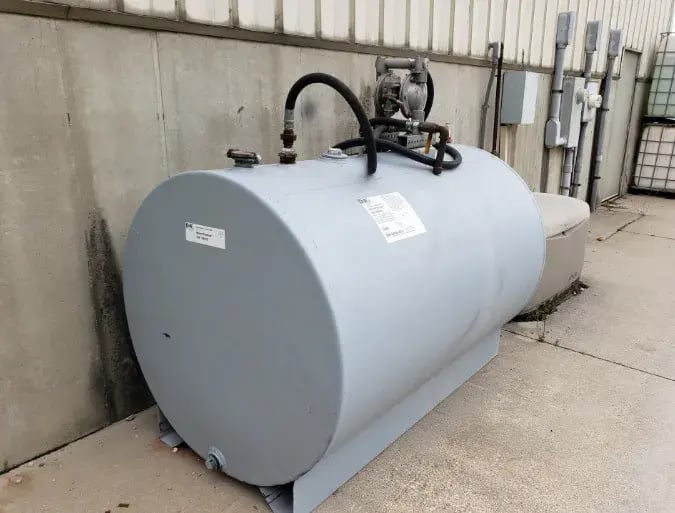
On the non-transportation side, the storage that counts is the fixed and portable oil containers sitting in your yard. That includes bulk fuel tanks, lube oil and hydraulic oil tanks, used oil tanks, 55-gallon drums, totes, and oil-filled equipment like transformers. The fuel inside a locomotive's own tank is a motive power container, and the SPCC rule exempts those from the capacity count. Fuel trucks that operate only inside your yard are mobile refuelers. EPA requires general secondary containment for them rather than a sized containment system, and they're regulated as part of the facility.
Once a container is in scope, the plan has to show how it's contained and maintained. Bulk storage containers need secondary containment large enough for the biggest single container plus room for rainfall, and our guide on how big SPCC containment needs to be explains the sizing. Tanks also need regular inspection and integrity testing, and the plan has to be reviewed at least every five years. Which type of plan you need depends mostly on total storage. A facility with 10,000 gallons or less of total aboveground oil storage can often self-certify, while a yard above that needs a plan certified by a Professional Engineer. Our articles on the different types of SPCC plans and Professional Engineer requirements go through the differences. Many active rail yards and transload terminals land in the PE-certified group.
How Do SPCC Rules Apply to Transload Facilities and Rail Loading Racks?
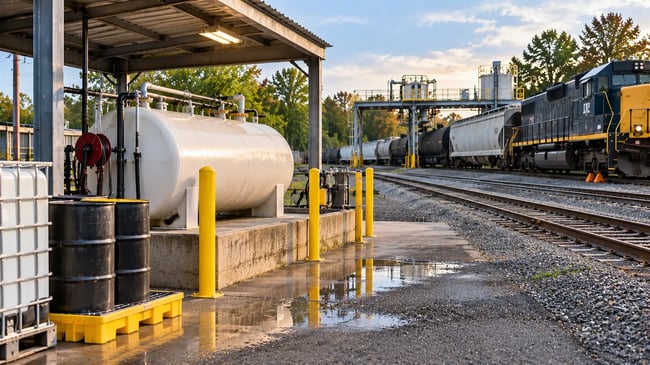
A transload facility moves product between modes, most often between rail cars and tank trucks. If the product is oil, such as fuel, lube oil, or vegetable oil, the transfer equipment is exactly what the 1971 agreement puts on the EPA side. Loading racks, transfer hoses, and loading arms used to move oil in bulk to or from railroad cars and highway vehicles are non-transportation-related, so the SPCC rule applies to them, along with any storage tanks on site.
For loading and unloading areas, the rule asks for a few specific controls. Where rack drainage doesn't flow to a catchment basin or treatment system built to handle a discharge, the area needs a quick drainage system, and the containment has to hold at least the largest single compartment of any tank car or tank truck loaded or unloaded there. The rack needs a warning light, barrier, sign, or interlock so a vehicle can't pull away with a hose still connected, and staff should inspect the lowermost drains and outlets on each vehicle before it leaves.
Many transload sites handle more than oil, such as chemicals, plastics, or ethanol blends. SPCC only covers oil, but New Jersey's Spill Act reaches other hazardous substances too, and the state's discharge prevention rules include standards for tank car and tank truck loading areas at major facilities. We'll cover that below. The rail cars themselves, while they're waiting to move or in transit, are generally a DOT matter, and the Federal Railroad Administration handles much of that oversight. If you're not sure whether a particular car is in transportation or being used as storage, treat that as a question to settle with the agencies before an inspector raises it.
What Should Locomotive Fueling Procedures Look Like at a Rail Yard?
Locomotive fueling is where the jurisdiction question gets awkward. The 1971 agreement lists equipment used for fueling locomotive units on the transportation side, which points toward DOT. The bulk tank that feeds the fueling lane, though, is fixed oil storage on the EPA side, and a discharge from either one is still a spill under New Jersey law. How the line applies to a given fueling setup depends on the layout, and we'd rather tell you that plainly than guess. Either way, we write fueling procedures into the plan, because fueling is a repeated, routine transfer, which makes it a natural place for a spill, and regulators in both camps will expect to see a disciplined process.
Good procedures are simple and specific. Fueling is attended from start to finish by someone trained to stop it, and the operator confirms the available tank space before starting. Connections sit over drip pans or contained surfaces, and nozzles, hoses, and couplings get inspected on a set schedule so worn parts are replaced before they fail. Pumps have an emergency shutoff that's easy to reach, spill kits sit at the fueling point, and the fueling lane drains somewhere controlled, with nearby storm drains protected. Mobile refuelers follow the same discipline and keep general containment equipment ready. The rule also expects a briefing on discharge prevention at least once a year, and we cover what that should include in our article on annual SPCC training requirements. For yards with rotating crews, our online environmental training library is a convenient way to keep that training on schedule.
What Do New Jersey's Spill Rules Add for Rail Yards and Transload Sites?
New Jersey's Spill Compensation and Control Act, usually called the Spill Act, covers discharges of petroleum and other hazardous substances, not just oil. Liability under it is generally strict and can be joint and several, which means a party can be held responsible for cleanup without anyone proving negligence. It also creates a duty to report discharges to NJDEP, and the details depend on the substance and the quantity. For the current hotline number and reporting thresholds, check NJDEP's website instead of relying on a number from an article. Our piece on the federal sheen rule for oil spill reporting covers the federal side, and our overview of SPCC plans in New Jersey covers more of the state picture.
Larger facilities face one more layer. Under N.J.A.C. 7:1E, a major facility has to prepare a Discharge Prevention, Containment and Countermeasure (DPCC) plan and a Discharge Cleanup and Removal (DCR) plan, submitted to NJDEP as a single document. Whether a rail fuel depot or a chemical transload terminal counts as a major facility depends on its total storage capacity and on what it stores, so check the rule against your own inventory. If you have underground tanks, N.J.A.C. 7:14B governs them, and installation work needs NJDEP-certified contractors. Cleanups of contamination typically involve a Licensed Site Remediation Professional (LSRP), and buying or selling an industrial site can trigger the Industrial Site Recovery Act (ISRA), so ask about it early in any transaction. Tank installations are also subject to the Uniform Fire Code, which local fire officials enforce.
If you're building or expanding a transload facility or fueling area, the construction phase has its own approvals. Those can include soil erosion and sediment control certification through your Soil Conservation District, construction stormwater coverage, and building and fire permits for tank installation. RMA doesn't prepare or file construction-phase permits, and most clients work with their engineer or contractor on them. What we do help with is the part that starts once the facility is running: the SPCC plan or amendment, DPCC and DCR plans where they apply, spill reporting procedures, inspections, training, and often Community Right to Know reporting. Because spills, enforcement, and liability can carry real legal exposure, bringing in an environmental attorney is reasonable when you're facing a discharge or an enforcement action.
How Can RMA Help With Rail Yard and Transload SPCC Plans?
We're a family-run firm based in New Jersey, and our senior staff do the actual plan work. For a rail yard or transload site, that usually starts with walking through what you store, how product moves, and where the EPA and DOT lines likely fall, then building a plan that matches how your crews work. SPCC plans from RMA generally run from $2,500 to $15,000, depending on total storage capacity, the number and type of containers, whether a PE certification is needed, and how much containment needs evaluating. Our breakdown of SPCC plan costs goes through the drivers. If your storage is below the threshold or the plan you have already covers the site, we'll tell you that and leave it there.
If you'd like a second set of eyes on your yard or terminal, there's no pressure and no obligation. You can call us, send an email, or fill out the form on our website, and we'll talk through your setup honestly. Whenever you're ready, reach out to RMA.