Propane and Other Fuels That Aren't "Oil" Under the Federal Oil Spill Plan Rule
If your facility runs on propane, whether that's forklifts, a backup generator, or building heat, you may have wondered if those tanks put you under the federal oil spill plan rule. That rule is called SPCC, short for Spill Prevention, Control, and Countermeasure, and it requires a written oil spill plan, called an SPCC Plan, from facilities that store more than a set amount of oil. Plenty of Pennsylvania facility managers first hear the term when an insurer, lender, or inspector asks about it, and propane is one of the most common points of confusion.
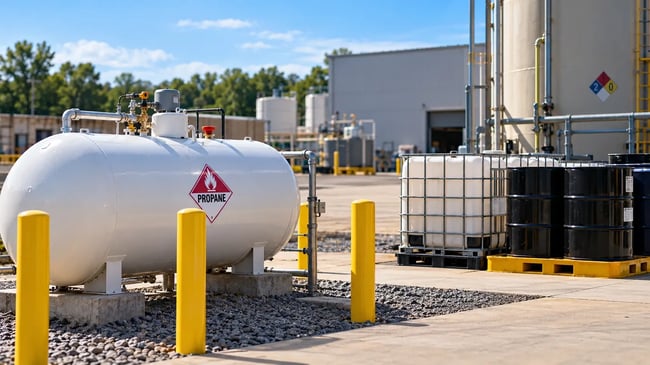
The short answer is no. Propane isn't oil under the SPCC rule, so propane tanks don't need an SPCC Plan and don't count toward the threshold. This article explains why, which other materials get the same treatment, and which materials people assume are exempt but aren't, like cooking oil, asphalt cement, and transformer oil. We also cover the separate rules that do apply to propane in Pennsylvania. If you'd like a second set of eyes on your own site, you can reach out to RMA and we'll give you a straight answer on where you stand.
Table of Contents
TL;DR
Propane isn't oil under the SPCC rule, so propane tanks don't need an SPCC Plan and don't count toward the 1,320-gallon aboveground oil threshold. Natural gas, DEF, and glycol antifreeze generally don't count either. Cooking oil, asphalt cement, transformer oil, and hydraulic oil do count, even though people often assume they don't. Propane still has its own safety rules in Pennsylvania through the Department of Labor and Industry, and large propane inventories can trigger Tier II reporting.
Does Propane Count as Oil Under the SPCC Rule?
The SPCC rule is written around oil, and the federal definition in 40 CFR 112.2 is very broad. It covers oil of any kind or in any form, including petroleum, fuel oil, sludge, synthetic oils, mineral oils, oil refuse, and oil mixed with wastes, along with animal fats and vegetable oils. Propane is a gas that's compressed into a liquid so it can be stored and shipped. EPA's SPCC guidance for its regional inspectors says that highly volatile liquids that vaporize on contact with air or water, including liquefied petroleum gas (LPG) and liquefied natural gas, aren't considered oil. That fits what the rule is for. SPCC exists to keep oil out of streams, rivers, and other navigable waters, and a propane release doesn't leave a liquid slick on the water. It turns to vapor.
In practice, that means a propane tank isn't counted toward your oil storage total, whether it's a 250-gallon tank behind a shop or a bulk tank holding thousands of gallons. It doesn't need SPCC secondary containment and it doesn't go into an SPCC Plan. The one wrinkle is natural gas production. The liquid that condenses out of natural gas at a well, often called condensate or drip gas, is oil, even though the gas itself isn't. If you're new to the rule, our overview of what an SPCC Plan is covers the basics.
Which Other Fuels and Chemicals Don't Count as Oil for an SPCC Plan?
Propane isn't the only material outside the rule. Because the definition is about oil, most materials that aren't oil by type fall outside it, though a few come with a catch. EPA also keeps the right to decide that a material is oil even if it isn't on any standard list, so check the safety data sheet and ask someone when a product is part petroleum.
| Material |
Counts as oil for SPCC? |
What to know |
| Propane and other LPG |
No |
Vaporizes on contact with air or water, so EPA doesn't treat it as oil. |
| Natural gas and liquefied natural gas |
No |
Same reasoning as propane. Condensate or drip gas from a gas well is oil. |
| Diesel exhaust fluid (DEF) |
No |
It's a urea and water mixture, not oil. |
| Glycol-based antifreeze |
Generally no |
Straight glycol isn't oil. Used antifreeze that's picked up oil, and coolants with oil in them, can count. |
| Acids, caustics, bleach, ammonia, and most other chemicals |
Generally no |
Not oil, but separate spill, reporting, and waste rules often apply. |
Staying outside SPCC doesn't mean a material is unregulated. Chemicals, fuels, and gases can fall under Tier II reporting, hazardous waste rules, fire code, and spill reporting requirements, each with its own thresholds. SPCC is just one program, and it only cares about oil.
Which Materials Count as Oil for SPCC Even Though They Don't Look Like It?
This is the list that catches people off guard. Anything that looks nothing like a fuel can still be oil under the rule, and the capacity of these materials adds to your total just like diesel does.
| Material |
Why it counts |
| Cooking oil, used cooking oil, and other vegetable oils and animal fats |
Federal law brought animal fats and vegetable oils into the oil definition alongside petroleum, so a restaurant grease tank or a food plant's oil storage counts. |
| Asphalt cement, binders, cutbacks, and emulsions |
They're petroleum products. The confusion comes from hot-mix asphalt, which the rule does exempt along with the containers that hold it. |
| Transformer oil and other electrical equipment oil |
Mineral oil in transformers and similar equipment isn't treated as a bulk storage container, but its capacity still counts toward your total once the equipment holds 55 gallons or more. |
| Hydraulic and lubricating oil |
Hydraulic systems, elevator and hoist reservoirs, gear boxes, and compressor lubrication systems all count as oil-filled equipment. |
| Synthetic oils, petroleum solvents, and used oil |
The rule names synthetic and mineral oils directly, solvents like mineral spirits and naphtha are petroleum, and used oil is still oil. |
If cooking oil is your question, we wrote a full answer on whether cooking oil needs an SPCC Plan. Drums add up quickly on shop floors and loading docks too, so our guide on whether 55-gallon drums are included in SPCC plans is worth a look if you store oil that way.
How Do You Count Oil Storage When Propane Tanks Are on Site?
Only oil counts toward the SPCC threshold, and only in containers of 55 gallons or more. A facility needs to look at an SPCC Plan when its total aboveground oil storage capacity is over 1,320 gallons, or its completely buried oil capacity is over 42,000 gallons. Capacity is what counts, not how full a tank happens to be, so an empty tank still adds to the total. Containers that are permanently closed don't count. Oil-filled equipment does.
Here's how it plays out with propane on site. Say a plant has a 2,000-gallon propane tank, a 500-gallon diesel tank on a backup generator, and a 275-gallon tote of hydraulic oil. The oil total is 775 gallons and the propane is ignored, so the plant is under the threshold. Add a 1,000-gallon aboveground used oil tank and the total becomes 1,775 gallons, which puts the plant over it. If your count lands under 1,320 gallons, you likely don't need a plan. If it lands close, count carefully, because it's easy to miss a drum or a piece of equipment. Our article on the steps to figure out if you need an SPCC Plan walks through the counting. In Pennsylvania, EPA Region 3 enforces the SPCC rule, and we explain who enforces SPCC plans if you want to know what an inspection looks like.
What Rules Apply to Propane Tanks in Pennsylvania?
Propane has its own rulebook in Pennsylvania, and it's separate from SPCC. The Department of Labor and Industry administers the state's Propane and Liquefied Petroleum Gas Act and its rules in 34 Pa. Code Chapter 13, which cover LPG facilities, tanks, and cylinders and build on the National Fire Protection Association's NFPA 58 Liquefied Petroleum Gas Code. Depending on the size and type of installation, a facility may need to apply to the department and get plan approval before a tank goes in. Your propane supplier knows these rules well and is usually the best first call, and your local fire official can tell you what else applies in your municipality.
DEP's storage tank program is a different matter. It regulates many aboveground and underground tanks under the Storage Tank and Spill Prevention Act and 25 Pa. Code Chapter 245, but the act excludes tanks used to store propane gas. Your diesel, used oil, and heating oil tanks are a separate question, so check those against DEP's storage tank program based on their size, type, and use.
One more report to know about is Tier II. Under the federal Emergency Planning and Community Right-to-Know Act, facilities report hazardous chemicals stored on site at 10,000 pounds or more, and propane is a hazardous chemical for that purpose. At about 4.2 pounds per gallon, 10,000 pounds works out to roughly 2,380 gallons of propane, and multiple tanks add together. Reports are due each March 1. Propane- or diesel-fired backup generators also raise air permit questions, which we cover in our guide to emergency backup generators and environmental permits.
If you're installing, moving, or expanding a propane tank, that work and its permits sit with your propane supplier, a licensed installer, or your engineer. RMA doesn't handle construction-phase permits or approvals. Where we come in is the operating side, once the facility is running.
How Does RMA Help With Oil Storage and SPCC Plan Questions?
We'd rather tell you that you don't need a plan than sell you one. If you're not sure how your storage adds up once propane, drums, equipment oil, and generator tanks are sorted into what counts and what doesn't, we can walk through it with you. If you do cross the threshold, a straightforward Tier I plan from RMA typically runs about $1,500 to $4,000, and our breakdown of SPCC plan costs explains what moves the price up or down. Staff training is part of the rule once a plan is in place, and our online environmental training library is one option for that.
We're a family-run firm based in New Jersey, and we work with facilities across Pennsylvania. You can call, email, or fill out the form on our website, and there's no obligation to hire us. If you'd like help with Tier II, oil storage counts, or the operating permits and plans your facility needs, contact RMA and we'll point you in the right direction, even when that's somewhere other than us.


