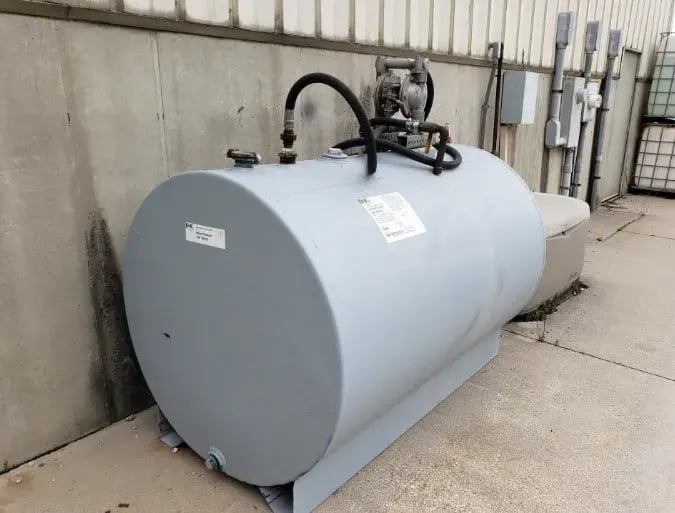
How a Diesel Generator Can Turn a New Jersey Office, Warehouse, or Retail Building Into a Regulated Oil Storage Site
Most people who own or manage an office building, a warehouse, or a retail center don't think of their property as an oil storage facility. There's no tank farm, no fuel island, no trucks lined up at a loading rack. But there's often a big diesel generator out back or on the roof, and that generator usually sits on a fuel tank that can hold hundreds or thousands of gallons. Add a separate day tank, a hydraulic elevator, or a few drums of lube oil, and the building can quietly cross the 1,320-gallon line that triggers federal oil spill planning rules. So the short answer is yes, a lot of commercial buildings in New Jersey need an oil spill plan because of the generator, and the owners usually find out during a sale, a lease negotiation, an insurance review, or an inspection.
In this article we'll walk through how a generator pushes a building over the limit, which tanks and equipment count, who's responsible when the building is leased, what a plan looks like for a simple generator site, and the containment problems we run into most often at commercial properties. We'll also cover what New Jersey adds on top of the federal rule. If you'd rather just have someone look at your setup and tell you where you stand, feel free to reach out to RMA and we'll talk it through with you.
Table of Contents
TL;DR
If your building has more than 1,320 gallons of aboveground oil storage capacity, counting every container of 55 gallons or more, and a spill could reasonably reach a waterway or storm drain, you need a written oil spill plan. A large diesel generator's base tank, plus a day tank, hydraulic elevators, or stored oil, is often enough to get there. Whoever owns or operates the equipment is responsible, so owners and tenants should settle it in writing. Many simple generator sites qualify for EPA's short self-certified Tier I template, as long as the tanks have proper containment.
How a Building Generator Pushes You Over the 1,320-Gallon Oil Spill Plan Threshold
The federal rule behind all of this is EPA's Spill Prevention, Control, and Countermeasure rule, usually shortened to SPCC. It's found at 40 CFR Part 112, and in plain terms it says that if a facility stores more than 1,320 gallons of oil above ground and a spill could reasonably reach a waterway, the facility needs a written plan for preventing spills and dealing with them if they happen. If you're new to the idea, our overview of what an SPCC Plan is covers the basics.
Two details catch building owners off guard. First, the rule counts capacity, not how much fuel is in the tank. A 2,000-gallon base tank that you keep half full is still a 2,000-gallon tank. Second, only containers of 55 gallons or more are counted, but every one of them is counted, and they add up across the whole property. Generators sized to back up an entire office building, a refrigerated warehouse, or a retail center commonly carry enough diesel to run for a day or more at full load, and that's where the gallons come from.
Here's how a few typical commercial setups shake out. These are illustrations, not your numbers, so check the nameplates and drawings for your own equipment.
| Building Setup |
Oil Containers of 55 Gallons or More |
Total Capacity |
Over 1,320? |
| Small office with a modest generator |
500-gallon generator base tank |
500 gallons |
No |
| Mid-size office with hydraulic elevators |
1,000-gallon base tank, two elevator reservoirs of about 150 gallons each, a few 55-gallon drums of lube oil |
About 1,465 gallons |
Yes |
| Distribution warehouse |
2,500-gallon base tank, 275-gallon day tank |
2,775 gallons |
Yes |
| Retail center or office with a natural gas generator |
Engine crankcase only, no diesel storage |
Usually well under |
Usually no |
The capacity number is only half the test. The rule also applies only if an oil spill could reasonably be expected to reach navigable waters or their shorelines. Owners sometimes assume they're off the hook because the generator sits on a paved lot far from any stream, but that test has to be made without counting manmade structures like berms or curbs that might hold a spill back. Parking lots drain to catch basins, and in most of New Jersey those catch basins lead to a creek, a river, or the bay. If you want a step-by-step way to work through it, our guide on the best four steps to figure out if you need an SPCC Plan lays it out.
Which Generator Tanks and Building Equipment Count Toward SPCC Capacity?
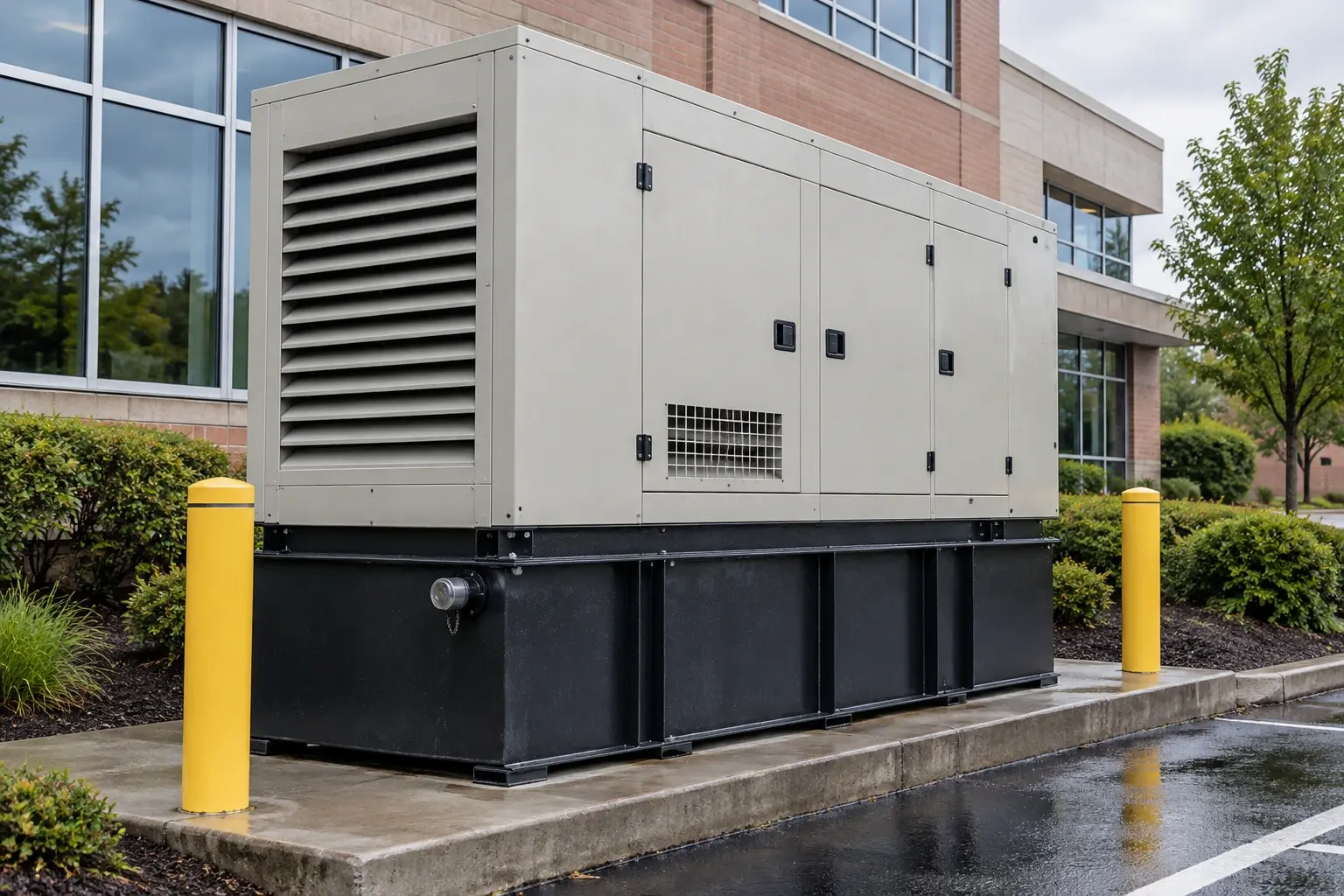
EPA treats a generator set as a combination of two things. The engine itself, with its crankcase and lube oil, is oil-filled operational equipment. The fuel tank underneath it, usually called a base tank or belly tank, is a bulk storage container. Both count toward your total if they hold 55 gallons or more, but the fuel tank is the one that drives the numbers and the one that carries the stricter containment requirements.
Day tanks are the piece people forget. Larger installations often keep a main storage tank outside and pipe fuel to a smaller day tank inside the generator room, so the engine has a ready supply. That day tank is its own container, and its capacity gets added on top of the main tank. The same goes for a second generator, a fire pump engine with its own fuel tank, or a spare tank someone set up years ago and never removed.
Beyond the generator, commercial buildings tend to have a few other oil sources that count. Hydraulic elevators run on oil reservoirs that often exceed 55 gallons each. Drums of lube or hydraulic oil in a maintenance room count, and our article on whether 55-gallon drums are included in SPCC Plans goes into how those are handled. Aboveground heating oil tanks count. Large electrical transformers count too, although pad-mounted transformers owned by the utility are generally the utility's responsibility rather than yours.
A few things don't count. Generators fueled by natural gas or propane don't add fuel storage to the total, because propane and natural gas aren't oil under this rule. Containers smaller than 55 gallons are left out. Fuel in the tanks of vehicles that move around the property is exempt. Completely buried tanks that are already regulated under the underground storage tank rules are also excluded from the aboveground count, though they bring their own requirements, which we cover in the New Jersey section below.
Building Owner or Tenant: Who's Responsible for the Generator Oil Spill Plan?
The SPCC rule puts the obligation on the "owner or operator" of the facility. That phrasing works fine at a factory where one company owns the land and runs the plant. It gets murky at a multi-tenant office park or a leased warehouse, where the landlord might own the generator, the tenant might pay for the fuel, and a service contractor might handle the testing. EPA's own guidance for leased property is practical: if the lease doesn't say who's responsible for the tanks, the parties should talk and settle it.
In practice, responsibility usually follows control of the equipment. If the landlord owns and maintains a generator that backs up the whole building, the plan typically belongs to the landlord. If a tenant installed its own generator to protect its servers or its cold storage, the tenant usually owns that plan. Single-tenant net leases are where things most often fall through the cracks, because the landlord assumes the tenant handles all building compliance and the tenant assumes the generator came with whatever paperwork it needed.
The fix is to put it in writing. A lease clause or side letter that names who prepares the plan, who does the monthly inspections, who trains the people who handle fuel deliveries, and who reports a spill will save a lot of finger-pointing later. That matters in New Jersey in particular, because liability for a discharge under state law can reach more than one party regardless of what the lease says. For questions about how liability would be divided after a spill, an environmental attorney is the right person to ask.
What an SPCC Plan Looks Like for a Simple Generator Site
The good news for most commercial buildings is that the plan doesn't have to be a giant binder. EPA created a streamlined option for "qualified facilities," and a building whose only real oil storage is a generator setup often fits the simplest version, called a Tier I qualified facility. To qualify for Tier I, the facility's total aboveground oil storage has to be 10,000 gallons or less, no single aboveground container can be larger than 5,000 gallons, and the facility can't have had a single discharge of more than 1,000 gallons, or two discharges of more than 42 gallons each within any 12-month period, in the three years before the plan is certified.
A Tier I facility can use EPA's fill-in-the-blank template, found in Appendix G of the rule, and the owner or operator can certify it without a Professional Engineer. The template covers the container inventory, the containment for each tank, how fuel deliveries are handled, inspection procedures, who to call in a spill, and a commitment to review the plan at least every five years. Our article on what a Tier I self-certified SPCC Plan is walks through the template in more detail.
Plenty of building managers fill out the template themselves, and if your setup is simple and you're comfortable with the rules, that's a reasonable choice. Where people get into trouble is filling it out wrong: missing a container, claiming double-walled containment the tank doesn't have, or never doing the inspections the plan promises. If your building has a tank over 5,000 gallons, more than 10,000 gallons total, or containment that isn't practical to provide, you're out of Tier I territory and into a Tier II or Professional Engineer certified plan.
As for cost, simple generator sites usually sit at the low end of the $2,500 to $15,000 range we see for SPCC Plans, and if your building already has a plan that just needs updating after a generator swap, a simple Tier I update typically runs about $1,500. Our breakdown of SPCC Plan costs explains what pushes a project up or down. You can also get a ballpark for RMA's help with your building using the calculator below.
Generator Fuel Tank Containment Problems at Commercial Buildings
Containment is where most generator sites have real issues, not paperwork. A generator base tank is a bulk storage container, so it needs secondary containment big enough to hold the full contents of the tank, with extra room for rain if it sits outdoors. The most common way to meet that is a double-walled tank, and EPA has said shop-built double-walled aboveground tanks can generally satisfy the sizing requirement. Many newer generators come on a double-walled base tank with a leak sensor between the walls, which makes compliance much easier. Our guide on how big SPCC containment needs to be covers the sizing math.
Older generators are a different story. Some sit on single-walled base tanks with no containment at all, or on a concrete pad with a short curb that holds a fraction of the tank. Day tanks inside generator rooms are often single-walled and sit near a floor drain, which can carry a leak straight to a storm sewer. We also see interstitial leak alarms that were disconnected years ago, fill ports with no spill bucket, and tank vents with no overfill protection, so a delivery driver who overfills the tank sends diesel out the vent and onto the roof or pavement.
Fuel deliveries deserve their own attention. The truck parks in a lot or loading dock, the hose runs to the fill port, and if something goes wrong the diesel heads for the nearest catch basin. Your plan needs to show how a delivery spill would be contained, whether that's a spill kit and drain covers staged at the fill point or a procedure for someone to attend every delivery. Monthly visual checks of the tank, the containment, and the alarm are a big part of staying in compliance, and our list of the top 10 things to do during SPCC monthly inspections is a good checklist to hand to your facilities staff.
What New Jersey Adds to Generator Oil Spill Rules
In New Jersey, the federal SPCC rule is enforced by EPA Region 2, not by the state. But New Jersey has its own spill law, the Spill Compensation and Control Act, usually called the Spill Act. It requires anyone responsible for a discharge of oil or another hazardous substance to report it to NJDEP right away through the department's 24-hour hotline, which is listed on NJDEP's website. The Spill Act also makes liability for cleanup strict, meaning fault doesn't matter, and it can be joint and several among the parties involved. That's another reason owners and tenants should sort out responsibility ahead of time. Our article on SPCC Plans in New Jersey covers how the state and federal layers fit together.
New Jersey also has a separate discharge prevention program under N.J.A.C. 7:1E, which requires Discharge Prevention, Containment and Countermeasure (DPCC) and Discharge Cleanup and Removal (DCR) plans. That program only applies to "major facilities," which means 200,000 gallons or more of total storage for all hazardous substances including petroleum, or 20,000 gallons or more of hazardous substances other than petroleum. A generator building isn't anywhere close, so DPCC and DCR plans almost never come into play for offices, warehouses, or retail sites.
If your generator's fuel tank is buried, it's likely covered by New Jersey's underground storage tank rules at N.J.A.C. 7:14B instead of the aboveground count. Work on regulated underground tanks, including installation and closure, has to be done by NJDEP-certified contractors. Aboveground generator tanks are also subject to the Uniform Fire Code, which your local fire official enforces, so tank location, spacing, and venting may come up during a fire inspection. And generators can trigger air permit questions too, which we cover in our article on emergency backup generators and environmental permits.
If you're installing a new generator or replacing an old one, the construction side, including electrical, building, and fire permits for the installation, belongs with your engineer and contractor. We don't handle construction permits. Once the new unit is in place and fueled, though, your building likely needs a new or amended oil spill plan, and that's the piece we can help with.
How RMA Helps Commercial Buildings With Generator Oil Spill Plans
We're a family-run firm based in New Jersey, and we've been helping facilities figure out their oil spill obligations since 1992. For a commercial building, that usually starts with a simple question: do you need a plan at all? We'll help you count your containers, look at where a spill would go, and tell you honestly if you're under the threshold or if the Tier I template is something you can handle on your own. If you do want us to prepare the plan, our senior staff does the work, checks the containment, and makes sure the plan matches what's on site. We can also train the people who handle fuel deliveries through our online environmental training library.
There's no pressure and no obligation. Give us a call, send us an email, or fill out the form on our website, and we'll talk through your building with you. When you're ready, you can contact RMA here.