Double-Walled Tanks at New Jersey Facilities: What the Second Wall Covers and What It Doesn't
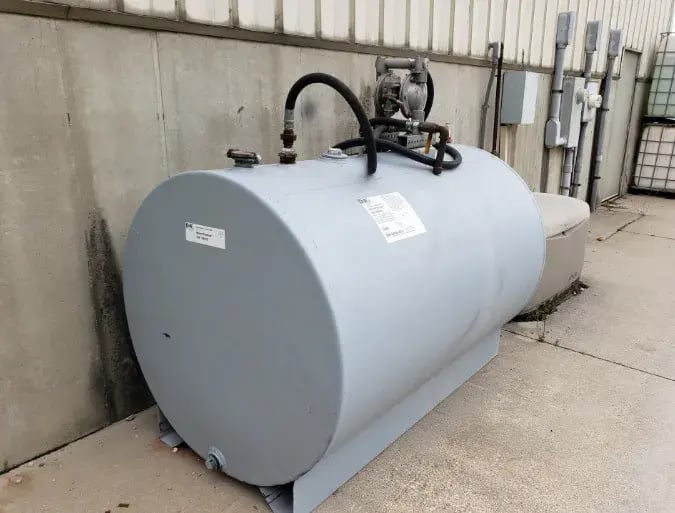
A lot of facilities buy a double-walled aboveground tank with one goal in mind, which is to skip the concrete dike and call containment done. It's an understandable plan. The second wall is built into the tank, it doesn't collect rainwater, and it takes up no extra floor space. For a New Jersey facility storing oil for a generator, a fueling station, or a boiler, the real question is whether that tank satisfies the federal oil spill prevention rule (SPCC, short for Spill Prevention, Control, and Countermeasure) and the state's discharge rules.
The short answer is that a double-walled tank can satisfy secondary containment for the tank itself, as long as it's built to the right standards and operated with the right safeguards. It doesn't cover the fill connection, the vent, the piping, or the spot where the delivery truck parks, and the space between the two walls needs to be checked on a schedule. This article walks through what qualifies, what still needs attention, what to inspect, and what to keep on file. If you'd rather have someone look at your tank and your SPCC Plan directly, you can reach out to RMA at any point.
Table of Contents
TL;DR
A shop-built double-walled tank can serve as secondary containment for the tank itself under EPA's SPCC rule, as long as it meets construction standards, has overfill protection, and every delivery is watched from start to finish. The second wall doesn't cover vent overfills, fill connections, piping, pumps, or the truck unloading area, so those still need their own containment or controls. You should also check the space between the walls on a set schedule and keep records of what you find. In New Jersey, facilities that qualify as major facilities face additional state requirements, so check your tank against both the federal and state rules before you drop the dike.
Do Double-Walled Tanks Count as Secondary Containment Under the SPCC Rule?
The SPCC rule is in 40 CFR Part 112, and EPA Region 2 enforces it in New Jersey. It applies to facilities that store more than 1,320 gallons of oil in aboveground containers (counting containers of 55 gallons or more), and it requires containment that keeps a spill from reaching navigable waters. For bulk storage containers, that means a way to hold the entire capacity of the largest container plus enough freeboard for rain. If you're new to the rule, our overview of how SPCC plans work covers the basics.
The rule is performance-based, which means it lists dikes, berms, and similar structures but also allows equivalent measures. EPA took that flexibility and applied it to double-walled tanks in a guidance memo issued in 1992 and amended in 2002. The original memo applied to smaller shop-fabricated tanks, generally under 12,000 gallons, and the 2002 amendment removed that capacity limit. Under that guidance, a qualifying double-walled tank can meet the secondary containment provisions for the tank itself. Because the interstice, the space between the walls, isn't exposed to the weather, these tanks also don't need extra freeboard for precipitation the way an open dike does.
Notice the phrase "can meet." Nothing in the guidance says buying a double-walled tank automatically puts you in compliance. The tank has to meet certain construction standards, it has to be operated with specific safeguards, and your SPCC Plan has to explain why the facility conforms. Gaps in those three are what we find most often.
What Does a Double-Walled Tank Need to Qualify as SPCC Secondary Containment?
EPA's guidance describes a double-walled tank that generally provides protection equal to a dike when four things are true. The inner tank is a steel tank listed by Underwriters Laboratories. The outer wall is built to nationally accepted industry standards, such as those from the American Petroleum Institute, the Steel Tank Institute, or the American Concrete Institute. The tank has overfill prevention that includes both an overfill alarm and an automatic flow restrictor or flow shutoff. And every product transfer into the tank is constantly monitored by a person.
The guidance is written for shop-fabricated tanks, meaning tanks built in a factory and delivered to the site. It isn't a blanket approval of every tank with two walls. EPA's original memo also flagged facilities with several tanks tied together by manifolds or piping as a situation where the presumption doesn't automatically hold, because one failure could release more than a single tank's volume. If your tanks share piping or can drain into each other, have that looked at specifically.
Your SPCC Plan carries the weight here. The plan needs to describe the tank, state which of these features it has, and explain why the facility conforms to the containment provisions. For plans that require a Professional Engineer's certification, the PE reviewing and approving the plan is the person signing off on that reasoning, so the tank's documentation should be in front of them. Our article on when a Professional Engineer is involved in SPCC Plans explains how that works.
What Still Needs Containment Around a Double-Walled Tank?
The second wall protects against one thing: a leak or rupture of the inner tank. Oil moves into, out of, and around a tank through a lot of other equipment, and EPA is clear that anything not contained within the double-walled tank itself is still subject to the general secondary containment requirements, along with the specific provisions for equipment in undiked areas.
Overfills and Vent Discharges
An overfill doesn't go through the tank wall. It comes out of the vent or the top fittings, and it lands on the ground outside both walls. EPA's guidance treats this as a gap in what a double-walled tank covers, which is why the overfill alarm, the flow restrictor or shutoff, and the constant monitoring of deliveries are part of the qualifying criteria. If you want to rely on something other than that overfill package, the guidance points to containment around the vent or fill area as an alternative. Either way, someone has to be standing at the tank during the delivery, with a way to stop the flow.
Piping, Pumps, and Fill Connections
Piping and connections are common places for spills to start. Hoses, fittings, valves, dispensers, and transfer pumps all sit outside the tank wall, and a failure there releases oil to the ground even when the tank itself is perfectly sound. The SPCC rule has specific provisions for facility piping and transfer equipment, including regular inspection of aboveground valves and piping, and EPA expects equipment outside the double wall to be addressed in the plan. Depending on the site, that might mean a containment pan under the fill port, a sump or double-walled piping, drip protection at the dispenser, or simply a documented inspection routine paired with spill response materials.
Truck Unloading Areas
Where the delivery truck sits is its own category. The rule has separate containment provisions for tank truck loading and unloading areas, generally based on the capacity of the largest compartment on the truck, and a double-walled tank doesn't satisfy them. Facilities often handle this with curbing, a drain connected to a holding sump, a containment pad, or portable drain covers and berms used for each delivery. Whatever you choose, the SPCC Plan should name it and explain how it works.
How Should You Monitor the Interstitial Space of a Double-Walled Tank?
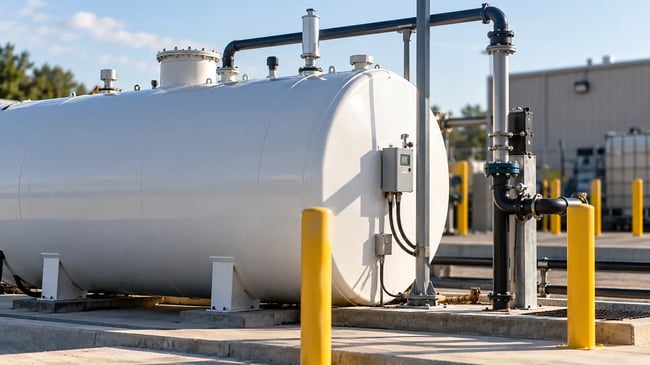
The interstice is the gap between the inner tank and the outer wall, and it's the whole reason a double-walled tank works. If the inner tank develops a leak, product collects there instead of reaching the ground. The trouble is that a leak into the interstice looks like nothing from the outside. If nobody checks it, the outer wall becomes the only barrier left, and the next failure becomes a discharge. A tank with a full interstice and a quiet alarm panel is a single-walled tank in practice.
Monitoring methods vary by tank and manufacturer. Many tanks have a monitoring port or tube where you can check for liquid with a gauge stick or by looking, and others use a float switch or liquid sensor wired to an alarm. Some systems hold the interstice under vacuum or pressure and watch for changes, and some use a fluid-filled reservoir. The right method is whichever one the manufacturer specifies for your tank, and your plan should say which one you use and how often it's checked. Many facilities fold the interstitial check into their monthly tank inspection, and our guide to SPCC monthly inspections shows what a thorough walkthrough covers.
Treat any liquid in the interstice as a finding to run down, whether it turns out to be product, water, or condensation. If it's product, the inner tank has failed and the tank should come out of service until it's repaired or replaced. If it's water, the source still needs to be found, because a path for water into the interstice can be a path for oil out of it. If you have electronic monitoring, test the alarm on a schedule too. An alarm that hasn't been tested is an assumption, and an inspector can reasonably ask when the last test was.
What Should You Check and Document for a Double-Walled Tank?
When EPA or a state inspector looks at a double-walled tank, they're looking for proof that the conditions behind the "equivalent containment" argument are being met every day, not just on the day the tank was installed. The table below pairs each item with what to confirm and what to keep on file.
| Item |
What to Confirm |
What to Keep on File |
| Tank construction |
Inner tank is a listed steel tank, outer wall built to a recognized industry standard |
Manufacturer specification sheet, nameplate photo, listing or certification |
| Overfill prevention |
High-level alarm and flow restrictor or shutoff are installed and working |
Test or inspection records, device specifications |
| Delivery procedure |
Someone attends every transfer and can stop the flow |
Written delivery procedure, training records for the people involved |
| Vent, fill port, and piping |
Containment or controls are in place, with no corrosion, leaks, or stained soil |
Inspection logs, photos of the containment method |
| Truck unloading area |
Containment or drainage control is sized and ready for each delivery |
Plan description, any capacity calculation, spill kit checks |
| Interstitial space |
Monitoring method works and the space is clear of liquid |
Dated monitoring log, alarm test records, notes on any findings and fixes |
| Integrity testing and inspection |
Inspections follow the industry standard your plan references |
Formal inspection reports, repair records |
| SPCC Plan |
Plan describes the tank, explains why it conforms, and is within its five-year review |
Current plan, PE review where required, review and amendment dates |
Two items on that list are easy to miss. The first is the delivery procedure, because "someone watches the truck" is easy to say and hard to prove without a written procedure and trained staff. Our article on annual SPCC training explains what the rule expects, and the online training library is one way to give delivery and operations staff that training. The second is the plan itself. Many facilities add a double-walled tank to an older plan and never update the plan to describe it. If your plan is getting old, our guide to plans over five years old is a good place to start.
How Do New Jersey Rules Affect Double-Walled Tank Containment?
The SPCC rule is only one layer in New Jersey. The state's Spill Compensation and Control Act (the Spill Act) makes discharges of petroleum and other hazardous substances reportable to NJDEP and puts cleanup responsibility on the party responsible. Facilities that qualify as major facilities under N.J.A.C. 7:1E also have to prepare a Discharge Prevention, Containment and Countermeasure (DPCC) plan. Whether you're a major facility depends on your total aggregate storage capacity and the substances you store, so check N.J.A.C. 7:1E against your own inventory. The state's most useful starting point is NJDEP's discharge prevention program pages.
For major facilities, the state rules have their own standards for aboveground tank storage, and they don't read exactly like the federal rule. They call for secondary containment or a diversion system for aboveground tank installations, they include a requirement that overfill and vent lines be protected by secondary containment or directed to another tank or holding area, and they set capacity standards that include extra room for six inches of rainwater where rain could collect in the containment. A double-walled tank may fit into that framework, but whether yours does is a question to answer against the rule text, and with NJDEP if there's any doubt, before you rely on the tank in place of a dike. The vent and overfill provision in particular lines up with the gap we described earlier. Our overview of SPCC plans in New Jersey covers how the state and federal layers fit together.
A few other points apply here. This article is about aboveground tanks, and underground tanks follow separate rules, including New Jersey's UST program, N.J.A.C. 7:14B, and work by NJDEP-certified contractors. The fire code is also separate from SPCC. It's enforced locally by your fire official, and it has its own view of tank installations, spacing, and protection, so a tank that satisfies EPA's guidance still has to satisfy the fire code. If you're installing a new tank, the construction side, including permits and the installation itself, is handled by your engineer and contractor. RMA doesn't prepare those construction-phase approvals. Once the tank is running, though, the operational side belongs to the facility, and that means an SPCC Plan or amendment that describes the new tank, DPCC requirements if you're a major facility, delivery procedures, inspections, and training. That's the part we can help with.
One more note on liability. A discharge from a fill port or vent is still a discharge, and a double-walled tank doesn't change that. If you've had a release and aren't sure of your reporting obligations or your exposure, an environmental attorney is the right person to talk to. For a sense of how enforcement works on the federal side, see who enforces SPCC plans and the most common SPCC violations and fines.
How Can RMA Help With Double-Walled Tank SPCC Compliance?
If you already have a double-walled tank, or you're deciding between one and a diked single-wall tank, we can look at what you have and tell you plainly where the second wall carries the load and where it doesn't. That usually means reviewing the tank's documentation, walking through your fill, vent, and piping setup, checking how your SPCC Plan describes the tank, and flagging gaps in monitoring and records. We're based in New Jersey and work with NJDEP's rules regularly, so we can also help you sort out whether the state's major facility requirements apply to your site. Where a plan needs a Professional Engineer's review and approval, we'll make sure the engineer has what they need to do it properly.
Sometimes the honest answer is that you're in good shape and just need to tighten up your inspection records. If so, we'll say that. There's no obligation and no pressure. You can call us, send an email, or fill out the form on our website, and you can also contact RMA directly to start the conversation.