Fuel Delivery and Tank Truck Unloading Rules for New Jersey Facilities: Containment, Drive-Off Prevention, and Spill Response
Fuel deliveries are one of the most likely moments for an oil spill at a facility. A tank can sit untouched for months, then a truck backs in, a hose goes on, and in the next twenty minutes there's a driver, a hose, a fill port, a pump, and a tank gauge all having to work correctly at once. Most facility managers have thought about the tank itself. Far fewer have thought about the ground under the truck while it's connected.
The short answer is that the federal oil spill rule, called the Spill Prevention, Control, and Countermeasure (SPCC) rule, expects containment sized for the largest single compartment of a delivery truck at a loading or unloading rack, a way to stop a truck from driving off while it's still hooked up, and written procedures for the transfer itself. Simpler fuel transfer areas fall under the rule's general containment requirement instead. This article walks through how the two differ, what the rule says about each, and what we'd put in place at a New Jersey facility. If you'd rather talk it through with someone who does this every day, you can always reach out to RMA.
Table of Contents
TL;DR
If your facility needs an SPCC Plan, the plan has to cover how fuel gets delivered. At a true loading or unloading rack, the rule requires containment for the largest single compartment of any truck that unloads there, plus a way to keep trucks from leaving while connected, such as wheel chocks, signs, a barrier, or an interlock. Simpler transfer areas follow the general containment rule, which looks at the most likely failure. Either way, the plan should spell out who attends the delivery, how overfills are prevented, and what spill gear and contacts are ready. New Jersey adds its own spill reporting duties on top.
What Counts as a Fuel Delivery Area Under SPCC Rules?
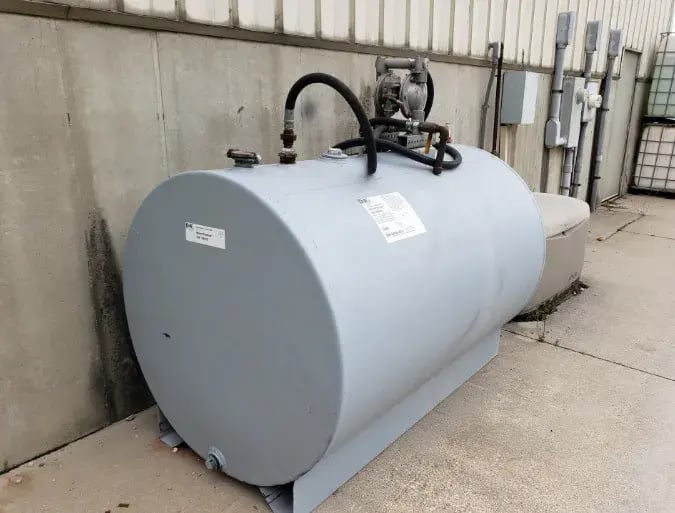
A fuel delivery area is any spot where a tanker truck connects a hose to one of your tanks or fill pipes. That could be the corner of the lot where a diesel truck fills your generator tank, the fill port for a heating oil tank behind a warehouse, a fleet fueling island, or a dedicated truck unloading station. It also includes the reverse, where a vacuum truck pulls used oil out of your container. If oil is moving between a vehicle and your equipment, you have a transfer point, and the SPCC rule cares about it.
SPCC applies when your facility stores more than 1,320 gallons of oil aboveground, counting containers of 55 gallons or more, and could reasonably be expected to discharge oil to navigable waters or adjoining shorelines. If you're covered, your plan has to describe your procedures for routine handling of product, and the rule specifically names loading, unloading, and facility transfers. In New Jersey, EPA Region 2 is the agency that enforces the federal rule, which we cover in more detail in our article on who enforces SPCC plans.
The delivery point gets overlooked because the tank usually has its own dike or double wall, so everyone assumes the spill risk is handled. That protection covers a tank failure. It does nothing for a hose that splits, a coupling that drips, a fill port that overflows, or a truck that pulls away early. Those failures happen outside the dike, on pavement that often drains toward a storm inlet.
How Do SPCC Loading Racks Differ From Simpler Fuel Transfer Areas?
The rule has a section written just for tank car and tank truck loading and unloading racks. A rack is generally a permanent, purpose-built structure where trucks load or unload product through fixed piping or loading arms, the kind you'd find at a bulk plant or a facility with a dedicated truck unloading station. Most small and mid-sized New Jersey facilities don't have one. They have a fill port on a tank, a fuel island, or a generator fill, and a truck parks nearby.
The rule text centers on racks, and facilities and inspectors don't always agree on where a rack ends and a simple transfer area begins. Your plan should say which one you have and explain why, so there's no guesswork later. The differences matter because the requirements aren't identical.
| Topic |
Loading or Unloading Rack |
Simpler Transfer Area |
| Main rule |
40 CFR 112.7(h), plus the general requirements |
General containment in 112.7(c), drainage in 112.8(b), transfer operations in 112.8(d) |
| Containment sizing |
At least the maximum capacity of any single compartment of a truck loaded or unloaded at the facility |
Based on the typical failure mode and the most likely quantity of oil discharged |
| Drainage |
Flows to a catchment basin or treatment facility designed to handle discharges, or use a quick drainage system |
Drainage from undiked areas where truck discharges may occur should flow to a pond, lagoon, or catchment basin that retains the oil |
| Drive-off protection |
Interlocked warning light or physical barrier system, warning signs, wheel chocks, or a vehicle brake interlock system |
No specific device listed, but vehicles entering must be warned, and the plan should describe procedures |
| Truck outlet check |
Inspect the lowermost drain and all outlets before filling and departure |
Not a named requirement, but a good procedure to include |
The rack requirements are more prescriptive, and EPA inspectors look for them. If your plan describes an active rack but doesn't address its containment, that shows up as a deficiency in EPA enforcement paperwork. We cover the penalty side in our article on top SPCC plan violations and fines.
How Big Should Containment Be at a Fuel Delivery Area?
At a rack, the rule is specific. Your containment has to hold at least the maximum capacity of any single compartment of a tank truck that unloads or loads at your facility. That's the largest compartment, not the whole truck and not your tank. Delivery trucks are often split into several compartments, and the logic is that a typical failure at the connection would involve one compartment at a time. The compartment sizes vary from truck to truck, so ask your supplier which trucks serve your site and write that configuration into your plan.
The containment system has to be built so that oil from a failure can't escape before cleanup. The rule's list of acceptable methods is broad, and includes curbing or drip pans, sumps and collection systems, culverting and gutters, dikes and berms, retaining walls, and sorbent materials. Active measures count too, not just passive ones. A curbed concrete pad that drains to a sump works well for a dedicated unloading station. A drip pan or spill containment unit under the fill port works for a single tank. A trench drain leading to a catchment basin is common where a truck lane serves several tanks.
For simpler transfer areas, the general containment rule says you only need to address the typical failure mode and the most likely quantity of oil discharged. That gives you more room to match the measure to the risk. Plenty of facilities size to the largest truck compartment anyway because it's an easy number to defend, and we usually suggest it where the space allows. The rule doesn't require it for every transfer point, though, and your plan should explain the reasoning either way.
Two details trip people up. First, rain collects in open containment, and draining it needs a valve that stays closed, an inspection of the water before it leaves, and a record of the event. Second, if containment truly isn't practicable, the rule lets you explain why in the plan and substitute a contingency plan and a written commitment of people and equipment. That's a fallback, and it needs a real justification. If your plan has to be certified by a licensed Professional Engineer, the engineer's review of the containment design is a step you want done carefully. Our article on SPCC oil spill containment sizing goes deeper on the math.
How Do You Prevent Truck Drive-Offs During Fuel Transfers?
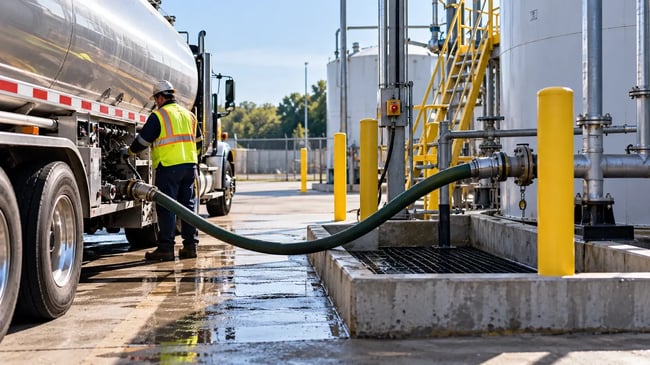
A drive-off happens when a driver pulls away with the hose or loading arm still connected. It tears the connection apart and dumps whatever is in the hose, plus anything still flowing, onto the ground. It's an old problem, which is why the rule addresses it directly at racks. Next to a loading or unloading rack, you need an interlocked warning light or physical barrier system, warning signs, wheel chocks, or a vehicle brake interlock system, so vehicles can't depart before the transfer lines are fully disconnected. The rule gives you options, so your plan should say which ones you use and how they're used in practice.
Wheel chocks and signs are the low-cost choices, and they only work if people use them every time. A barrier or gate that's physically closed during unloading is stronger. A brake interlock is stronger still, since the truck can't move while the transfer line is connected. Many suppliers also have their own habits, like a cone on the hood or a tag on the steering wheel, and those can back up your measures. They shouldn't replace them, because you can't control another company's driver habits.
For a simpler fuel transfer area, the rule doesn't list a specific device. It does require you to warn vehicles entering the facility so no vehicle endangers aboveground piping or other oil transfer operations, and your plan still has to describe the loading and unloading procedures. We'd include chocking and a clear parking position in those procedures, and bollards where vehicles could hit piping or a fill port. Before a truck is filled at a rack and again before it leaves, the rule also requires a close inspection of the lowermost drain and all outlets for leaks. It's a quick check that catches a truck problem before it becomes your spill.
Between deliveries, fill connections should be capped or blank-flanged when not in use, and the security section of the rule expects you to secure loading and unloading connections of oil pipelines. A locked fill cap is a simple way to meet that expectation, and it keeps strangers from dropping product into your tank.
Who Should Attend Fuel Deliveries, and What Spill Response Should Be Ready?
The rule doesn't contain one sentence saying a staff member must watch every delivery. What it does require is overfill prevention for each bulk storage container, using at least one device such as a high liquid level alarm at a constantly attended station, a high level pump cutoff, direct audible or code signal communication between the person gauging the tank and the pump operator, or a fast response gauging system. If you rely on gauging, a person has to be present to monitor the gauges and the overall filling, and you have to regularly test the liquid level sensing devices. In other words, the rule leans on somebody being there, and your plan should make that explicit.
A delivery procedure that works at most facilities looks like this in practice. Before ordering, someone confirms how much room the tank has. When the truck arrives, a trained employee checks that containment is clear and drains are closed, confirms the truck is chocked, and watches the connection and the gauge for the whole transfer. That person knows how to stop the flow, whether that's a pump shutoff, a valve, or a call to the driver. After the hose is disconnected, they check the area, record the delivery, and make sure fill caps are secured. Your plan should name who does each step.
Spill response readiness is the other half. A spill kit with sorbent, drain covers, and a way to block storm inlets should be staged close to the delivery point, not locked in a building across the lot. Your plan also needs a contact list covering the facility response coordinator, the National Response Center, any cleanup contractor you've lined up, and the agencies you'd have to notify. It needs the details someone will have to report, like the exact location, the material, the estimated quantity, and the source. Our article on the sheen rule for reporting an oil spill explains the federal reporting trigger.
Training ties it together. Oil-handling personnel have to be trained on equipment operation, discharge procedures, applicable pollution control laws, and the contents of your plan, you need a designated person accountable for discharge prevention, and the rule calls for discharge prevention briefings at least once a year. If you haven't built that out, our guides on what SPCC training should include and our online training library are good starting points. Inspection records belong with the plan for three years, and our list of monthly SPCC inspection items can help you make the delivery area part of your routine.
What Do New Jersey's Spill Rules Add to Fuel Delivery Areas?
The federal SPCC rule is the starting point, and New Jersey layers its own rules on top. The state's Spill Compensation and Control Act, usually called the Spill Act, covers discharges of hazardous substances as well as oil, and it puts a duty on you to report discharges to the New Jersey Department of Environmental Protection (NJDEP). Check NJDEP's website for the current hotline number before you put it in your plan, and keep it next to your federal contacts. A delivery spill that stays on pavement can still be reportable in New Jersey, even where it wouldn't trigger the federal sheen rule.
Facilities that qualify as "major facilities" under N.J.A.C. 7:1E also need Discharge Prevention, Containment, and Countermeasure (DPCC) and Discharge Cleanup and Removal (DCR) plans, and those plans address transfer operations too. Whether your facility counts as a major facility depends on its total storage capacity and what it stores, so check the rule against your own inventory. Underground tanks fall under separate state rules in N.J.A.C. 7:14B, and local fire officials enforce the Uniform Fire Code, which can carry its own expectations for fuel handling. Confirm those with your local fire official. We've written more about how the layers fit together in SPCC plans in New Jersey.
If you're building a new unloading pad, adding a tank, or redeveloping part of your site, the construction side has its own approvals, like construction and fire permits and soil erosion requirements. We don't prepare those, and your engineer or contractor will be the right people for them. Once the facility is operating, we can help with the pieces we do handle, like updating your SPCC Plan to cover the new delivery point and sorting out which state requirements apply to you. And because discharges can create real liability, an environmental attorney may be the right call if you've had a significant spill or an agency has contacted you.
How Can RMA Help With SPCC Fuel Delivery Area Compliance?
We've spent more than thirty years helping facilities write SPCC Plans that match how they actually operate, and delivery areas are a place where plans and reality often drift apart. We can review your current plan against how fuel gets delivered today, help you work out whether you have a rack or a simpler transfer area, check containment sizing, and tighten your delivery procedures and training. We're based in New Jersey, so we're familiar with how NJDEP and the state's rules fit alongside the federal requirements. And if you're not sure you need our help at all, we'll tell you that too.
There's no pressure and no obligation. You can call us at 888-RMA-0230, send us an email, or fill out the form on our website, and a member of our team will follow up. When you're ready, just contact RMA and tell us what your delivery setup looks like.