If Oil Is Still on Site, Your SPCC Obligations Don't Stop When the Business Does
A plant shuts down, a company moves to a new site, or a seasonal operation goes quiet for a couple of years. The fuel tank is still out back, the drums of hydraulic oil are still in the shop, and nobody's coming in every day. A lot of owners assume the federal oil spill rules went dormant along with the production schedule. They didn't. The Spill Prevention, Control, and Countermeasure (SPCC) rule cares about how much oil your containers can hold and where they sit, not whether anyone's running the operation.
The short version is that your obligations continue until the oil containers are permanently closed in the way the rule defines, or the oil and tanks are gone. In this article we'll walk through your three options, the Pennsylvania DEP tank closure steps that sit on top of them, and how to choose between them. If you'd rather talk through your own site, you can reach out to RMA anytime.
Table of Contents
TL;DR
Yes, SPCC rules still apply to an idle or closing Pennsylvania facility as long as the oil containers are still there, even if they're empty. You can keep the plan and inspections going, permanently close the containers by draining them, disconnecting the piping, locking the valves, and posting dated signs, or remove the oil and tanks entirely. Pennsylvania's DEP storage tank rules add their own steps for tanks it regulates, including a 30-day notice before permanent closure and a registration update afterward. Which path makes sense depends on how long the site will sit idle and what shape the tanks are in.
Does SPCC Still Apply When a Pennsylvania Facility Goes Idle?
Yes, if oil is still on site. The SPCC rule (40 CFR Part 112) applies to facilities that can store more than 1,320 gallons of oil in aboveground containers, counting only containers of 55 gallons or more, or more than 42,000 gallons in completely buried tanks. The test is capacity, not contents. An empty 5,000-gallon tank counts toward the threshold exactly as a full one does. The rule also pulls in containers used for standby, seasonal, or temporary storage, and anything that isn't "permanently closed" as the rule defines that term. "Idle" isn't a status the rule recognizes.
If you're not sure whether you have a plan, an SPCC Plan is the written document that describes the oil containers at your site, the containment around them, your inspection routine, and how you'd respond to a spill. If your site is over the threshold, you need one. If you already have one, going idle doesn't pause it. If you've never had one and you're winding down a site, the first job is adding up your container capacity, including oil-filled equipment like transformers and hydraulic systems, because that number decides whether any of this applies. Our guide on figuring out whether you need an SPCC Plan walks through the math, and what an SPCC Plan is covers the basics.
In Pennsylvania, EPA Region 3 enforces the SPCC rule, and a separate set of rules from the Pennsylvania Department of Environmental Protection (DEP) governs the tanks themselves under its storage tank program. Closing or idling a site can trigger obligations under both, and they use different vocabulary. A tank can be "out of service" as far as DEP is concerned and still count in full toward your SPCC threshold. If you want the background on who shows up and why, see our article on who enforces SPCC Plans.
Facilities with oil left behind really have three paths: keep the plan and inspections going, permanently close the containers, or take the oil and tanks off site. They aren't mutually exclusive. Plenty of sites close some containers, remove others, and keep a smaller operation under the plan.
Option 1: Keeping Your SPCC Plan and Inspections Going
This is the least dramatic option because nothing changes on paper. You keep the oil, keep the plan current, and keep doing what the plan says. That means the inspections and records, annual spill-prevention briefings for people who handle oil, the five-year plan review, and amendments when something changes. The rule gives you six months to amend the plan after a change that materially affects your spill potential, and if your plan is certified by a professional engineer, technical amendments need an engineer's certification too. When a PE is required, we work with an outside professional engineer, so you'll know who's involved before anyone is billed.
Idle sites add their own problems. Plans commonly commit to monthly visual inspections of tanks, containment, and piping, and once your plan says so, that's what an inspector will hold you to. Our list of what to check during monthly SPCC inspections still applies at a quiet site. It's also where rainwater fills dikes, valves get left open, and a slow leak can run for weeks because nobody's there to see it. Inspection records have to be kept for three years, and a gap in the log while the plant sat dark is easy for a reviewer to spot. Common SPCC violations and fines often come down to missing paperwork like this.
Training and plan access matter too. The rule calls for spill-prevention briefings at least once a year for oil-handling personnel. If nobody works at the site, there may be no one to brief, but whoever checks on it still needs to know what the plan expects, and our article on annual SPCC training explains the requirement. If the site isn't normally attended at least four hours a day, the rule lets you keep the plan at the nearest field office instead of on site, as long as it's available for review. Meanwhile your five-year review date keeps running whether or not the lights are on, so see how SPCC Plan five-year reviews work if yours is coming due.
Option 1 fits short shutdowns, seasonal operations, and sites with a planned restart where the tanks are in good shape. It gets expensive in effort and risk the longer a site sits, because you're maintaining a full compliance program for a place that isn't earning anything.
Option 2: Permanently Closing Oil Containers Under the SPCC Rule
The SPCC rule does give you a way out without hauling a single tank away. A container that's "permanently closed" doesn't count toward your capacity. The rule defines it narrowly. All liquid and sludge has to be removed from the container and its connecting lines. Every connecting line and pipe has to be disconnected from the container and blanked off. All valves, except ventilation valves, have to be closed and locked. And each container needs a conspicuous sign saying it's permanently closed, with the date of closure. Miss any one of those and the container still counts, whatever you call it.
If every container at the site gets closed this way, your counted capacity drops to zero and the SPCC rule no longer applies to the facility. If only some are closed, you recalculate with what's left. A site that started at 4,000 gallons and now has 900 gallons in active containers has dropped under the 1,320-gallon line, though you'll want to total everything carefully first, including drums of 55 gallons or more, oil-filled equipment, and fuel trailers or skid tanks, which don't get the exemption that applies to fuel tanks built into vehicles. Our article on whether 55-gallon drums count toward SPCC covers one of the most common miscounts.
Document the closure while you do it. Photos of the locked valves, the blanked lines, and the dated signs, plus a record of who emptied what and where the oil went, give you proof if EPA or a buyer's attorney asks later. Keep your plan and inspection records for the closed containers too. If the facility remains over the threshold after the closure, update the plan's container list and site diagram so they match what's actually there. And if oil ever goes back into one of those containers, you've effectively put a new container into service, which means the plan and any DEP registration need to catch up.
SPCC "permanently closed" and DEP "permanent closure" are different things, and doing the first doesn't satisfy the second. For tanks DEP regulates, the Pennsylvania steps come on top, which we'll cover below.
Option 3: Removing Oil and Tanks From the Site
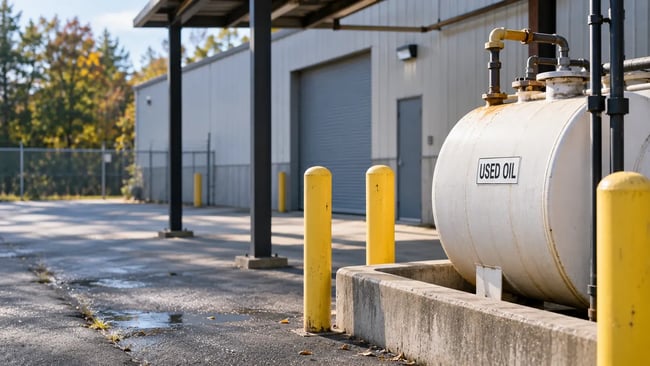
Taking everything off site is the cleanest answer for a long-term closure, a property sale, or tanks that are old enough that nobody wants to keep inspecting them. Once the oil and the containers are gone, there's nothing left to count, and the SPCC obligation ends with them. The work is more than emptying a tank, though. An empty tank that's still on site and not permanently closed still counts, so draining alone doesn't change your SPCC status.
The list of things to clear usually includes bulk tanks and day tanks, drums and totes, oil-filled equipment such as hydraulic systems, compressors, and transformers, and used oil containers. The oil itself has to be reused, recycled, or disposed of properly, and our summary of used oil regulations is a good starting point if you've got a lot of it. Sumps and containment areas holding oily water or sludge need to be dealt with as well. Look at the ground around the tanks while you're there. If you spot staining or a smell, that's a reason to stop and sort out reporting before the tanks leave, not after.
In Pennsylvania, tank handling at DEP-regulated tanks has to be supervised by a DEP-certified installer, and removal can involve local permits, such as fire marshal or municipal approvals. We don't do tank removal or building and demolition permits, so for that piece you'll work with a tank contractor and your municipality. What we can help with is everything around it: confirming what's still subject to SPCC, making sure the closure is documented, and closing out the plan properly.
What Do Pennsylvania DEP Tank Closure Rules Require?
Pennsylvania's Storage Tank and Spill Prevention Act and the regulations under it (25 Pa. Code Chapter 245) apply to tanks DEP regulates, which depends on the tank's size, type, and contents. Large aboveground tanks fall under one set of rules, small aboveground tanks under a simplified program, and underground tanks under their own closure rules. Check your tanks against DEP's storage tank program before assuming either way. If a tank is regulated, going idle or closing triggers specific steps.
For a large aboveground tank taken out of service temporarily, DEP's rules call for these steps:
- Submit an amended registration form to DEP within 30 days after the change in tank status.
- Empty the tank and handle the contents under state and federal waste rules.
- Secure the tank against unauthorized entry, and cap or blind all piping except vents.
- Maintain the tank's integrity and protect it against flotation while it sits.
- Keep inspection requirements in mind. Inspection intervals can be delayed, but the delayed inspections have to be done before the tank goes back into service.
- Permanently close the tank within five years unless DEP approves a written request for an extension.
For permanent closure of a large aboveground tank, the owner has to notify DEP at least 30 days before starting, unless DEP allows less time or the work responds to a corrective action. A site assessment looks for any release, and a closure report documents the work, with both retained for three years. The tank has to be cleaned, freed of hazardous vapors, and ventilated if it stays on site, or emptied and removed under current industry practice and waste rules. A tank left in place has to be legibly marked with the date of permanent closure, and a tank closed in place has to be rendered inoperable and secured. If the tank is under a fire marshal or other local permit, those agencies need to be notified. Within 30 days of completion, the owner submits an amended registration form signed by the owner and the certified installer who supervised the work. If the assessment turns up contamination, the corrective action process takes over.
Small aboveground tanks under the simplified program follow a shorter path that includes a visual examination of the surface, soil, and area around the tank for signs of a release, and the same amended registration within 30 days. DEP's closure page lays out the full sequence for aboveground and underground tanks, including the notification forms, hiring a DEP-certified remover, the sampling requirements, and the closure report when it's required or requested. DEP's Division of Storage Tanks can answer questions at 1-800-42-TANKS (1-800-428-2657) from within Pennsylvania.
| Term |
Who Uses It |
What It Means for Your Tank |
| Temporarily out of service |
DEP |
Tank is emptied, secured, and registered as out of service. It still counts toward your SPCC capacity unless it also meets the SPCC definition below. |
| Permanently closed |
EPA (SPCC rule) |
Liquid and sludge removed, lines blanked off, valves locked, dated sign posted. The tank stops counting toward SPCC capacity. |
| Permanent closure |
DEP |
30-day notice, site assessment, certified installer on site, closure report, and amended registration. Needed for DEP-regulated tanks even if the SPCC definition is already met. |
How Do You Choose Between Idling, Closing, and Removing Oil Storage?
The deciding factors are usually how long the site will sit idle, what condition the tanks are in, and what's going to happen to the property. A shutdown with a firm restart date points toward keeping the plan going. A site that's headed for sale points toward removal, since buyers, lenders, and insurers tend to ask about tanks, and a Phase I environmental site assessment will flag them. In between, permanent closure under the SPCC definition can shrink your obligations without the cost of pulling tanks, but only if the numbers get you under the threshold.
| Option |
What You Keep Doing |
Best Fit |
Watch Out For |
| Keep the plan going |
Inspections, records, training, five-year review, amendments |
Short shutdowns and planned restarts |
Gaps in inspections at an unattended site |
| Permanently close containers |
Records of the closure, plus the plan for anything still active |
Longer idle periods where remaining capacity falls under the threshold |
Missing one step of the definition, and separate DEP closure steps |
| Remove oil and tanks |
DEP closure paperwork and records for the removed tanks |
Property sales, long-term closures, old tanks |
Contamination found during removal, and local permits |
You may not need a consultant at all for the simplest case. If you've got one small tank, you're removing it, and DEP's closure forms and a certified tank contractor cover the work, that's a job you can handle without us. Where it gets harder is the mixed site: a few tanks to remove, some drums and equipment to count, a plan that needs updating, and a handful of DEP registrations to sort out, all while the facility is either partly operating or being prepared for sale.
One last point on risk. Inspectors from EPA Region 3 can ask for your plan and records whether or not the site is busy, and a release from an unattended tank still has to be reported and cleaned up. If you've already received an information request or a notice of violation from EPA or DEP about the site, an environmental attorney may be the right first call before you respond. Our overview of SPCC Plans is a good refresher on how the pieces fit together.
How RMA Helps With SPCC Obligations at an Idle or Closing Facility
We're a family-run firm, and for sites in this spot we usually start by adding up what's actually on the property and figuring out whether the SPCC rule still applies. From there we can write or revise a plan that reflects the containers you're keeping, document containers you've permanently closed, and tell you plainly when a site has dropped below the threshold and what records to hang on to. If your plan needs a PE's certification for technical changes, we work with an outside professional engineer. Initial SPCC training is free with a new RMA plan, which helps if a skeleton crew is left to look after the site. We can also point you toward tank contractors and the right DEP contacts for the closure work, since that part isn't something we do ourselves.
There's no pressure and no obligation. If you'd like a second opinion on whether you still need a plan, or you're not sure which of the three options makes sense, you can call us, send an email, or fill out the form on our website. You can also contact RMA directly and one of us will talk it through with you. If you'd rather get your team up to speed on its own, our online training library has courses you can buy.


