How Heating Oil Tanks at New Jersey Businesses, Churches, Schools, and Older Buildings Fit Into Federal Oil Spill Plan Rules and New Jersey's Tank and Spill Rules
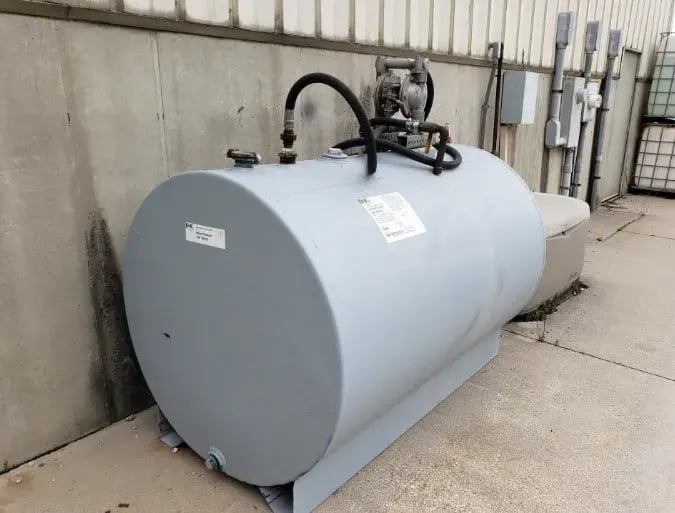
Plenty of New Jersey buildings still heat with oil. Older offices, churches, private schools, apartment buildings, and small manufacturers often have a fuel oil tank in the basement, out back, or buried under the parking lot, and many of those same buildings added an emergency generator with its own fuel tank in the last decade or two. Most owners have never heard of a federal oil spill plan, so here's the short answer. Yes, a heating oil tank at a business counts toward the federal oil storage threshold. The well-known heating oil exemption only covers tanks at single-family homes, not commercial, institutional, or multi-family buildings. If your heating oil tank and generator tank together hold more than 1,320 gallons aboveground, your facility very likely needs an oil spill plan.
In this article, we'll walk through how the federal rule treats heating oil, how to add up your tanks the way EPA does, and where New Jersey's own tank and spill rules fit in, since some heating oil tanks are exempt from the state's underground tank program while others aren't. We'll also cover what happens if a heating oil tank leaks, a few common New Jersey building setups and where each one lands, and what a plan costs if you do need one. If you'd rather have someone look at your tank list with you, feel free to reach out to RMA and we'll tell you where you stand, even if the answer is that you don't need us.
Table of Contents
TL;DR
The federal heating oil exemption only covers tanks used solely at a single-family home, so heating oil tanks at businesses, churches, schools, and apartment buildings count toward the federal oil spill plan threshold. If your aboveground tanks of 55 gallons or more, including heating oil and generator fuel tanks, add up to more than 1,320 gallons and a spill could reach water, you likely need an SPCC Plan. New Jersey separately exempts many smaller nonresidential heating oil tanks from its underground tank program, but it doesn't exempt anyone from reporting a leak. A heating oil spill still has to be reported to NJDEP and cleaned up under the state's rules.
Do Heating Oil Tanks at Businesses Count Under the Federal SPCC Rule?
First, the plain-language version of the rule. EPA requires facilities that store more than a certain amount of oil to have a written oil spill plan, called a Spill Prevention, Control, and Countermeasure Plan, or SPCC Plan. It lays out how you store oil, how you'd keep a spill from reaching water, how you inspect your tanks, and how you train the people who handle them. The rule applies when a facility has more than 1,320 gallons of aboveground oil storage capacity, or more than 42,000 gallons of capacity in completely buried tanks, and could reasonably be expected to spill oil into a waterway or shoreline. In New Jersey, EPA Region 2 enforces it.
Heating oil is oil under this rule, the same as diesel, gasoline, or lubricating oil. The confusion comes from an exemption EPA added in its 2008 amendments. The federal rule excludes any container for heating oil used solely at a single-family residence, both from coverage and from the capacity count. EPA's guidance explains it didn't intend to regulate residential oil use at non-commercial buildings, and that the exemption covers containers at a farm or other single-family residence that are used only to heat that residence.
That's a narrow door. A heating oil tank at an office building, a church, a school, a warehouse, a restaurant, or a strip mall doesn't fit through it. Neither does a tank serving a multi-family apartment building, because that isn't a single-family residence. Where it gets interesting is property with more than one building. A church campus with a parsonage is a good example. A tank that only heats the single-family parsonage can fall under the exemption, while the tank heating the sanctuary or the school building next door still counts.
Why Most Commercial Heating Oil Tanks Count Toward SPCC
A few other SPCC basics matter here. The rule counts container capacity, not how much oil is in the tank, so a 1,000-gallon tank you only fill halfway still counts as 1,000 gallons. Only containers of 55 gallons or more count, which is why the small day tank on some boilers may drop out of the math while the main storage tank stays in. Our article on whether 55-gallon drums are included in SPCC plans covers that cutoff in more detail. Tanks that are "permanently closed," meaning drained of all oil and sludge, disconnected, locked, and labeled, also drop out. A tank you stopped using after switching to natural gas but never cleaned out does not.
How to Add Up Heating Oil and Generator Tanks for the SPCC Threshold
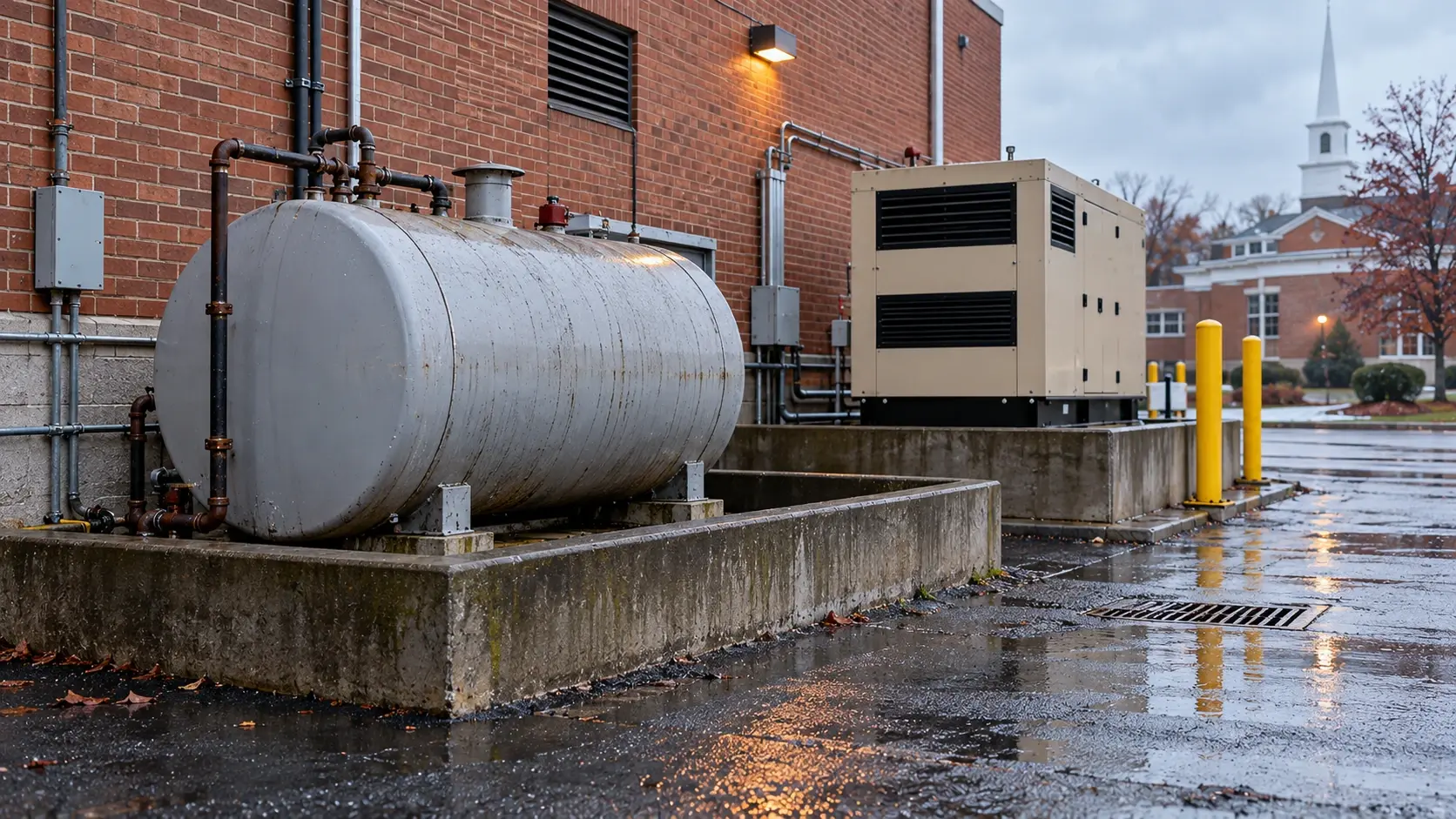
The scenario we see most often goes like this. A building has had a 1,000-gallon heating oil tank for decades and never needed a plan. Then someone installs an emergency generator with a 500-gallon fuel tank underneath it, and nobody adds the two together. That building now has 1,500 gallons of aboveground oil storage capacity, which is over the 1,320-gallon line. The generator didn't need to be large for this to happen. It only needed to push an existing total over the top.
Generator fuel tanks count like any other storage tank. Belly tanks under the generator, separate day tanks of 55 gallons or more, and standalone fuel tanks all go into the total. Oil-filled equipment counts too, so if you own a transformer or a large hydraulic system with 55 gallons or more of oil, add it in. Our article on environmental permits for emergency backup generators covers the other rules a generator can bring with it. Here's how a typical tally looks.
| Container at the facility |
Capacity |
Counts toward 1,320 gallons? |
| Aboveground heating oil tank serving the main building |
1,000 gallons |
Yes |
| Generator belly tank |
500 gallons |
Yes |
| Drums of hydraulic oil in maintenance |
2 x 55 gallons |
Yes |
| Five-gallon pails of motor oil |
Under 55 gallons each |
No |
| Heating oil tank serving only a single-family residence on the property |
275 gallons |
No |
| Total counted aboveground capacity |
1,610 gallons |
Over the threshold |
Crossing 1,320 gallons is the first test. The second is whether a spill could reasonably reach a waterway, which includes storm drains, ditches, and streams that lead to one. In a state as built up and wet as New Jersey, most sites meet that test. You also can't count on your building, curbs, or containment walls to argue your way out of it. EPA's rule says you look at geography and location without considering manmade structures that might hold back a spill. Our guide on the four steps to figure out if you need an SPCC Plan walks through both tests.
Underground Heating Oil Tanks and the 42,000-Gallon Buried Threshold
Buried heating oil tanks work a little differently. Many completely buried tanks are exempt from SPCC because they're already covered by EPA's underground storage tank rules. Under federal law, though, a tank storing heating oil used on the premises where it's stored isn't regulated as an underground storage tank, so it doesn't get that exemption. That means a buried heating oil tank counts toward the separate 42,000-gallon buried threshold, which few buildings come close to. The bigger effect is that if your aboveground tanks already put you over 1,320 gallons, your SPCC Plan generally has to address that buried heating oil tank too. Whether a buried tank regulated only under New Jersey's own program changes that analysis depends on exactly how the tank is regulated, so check it against the rule rather than assuming.
What New Jersey's Tank Rules Say About Commercial Heating Oil Tanks
New Jersey regulates underground storage tanks under its own rules at N.J.A.C. 7:14B, which in some ways reach further than the federal program. For heating oil, the dividing line is size and building type. The state's rule exempts tanks of 2,000 gallons or less used to store heating oil for onsite consumption in a nonresidential building, and it exempts residential heating oil tanks of any size. A nonresidential heating oil tank larger than 2,000 gallons is a regulated tank under the state program. NJDEP has specifically included heating oil tanks over 2,000 gallons in its tank compliance initiatives, while excluding homeowner tanks.
| Heating oil tank type |
Federal SPCC rule |
NJ underground tank rules (N.J.A.C. 7:14B) |
| Single-family home, any size |
Exempt and not counted |
Exempt (residential) |
| Nonresidential building, aboveground |
Counts toward 1,320 gallons |
Not an underground tank program issue |
| Nonresidential building, buried, 2,000 gallons or less |
Counts toward 42,000 buried gallons |
Exempt |
| Nonresidential building, buried, over 2,000 gallons |
Counts toward 42,000 buried gallons |
Regulated tank |
Being exempt from the state tank program doesn't mean a tank is unregulated in every sense. New Jersey calls these unregulated heating oil tanks, and the people who close, test, or remediate them still need state certification. Tank installation, removal, and abandonment also run through the construction code and local officials. The state's Department of Community Affairs splits its guidance at the same line, with one set of procedures for heating oil tanks under 2,001 gallons and another for commercial heating oil tanks of 2,001 gallons and over. The Uniform Fire Code adds its own storage requirements, enforced by your local fire official.
We don't handle any of that construction-side work. Installing, replacing, or removing a tank goes through your contractor, an NJDEP-certified tank professional where one is required, and your local construction and fire officials. Where we come in is the operating side once the tank is in service: whether the new tank changes your SPCC status, whether your existing plan needs an amendment, and what inspections, training, and spill procedures go with it. We're also glad to help you figure out which construction pieces apply and who to call for them.
How New Jersey's Spill Act Applies to Heating Oil Leaks at Businesses
Whatever your SPCC status and whatever your tank's status under 7:14B, New Jersey's Spill Compensation and Control Act, usually just called the Spill Act, still applies. It's the state law that makes discharges of petroleum and other hazardous substances the responsibility of the people who caused them or who own or control what leaked. It covers far more than oil, but heating oil is squarely included, and there's no size exemption for the tank. If heating oil gets into soil, groundwater, or surface water, that discharge has to be reported to NJDEP's 24-hour hotline, 1-877-WARNDEP (1-877-927-6337).
Safety comes first. If oil is spreading toward a drain, a stream, or a basement, or there's any fire risk, call 911 and get people clear before anything else. Then call the NJDEP hotline, stop the source if you can do it safely, and call your fuel supplier to pump out what's left in the tank. For a leaking unregulated heating oil tank, the cleanup has to be handled by a state-certified professional under New Jersey's heating oil tank remediation rules. For a regulated tank, cleanup generally runs through a Licensed Site Remediation Professional, or LSRP. Spill Act liability is strict, which means fault usually isn't the question, so it's often wise to bring in an environmental attorney once a discharge is confirmed. Our article on when you have to report an oil spill covers the federal side of reporting.
You may also have heard about New Jersey's discharge prevention plans for "major facilities." Those plans, called DPCC and DCR plans under N.J.A.C. 7:1E, apply to facilities with very large combined storage, generally 200,000 gallons or more of all hazardous substances including petroleum, or 20,000 gallons or more of hazardous substances other than petroleum. A building heated with oil almost never gets near those numbers on heating oil alone. If you also store chemicals on site, though, it's worth adding up that inventory separately, since the non-petroleum threshold is much lower.
Common New Jersey Heating Oil Tank Setups and Where They Land
Every site is different, but most of the oil-heated buildings we hear about in New Jersey look like one of these. Use the table as a starting point, then check your own tank list against the rules. The sizes below are examples, not limits.
| Building and tanks |
Federal SPCC |
New Jersey |
| Church with one 1,000-gallon aboveground heating oil tank and nothing else |
Under 1,320 gallons, no plan required |
Spill Act reporting applies |
| Private school with a 2,000-gallon aboveground heating oil tank |
Over 1,320 gallons, plan likely required |
Spill Act reporting applies |
| Office with a 1,000-gallon heating oil tank plus a 500-gallon generator tank |
1,500 gallons combined, plan likely required |
Spill Act reporting applies |
| Apartment building with a 1,500-gallon heating oil tank |
Not single-family, so it counts, plan likely required |
Spill Act reporting applies |
| Warehouse with a buried 4,000-gallon heating oil tank and a 300-gallon generator tank |
Under both thresholds, no plan required |
Regulated tank under 7:14B, plus Spill Act reporting |
The church in the first row is one generator away from needing a plan, and that's the situation to watch. Any time you add a generator, a used oil tank, or a bigger heating oil tank, rerun the total before the new equipment goes into service. New facilities and new oil storage need the plan in place before operations start, not after an inspector notices. The warehouse in the last row shows the opposite pattern. It's under both federal thresholds, but the buried tank's size puts it in New Jersey's regulated tank program, which has its own registration and operating requirements.
For more on how New Jersey's rules stack on top of the federal plan, our overview of SPCC plans in New Jersey is a good next read, and our article on who enforces SPCC plans explains how EPA inspections work.
What an SPCC Plan Costs for a Heating Oil and Generator Facility
The good news for most oil-heated buildings is that their plans tend to be on the simple end. A facility with 10,000 gallons or less of aboveground oil storage and a clean spill history can qualify as a "qualified facility." If no single aboveground container is larger than 5,000 gallons, it's a Tier I qualified facility, and the owner can fill out EPA's template and certify the plan without hiring a Professional Engineer. A church or small office with a heating oil tank and a generator often fits that description. If that's you, you may not need a consultant at all, and our explainer on Tier I self-certified SPCC plans walks through whether it fits.
When a facility doesn't qualify, or the owner would rather have someone else handle it, the cost depends on total storage capacity, the number and type of containers, whether a PE has to certify the plan, and whether secondary containment around the tanks needs to be evaluated or calculated. Older heating oil tanks sometimes sit in basements or yards with no containment, and figuring out how to address that can be the biggest piece of the job. Our article on how big SPCC containment needs to be covers the sizing. Across the plans we prepare, costs run from about $2,500 to $15,000, and a simple building with a heating oil tank and a generator typically sits toward the lower end. Our breakdown of SPCC plan costs goes further, and you can use the calculator below to estimate what our help would cost for your site.
How RMA Helps New Jersey Facilities With Heating Oil Tanks and SPCC Plans
We're a family-run firm based in New Jersey, and we've been helping facilities sort out oil storage rules since 1992. For oil-heated buildings, that usually starts with a tank inventory: what you have, how big each container is, what's buried and what isn't, and whether the total puts you under the federal rule. If you're under the threshold, we'll tell you. If you qualify for a Tier I self-certified plan, we'll tell you that too. If you need a full plan, an amendment after adding a generator, or a five-year review, our senior staff does the work, and we'll help with the inspections and employee training that keep the plan current.
There's no obligation to talk with us. You can call, email, or fill out the form on our website, and we'll give you a straight answer about where your facility stands. When you're ready, just get in touch with RMA and we'll take it from there.