A Practical Walk Through Your Storage Areas, Loading Docks, Dumpsters, and Equipment, Measured Against What NJDEP's No Exposure Rule Allows
A New Jersey facility that does all of its industrial work indoors can skip the industrial stormwater permit by filing a Permanent No Exposure Certification with the New Jersey Department of Environmental Protection (NJDEP). Filing is the easy part. The certification is a signed statement that nothing industrial at your site touches rain or snowmelt, and the only way to know whether that's true is to go outside and look at the yard, the dock, the dumpster, and the equipment parked along the building.
The short answer to how you evaluate it is to walk the whole site against the rule's wording, ideally in the rain, and treat anything industrial you find outdoors as either something to move inside or a sign that you need a permit instead. This article covers what NJDEP's rule says, how to prepare for the walk, what to check at storage areas, loading docks, dumpsters, and outdoor equipment, and what to do when you find a problem. If you'd like a second set of eyes on your site, you can always reach out to RMA.
Table of Contents
TL;DR
To evaluate no exposure at a New Jersey facility, walk the entire site, preferably during a rain, and check storage areas, loading docks, dumpsters, and equipment against NJDEP's rule. Industrial materials and activities have to be inside a permanent, fully roofed and walled building, with narrow exceptions for covered waste containers, well-maintained vehicles, and intact pipe. One exposed item can disqualify the whole facility. If you find problems you can't fix, a permit is the next step, and the certification has to be renewed every five years and doesn't transfer to a new operator.
What Does Permanent No Exposure Mean at a New Jersey Industrial Facility?
In New Jersey, industrial stormwater is regulated through NJPDES, the New Jersey Pollutant Discharge Elimination System, which is the state's version of the federal NPDES permit program. The no exposure rule sits at N.J.A.C. 7:14A-24.6. It excludes an operating entity from needing a permit for stormwater-only discharges when there's "Permanent No Exposure" of industrial materials and activities to rain, snow, snowmelt, and runoff, and the operator files the certification. If you want the broader picture first, our guides to general, individual, and no exposure permits and to stormwater associated with industrial activity cover the basics.
The definition is strict. All industrial materials have to be stored, and all industrial activities performed, inside a permanent building or structure that's anchored to a permanent foundation and completely roofed and walled. "Industrial materials and activities" is a wide net. It takes in material handling equipment, industrial machinery, raw materials, intermediate products, by-products, final products, and waste products, along with storing, loading, unloading, transporting, or conveying any of them. That last piece is why the dock and the yard matter as much as the production floor. EPA's federal wording refers to a storm-resistant shelter, which is looser than New Jersey's permanent building standard, so a site that would pass under the federal rule can still fail here.
Two features of the rule shape how you inspect. The exclusion applies to the facility as a whole, not to individual outfalls or drainage areas, so you can't certify the clean half of the property and deal with the messy corner later. And a short list of items is allowed to stay outside, which we cover in the dumpster and equipment sections below.
How Should You Prepare for a No Exposure Site Walk in New Jersey?
Start with a site plan that shows your buildings, paved areas, and every storm drain, ditch, and inlet. You want to know where water goes before you decide what it touches. Then pick your timing. A dry morning pass catches stains, residue, and clutter. A walk during or right after a rain shows you where water pools, what it crosses on the way out, and which doors, docks, and containers it reaches. If you can only do one, do the rain walk and wear the boots.
Bring someone who doesn't work at the facility every day. People who've been on a site for years stop seeing the pallet that's sat by the back door since spring. Pair that person with the operations lead who knows what happens at 5 a.m. and on weekends, because deliveries, waste pickups, and maintenance often happen when nobody's walking the property. Take dated photos of every area, including the clean ones, and write down what you checked. The rule lets NJDEP inspect the site to verify your certification and make its inspection reports available to the public on request, so a record of your own walk is worth having.
What Should You Look For Around Outdoor Storage Areas?
Storage is where most no exposure claims fall apart, and it usually isn't the big stockpile. It's the small stuff that crept outside because there wasn't room: a few pallets of finished product against the back wall, a tote of spent filters, a pile of scrap waiting for the next pickup. Under NJDEP's definition, a raw material, a final product, and a waste product all count the same way. If it's industrial and it's outdoors, it's exposure.
| What you might find |
Why it's a problem |
Common fix |
| Pallets or finished product by the building |
Final products are industrial materials, and they're exposed unless inside a permanent structure |
Move inside or reconfigure staging |
| Drums, totes, or buckets outdoors |
Raw materials and waste products are covered, even in small quantities |
Relocate indoors, or consolidate |
| Product under a tarp or open-sided canopy |
A tarp or canopy isn't a permanent, fully roofed and walled structure |
Build or lease enclosed storage, or move indoors |
| Scrap, cardboard, or spent materials piled outside |
Waste and by-products count as industrial materials |
Move to a qualifying container or indoors |
| Stains or residue where material used to sit |
Leftover residue can still be picked up by runoff |
Clean up and fix the source |
| A trailer parked and used as storage |
A trailer serving as storage is a harder call than a truck moving product |
Move product inside, or ask NJDEP before relying on it |
Walk the whole perimeter, not just the areas the operation uses every day. Look behind the building, along fence lines, and around the edges of the paved area. Check the ground as well as the objects, since staining under a spot where nothing sits today tells you something sat there until recently. Our guide on how to do a stormwater visual inspection has more detail on what to look for when you're reading a surface.
How Do You Evaluate Loading Docks and Truck Areas for No Exposure?
The rule treats loading, unloading, transporting, and conveying materials as industrial activities, which means the dock is part of the evaluation even when everything ends up inside. A truck that backs up to an open, uncovered dock and unloads raw material in the rain is performing an industrial activity outdoors. The fact that the material goes straight inside a minute later doesn't change where the work happened.
The best way to check a dock is to watch a delivery or a shipment from start to finish. Notice where the truck sits, where the pallets are staged before they cross the threshold, and whether anything waits outside overnight or over a weekend. If the dock has a roof, look at whether it's a permanent structure that's completely roofed and walled, or an overhang that leaves the sides open. A canopy over the door keeps the rain off the forklift driver, but under the rule's wording it isn't the same as an enclosed building. Dock seals and enclosed dock bays are the kinds of features that can close that gap.
Look down as well. Drips and spills where trucks idle, staining around a dock drain, and residue on the apron are all signs that material is leaving the building and meeting the pavement. Also note how trailers get cleaned. Washing out a trailer or a truck bed in the lot is a different activity from loading it, and it's one we see overlooked. Our article on the difference between stormwater and process water explains why washwater isn't treated like rain.
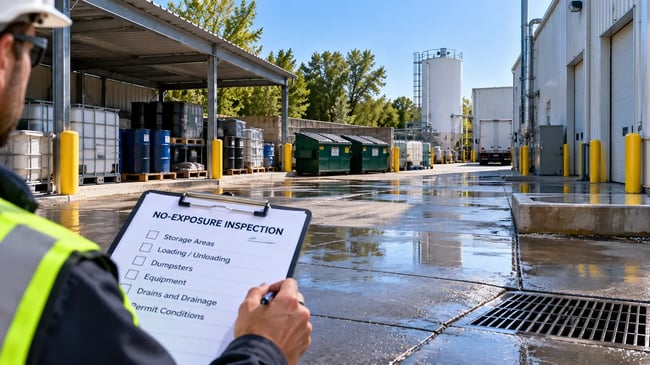
Which Dumpsters and Waste Containers Can Stay Outside Under No Exposure?
This is one of the few places the rule gives you room. A dumpster or similar rigid container doesn't need to sit inside a permanent building, but only if it meets every condition NJDEP lists. Miss one and the container counts as exposure.
| Condition in the rule |
What to check on your site |
| Used only for routine collection and temporary storage of waste generated at the facility |
Is it holding your everyday trash, or is it also serving as storage for product, scrap awaiting sale, or someone else's material? |
| Watertight and leak proof |
Look for rust-through, cracked seams, damaged drain plugs, and any sign of liquid at the bottom |
| Covered |
Are the lids shut during your walk? An open-top roll-off is uncovered |
| No visible residue or contamination on the exterior |
Check the outside surfaces, lids, and the ground around the base for drips and staining |
| Rigid container of dumpster size or larger |
Open bins, loose bags, and small buckets don't fit the exception |
The failures we see most often are mundane. A lid propped open because it's easier for the crew, a dumpster with greasy streaks running down one side, or a bin that quietly turned into a place to stash cardboard bales and used pallets. Check whether lids are actually closed at different times of day, since a lid that's shut at 10 a.m. may be open all afternoon. If your containers hold anything liquid, look hard at the seams and the bottom. And remember that the exception covers waste generated at your facility, so a container that's collecting material from elsewhere is a different matter.
How Do You Check Outdoor Equipment, Machinery, and Vehicles for No Exposure?
Equipment gets overlooked because it feels like part of the landscape. Industrial machinery and material handling equipment are both named in the rule, so a compressor, a tank, a conveyor, or a piece of process equipment sitting outside is something you need to evaluate, not ignore. Ask what each piece does, what it touches, and whether it's ever opened, cleaned, fueled, or serviced outdoors. Pressure-washing a machine in the lot is an industrial activity in the open, even if the machine itself lives indoors.
The rule carves out two equipment-related exceptions, and both are narrow. Vehicles used in material handling can stay outside if they're adequately maintained and in normal operating condition. In practice, that means looking for drips under forklifts and yard vehicles, drip pans that are overflowing, and equipment that's visibly leaking or in poor repair. A forklift that's parked outside every night and leaves a dark spot on the pavement doesn't meet the standard. Pipe can also stay outside if it isn't deteriorated, doesn't leak, and is installed to move materials through the facility. The rule specifically says pipe doesn't include pumps or inlet and outlet valves, so a pump skid or a valve cluster out in the yard doesn't qualify for the exception.
Check the ground under and around each item, and look at the cleaning and maintenance routines as well as the equipment. If a vehicle gets fueled, washed, or repaired outside, find out where and how. Pay attention to anything that's parked there seasonally, like a spare machine waiting for repair or a piece of equipment stored for the winter.
What Do You Do With Problems You Find During a No Exposure Evaluation?
Most findings have a simple fix: move it inside, put a lid on it, fix the leak, or clean up the stain. Ask for each item whether the fix is cheap enough to make before you certify. Moving a few drums indoors almost always costs less than living with a permit. If the fix is a permanent enclosure, such as an addition or a covered storage building, the project can bring its own approvals, which we cover below.
If you can't get everything under cover, the exclusion isn't available and the facility needs a permit instead. For a lot of sites the basic general permit, the 5G2 Basic Industrial Stormwater permit, may fit. A site that doesn't fit any general permit may need an individual NJPDES industrial permit. A permit brings a stormwater pollution prevention plan, which we call a SWPPP (you'll also hear it called an SPPP, an SP3, or just a stormwater plan), plus inspections and annual certification. Our guide to what a SWPPP is shows what that plan covers, and our article on stormwater best management practices covers the controls it typically describes.
If your facility already holds a stormwater permit and you're moving to no exposure, the rule says NJDEP will inspect to confirm the conditions are met before it modifies or revokes your authorization. Until NJDEP gives you a final modification or revocation, your permit and all of its conditions, including monitoring and reporting, stay in force. Don't stop doing anything the permit requires just because you've submitted the certification.
A few conditions follow you after you certify. The certification is submitted every five years, and it doesn't transfer, so a new operator has to file its own. If conditions change and something becomes exposed, the exclusion stops applying and the discharge can be treated as unpermitted until a permit is in place. A facility that expects a change, like a new outdoor storage area, should apply for authorization before the change happens. NJDEP also keeps the authority to require a permit if a facility's stormwater is causing or contributing to a water quality problem. If you've already certified and you find exposure during your walk, an environmental attorney may be worth talking to about how to handle it.
When fixing exposure means building something, the construction side is separate. An addition or enclosed storage building can trigger soil erosion and sediment control certification through the local Soil Conservation District, construction stormwater coverage under New Jersey's 5G3 general permit, municipal site plan approvals, and stormwater management design requirements under N.J.A.C. 7:8, depending on the size of the project. RMA doesn't prepare those construction-phase permits or approvals, and you'll usually work with your engineer, contractor, or a soil erosion specialist on them. We can help you figure out what the construction phase is likely to need and point you toward the right people. Once the facility is running, the operational question comes back, and that part we handle. If your team handles the walk and the paperwork itself, our online environmental training library can help get people up to speed, and our article on whether you can get a stormwater permit yourself explains when that route makes sense.
How RMA Helps New Jersey Facilities Evaluate No Exposure Conditions
We're a family-run firm based in New Jersey, and we've been helping facilities with environmental compliance since 1992. A senior member of our team can look at your SIC code, your site, and where your water goes, then tell you whether no exposure is realistic, whether a permit fits better, or whether you can handle the whole thing yourself. If you don't need us, we'll say so. When you do want help, we can review your findings, help you prepare the certification or the permit paperwork, and build the plan and routine that come with a permit.
There's no pressure and no obligation. You can call us, send an email, or fill out the form on our website, and we'll talk through what you found on your walk. Whenever you're ready, just contact RMA and we'll help you work out the right next step.