Realistic Timelines for a Pennsylvania Individual NPDES Stormwater Permit, From Application Prep to Final Issuance
If DEP has told you, or your consultant has, that your Pennsylvania facility needs an individual stormwater permit instead of the more common PAG-03 general permit, the next question is almost always how long it's going to take. The answer comes in two pieces. DEP's review runs on its own clock, and that part is published. The other piece is how long you need to put a complete application together, and that part varies a lot more from site to site.
Here's the short version. For a new individual industrial stormwater permit, DEP's target is to take final action within 198 business days, roughly nine months, and that clock doesn't include the time you spend preparing. Below we walk through each stage, from preparation and DEP's completeness check to technical review, the draft permit, public comment, and final issuance, along with what commonly slows things down. If you'd rather talk through your own situation, you can reach out to RMA and we'll tell you what to expect for your site.
Table of Contents
TL;DR
For a new individual industrial stormwater permit, DEP aims to take final action within 198 business days of receiving your application, which is roughly nine months. That clock doesn't include your preparation time, and preparation, especially stormwater sampling and the required local notices, is often the longest part. Inside DEP's review, the completeness check targets 10 business days and the draft permit goes out for at least 30 days of public comment. Incomplete applications, deficiency letters, data gaps, and public interest are what stretch the schedule, and the deadline is a fee-refund guarantee, not a promise of approval.
What Is a Realistic Timeline for a PA Individual Stormwater Permit?
DEP's own procedure for individual industrial waste and industrial stormwater permits says the department has 198 business days to take final action on a new application, under the Governor's Executive Order 2023-07. If DEP misses that deadline, the applicant may get the application fee refunded through the state's PAyback program. Renewals sit outside it because they carry no application fee. At roughly 21 business days a month, 198 business days works out to a little over nine months on the calendar, so a new individual permit is a nine-month-plus review for DEP at its target pace, with your preparation time stacked in front of it.
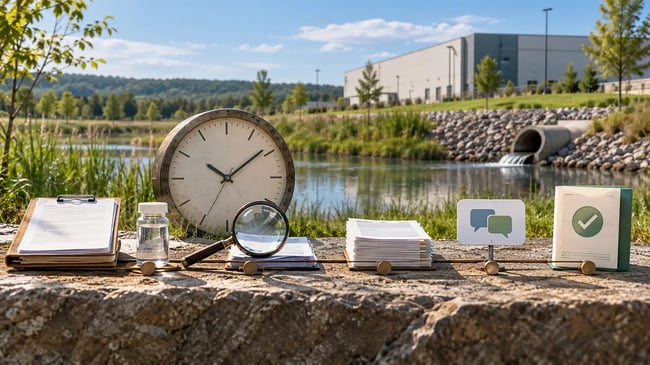
Two things keep that number from being a promise. It's a deadline for a decision, and the decision can be a denial. DEP's procedure also describes how staff will generally handle applications while reserving room to deviate when circumstances call for it. Treat 198 business days as the target for a clean, well-prepared application, not a guarantee for every project. In our experience, guarantee dates haven't carried much weight in practice, so build your schedule with room to spare instead of counting on them. The graphic below shows how the stages fit together.
Pennsylvania Individual Industrial Stormwater Permit Timeline
1
Prepare your application YOUR TIME
Site and drainage evaluation, maps, stormwater sampling data, local notices, and the application forms. DEP's clock hasn't started, and the length depends on your site.
2
DEP completeness review DEP
DEP's procedure sets a goal of 10 business days from receipt.
3
Technical review and draft permit DEP
DEP sets limits and monitoring and writes the fact sheet. In most cases a new application gets one deficiency letter, usually with 15 business days to respond.
4
Public notice and comment DEP + PUBLIC
30 days after the notice appears in the Pennsylvania Bulletin, or 45 days when a site-specific water quality criterion sets the limits. DEP can extend either by 15 days.
5
Comments, final permit, and issuance DEP
DEP addresses comments, redrafts if the changes are significant, and issues the final permit, which takes effect the first day of the following month.
DEP's overall target for a new application, steps 2 through 5: 198 business days, or roughly nine months.
What Is an Individual NPDES Stormwater Permit, and Who Needs One in Pennsylvania?
NPDES stands for National Pollutant Discharge Elimination System, the federal program that regulates what leaves your site and reaches streams and storm sewers. In Pennsylvania, DEP, the Department of Environmental Protection, runs it. Most industrial facilities that need stormwater coverage use PAG-03, a general permit written once for a whole class of facilities. An individual permit is written for one facility, with limits and monitoring built around its discharge and the stream that receives it.
Facilities usually end up on the individual path because they can't use PAG-03. The most common reason is a discharge to a High Quality or Exceptional Value stream, which PAG-03 doesn't cover, though other site conditions can push a facility there too. Our guide to which NPDES permit you need compares the general, individual, and No Exposure options. If PAG-03 turns out to be your route, the review follows a different and generally shorter track, which we cover in our PAG-03 timeline article. For comparison, a PAG-03 project with a consultant typically runs about 1 to 3 months of preparation and 2 to 6 months of DEP review. An individual permit is more involved, so plan on a longer road than that.
One clarification on terms. DEP also issues individual NPDES permits for construction stormwater, and those follow a separate review that can involve the county conservation district. This article covers the industrial permit. RMA doesn't prepare construction-phase permits or approvals, so for those you'll work with your engineer or an erosion and sediment control specialist. If you're building a new facility, you'll often need both: the construction approvals now, and the industrial permit for operations once the site is running. That second one is where we help.
How Long Does It Take to Prepare an Individual Stormwater Permit Application?
Preparation is usually the longest and least predictable stage, and DEP's clock hasn't started yet. DEP's procedure lists what a complete application includes: the individual industrial stormwater application with every applicable section filled out and the required attachments such as site maps, a signed General Information Form, a topographic map showing the facility and its discharges, and the minimum testing called for in the application instructions. It also asks for copies of the Act 14 notification letters you sent to the municipality and county, with the signed receipt cards. For a new facility or a significant change to its discharges, you also need proof that a notice ran in a local newspaper once a week for four consecutive weeks.
That last item shows how a calendar slips. Four weeks of newspaper notices can't be compressed, and they have to be finished before your package is complete, so they're worth starting early while the rest of the application comes together. The site work takes real time too. Someone has to walk the property, find the outfalls, trace where water goes, and identify what materials and activities are exposed to rain. Our overview of stormwater associated with industrial activity covers what DEP is looking for there.
Why Does Stormwater Sampling Data Often Set the Pace?
Testing is where schedules most often stall. The application instructions set minimum testing, and stormwater samples can only be collected when it rains, usually under specific storm conditions. You can't schedule rain, so a dry stretch can leave you waiting. Samples also have to be collected correctly and handled by a lab that can meet the required detection levels, or you risk repeating the work. Our articles on taking your own stormwater samples and picking a water testing lab walk through both. DEP's procedure doesn't set a duration for any of this, so we won't either. It can go fairly quickly when you have good site records and recent data, and it can run well past your plan when samples have to wait on the weather.
How Long Does DEP's Completeness Review Take?
Once DEP has your application and fee, its procedure directs the reviewer to finish the completeness review within 10 business days. The reviewer checks that the package is administratively complete and technically adequate on its face. DEP doesn't log an application in its eFACTS tracking system until the fee arrives, so a missing payment can quietly delay the start. If everything's in order, DEP doesn't send a completeness letter and the application simply moves on to technical review, so no news in the first two weeks can just mean the application passed. You can follow your application on DEP's Track a Permit page.
When something's missing, the rules get strict quickly. For a new application, a gap the reviewer judges fixable within a day gets a phone call, and DEP expects the missing material by the end of the next business day. If DEP can't reach you within five business days, the fix doesn't take, or the gaps are significant, DEP denies the application. The fee isn't returned, and resubmitting means paying a new fee and starting the review over.
How Long Do DEP's Technical Review and Draft Permit Take?
This is the longest stretch of DEP's own work, and DEP's procedure doesn't assign it a fixed number of days. It uses up most of the 198-business-day window. The reviewer sets the pollutants of concern, effluent limits, and monitoring requirements, looks at the stream's designated and existing uses, and checks whether the receiving water has a wasteload allocation under an EPA-approved TMDL, which is a pollution budget for an impaired stream. Our article on TMDLs and impaired waters explains how that connects to your permit. The reviewer also checks the facility's open violations. For a new or increased discharge to a High Quality or Exceptional Value stream, the fact sheet has to include an antidegradation analysis, which adds work to the review. The fact sheet is the document that explains the basis for the draft permit, and the Permits Chief has to sign it before any draft goes out.
Deficiency letters are the main way this stage grows. Small technical problems get a phone call and a next-business-day deadline. For anything bigger, DEP in most cases sends a single technical deficiency letter on a new application, before it writes the draft permit, and asks for a response within 15 business days unless the reviewer allows longer. If you miss that deadline or the answer doesn't resolve the issue, the application goes to DEP's elevated review process. That can end in a published notice of intent to deny and, after a 30-day comment period, a denial.
After the Permits Chief signs off, DEP sends you the draft permit, the fact sheet, and a public notice. You post that notice near the entrance to your premises, and DEP publishes its own notice in the Pennsylvania Bulletin. The public then has 30 days from the Bulletin publication date to comment, or 45 days when a site-specific water quality criterion is used to set the limits. DEP can add 15 days to the comment period. The comment period starts at publication, not when you receive the draft, so the gap between the two adds to your calendar.
Public interest changes the picture. DEP's procedure calls for a public hearing when five or more independent parties request one on a stream that isn't Exceptional Value, when even one party requests one on an Exceptional Value stream, or when DEP sees significant public interest. A hearing needs its own Bulletin notice at least 30 days ahead, and DEP then prepares written responses to the comments. Some permits also go to EPA Region 3, which has 30 days under its agreement with DEP to comment or object. That's generally reserved for larger dischargers and certain situations, such as discharges to waters with an EPA-approved TMDL, so a smaller stormwater-only permit may never go to EPA.
After comments, DEP decides whether to change the draft. If the changes make limits more stringent, add limits that weren't in the draft, or add significant conditions, DEP issues a revised draft with a new public notice, and the comment period starts again. If not, DEP finalizes the permit, and an individual permit takes effect on the first day of the month after issuance.
What Commonly Delays a PA Individual Stormwater Permit?
Most delays come from a short list of causes. The table pairs each one with what DEP's procedure says happens and what tends to help.
| Cause |
What happens |
What helps |
| Incomplete application |
DEP denies the application if the gaps can't be fixed quickly, and the fee isn't returned. |
Check the package against DEP's completeness list and send the fee with it. |
| Deficiency letters |
Usually one letter with 15 business days to respond. A missed deadline triggers elevated review. |
Answer every point in one complete response. |
| Data gaps |
Missing testing keeps the application from being complete or technically adequate. |
Start sampling early and plan around rain. |
| Unresolved violations |
DEP warns in the draft cover letter that the final permit may not issue until they're resolved. |
Resolve open violations before you apply. |
| Public interest |
Comments, a hearing, or a significant redraft can add time and a new comment period. |
Do the Act 14 notices and site posting correctly, and build in room for comments. |
| Coordinated approvals |
For a new facility that also needs a Water Quality Management permit, DEP won't issue the NPDES permit on its own. |
Identify every DEP approval you need before you submit. |
Then there's what the guarantee does and doesn't do. DEP's Permit Review Process and Permit Decision Guarantee policy is the framework behind the 198-day target. A missed deadline can mean a fee refund. It doesn't mean a permit, and the policy lays out circumstances where the guarantee doesn't apply, so read it before you count on a refund. DEP posts its standard operating procedures, including the one for individual industrial stormwater permits, on its Decision Guarantee page.
How Can You Keep an Individual Stormwater Permit Application on Schedule?
You can't speed up DEP's review, but you can avoid handing it reasons to slow down. Use DEP's completeness list as your checklist, send the right fee with the package, and start the newspaper notices and sampling first, since they're the pieces you can't rush. Clear up open violations before you apply, and when a deficiency letter arrives, answer every point in one complete response inside the response window. Then build your start-up plan around the full timeline, with your preparation plus DEP's 198 business days, instead of the best case.
If you already hold an individual permit, renewals run separately, with no application fee and no refund guarantee. DEP generally issues individual permits for five-year terms, so put the renewal on your calendar well ahead of expiration, because DEP handles late and incomplete renewals under their own procedure. Our article on common NPDES permit problems covers the mistakes we see most.
How Does RMA Help With a PA Individual Stormwater Permit?
We work with Pennsylvania facilities on stormwater permits all the time. We start by checking whether you need an individual permit at all, because some facilities can use PAG-03 or qualify for a No Exposure Certification instead, and we'll tell you if that's your situation. If an individual permit is the right route, we help evaluate your site, coordinate sampling, prepare the application and supporting documents, and stay involved to answer DEP's questions through review. We can't make DEP move faster, and anyone who promises otherwise is guessing, but we can help you submit a complete application the first time.
If you'd like to talk it over, you can call us at 888-RMA-0230, email us, or fill out the form on our website, and you can reach out to our team whenever you're ready. No pressure and no obligation. You can also browse our Pennsylvania NPDES and stormwater resources or our broader NPDES learning center any time.