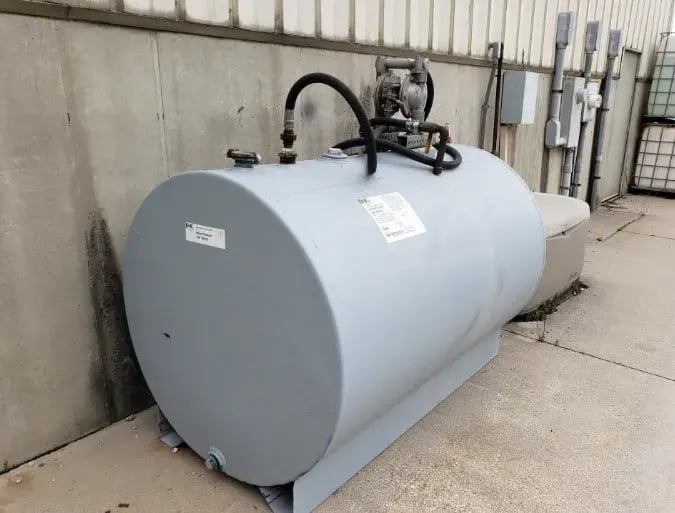
Drum Counting Rules for New Jersey Shops and Manufacturers: When 55-Gallon Drums of Oil Trigger an SPCC Plan, How Totes Count, and What Containment You'll Need
Plenty of small shops and manufacturers assume oil spill rules are for fuel depots and big tank farms. If you don't have a tank out back, why would you need an oil spill plan? The problem is that the federal rule doesn't care whether your oil sits in one big tank or a row of drums along the back wall. Every container of oil that holds 55 gallons or more counts. Once your total aboveground capacity in those containers goes over 1,320 gallons, you need a written oil spill prevention plan. Twenty-five drums of lube oil, hydraulic oil, or used oil gets you there without a single tank on the property.
Below, we walk through how drums and totes are counted, a few quick examples of how a typical shop crosses the line, what secondary containment the rule expects for drum storage areas, and the practical ways shops meet that requirement, from spill pallets to dedicated containment buildings. We'll also cover what New Jersey adds on top of the federal rule and when you can write the plan yourself instead of hiring anyone. If you'd rather have someone look at your inventory and tell you where you stand, feel free to reach out to RMA and we'll help you sort it out.
Table of Contents
TL;DR
Every oil container of 55 gallons or more counts toward the federal 1,320-gallon threshold, so 25 full-size drums of oil is enough to require a spill plan even if you don't have a single tank. Drums count by their capacity, not how full they are, and totes and oil-filled equipment get added to the same total. If you're covered, your drum storage area needs containment that can hold the largest single container plus room for rain if it's outdoors, which most shops handle with spill pallets, containment decks, or a curbed storage area. Most drum-only shops fall well under 10,000 gallons and can self-certify a simple plan, and New Jersey adds its own duty to report spills to NJDEP right away.
How Many 55-Gallon Oil Drums Trigger an SPCC Plan?
The federal rule is called the Spill Prevention, Control, and Countermeasure rule, or SPCC, and it lives at 40 CFR Part 112. In plain terms, it says that if your facility stores more than 1,320 gallons of oil aboveground, and a spill could reasonably reach a waterway, you need a written plan explaining how you'll prevent a spill and what you'll do if one happens. In New Jersey, EPA Region 2 enforces it. If you want the background on that, we've covered who enforces SPCC plans in a separate post.
The math for drums is simple. A standard drum holds 55 gallons, and the rule counts any container of 55 gallons or more. Twenty-four drums comes to exactly 1,320 gallons, which doesn't trip the rule, because the threshold is "more than" 1,320. Add one more and you're at 1,375 gallons and covered. That 25th drum is often a used oil drum nobody thought to count, or a drum of new hydraulic oil that showed up on a delivery and never left.
| Number of 55-gallon oil drums |
Total capacity |
SPCC plan required? |
| 10 drums |
550 gallons |
No, unless other oil containers push the total over |
| 20 drums |
1,100 gallons |
No, but one tote or a hydraulic reservoir could change that |
| 24 drums |
1,320 gallons |
No, it has to exceed 1,320 |
| 25 drums |
1,375 gallons |
Yes, if a spill could reach water |
| 40 drums |
2,200 gallons |
Yes, if a spill could reach water |
That "could reasonably reach water" piece trips people up. It's not limited to shops on a riverbank. A storm drain in the parking lot, a ditch along the road, or a culvert that eventually feeds a creek can all create a path. The rule also says you can't count on manmade structures like a curb or a building to stop oil when you're deciding whether you're covered. Those only come into play once you're writing the plan. Most shops in New Jersey, with its dense network of streams, storm sewers, and tidal waterways, have a hard time arguing their way out.
How Drums, Totes, and Other Oil Containers Count Toward the SPCC Threshold
The rule counts capacity, not contents. A drum that's half full, or one that's empty but still in service, counts as 55 gallons. The same goes for a 275-gallon or 330-gallon tote of oil, which counts at its full size. Shops that rotate drums often undercount because they tally what's on hand on a slow week rather than what the storage area holds when it's full. We go into more detail on edge cases in our post on whether 55-gallon drums are included in SPCC plans, but the table below covers what most shops run into.
| Container or equipment |
Counts toward 1,320 gallons? |
| 55-gallon drums of lube, hydraulic, gear, or cutting oil |
Yes, at full capacity |
| Used oil drums and used oil tanks |
Yes |
| Totes (IBCs) holding oil |
Yes, at full capacity |
| Oil-filled equipment with 55 gallons or more (hydraulic presses, transformers, large gearboxes) |
Yes |
| Vegetable or other non-petroleum oils in drums |
Yes, they're still oil under the rule |
| Containers smaller than 55 gallons (5-gallon pails, 30-gallon drums) |
No |
| Fuel tanks that power vehicles and equipment |
No, motive power containers are exempt |
| Propane |
No |
| Drums of solvents, acids, or other non-oil chemicals |
Not for SPCC, though New Jersey's spill rules still cover them |
The combination is where most shops get surprised. Take a small fabrication shop with eight drums of lube and hydraulic oil (440 gallons), two 330-gallon totes of cutting fluid concentrate (660 gallons), and a 275-gallon used oil tank. That's 1,375 gallons, and the shop is covered, even though the owner would tell you they "only have a few drums." Add a press with a big hydraulic reservoir and the number climbs from there. Used oil in particular deserves its own look, and our top things to know about used oil regulations covers the separate handling rules that apply to it.
If you're not sure where your shop lands, walk the building with a clipboard and write down every oil container and piece of oil-filled equipment that holds 55 gallons or more, then total the capacities. Our guide to the steps to figure out if you need an SPCC plan walks through the rest of the decision.
Do Oil Drum Storage Areas Need SPCC Secondary Containment?
Yes, once you're covered. Secondary containment just means a backup barrier that catches oil if a drum leaks, gets punctured by a forklift, or tips over. For drums and other portable containers, the federal rule says you have to position them to prevent a spill from leaving the site, and provide containment big enough to hold the largest single container in the area, plus enough extra room to hold rainwater if the area is exposed to weather.
For a drum-only storage area, that means the containment has to hold at least 55 gallons. If a 330-gallon tote shares the same pallet or curbed area, the containment has to hold 330 gallons, because the tote is now the largest container. Outdoors, you need extra space on top of that for rain. Indoors, rain usually isn't a factor, but you still have to keep the containment clean and dry so its capacity is really there when you need it. A spill pallet full of rainwater or old absorbent can't hold a leaking drum.
Containment sizing is one of the most common things inspectors write up, so it's worth getting right the first time. We've written a full explainer on how big SPCC oil spill containment needs to be if you want to see how the calculations work for different setups. Keep in mind that the containment rule covers more than the storage spot. Areas where you fill drums, pump from them, or move them around also need some way to stop a spill from reaching a drain or the outside, even if that's as simple as spill kits, drain covers, and trained staff.
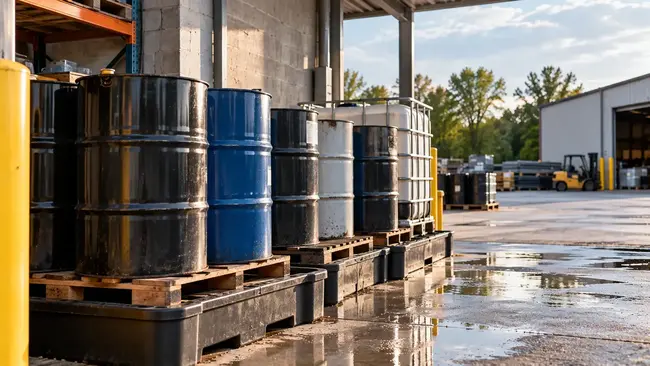
Spill Pallets, Containment Buildings, and Other Oil Drum Containment Options
The good news for drum storage is that containment is cheap and easy to buy compared to building a concrete dike around a big tank. Most shops pick from a short menu, and the right choice depends on how many drums you keep, whether they're inside or outside, and how often you move them.
| Option |
Best for |
Things to watch |
| Spill pallets (2-drum or 4-drum) |
Indoor shops with a handful of drums in one or two spots |
Check the rated sump capacity, keep the grate clear, and empty any liquid that collects |
| Modular spill decks |
Longer rows of drums where you want a flexible footprint |
Linked sections need to share capacity as rated, so follow the maker's setup |
| IBC (tote) containment units |
Shops storing oil in 275- or 330-gallon totes |
The sump has to hold the full tote, which makes these bulkier |
| Covered drum storage buildings or lockers |
Outdoor storage where you want to keep rain out |
Fire code rules may apply to where they sit and what's inside |
| Curbed room or berm with a sealed floor |
Larger drum rooms where pallets would get in the way |
Floor drains inside the curb defeat the purpose, and the sealant has to stay intact |
For an indoor shop with a dozen or two drums, spill pallets are usually the fastest fix, and they let you comply without changing your layout. For larger drum rooms, a curbed area is often less hassle day to day because forklift drivers aren't threading drums onto pallets. Outdoor storage is where shops get into the most trouble. Uncovered pallets fill up with rain, and that rainwater has to be checked for oil before it's drained. A covered storage building or locker solves that problem and also cuts down on rusted drums.
Whatever you choose, it has to be part of your routine. The plan will call for regular inspections of drums and containment, and our list of things to do during SPCC monthly inspections is a good starting checklist. Staff who handle oil also need SPCC training, and our online environmental training library covers it for shops that want a simple way to keep everyone current.
What New Jersey Adds for Shops That Store Oil Drums
New Jersey layers its own law on top of the federal rule. The Spill Compensation and Control Act, usually called the Spill Act, covers discharges of oil and a long list of other hazardous substances. One piece of it applies to almost every shop: if oil or another hazardous substance is released to the environment, you're expected to report it to NJDEP immediately through the state hotline at 1-877-WARNDEP (1-877-927-6337). That's separate from any federal reporting duty, and it applies whether or not you have an SPCC plan. There are narrow exceptions for some small, contained releases, so check N.J.A.C. 7:1E against your situation rather than assuming a small spill doesn't need a call. Our post on when you have to report an oil spill covers the federal side.
New Jersey also has its own spill planning rule, which requires Discharge Prevention, Containment, and Countermeasure (DPCC) and Discharge Cleanup and Removal (DCR) plans for "major facilities" under N.J.A.C. 7:1E. The thresholds are high: 200,000 gallons or more of hazardous substances of all kinds, including petroleum, or 20,000 gallons or more of non-petroleum hazardous substances. Drum-based shops almost never get close, but drums and totes of chemicals do count toward that total, so a chemical-heavy manufacturer should run the numbers. Our post on SPCC plans in New Jersey goes into how the state and federal programs fit together.
Two other programs often touch drum storage. The Uniform Fire Code, enforced by your local fire official, has its own rules for storing combustible and flammable liquids, including quantity limits and separation distances, and those can affect where your drum area or storage building goes. And if you store enough of certain chemicals, Community Right to Know reporting may apply. Neither changes your SPCC math, but both are worth checking when you set up or move a drum storage area.
Can a Small Shop Write Its Own SPCC Plan for Drum Storage?
Often, yes. The federal rule lets smaller facilities, called "qualified facilities," self-certify their plan instead of paying a Professional Engineer to certify it. If your total aboveground oil capacity is 10,000 gallons or less, and you haven't had a single spill over 1,000 gallons or two spills over 42 gallons each within any 12-month period in the last three years, you qualify. If no single container is larger than 5,000 gallons, which describes every drum-only shop, you're a Tier I qualified facility and can use EPA's fill-in-the-blank template.
For a shop with 30 drums and a couple of totes, that template is a reasonable path, and we'd rather tell you that than sell you something you don't need. Our explainer on the Tier I self-certified SPCC plan covers what it takes. The catch is that self-certifying means you're the one vouching that your containment is sized correctly, your inspection schedule is right, and your staff are trained. Shops that call us usually do so because they've got a mix of drums, totes, and oil-filled equipment, they're not sure what counts, or an insurer or customer is asking for a plan and they want it done right.
When shops do hire help, SPCC plans generally run $2,500 to $15,000, and a drum-only shop with a simple layout usually lands toward the low end of that range. The drivers are the number and type of containers, how much containment needs evaluating, and whether the facility qualifies for self-certification. Our breakdown of SPCC plan costs covers the details, and you can use the calculator below to estimate what RMA's help would cost for your shop.
How RMA Helps New Jersey Shops With Oil Drum Spill Plans
We're a family-run firm based in New Jersey, and we've been helping shops, manufacturers, and industrial facilities with oil spill plans since 1992. For drum-heavy operations, that usually means walking through your inventory with you, confirming whether you're over the threshold, checking that your containment is sized and placed correctly, and putting together a plan your team can follow. If you qualify to self-certify and just want a second set of eyes on your template, we can help with that too. And if you're under the threshold, we'll tell you so.
There's no pressure and no obligation. Give us a call, send an email, or fill out the form on our website, and a senior member of our team will talk through your setup with you. If you'd like to start that conversation, contact RMA and we'll help you figure out the simplest way to get your drum storage in order.