What Stormwater Benchmarks Mean, How Your Sample Results Get Compared to Them, and What Happens When a Number Comes Back High
If your facility has PAG-03 coverage, Pennsylvania's general permit for stormwater from industrial sites, you sample your runoff and send the results to DEP. Sooner or later, someone looks at a lab report, sees a number above the "benchmark value" listed in the permit, and wonders if they just broke the law. They didn't. A PAG-03 benchmark value is a pollutant concentration that your stormwater results get measured against, and it works as a warning light, not a pass/fail limit. One high result isn't a violation. Repeated high results for the same pollutant are what trigger required follow-up, starting with a corrective action plan.
In this article, we'll walk through what benchmark values are, how they differ from the hard limits found in some permits, how your lab results get compared to them, which pollutants usually carry benchmarks, and exactly what PAG-03 requires when results stay high. We'll also cover why a single bad number is usually a reason to investigate rather than panic. If you're looking at results right now and want a second set of eyes, feel free to reach out to RMA and we'll help you sort out what they mean.
Table of Contents
TL;DR
PAG-03 benchmark values are pollutant concentrations that your stormwater sample results get compared against to see whether your site's pollution controls are working. They aren't hard limits, and the permit says plainly that going over one isn't a violation. If the same pollutant stays above its benchmark for two or more monitoring periods in a row, you have to send DEP a corrective action plan within 90 days, and after four in a row, a new plan plus a checklist of the controls you've considered. A single high result is a signal to check your sampling and your site, fix what you find, and keep good records.
What Are PAG-03 Benchmark Values?
PAG-03 is the general NPDES permit Pennsylvania DEP uses to cover stormwater runoff from many types of industrial facilities. NPDES stands for National Pollutant Discharge Elimination System, the federal Clean Water Act permit program that DEP runs in Pennsylvania. The permit is built around sector appendices. Your facility falls into an appendix based on what you do there, and that appendix tells you which pollutants to test for, how often, and which of them have benchmark values.
A benchmark value is a pollutant concentration, usually written in milligrams per liter (mg/L), that DEP picked as a reasonable target for runoff from that type of operation. The permit describes benchmarks as a tool for judging whether a site's best management practices (BMPs), meaning the everyday controls like covered storage, spill cleanup, sweeping, and sediment barriers, are doing their job. When your stormwater comes back under the benchmark, your controls look like they're working. When it comes back over, something on your site is probably getting into the runoff, and it's worth finding out what.
Not every pollutant you test for has a benchmark. Some parameters are "monitor and report" only, meaning you sample, send in the result, and there's no number to compare it against. The current PAG-03, which took effect on March 24, 2023 and runs through March 23, 2028, added Total Nitrogen and Total Phosphorus monitoring to every appendix, and those work this way for most facilities. The benchmarks that do apply to you are listed in your sector's appendix, which is the only place to get the right numbers for your site.
How Are PAG-03 Benchmark Values Different From Effluent Limits?
The difference between a benchmark and an effluent limit is the single most useful thing to understand about your PAG-03 results. An effluent limit is a legal ceiling. If a permit sets an effluent limit for a pollutant and your discharge goes over it, that's a permit violation, and it can lead to enforcement and penalties. A benchmark is a performance target. PAG-03 says directly that its benchmark values aren't effluent limitations and that exceedances don't count as permit violations.
That doesn't mean benchmarks can be ignored. The permit attaches real obligations to repeated exceedances, and skipping those obligations is a violation. So the question with a high benchmark result isn't "did we break the permit?" It's "what's causing this, and are we fixing it before it happens again?" We go deeper on the general concept in our article on benchmark values vs. effluent limits, which applies across states. Here's how the two compare under a Pennsylvania permit.
| Question |
Benchmark Value |
Effluent Limit |
| What is it? |
A target concentration used to judge whether your stormwater controls are working |
A legal maximum your discharge can't exceed |
| Is one exceedance a violation? |
No |
Yes |
| What does an exceedance trigger? |
Investigation, and after repeated exceedances, a corrective action plan |
Possible enforcement, penalties, and required fixes |
| Where is it found? |
PAG-03 sector appendices, and some individual stormwater permits |
Some PAG-03 appendices for specific regulated activities, and many individual permits |
One wrinkle worth knowing: a few PAG-03 appendices include true effluent limits for certain activities that are covered by federal effluent guidelines, alongside the benchmarks. If your appendix has both, keep them straight. And if your facility is on an individual NPDES permit instead of PAG-03, your permit may borrow PAG-03 style benchmarks or set firm limits, so read your own permit rather than assuming it works the same way.
How Are PAG-03 Sample Results Compared to Benchmark Values?
PAG-03 sampling runs on monitoring periods. For most facilities that means twice a year, January through June and July through December, though your appendix sets the frequency. During each period, you collect a sample from each monitored outfall (the point where stormwater leaves your site, like a pipe, ditch, or swale) during a qualifying storm, send it to a lab, and report the results to DEP through the eDMR system. Our guide to PAG-03 and taking stormwater samples covers the sampling side, and our Pennsylvania eDMR reporting guide walks through how results get submitted.
The comparison itself is simple. You line up each result against the benchmark for that same pollutant in your appendix. The lab reports TSS at a certain number of mg/L, and you check whether it's above or below the TSS benchmark. You do that pollutant by pollutant and outfall by outfall. A high zinc result at Outfall 001 tells you about the drainage area feeding Outfall 001, not about your whole site. pH is the one that works a little differently, since it's measured on a scale rather than as a concentration and is checked against an acceptable range, so a result can be out of line by being too low or too high.
Two details catch people off guard. First, the lab has to be able to measure low enough. The current PAG-03 lists target quantitation levels that labs must meet, so a lab running a less sensitive method can hand you results that don't satisfy the permit. Second, lab reports are full of qualifiers, detection limits, and units that are easy to misread. If your report is confusing, our article on why NPDES lab results can be confusing is a good place to start before you decide anything is over a benchmark.
Which Pollutants Have PAG-03 Benchmark Values?
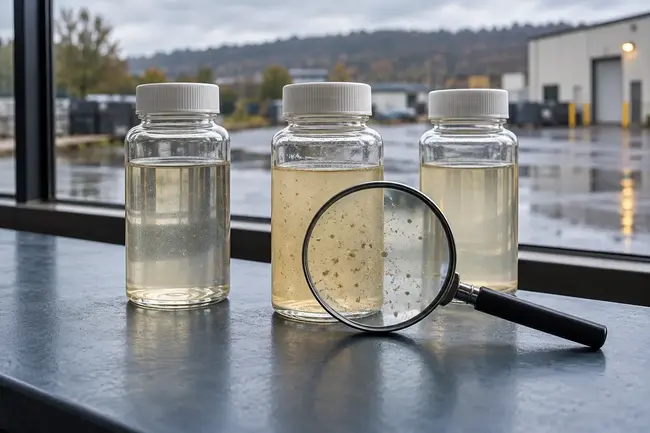
It depends on your sector. Each PAG-03 appendix carries its own list, and a concrete plant, a scrap yard, and a metal fabricator will each see different parameters. Still, a handful show up again and again, and knowing what each one usually points to makes a high result much easier to track down.
| Parameter |
What It Measures |
Common Sources on Industrial Sites |
| Total Suspended Solids (TSS) |
Sediment and other particles carried in the water |
Bare soil, gravel yards, stockpiles, truck tracking, unswept pavement |
| Oil and Grease |
Petroleum and other oily material |
Leaking equipment, fueling areas, parking lots, drum storage |
| Metals (such as zinc, iron, aluminum, copper, lead) |
Dissolved and particle-bound metals |
Scrap and metal storage, galvanized roofs and fencing, grinding dust, vehicle wear |
| pH |
How acidic or alkaline the water is |
Concrete washout and cement dust (high pH), certain chemicals and materials (low pH) |
| Chemical Oxygen Demand (COD) |
Organic and chemical material that uses up oxygen in streams |
Food and organic waste, spills, process residues |
| Nitrate + Nitrite Nitrogen |
Nitrogen compounds that feed algae growth |
Fertilizers, certain chemicals, organic material |
We've left the actual benchmark numbers out on purpose. They vary by appendix, DEP has revised several of them between permit cycles, and a number pulled from an old permit or another state's permit can send you chasing a problem you don't have, or miss one you do. Your appendix in the current PAG-03 is the only reliable source. Iron is a good example of a parameter worth a closer look, since it can come from natural soils as easily as from your operations, which we explain in our article on iron in stormwater monitoring.
What Happens When a PAG-03 Benchmark Value Is Exceeded?
PAG-03 uses a step-by-step response that gets more demanding the longer a problem continues. The trigger is consecutive exceedances, which means the same pollutant at the same outfall coming back above its benchmark in back-to-back monitoring periods. A high TSS result in one period followed by a clean TSS result in the next resets the count.
| Exceedance History |
What PAG-03 Requires |
| One exceedance |
Report it accurately on your eDMR. No formal plan is required yet, but this is the time to investigate and fix the likely cause. |
| Two or more consecutive exceedances |
Develop a corrective action plan (CAP) and submit it to DEP within 90 days of the end of the monitoring period that triggered it. |
| Four or more consecutive exceedances |
Submit a new CAP along with DEP's Stormwater BMPs Checklist (3800-PM-BCW0083l), certifying that all applicable controls have been considered, within 90 days of the end of the triggering period. |
| Continued exceedances |
DEP can require additional controls or, if it notifies you in writing, require you to apply for an individual NPDES permit. |
What Goes Into a PAG-03 Corrective Action Plan
A corrective action plan is a document you send DEP that identifies the additional steps you'll take to bring the pollutant back down to the benchmark, along with a schedule for doing them. It doesn't need to be a thick report, but it does need to be specific. A good CAP names the pollutant and outfall, explains what you believe is causing the problem, lists the changes you're making, and says when each one will be in place. Those changes usually belong in your PPC Plan too, since that's the plan your facility keeps for preventing stormwater pollution under PAG-03. Our comparison of SWPPPs and PPC Plans for PAG-03 explains how that plan works.
The 90-day clock is where facilities get into real trouble. The exceedances themselves aren't violations, but missing the CAP, sending a vague one, or not following through on what it promised can be. Inspectors also look at sampling records and exceedance history during site visits, as we cover in our article on what happens during a PA DEP stormwater inspection, so a paper trail showing you responded quickly works in your favor.
Why One High PAG-03 Result Means Investigate, Not Panic
Stormwater is messy to sample. A single result reflects one storm, at one moment, at one outfall, and plenty of things can push it over a benchmark that have nothing to do with how well you run your site. That's why the permit waits for a pattern before requiring a formal response. But "not a violation" isn't the same as "nothing to do." The best time to fix a problem is after the first high result, because that's how you keep the second one from starting the CAP clock.
Check the PAG-03 Sample Before Blaming the Site
Start with the sample itself. Was it collected at the right spot and at the right time in the storm? Did the bottle pick up sediment from the bottom of a ditch or puddle? Was it the right container, kept cold, and delivered to the lab within the holding time? Did someone grab runoff from a different drainage area? pH is especially touchy, since it can drift within minutes of collection. Sampling mistakes are one of the most common reasons for a bad number, and our article on the top reasons stormwater samples go bad lists the usual suspects.
Walk the Drainage Area Feeding the Outfall
If the sample looks solid, walk the area that drains to that outfall, ideally soon after the storm. Look for whatever matches the pollutant. High TSS usually traces back to bare ground, tracked-out dirt, or a stockpile without a berm. Oil and grease points to a leaking machine, a messy fueling area, or drums stored outside without cover. Metals often lead you to uncovered scrap, grinding dust, or a galvanized roof. Write down what you found and what you changed, even if it's as simple as sweeping more often or moving a dumpster under a roof.
Fix It With Practical PAG-03 Stormwater Controls
Most benchmark problems get solved with ordinary BMPs, not expensive treatment systems. Better housekeeping, covering materials, fixing leaks, adding inlet protection, and changing where trucks drive solve a large share of them. Our article on stormwater BMPs covers the options, and our guide on what to do when stormwater sampling results are high lays out a response process that works for any permit. Employee habits are often the root cause too, so stormwater training from our online environmental training library can help the people on the ground understand why sweeping and covering things matters to the numbers.
Sometimes the source isn't yours. Runoff from a neighboring property, natural soil conditions, or even pollutants already in the rain can push a result up. Those situations are worth documenting carefully, and if they keep happening, worth discussing with DEP, but don't assume an outside source without checking your own site first.
How RMA Helps With PAG-03 Benchmarks and Sampling
We help Pennsylvania facilities make sense of their PAG-03 results and respond the right way when a number comes back high. That can mean reviewing a lab report to confirm whether there's an exceedance at all, figuring out whether the sample or the site is the problem, walking the drainage areas to find the source, recommending practical fixes, writing a corrective action plan that DEP can act on, and updating your PPC Plan so it reflects what you changed. Some facilities just need help with one stubborn outfall. Others want us to handle their sampling program and eDMR reporting year-round so exceedances get caught early.
If you're staring at results you aren't sure how to read, or you've already had one high result and want to keep it from becoming two, we're happy to talk it through with no pressure and no obligation. You can call us, email us, or fill out the form on our website, and we'll let you know honestly whether you need help or can handle it yourself. Just contact RMA to get started.


