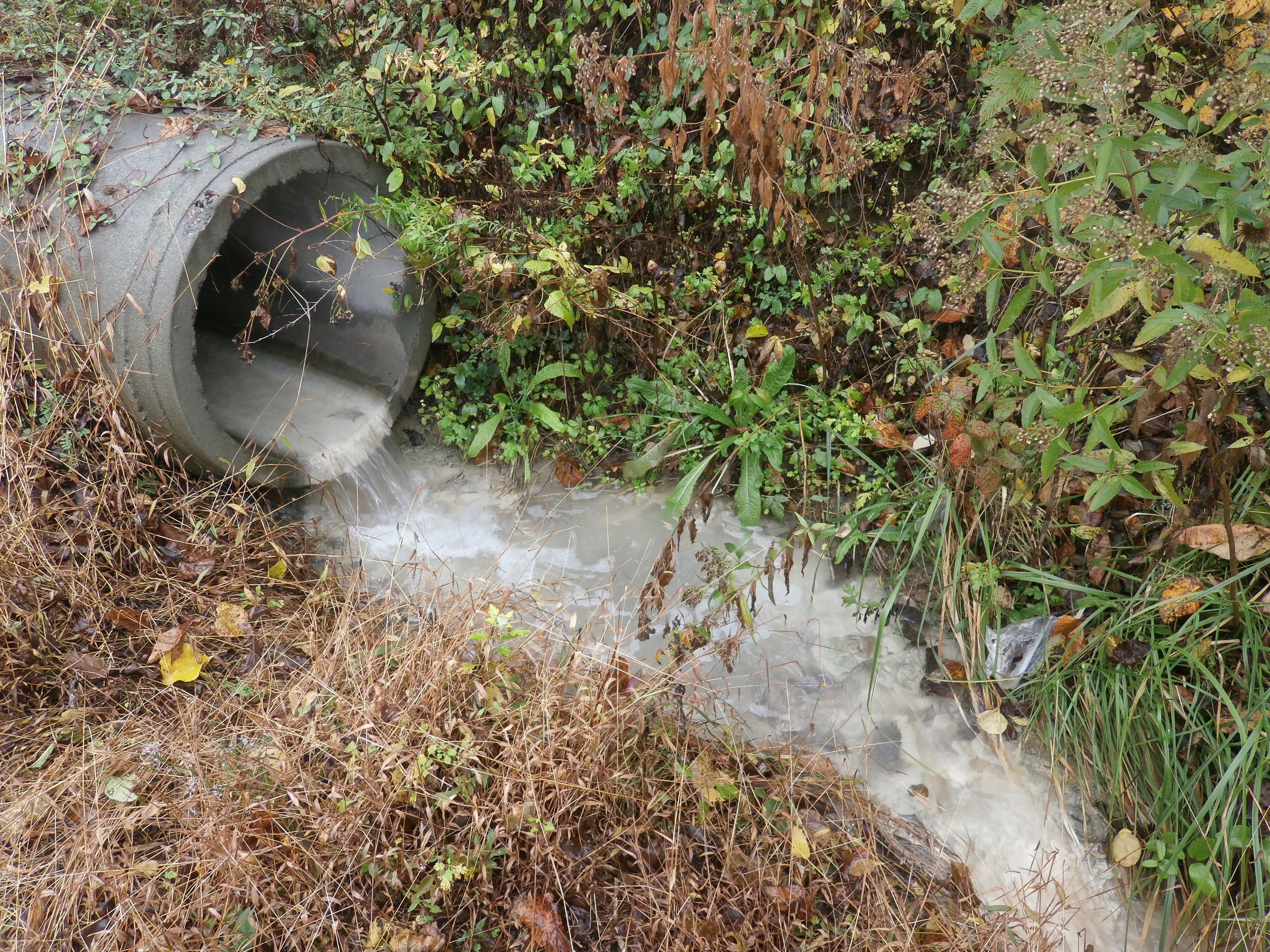
A Step-by-Step Guide to PAG-03 Eligibility, DEP's Current Application Materials, the Site Information You'll Need, and How to Submit
If your Pennsylvania facility has industrial activity outdoors and rain or snowmelt runs off the site, the state may expect you to hold a stormwater permit. The most common route is PAG-03, the general permit that Pennsylvania's Department of Environmental Protection (DEP) issues under the federal NPDES program, which is the permit system for anything discharged to streams and storm sewers. You apply by filing a Notice of Intent (NOI), the form that asks DEP to cover your facility under that permit. Plenty of facility managers want to know whether they can file it themselves, and the answer is yes, as long as you know what DEP checks before it says yes.
This guide covers how to apply for PAG-03 coverage on your own: how to confirm you're eligible, what DEP's current application package contains, how to gather the site information it asks for, how to submit and pay, and what happens afterward. We'll also point out where do-it-yourself applications tend to go wrong, because DEP denies a new NOI with significant gaps instead of holding it open, and the filing fee isn't returned when that happens. If you'd rather hand it off, or you want a second set of eyes before you submit, you can reach out to RMA and we'll tell you plainly which way makes sense for your site.
Table of Contents
TL;DR
Yes, you can apply for PAG-03 coverage yourself. You file a Notice of Intent with DEP on form 3800-PM-BCW0083b, along with a $500 fee, a topographic map, a site map, a plan for preventing and responding to pollution releases (the PPC Plan), municipal and county notices, and sampling data if your facility already operates. DEP denies a new application with significant gaps and keeps the fee, so most of the work is getting the site information and plan right before you submit. Facilities that discharge to High Quality or Exceptional Value streams can't use PAG-03 and need an individual permit instead.
Are You Eligible for PAG-03 Coverage Before You Apply?
Eligibility comes first, because a flawless application still gets denied if your facility can't use the general permit. Start with your classification. DEP decides who needs coverage using the federal definition of stormwater associated with industrial activity, which leans heavily on your primary Standard Industrial Classification (SIC) code, the four-digit code that identifies what your facility does. When several activities happen on site, the one that brings in the most revenue sets your primary code. A secondary code on its own usually doesn't trigger a permit unless DEP decides your runoff carries pollutants. Our post on stormwater associated with industrial activity walks through the categories, and who needs a stormwater permit covers the basics of coverage.
Next, check what rules PAG-03 out. Facilities that discharge to High Quality or Exceptional Value streams, the two most protected classes under Chapter 93 of DEP's water quality rules, can't use the general permit and apply for an individual NPDES permit instead. The same goes for vehicle wash water, which PAG-03 doesn't authorize, for asphalt emulsion plants subject to federal effluent limits, and generally for new salt stockpiles designed to hold 3,000 tons or more. A facility that already has an individual permit for non-stormwater discharges can't pull its stormwater into PAG-03 either. If your runoff goes into a municipal storm sewer you still need coverage, and for a new discharge DEP wants evidence that the sewer's owner accepts it.
Two other outcomes can take your facility out of PAG-03 altogether. If every industrial activity and material at your site sits indoors or under a roof, a No Exposure Certification may replace the permit, which our post on no exposure explains. And if your stormwater flows only into a sanitary or combined sewer that's part of a public treatment works, DEP's guidance says permit coverage isn't required, though you'd have pretreatment obligations to that utility. Sewer authorities and municipalities can have their own rules and fees, so confirm your situation locally before you decide that DEP's permit doesn't apply. Our guide to which NPDES permit you need compares all three paths side by side.
What Does the PAG-03 Application Package Include?
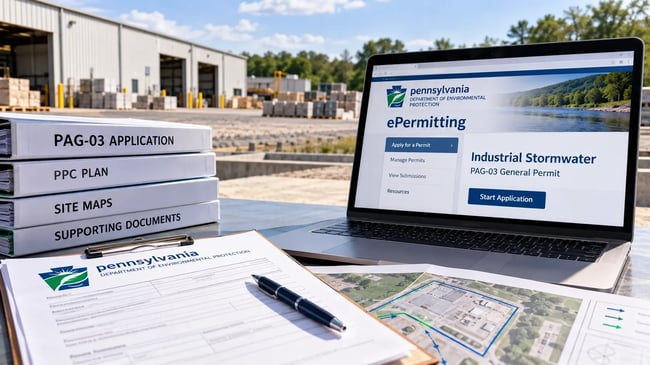
DEP's NOI checklist (form 3800-PM-BCW0083c) and its internal review procedure for new applications show what a complete package looks like. You can find the current forms, instructions, and permit text in DEP's eLibrary folder for PAG-03, and DEP's industrial stormwater FAQ answers most of the edge-case questions. Here's how the package breaks down.
| Item |
What it is |
Notes |
| Notice of Intent (3800-PM-BCW0083b) |
The main application: facility details, SIC codes, outfalls, best management practices, and stormwater quality information |
Must be signed. DEP's review procedure calls for three copies unless you file electronically |
| General Information Form (0210-PM-PIO0001) |
DEP's standard form for the applicant and facility |
New coverage only |
| Act 14 notices |
Notification to the municipality and county where the facility sits |
New coverage only |
| Topographic map |
Shows the facility and each discharge point |
Required for every NOI |
| Site map or sketch |
Shows structures, discharge points, and how water drains across the property |
Must match what the NOI says about outfalls |
| PPC Plan |
Preparedness, Prevention and Contingency Plan for your facility |
DEP reviews it against its emergency response plan guidelines |
| Municipal sewer acceptance |
Evidence that the owner of a municipal separate storm sewer system (MS4) accepts your new discharge |
New discharges to an MS4 only |
| Sampling data |
Lab results for the pollutants in your PAG-03 appendix |
Facilities that already operate |
| Filing fee |
$500 |
New coverage. DEP's procedure notes there's no fee for a renewal NOI |
The permit has appendices A through U, each tied to an industry group with its own monitoring and best management practice requirements. If a site has more than one industrial activity, more than one appendix can apply, outfall by outfall.
Most of the effort goes into walking your site with the NOI in hand. Identify every area where industrial activity or industrial materials are exposed to weather, then trace where the water from each area goes. The NOI asks for each discharge point, which is any place runoff leaves your property or enters a storm system, along with the treated and untreated impervious area draining to it and the best management practices (BMPs), the practical controls like covers, berms, and sweeping, that protect each area. Our post on stormwater BMPs gives examples of what reviewers expect to see.
DEP's reviewer compares your NOI against your maps, and mismatches are what trip people up. Unclear maps, discharge points that don't line up between the sketch and the form, and vague BMP descriptions are the sort of errors DEP's procedure treats as significant. If several outfalls drain similar areas, you can group them and sample one representative outfall, but changing that choice later takes an amended NOI, a $500 filing fee, and DEP's approval before you sample at the new location. Water that leaves as sheet flow, or drains to a basin that rarely overflows, still counts as a discharge when there's any possibility of runoff leaving the site, so don't leave those areas off your plan.
What Stormwater Sampling Data Does a PAG-03 NOI Need?
If your facility is already operating, DEP wants to see what your runoff looks like. Its FAQ says to analyze the pollutants in your applicable appendix, provide the past two years of sampling information as the NOI requires, and include results for any pollutant causing an impairment in the stream that receives your discharge. DEP's review procedure looks for at least one result for each pollutant in your appendix. New facilities that haven't started operating don't submit anticipated stormwater quality data. If your facility has been operating without coverage, the NOI form has you select Existing Facility without entering a permit number, and New as the type of approval.
For sampling, a qualifying storm event is one that produces more than 0.1 inch of precipitation and comes at least 72 hours after the previous storm. Grab samples should be collected during the first 30 minutes of the discharge, and if that isn't possible DEP expects you to collect as soon as you can afterward and explain why. Our posts on taking a good stormwater sample and picking a testing lab will save you from a bad round of data.
Look at your numbers before you file. DEP's reviewers are told to consider an inspection, a fresh look at your BMPs, or a requirement to apply for an individual permit when results come in at more than four times the benchmark value in PAG-03. For streams that are impaired and have a wasteload allocation (a pollution limit assigned to dischargers) for a pollutant you discharge, DEP's procedure calls for an individual permit. Our explanation of benchmark values and effluent limits shows how to read your results against those thresholds.
How Do You Prepare the PPC Plan for a PAG-03 Application?
The PPC Plan is usually the longest piece of the package to write. DEP reviews it against its guidelines for environmental emergency response plans (document 400-2200-001) and the NPDES supplement that goes with them, so the plan has to cover more than stormwater controls. Expect to describe your materials and where they're stored, how you prevent releases, how your team responds to a spill, who's responsible for what, and how employees are trained. If you've written a SWPPP in another state, the PPC Plan will feel familiar but broader, and our comparison of SWPPPs and PPC Plans for PAG-03 lays out the differences.
Write the plan from your actual site walk, not from a template with the facility name swapped in. DEP inspectors compare what the plan says to what they see in the yard, and our post on what happens during a PA DEP stormwater inspection shows how that comparison tends to go. A plan that describes covered storage and weekly inspections when the pile is uncovered and nobody's checked it in months causes more trouble than a plain, accurate one.
How Do You Submit a PAG-03 NOI and Pay the Fee?
Once your package is assembled, the submission itself is straightforward. Work through it in this order.
- Download the current forms from DEP's eLibrary folder instead of reusing an old NOI. DEP's procedure notes that a reviewer can treat missing information on an outdated form as a deficiency.
- Complete the NOI, the General Information Form, and your maps, then send the Act 14 notifications to your municipality and county.
- Check everything against DEP's checklist (3800-PM-BCW0083c) and have the NOI signed by someone who meets the signatory rules in 25 Pa. Code § 92a.22, so confirm who at your company is authorized before you sign.
- Include the $500 filing fee. DEP can take it with an electronic submission, or you can send a check with a paper package.
- Submit to DEP. Its NPDES guidance lists PAG-03 as an electronic submission type, and the paper route is three signed copies to the DEP regional office for your area. If your site is in Erie or Allegheny County or the Delaware River Basin, DEP also sends a copy to the county health department or the Delaware River Basin Commission unless you've done so yourself.
DEP's review procedure covers new NOIs under its Permit Decision Guarantee, which commits to a decision within 57 business days. That clock is meant for a complete submission, and DEP doesn't issue a completeness letter when your NOI is complete. Our post on how long PAG-03 coverage takes covers the timeline in more detail. Fees and forms get updated, so confirm what's current on DEP's industrial stormwater page before you file.
What Happens After You Submit, and What Does PAG-03 Coverage Require?
After you file, an application manager at the regional office reviews your NOI for completeness and technical adequacy. If something small is missing, meaning a gap that can be fixed within a business day, they'll call you and give you until the end of the next business day to send it. If the gaps are significant, DEP issues a denial letter, keeps the fee, and expects a new fee with your resubmission. Reviewers also check whether you have unresolved violations, which can hold up coverage. When everything checks out, you receive the coverage letter and permit package, including your appendix, DMR forms, and annual report template.
Coverage starts the clock on a set of ongoing duties, and they begin on the effective date. If a qualifying storm doesn't happen before your first report is due, DEP lets you report a no-data code in place of sample results. Here's what to expect.
| Requirement |
What it involves |
| Stormwater sampling |
At least once every six months, with results reported as the maximum daily value |
| eDMR reporting |
Electronic Discharge Monitoring Reports through DEP's eDMR system, which every industrial stormwater permittee must use |
| Annual Report |
Due March 23 each year on DEP's template (3800-PM-BCW0083h) |
| Annual fee |
Due March 23 each year, with or without an invoice. The first one comes due after one full year of coverage |
| Corrective Action Plan |
Required after two or more consecutive monitoring periods above the benchmark for the same pollutant at the same outfall, submitted within 90 days of the end of that period |
| Permit term |
The current PAG-03 runs from March 24, 2023 to March 23, 2028 |
Our guide to Pennsylvania's eDMR system includes a video walkthrough, and our post on PAG-03 and stormwater sampling goes deeper on the monitoring side. The people doing your inspections and sampling need to know the procedures, and our online training library is one way to cover that.
How Much Does a PAG-03 Application Cost, and Is Doing It Yourself Realistic?
The agency side is simple: a $500 application fee for new coverage and a $500 annual fee after that. The larger costs are your time and the outside work the application depends on, including lab testing, maps, a site drainage evaluation, and the PPC Plan. What moves the total is the number of outfalls, the size and complexity of the site, how many appendices apply, whether a PPC Plan and sampling data already exist, and whether anything about your receiving stream complicates eligibility. Our post on what a PAG-03 permit costs breaks those drivers down further.
As for doing it yourself, a small facility with one or two clearly defined outfalls, a tidy drainage layout, and someone on staff who's comfortable with maps and technical forms can realistically file its own NOI. It gets harder with several outfalls or appendices, unclear drainage, no existing sampling data, results close to the benchmarks, or an impaired receiving stream. The risk in those cases is a denial that costs you the fee and weeks of delay. We'd rather tell you that than sell you work you don't need, and our post on DIY versus hiring a consultant takes the decision apart in more detail. If you decide you want help with the application, the pricing calculator below gives you a quick number for RMA's work.
What If Your PAG-03 Facility Is Still Being Built?
Construction-phase stormwater is a separate track. Earth disturbance at a building site needs its own approval under Chapter 102 of DEP's rules, typically coverage under the PAG-02 general permit or an individual permit, handled through DEP or your county conservation district. Your engineer or contractor usually leads that work. We don't prepare those construction approvals, though we can help you figure out what the construction phase calls for and point you toward the right professionals.
What we do help with is the operating side. Once the facility runs, it'll need PAG-03 coverage or a No Exposure Certification, a PPC Plan, and a sampling and inspection routine. New facilities don't submit anticipated stormwater quality data with the NOI, but you should plan the filing around your start-up date so coverage is in place when industrial activity begins.
How Can RMA Help With Your PAG-03 Application?
We work with Pennsylvania facilities on PAG-03 all the time, and the help can be as small or as large as you want. You might only need us to confirm whether PAG-03, an individual permit, or a No Exposure Certification fits your site, or to review a draft NOI before it goes to DEP. Or we can handle the whole thing: the site walk, drainage evaluation and maps, PPC Plan, sampling coordination, NOI assembly, and follow-up with DEP, with ongoing support for sampling, eDMRs, and annual reports afterward. If you're comparing options, our post on choosing a PAG-03 consultant offers questions worth asking any firm, including us.
There's no pressure and no obligation. You can call us, email us, or fill out the form on our website, tell us a little about your facility, and we'll let you know whether filing it yourself looks reasonable or whether we're the better fit. If you're ready to talk, contact RMA and we'll take it from there.