A Step-by-Step Way to Map Your Oil Tanks, Transfer Points, Drainage Paths, Containment, and Spill Response Equipment
If you store oil at a Pennsylvania facility, whether that's diesel in a generator tank, hydraulic oil in a tote, or drums of motor oil in a shop, your oil spill plan is supposed to include a drawing of the site. Under the federal rules, that plan is called a Spill Prevention, Control, and Countermeasure Plan, or SPCC Plan, and the drawing is called the facility diagram. Plenty of facility managers assume it takes a CAD drafter or an engineer. It doesn't. For most sites you can create it yourself with a printed site plan or aerial photo, a clipboard, and a walk around the property.
This article walks through how to build the diagram step by step: what the federal rule requires it to show, how to map your tanks and drums, where oil gets transferred, which way a spill would run, what containment and response equipment to mark, and which Pennsylvania details to check against it. If you'd rather have someone walk the site with you, you can reach out to RMA at any point, but you don't need us to finish a solid diagram on your own.
Table of Contents
TL;DR
Yes, you can draw your own SPCC facility diagram. It's a marked-up site drawing, not an engineering drawing, and it has to show each oil container of 55 gallons or more, your mobile container areas, buried tanks, transfer points, and the piping that connects them. Adding drainage paths, containment, and spill response equipment, which EPA recommends, makes it useful to inspectors, employees, and responders. Tier I facilities aren't required to include a diagram, but Tier II and PE-certified plans are, and Pennsylvania's storage tank rules and local fire code are worth checking against yours.
What Does an SPCC Facility Diagram Have to Show?
The federal rule is 40 CFR 112.7(a)(3), and it's specific about what the drawing has to contain. It has to mark the location and contents of each fixed oil storage container, along with the storage area where mobile or portable containers are kept. It has to show every transfer station and the pipes connecting them. And it has to show buried tanks, including ones the SPCC rule otherwise exempts because they're covered by the federal underground tank program, which you mark as "exempt." Containers under 55 gallons and permanently closed containers don't need to be on it.
Whether the rule requires a diagram at all depends on the type of plan your facility uses, and that comes down to how much oil you store. We cover the differences in our article on the different types of SPCC plans, but the short version for diagrams looks like this:
| Plan Type |
Who Qualifies |
Diagram Required by the Rule? |
| Tier I qualified facility |
10,000 gallons or less of aboveground oil, no single container over 5,000 gallons, and a clean spill history |
No, but EPA's template still asks for a container list and flow direction by area |
| Tier II qualified facility |
10,000 gallons or less of aboveground oil with at least one container over 5,000 gallons, and a clean spill history |
Yes, prepared by the owner or operator |
| Full PE-certified plan |
More than 10,000 gallons of aboveground oil, or a facility that doesn't meet the qualified facility criteria |
Yes, reviewed by the certifying professional engineer |
Tier I facilities can skip the diagram under the rule, but the Tier I template asks you to list your containers and record the direction a spill would flow from each area, so most Tier I owners end up sketching a site map anyway. For a Tier II or PE-certified plan, the drawing is part of the plan and an inspector will expect to see it. Our articles on the Tier I plan and the Tier II plan go through what each involves.
What Do You Need Before Drawing Your SPCC Facility Diagram?
Start with a base drawing you don't have to create from scratch. A site plan, survey, as-built drawing, or a printed aerial photo of the property all work. EPA allows flexibility in how the diagram is drawn, and it lets you reuse drawings made for other purposes, such as construction plans or electrical one-line diagrams, as long as you add whatever the SPCC rule needs that those drawings leave out. Hand-drawn is fine too. What matters is that someone who has never seen your site could use it to find every container.
Next, walk the site and build an inventory before you draw anything. For each container, write down what kind of oil it holds, its shell capacity (the size of the container, not how full it is today), whether it's fixed or mobile, and where it sits. Count every container of 55 gallons or more, including totes, drums, generator base tanks, day tanks, and oil-filled equipment like transformers and hydraulic systems. Animal fats and vegetable oils count as oil. Propane and diesel exhaust fluid don't. Tanks on fuel trailers and skid tanks count, while the fuel tank that runs the engine of a vehicle or a piece of mobile equipment does not. Our article on whether 55-gallon drums are included in SPCC plans covers how drums get counted.
How Do You Map Oil Storage Containers, Drums, and Buried Tanks?
Draw each fixed container where it sits on your base map, roughly to scale, and give every one a label such as Tank 1, Tank 2, or Tank A. Write the type of oil and the capacity next to the label, or put them in a table beside the drawing and reference the table. A table keeps the drawing readable when you've got a dozen containers, and either approach works. Here's an example of what a companion table might look like:
| Label |
Container |
Oil |
Capacity |
Location |
| T-1 |
Aboveground tank, fixed |
Diesel |
2,000 gallons |
East side of building, near generator |
| T-2 |
Tote, portable |
Hydraulic oil |
330 gallons |
Maintenance bay |
| DA-1 |
Drum storage area, up to 8 drums |
Motor oil, gear oil |
55 gallons each |
Back wall of shop |
| UST-1 |
Buried tank, marked "exempt" |
Gasoline |
4,000 gallons |
Front lot, near fueling island |
That table is an example only, so use your own container list. Mobile and portable containers get marked differently. You don't need to plot every drum and tote. Mark the area where they're stored, and if they're stored in one place and used in another, mark both areas. Note the general contents, and if what's in them changes often, write "contents vary" and keep a separate log. Parked fuel trailers and skid tanks go on the drawing in the spot where they usually sit.
Buried tanks always go on the diagram. If a tank is completely buried and meets the federal underground storage tank rules or an approved state program, it's generally exempt from the SPCC rule, but you still show its location and contents and label it "exempt."
How Do You Show Transfer Points, Piping, and Oil-Filled Equipment?
A transfer station is anywhere oil moves from one place to another: the spot where the delivery truck parks and fills a tank, a fueling island, a drum filling station, a loading rack, or the fill port on a generator. Mark each one on the drawing, including the location of the fill port and where the truck sits during a delivery. The rule itself points to loading and unloading equipment and tank overflow as typical failure points, so these spots deserve the same attention as the tanks.
Show the piping that connects things, such as the line from a tank to a generator, a dispenser, or a day tank, and mark whether it runs aboveground or buried. Where piping is dense, a single labeled line is acceptable, for example "supply and return," as long as more detailed drawings are kept on site and your plan says where to find them. You don't need to draw every valve and fitting, though marking the main shutoff valves helps anyone responding to a spill.
Oil-filled equipment follows the same logic. Transformers, hydraulic systems, compressors, and process equipment with oil reservoirs of 55 gallons or more go on the drawing with their location and contents. For a production area with many oil-filled components, a labeled box covering the area works, paired with a more detailed equipment drawing kept at the facility. Our article on the most overlooked SPCC plan requirements covers other items that tend to get missed.
How Do You Map Drainage Paths and Flow Direction on an SPCC Diagram?
People often leave this part off, and it's where a diagram earns its keep. The purpose of an SPCC Plan is to keep oil from reaching navigable waters or adjoining shorelines, and oil rarely gets there in a straight line from the tank. It runs across pavement, into a storm inlet or trench drain, down a swale or ditch, and into a creek. Your diagram should show that path.
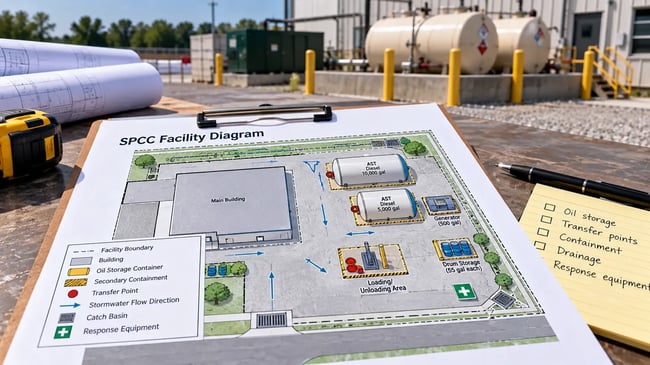
Mark every storm drain inlet, catch basin, floor drain, trench drain, culvert, ditch, and outfall near your oil areas, along with the nearest stream, pond, or wetland. Then draw an arrow from each container, transfer point, and piece of oil-filled equipment showing the direction an uncontained spill would travel, based on the slope of the ground and pavement. The best way to do this is to walk the site during or right after a rain and watch where the water goes. Stormwater usually runs to the nearest stream and not to a treatment plant, so a floor drain connected to the sanitary sewer and a storm drain connected to a creek are very different risks.
This ties directly to the plan itself. EPA's Tier I template asks you to record, for each area, the potential discharge volume, the direction of flow, and the containment method, and full plans have to predict the direction, rate of flow, and total quantity of oil from each major equipment failure under 40 CFR 112.7(b). If a discharge does reach a creek or leaves a sheen, our article on when you have to report an oil spill under the sheen rule explains the reporting side.
How Do You Show Secondary Containment and Spill Response Equipment?
Next, show what's supposed to stop a spill. Mark each secondary containment structure on the drawing: dikes, berms, retaining walls, curbing, drip pans, sumps, and any drainage or diversion system that routes oil away from a drain. For the bulk storage containers at qualified facilities, containment has to hold the capacity of the largest single container plus room for rain, and the rule lets you use an equivalent method. Sizing is its own topic, and our article on how big your SPCC oil spill containment needs to be walks through the math.
Mark the valves, too. Where a diked area has a drain, the rule expects it to be controlled by a manual, open-and-closed valve that stays closed except when you've checked the water and released it. Showing those valves on the drawing tells a new employee which ones matter and where they are.
Then add the response side, which the rule doesn't require on the drawing but EPA recommends. Mark your spill kits, drain covers, absorbent booms and pads, shutoff or emergency stop valves, and fire extinguishers or other firefighting equipment. A responder or a new employee should be able to look at the drawing and know where to grab a kit and which valve to close. Finish with the details that make any map usable: a north arrow, a scale or a note that it's not to scale, a legend for your symbols, and the date you last updated it. Here's the full picture side by side:
| Required by 40 CFR 112.7(a)(3) |
Recommended by EPA |
| Fixed containers, with location and contents |
Container IDs and capacities |
| Storage areas for mobile or portable containers |
Secondary containment structures and oil/water separators |
| Transfer stations and connecting piping |
Storm drain inlets and surface waters a discharge could reach |
| Buried tanks, marked "exempt" where they're exempt |
Direction of flow in a discharge |
| Oil-filled equipment, including electrical equipment, with location and contents |
Spill kits, booms, and other active containment equipment |
| |
Valves or drainage controls, firefighting equipment, and key piping valves |
| |
North arrow, scale, legend, and area maps |
What Pennsylvania Requirements Should You Check Against Your Diagram?
The SPCC rule is federal, and EPA Region 3 enforces it in Pennsylvania, but the state has its own layer. Pennsylvania DEP runs a storage tank program under the Storage Tank and Spill Prevention Act, with technical standards in 25 Pa. Code Chapter 245. For regulated aboveground tanks, those standards cover facility operations and spill response, preventive maintenance, security, and tank labeling. Whether a specific tank falls under DEP's program depends on its size, type, and use, so check yours against DEP's storage tank program before assuming it's in or out. Your diagram helps with that, since it already lists every tank with its capacity and contents.
Pennsylvania also requires a Spill Prevention Response Plan for aboveground storage tank facilities with more than 21,000 gallons of total capacity of regulated substances. It's a separate document from an SPCC Plan, but the two overlap, and EPA allows a diagram prepared for a state plan to be used in an SPCC Plan if it meets the SPCC rule. Check the state plan's own content requirements before assuming one drawing covers both.
Fire code requirements for tanks are enforced locally and vary by municipality, so confirm your local fire official's rules and mark any fire-related equipment they require on your drawing. Installing or upgrading a tank may also require a DEP-certified installer in Pennsylvania.
If you're building a new facility or adding tanks, the construction side is a separate set of approvals. Construction stormwater permits, erosion and sediment control, building permits, and fire permits for tank installation go through your engineer, your contractor, and your local officials, and RMA doesn't prepare them. Once the facility is running, though, it will almost always need an SPCC Plan or an amendment, a diagram that matches what was built, DEP tank requirements where they apply, inspections, and training. That's the part we help with.
How Do You Keep Your SPCC Facility Diagram Accurate?
A diagram that was right three years ago can be wrong today. Redraw it whenever you add or remove a tank, move a drum area, install a generator, change a transfer point, pave or regrade an area that changes where water runs, or add a storm drain. EPA treats changes to the diagram itself as administrative, so a redrawn map doesn't need a professional engineer to recertify it. The facility change behind it is a different matter. A change that affects your potential for a discharge, like adding a tank, is a technical amendment to the plan, and you have six months after the change to amend the plan. Technical amendments get recertified by whoever certified the plan. Our article on when to update your SPCC plan and whether you can do it yourself goes through the details.
Put the diagram to work, too. EPA notes it can be attached to your inspection checklist so staff know which containers and equipment to check, which pairs well with our list of the top 10 things to do during your SPCC plan monthly inspections. Walk employees through it at your annual discharge prevention briefing, and check it against the site during the plan's five-year review, which we cover in our guide to SPCC plan five-year reviews. If your team needs training, our online environmental training library has courses available.
Should You Draw Your SPCC Facility Diagram Yourself or Get Help?
For most small and mid-sized facilities, drawing the diagram yourself is realistic. With a handful of tanks, one or two drum areas, and a simple site, the walk-through and the drawing can take a few hours. We'd rather tell you that than have you pay for something you can do on your own.
Help makes sense when the site gets complicated: several buildings, lots of oil-filled equipment, buried piping, drainage you can't trace, multiple facilities that need consistent drawings, a plan that's more than five years old, or a facility that crosses into PE-certified territory. When a plan needs a professional engineer, we work with an outside PE, and our staff typically handles the site work and builds the plan before the engineer reviews, stamps, and seals it. That review adds time and a fee, which is covered in our article on professional engineers and SPCC plan requirements.
The diagram itself costs you nothing but time. Having us build the whole plan, diagram included, typically runs about $1,500 to $4,000 for a Tier I plan, and SPCC plans overall run from about $1,500 to $15,000. Where you land depends on how much oil you store, how many containers and pieces of oil-filled equipment you have, how complex the site and drainage are, and whether a PE has to certify the plan. Our article on SPCC plan costs breaks that down further, and the pricing calculator below gives you a ballpark based on your own facility.
How Can RMA Help With Your Pennsylvania SPCC Facility Diagram?
We're a family-run firm based in New Jersey, and we work with facilities across Pennsylvania on SPCC Plans, including the site walk, the diagram, and the plan that goes with it. Some clients hand us the whole job. Others draw the diagram themselves and want us to talk through what they've got, or they only need help figuring out which type of plan fits. If you don't need us, we'll tell you that.
There's no pressure and no obligation. You can call us, send an email, or fill out the form on our website, and a member of our team will follow up to talk about your facility and what makes sense for it. Whenever you're ready, contact RMA and we'll start with the basics.