A Self-Audit of Your Oil Storage, Containment, Facility Diagram, Operating Changes, and the Federal Deadlines That Decide When Your Plan Has to Be Amended
Most facility managers who pull their SPCC Plan out of the binder after a few years find it describes a site that has quietly changed. A tank got swapped, a generator showed up behind the building, the diesel supplier changed, the person listed as the emergency contact left two years ago. The plan is supposed to be a working document, and the only way to know whether yours still works is to check it against the facility.
This article walks you through that check step by step, covering your oil storage list, secondary containment, the facility diagram, operating changes, and the federal rules that tell you when an amendment is due, plus the New Jersey rules that sit on top of them. If you work through it and decide you'd rather hand the job off, you can always reach out to RMA, but plenty of facilities can do this review on their own, and we'll tell you where that's realistic.
Table of Contents
TL;DR
To review your own SPCC Plan, walk the site with the plan in hand and compare four things: your oil storage list, your containment and overfill protection, your facility diagram, and any changes in how you handle oil. Federal rules require a documented review at least every five years, and any change that materially affects the chance of a spill means you have six months to amend the plan. Plans that need a Professional Engineer's certification still need one for technical amendments, while qualified facilities under 10,000 gallons can self-certify. In New Jersey, EPA Region 2 enforces the federal plan, and major facilities also carry a state DPCC/DCR plan with its own, shorter amendment clock.
When Do You Need to Review an SPCC Plan in New Jersey?
Federal rules ask for two kinds of review. The first is scheduled. At least once every five years you have to sit down with the plan, compare it to the facility, and sign a short statement saying you did it and whether the plan needs to change. The second is triggered by events. Any time something changes in how you store, move, or handle oil in a way that materially affects the chance of a discharge, the plan has to be amended, and the clock for that is six months. Our article on SPCC plan five-year reviews covers how the review differs from a full rewrite.
New Jersey facilities can have a third layer. EPA Region 2 enforces the federal SPCC rule here, and the New Jersey Department of Environmental Protection (NJDEP) separately regulates "major facilities" under N.J.A.C. 7:1E, which must keep a Discharge Prevention, Containment and Countermeasure (DPCC) plan and a Discharge Cleanup and Removal (DCR) plan approved by the state. Most small and mid-size facilities aren't major facilities, so the federal plan is the document that matters most for them, but the self-audit below points out where to check.
Plan on a half day for a first pass. Bring the plan, your inspection records, a list of every tank, drum area, and piece of oil-filled equipment on site, and someone who knows how the facility operates day to day. Inspectors compare the plan to the site, and a plan that doesn't match is one of the easier SPCC violations for them to document.
How Do You Audit Your Oil Storage List and Capacity?
Start with the inventory, because every other part of the plan builds on it. The SPCC rule applies when a facility stores more than 1,320 gallons of oil in aboveground containers, counting only containers of 55 gallons or more. What counts is the shell capacity of each container, not how full it is today. That means a 10,000-gallon tank that usually sits at a quarter full still counts as 10,000 gallons.
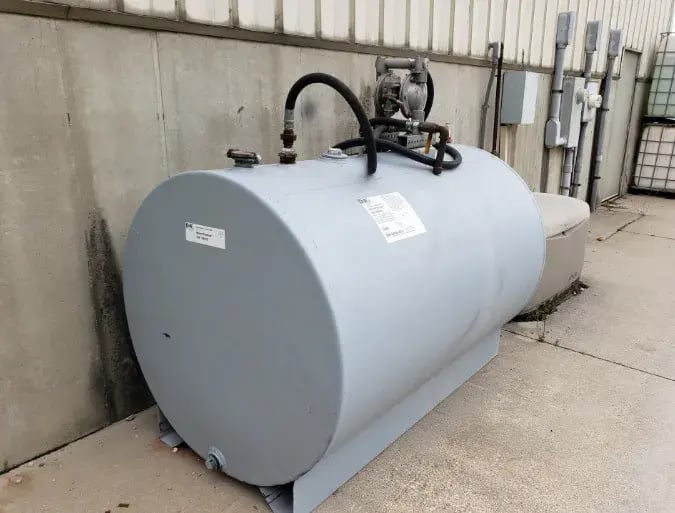
Walk the property and list every container: bulk fuel tanks, day tanks on generators, hydraulic reservoirs, used oil tanks, drum storage, totes, and oil-filled electrical equipment such as transformers. Oil here means more than petroleum. Vegetable oils and animal fats count, which surprises food and beverage facilities. Propane doesn't count. Compare your list line by line to the oil storage table in the plan, and check the type of oil and the capacity for each container. The plan needs the type and capacity of every fixed container, and for mobile or portable containers it needs either each container's details or a reasonable estimate of how many you'll have, what they hold, and how big they are.
Two situations deserve a closer look. If you've added containers since the plan was written, check your aggregate total, because crossing certain thresholds changes what kind of plan you need, which we cover in the federal rules section below. And if you have 55-gallon drums rotating in and out of a storage area, make sure the plan describes that area and its maximum use rather than the drums you happened to see the day the plan was written.
How Do You Check SPCC Secondary Containment and Overfill Protection?
Containment is where physical problems tend to turn up, so take your time here. For bulk storage containers, the rule calls for secondary containment large enough to hold the entire capacity of the largest single container in the containment area, plus additional room for precipitation. Dikes, walls, curbing, and double-walled tanks are all common ways to meet this. If you've never confirmed that your containment sizes out on paper, our guide on SPCC secondary containment sizing walks through the math.
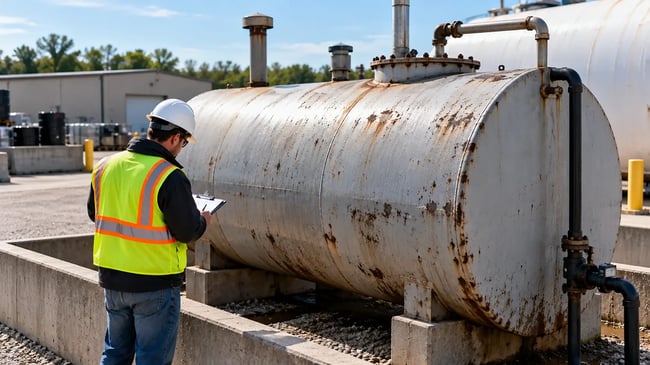
Sizing is only part of the check. Containment has to be able to hold oil in practice, which means walls and floors without cracks, penetrations that are sealed, and drain valves that stay closed. The table below gives you a working checklist, with the rule section for each item so you can compare your plan's wording against the source.
| Item to Check |
What You're Looking For |
Rule Reference |
| Dike or containment capacity |
Room for the largest container plus precipitation, and walls and floor that can hold oil |
40 CFR 112.7(c), 112.8(c)(2) |
| Rainwater drainage from dikes |
Valves kept closed, water checked before release, and a record of each release |
40 CFR 112.8(c)(3) |
| Container integrity |
Scheduled testing and visual inspection of bulk containers, with records |
40 CFR 112.8(c)(6) |
| Overfill prevention |
A working system or documented procedure for each container, tested regularly |
40 CFR 112.8(c)(8) |
| Visible leaks |
Weeping seams, stained soil, or leaking gaskets repaired promptly, with oil removed |
40 CFR 112.8(c)(10) |
| Mobile and portable containers |
Positioned over or within containment sized for the largest container |
40 CFR 112.8(c)(11) |
| Truck loading and unloading areas |
Containment for the largest compartment, plus warning signs, chocks, or an interlock |
40 CFR 112.7(h) |
Two records deserve a second look while you're at it. The rule requires you to keep inspection and testing procedures, along with signed records, for three years alongside the plan. If your records have gaps, that's worth fixing now, because it's the first thing a reviewer asks for. Our list of monthly SPCC inspection items can help you tighten the routine. The second is training. Oil-handling personnel need to be trained on the plan, a person has to be designated as accountable for spill prevention, and discharge prevention briefings have to happen at least once a year. See our article on annual SPCC training for what the briefing needs to cover, and our online training library if you'd rather not build it yourself.
Does Your SPCC Facility Diagram Match the Site?
The facility diagram is the page inspectors tend to flip to first, since it shows at a glance whether the plan reflects the real facility. The rule says the diagram must mark the location and contents of each fixed oil storage container and the storage area for any mobile or portable containers. It must also show all transfer stations and connecting pipes, and it must identify any underground tanks that are exempt from the SPCC rule, marked as "exempt." In New Jersey, regulated underground storage tanks fall under NJDEP's separate UST program (N.J.A.C. 7:14B), but they still belong on the diagram so the full picture of oil on site is visible.
To check it, take a printed copy of the diagram outside and look for what's missing. Look for the generator that arrived after the plan was written, the tote storage area that moved to the other side of the building, a new fueling station, and any piping that was added or rerouted. Then look for the opposite problem, equipment on the diagram that's gone. A decommissioned tank still shown as active means the plan describes a hazard that doesn't exist, and whoever reads it will wonder what else is out of date. Also confirm the diagram shows the drainage path from your containment areas and where a spill from each source would flow, since the plan has to address that for any equipment with a realistic chance of failure.
While you have the diagram open, check the pages around it. The contact list needs current names and phone numbers for your facility response coordinator, the National Response Center, your cleanup contractor, and the agencies you'd notify after a spill, which in New Jersey includes NJDEP's discharge hotline. Confirm that number on NJDEP's website instead of trusting an older printout. These contact updates are administrative, so they don't trigger the formal amendment process, but a spill is the wrong moment to find out the number is wrong.
Which Operating Changes Trigger an SPCC Plan Amendment?
This is the part of the audit where most plans fall behind, because operating changes happen without anyone thinking of them as plan events. The rule asks for an amendment when there's a change in facility design, construction, operation, or maintenance that materially affects the potential for a discharge. EPA's own examples are a useful guide. The table below sorts common changes into those that usually call for an amendment and those that usually only need a housekeeping update.
| Change at the Facility |
Usually Needs an Amendment? |
| Adding, removing, or decommissioning a tank or other container |
Yes, since commissioning and decommissioning containers are both named in the rule |
| Replacing, rebuilding, or moving a container |
Yes |
| Installing or replacing piping |
Yes |
| Construction or demolition that alters a dike, wall, or other containment |
Yes |
| Changing the product stored or the way a container is used |
Yes |
| Revising standard operating or maintenance procedures that the plan describes |
Yes, if the change affects spill potential |
| New phone numbers, employee names, or a new cleanup contractor |
Usually a non-technical update, but keep the plan current |
When you can't tell whether a change is technical, treat it as technical. The cost of an unnecessary amendment is small, and the cost of skipping one that was required is a plan that no longer reflects the facility. Our article on when to update your SPCC plan goes through more of these judgment calls.
If your audit turns up a change you haven't documented, don't panic about the date. The amendment clock runs six months from the change, which gives most facilities room to catch up, and a plan revised in good faith beats one that stays wrong. If the fix involves physical work, such as new containment, a replacement tank, or a new fueling area, keep in mind that the construction side has its own permits and approvals, including local construction and fire permits and, for underground tanks, NJDEP-certified UST contractors. We don't prepare construction-phase permits, so those typically go through your engineer or contractor. Once the work is done and the facility is running, the SPCC amendment that documents it is something we can help with.
What Are the Federal SPCC Plan Update and Certification Rules?
The deadlines are spelled out in 40 CFR 112.5, and they're easier to hold in your head as a short table than as regulation text.
| Requirement |
Deadline or Frequency |
Rule |
| Review and evaluate the plan, with a signed statement of whether you'll amend |
At least once every five years |
112.5(b) |
| Amend after a review that finds field-proven technology that would significantly reduce spill likelihood |
Within six months of the review, then implement within six months of the amendment |
112.5(b) |
| Amend after a material change at the facility |
Prepare within six months, implement as soon as possible and no later than six months after preparing |
112.5(a) |
| Move to a PE-certified plan after exceeding the qualified facility limits |
Within six months of the amendment |
112.6(a)(2), 112.6(b)(2) |
| Keep inspection and testing records with the plan |
Three years |
112.7(e) |
| Hold discharge prevention briefings for oil-handling staff |
At least once a year |
112.7(f)(3) |
The five-year review is the one facilities forget, and it's easy to document. You don't need a rewrite. You need to complete the review, then sign and date a statement in the plan, or in a log or appendix, saying you completed it and whether you'll amend the plan as a result. If your plan has gone past five years without that statement, our article on SPCC plans over five years old explains how to get back on track.
Who has to certify the amendment depends on your plan type. A facility with a full plan has a Professional Engineer (PE) certify technical amendments, and PE certification requires the engineer to be familiar with the rule and to have visited and examined the facility. Some SPCC firms have a PE on staff, while others work with a trusted outside PE, and either way the point is that a licensed engineer reviews and approves the changes. Our article on PE requirements for SPCC plans covers what the engineer is signing.
Qualified facilities get a break. If your total aboveground oil storage is 10,000 gallons or less and you have a clean discharge history as the rule defines it, you may be able to self-certify. A Tier I facility, where no single aboveground container is larger than 5,000 gallons, can use EPA's template and self-certify technical amendments. A Tier II facility, with a container above 5,000 gallons and a total of 10,000 or less, can self-certify too, with a catch: any alternative measure that takes the place of a standard requirement, such as a determination that secondary containment isn't practicable, has to be reviewed and certified by a PE. Our overview of the Tier I self-certified SPCC plan shows what qualifies.
The qualified facility limits are the reason your inventory matters. If a change pushes you over 10,000 gallons in total, or a Tier I facility adds a container above 5,000 gallons, you have six months to prepare a plan that fits your new situation, which for many facilities means a PE-certified plan. A discharge can also change your status. Reportable discharge history is part of the qualification test, and a single discharge over 1,000 gallons to navigable waters, or two discharges of more than 42 gallons each within twelve months, has to be reported to EPA and can affect whether you keep qualifying.
How Do New Jersey Rules Change Your SPCC Plan Review?
The federal plan is the starting point, but New Jersey adds a few things worth checking while you're reviewing. The first is whether your facility is a "major facility" under the Spill Compensation and Control Act (the Spill Act) and N.J.A.C. 7:1E. That status depends on the total storage capacity of the petroleum and other hazardous substances you hold, with some exclusions, such as out-of-service tanks and containers of five gallons or less, so the answer comes from adding up your own inventory against the current rule text and its list of hazardous substances. NJDEP has also proposed revisions to N.J.A.C. 7:1E in recent years, so read the current version rather than relying on an older summary.
If you are a major facility, you carry a combined DPCC/DCR plan that NJDEP has approved, and it has its own amendment clock. The rule calls for an amendment within 30 days of a modification that necessitates a change in the plan, certified under N.J.A.C. 7:1E-4.11 and submitted to NJDEP for approval. Certain administrative changes, such as employee names, are reported to NJDEP within 30 days but don't count as plan amendments. That 30-day clock is much shorter than the federal six months, so a major facility that treats the federal timeline as its deadline can fall out of compliance with the state plan. A facility that isn't a major facility yet but plans to add enough storage to become one should read N.J.A.C. 7:1E-4.5 before the new tanks go in, because the state plan submission comes with its own timing.
Beyond plan paperwork, keep three other New Jersey pieces in view during your audit. The Spill Act makes dischargers responsible for cleanup and removal costs, and that liability is generally described as strict and shared among responsible parties, so a well-kept plan and inspection record are worth having when something goes wrong. If a discharge has happened at your site, cleanup in New Jersey typically involves a Licensed Site Remediation Professional (LSRP), and it's reasonable to talk with an environmental attorney about reporting and liability questions. Local fire officials also enforce the Uniform Fire Code on tank installations and storage, and the specifics vary by municipality, so ask yours before you add or move a tank. Our article on SPCC plans in New Jersey gives the broader state picture, and our piece on who enforces SPCC plans explains the EPA side.
Should You Update Your SPCC Plan Yourself or Hire Help?
If you're a Tier I facility with a small number of tanks, a simple site, and a plan built on EPA's template, you can often handle the five-year review and routine amendments on your own, and you don't need a consultant to do it. The audit in this article is most of the work. Where self-service stops making sense is when the plan is PE-certified, when your containment or sizing is in question, when you've crossed a threshold, when a determination of impracticability is involved, or when you've lost track of what changed over the years. At that point a mistake can mean a plan that looks complete and doesn't hold up in front of an inspector.
On cost, a simple Tier I plan update runs about $1,500 with us, while a PE-certified plan with complex containment questions starts around $7,500 and can go higher. New SPCC plans fall in a wider band of roughly $2,500 to $15,000. The things that move the number are total storage capacity, how many containers and what types, whether the plan needs PE certification, and whether the secondary containment needs evaluating. Our breakdown of SPCC plan costs goes through each factor, and whether your plan can be updated or needs a redo depends on how far the site has moved from what the plan says. If you'd like a number for your own facility, you can use the pricing calculator below to see what RMA's help would cost.
How Can RMA Help With Your New Jersey SPCC Plan Review?
We're based in New Jersey and we've worked through plan reviews with facilities of every size, from a single diesel tank to multi-tank sites with state plans. If you've done the audit and want a second set of eyes, we can look at what you found and tell you straight whether your plan needs a full update, a smaller amendment, or nothing at all. We can also tell you whether your plan needs PE certification or qualifies for self-certification, and what to expect for the construction-side pieces we don't handle ourselves.
There's no obligation and no pressure. You can call, email, or fill out the form on our website, and a member of our team will talk through your situation. If you'd like to start with a conversation, contact RMA whenever it suits you.