A Step-by-Step Guide to Writing a New Jersey Industrial Stormwater Pollution Prevention Plan Yourself, From Picking the Right NJPDES Permit to Drainage Mapping, BMPs, and Keeping the Plan Current
Yes, you can write your own SWPPP for a New Jersey facility, and for plenty of sites it's a reasonable thing to do. A stormwater pollution prevention plan is a written description of your property, where rainwater goes when it lands there, what could pollute that water, and what you do to keep the two apart. NJDEP calls it an SPPP, and you'll also hear it called an SP3 or just a stormwater plan, but we'll say SWPPP here. NJDEP provides forms to build it on, and as far as we know the basic permit doesn't require an engineer to sign it. What takes effort is the site walking, the drawing, and the follow-through once the plan exists.
This guide takes you through the steps in the order we'd do them: finding the right NJDEP permit, assessing your site, building your team and inventory, drawing the drainage map, choosing best management practices, and keeping the plan alive after it's written. We'll also cover where homemade plans tend to go wrong. If you'd rather have an experienced person write it, or you just want a second opinion on a draft, you're welcome to reach out to RMA at any point.
Table of Contents
TL;DR
You can write your own New Jersey industrial SWPPP. Start by confirming which NJDEP stormwater permit covers your facility, because the plan has to match that permit. Then walk the site, list every industrial activity and material, draw a map showing where rain runs, pick controls for each pollution source, and write a maintenance plan. Keep the plan on site, update it when things change, and follow the inspection, training, and certification routine your permit sets. Simple indoor sites often do fine on their own. Larger sites, industry-specific permits, and sites with sampling usually benefit from experienced help.
What Is a New Jersey Industrial SWPPP and Does Your Facility Need One?
New Jersey regulates rain and snowmelt running off industrial sites. When rain falls on a yard, picks up oil, metal, dust, or chemicals, and runs to a storm drain, a ditch, a stream, or into the ground, that counts as a discharge. NJDEP controls those discharges through the New Jersey Pollutant Discharge Elimination System (NJPDES), under the state's Water Pollution Control Act. Each industrial permit it issues requires a stormwater pollution prevention plan, and the plan is how you show you're keeping pollutants out of the rain.
Not every business needs one. A warehouse or office with nothing industrial happening outside often doesn't need an industrial stormwater permit, and some facilities qualify for a no exposure exclusion instead. Coverage turns on your industry classification, whether materials or activities are exposed to rain, and where your runoff goes. Our articles on stormwater associated with industrial activity and what a SWPPP is cover the basics.
Two limits on this guide. If your site drains to a sewerage authority's system instead of a storm sewer, the authority's rules may apply instead of, or alongside, NJDEP's, so confirm where your water goes first. And if you're building or expanding, separate construction-phase approvals apply while the work is underway, such as soil erosion and sediment control certification and construction stormwater coverage. We don't prepare those, and you'll usually work with your engineer or contractor on them. This guide covers the plan a facility needs once it's running.
Which NJPDES Permit Does Your SWPPP Have to Satisfy?
This comes first because the plan gets written to the permit. A template from another state or another company's binder can miss what a New Jersey permit spells out. New Jersey doesn't use one permit for everybody, so figure out which of these applies to your site.
| Option |
Who it generally fits |
What it means for your plan |
| Basic Industrial Stormwater General Permit (5G2) |
Regulated facilities that have eliminated, or can eliminate within six months of authorization, all exposure of industrial materials and activities to rain and snowmelt |
A SWPPP, monthly inspections, an annual comprehensive inspection, annual training, and an annual certification, with no stormwater sampling |
| Industry-specific general permits (CPM, R4, R13, RSG, SM and SM2, RVR, WRC) |
Concrete products, hot mix asphalt, mining and quarrying, sand and gravel, scrap metal, vehicle recycling, and wood waste recycling and leaf composting |
Each permit sets its own plan contents and routine, and some involve sampling, so read the one that applies |
| Individual NJPDES permit |
Facilities that can't eliminate exposure and don't fit any general permit |
A plan and requirements written for your specific site |
| Permanent no exposure certification |
Facilities where everything industrial stays indoors or under permanent cover |
No industrial permit and no permit-required plan, but the bar is high and the site has to stay that way |
The 5G2 is the one most realistic to write a plan for yourself, but its eligibility test trips up a lot of sites. We've seen a loose dumpster lid, a loading dock that sticks out past the building wall, parked equipment, and an outdoor generator each knock a site off the 5G2. Our guides to the 5G2 Basic Industrial Stormwater Permit, NPDES permit types, and individual NJPDES permits help you sort out where you land, and our article on what no exposure means shows how strict the exclusion is.
How Do You Assess Your Site and Find Stormwater Exposure?
Put on boots and walk the whole property with a camera and a notepad. Do it once on a dry day when you can poke around, and again during or right after a rain, when you can see where water goes. Bring someone who works at the site every day, because they know about the drum behind the shop and the pallet that always ends up by the fence. Dated photos will help with the map and inventory.
Check loading docks and doors, dumpsters and roll-offs, outdoor storage, parked vehicles and equipment, fuel and chemical storage, roofs and vents that shed dust, every storm drain and floor drain, and the pavement itself, where oil stains and pooling water tell you a lot. Ask one question about each item: can rain touch this, and if it can, where does that water end up? The cheapest fix is usually to move the item indoors or put a roof over it. Our guide to doing a stormwater visual inspection has tips on what to notice.
How Do You Build Your SWPPP Team and Materials Inventory?
The team is the group of people responsible for the plan. NJDEP's forms ask you to list team members and their responsibilities, and the group that works best is small and practical: someone with the authority to make decisions and spend money, someone from maintenance or operations who knows the physical site, and a backup. Use real names and titles, and update them when people leave. A team list naming someone who quit two years ago is one of the first things an inspector notices.
The inventory is where plans most often go sideways. NJDEP's inventory form asks for all industrial activities, all source materials, and all non-stormwater discharges at the facility, along with any other NJDEP approvals the site holds. A source material is anything that could end up in runoff: raw materials, products, wastes, by-products, machinery, fuels, lubricants, solvents, and detergents. A facility that lists its main product and forgets the used oil drum and the dumpster has a plan that doesn't match the site. Process, cooling, and wash water can raise separate permitting questions, and our explainer on the difference between stormwater and process water shows why. If you store oil, point to your SPCC plan too, and see our article on the difference between an SPCC plan and a SWPPP for how the two fit together.
How Do You Draw the Drainage Map for Your SWPPP?
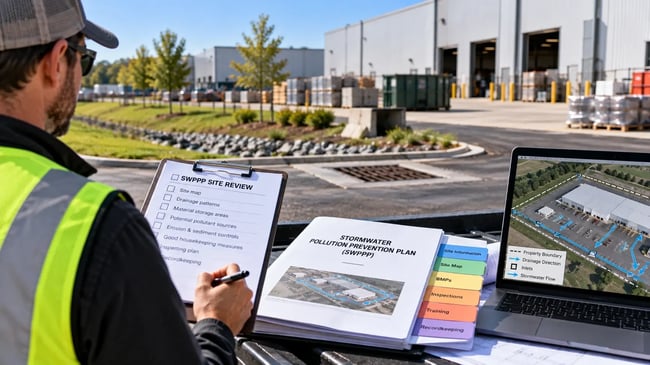
The map is the picture that holds the plan together. You don't need a survey-grade drawing, but someone who has never visited should be able to follow it. Start with an aerial photo, site plan, or survey, print it large, and draw on it. Then check it against what you saw on the rainy walk, because water often moves differently than the plan sheet suggests.
A useful map shows the property boundary, buildings, paved and unpaved areas, and the direction water flows across the site, drawn as arrows. It marks every storm drain, catch basin, and inlet, and the places where runoff leaves your property. Then it adds your inventory and the controls at each spot. Add a legend and a north arrow, and date the map.
The part people skip is tracing where each drain goes. Water that enters a storm drain might discharge to a ditch, a stream, a municipal storm sewer, a sewerage authority's system, or the ground, and the answer affects which rules apply. If you can't tell from the site, call your town's public works department or sewerage authority. Several older New Jersey cities have combined sewers, so don't assume your drains behave like the ones at the last facility you worked at.
How Do You Choose BMPs and Write the Maintenance Plan?
Best management practices, or BMPs, are the things you do to keep pollutants away from rain. Some are structural, like a roof over a storage area, a berm, a containment pad, or a drain cover. Others are habits written into procedures, like sweeping, closing dumpster lids, using drip pans, and cleaning up spills right away. The order of preference: remove the material from the weather, cover it, contain it, and clean up after it. Our guide to stormwater BMPs has more examples.
| Pollution source |
Typical BMPs |
| Dumpsters and roll-offs |
Lids kept closed, covered or fully enclosed units, regular leak checks |
| Outdoor storage |
Move indoors, build a roof or shed, or use sealed containers |
| Vehicles and equipment |
Drip pans, maintenance indoors, regular leak checks, designated parking areas |
| Oil and chemical storage |
Indoor storage or covered secondary containment, tied to your SPCC plan where one applies |
| Dust, debris, and spills |
A sweeping schedule, trash pickup, spill kits at the point of use, a written cleanup procedure |
Write each BMP so someone could do it without asking you. "Keep area clean" doesn't tell anyone anything, while "sweep the north lot every Friday and log it" does. NJDEP's forms also ask you to pair each source with a corrective action or BMP and a scheduled completion date, so a control you haven't finished yet goes in the plan with a date next to it. The maintenance plan covers upkeep: who checks drain covers, berms, and containment, who sweeps and how often, who restocks spill kits, and where it's recorded. Match it to what your people will really do, because a plan that promises weekly checks and delivers monthly ones is a problem the first time someone asks for records.
How Do You Assemble the SWPPP and Keep It Current?
Put the pieces together in the order NJDEP's forms follow: team, inventory, site map, BMPs with schedules, and maintenance plan, plus any references to your SPCC plan and your training records. Sign and date it and keep it at the facility. You don't mail the SWPPP to NJDEP, and the 5G2 certification form says so directly. You hand it over when an inspector asks, and inspectors do ask. Newly authorized 5G2 facilities get six months to get the plan in place, though we recommend starting sooner. After that, the routine keeps you compliant. This is what a 5G2 facility does, and other permits set their own versions, so check yours.
| Task |
How often |
What it involves |
| Routine inspection |
Monthly |
Walk the areas exposed to rain and snowmelt, look for leaks, trash, uncovered materials, and drain problems, and write it down |
| Comprehensive inspection |
Once a year |
A deeper version of the monthly walk that also reviews the plan, inspection records, and training records |
| Employee training |
At least annually |
Document who attended, what was covered, who taught it, and how long it ran |
| Certification to NJDEP |
Once a year |
Submit the certification form, with the due date tied to your authorization, and keep a copy and the plan on file |
| Plan update |
Whenever something changes |
New building, moved storage, new drain, new product line, or new team member |
Training doesn't have to be elaborate, and our article on taking 5G2 training online explains what the permit asks for. Our online environmental training library can cover part of the need. You're certifying under penalty of law when you sign the annual form, so the plan has to match the site.
Where Do Self-Written New Jersey SWPPPs Go Wrong?
An inspector compares the plan to the property, and any mismatch becomes the finding. The plan was copied from another company's binder and describes a site that doesn't exist. The map is ten years old. The inventory leaves out the dumpster or the used oil. The plan says everything is under cover while a trailer or a pallet sits in the rain. The BMP list sounds good, but nobody does the things on it or keeps a record. Our article on common NPDES permit problems covers more of these.
Another common problem is choosing the wrong permit and writing a flawless plan for it. A site with real outdoor activity that signs up for the 5G2 because it's the simplest option has built the whole program on a promise it can't keep. Doing it yourself is the sensible call for a small indoor facility with a few materials and someone willing to walk the site, and our piece on writing your own SWPPP goes through the trade-offs. Larger sites, several activities, an industry-specific permit, sampling, or a team with no time usually call for experienced help, because the cheapest option often turns into the expensive one after the first notice of violation.
What Does Writing Your Own SWPPP Cost Compared With Hiring Help?
Doing it yourself costs time instead of consulting fees. The walk, the map, the inventory, the writing, and the first round of training all take real hours, and the total depends on how big and complicated your site is. The BMPs themselves cost money either way, since a new covered storage area, a closed dumpster, or a sweeping contractor costs the same whether you or a consultant decided you needed it. NJDEP's annual permit fees are separate and depend on the permit, so check NJDEP's current fee schedule.
What a consultant charges depends on which permit category applies, how large and complicated the site is, whether a plan already exists, and how much of the routine you want help with. Our pricing calculator below gives you a ballpark for RMA's help with NJPDES permitting and plans, and it takes a couple of minutes without talking to anyone.
We're not always the cheapest among environmental consulting firms, and we don't try to be, because our senior staff do the work themselves. Compared with an environmental engineering firm we're usually a little cheaper, since engineering is its own expensive specialty.
How Can RMA Help With Your New Jersey SWPPP?
We're based in New Jersey and have worked with NJDEP's industrial stormwater permits for decades. For SWPPPs, that usually means confirming which permit fits your site, writing or updating a plan that matches what your facility does day to day, and training your team to run inspections and, where a permit requires it, to take their own stormwater samples correctly. After you're permitted, we offer annual support: reminders, help interpreting results, plan and annual reporting updates, and inspection prep, either hands-off or hands-on. We're not the right fit for major engineering design, treatment system construction, large construction stormwater projects, or very large portfolios of facilities, and we'll tell you up front if a tight timeline isn't realistic.
If you'd like a second set of eyes on a draft, a straight answer on which permit you need, or someone to take the whole thing off your plate, you're welcome to call us at 888-RMA-0230, email the team, or fill out the form on our website. There's no pressure and no obligation, and you can contact RMA whenever the timing works for you.