A Step-by-Step Guide for Pennsylvania Facilities to Writing Their Own Oil Spill Prevention Plan, From Applicability and Drainage to Containment and Response Procedures
If you run a facility with a few fuel tanks, a generator, some hydraulic equipment, or a row of 55-gallon drums, you've probably been told you need an SPCC plan, and you may be wondering whether you have to pay a consultant for it. SPCC stands for Spill Prevention, Control, and Countermeasure. It's the federal oil spill plan EPA requires from facilities that store oil above certain amounts. Many smaller facilities can legally write and sign their own, and EPA even publishes a free template to do it. Whether you should is a separate question, and the answer depends on your site.
This guide walks through the work in the order you'd do it: confirming the rule applies, inventorying your oil, tracing drainage, sizing containment, drawing the facility diagram, writing response procedures, and handling the inspections, training, and reviews that keep the plan valid. We also cover the Pennsylvania tank rules that sit on top of the federal plan. If you get partway through and decide you'd rather hand it off, you can reach out to RMA any time, and if you can do it yourself, we'll tell you that too.
Table of Contents
TL;DR
Yes, in many cases. A facility that stores 10,000 gallons of oil or less above ground, has no single container over 5,000 gallons, and hasn't had a significant spill in the past three years can write and sign its own federal oil spill plan using EPA's free template. Larger facilities, and anyone who can't meet the containment rules, need a licensed professional engineer to certify the plan. The work is the same either way: list your oil storage, trace where a spill would go, size your containment, draw a diagram, write response steps, and keep up inspections, training, and reviews. Pennsylvania adds its own DEP tank rules on top.
Can You Legally Write Your Own SPCC Plan?
Sometimes, yes. The federal oil pollution prevention rule, 40 CFR Part 112, lets the owner or operator of a "qualified facility" prepare and certify the plan without an engineer. A facility qualifies when its total aboveground oil storage capacity is 10,000 gallons or less and it has a clean discharge history. That means no single discharge over 1,000 gallons, and no two discharges over 42 gallons each within any 12-month period, in the three years before you certify the plan. Qualified facilities split into two tiers depending on how big your largest container is.
| Your facility |
Who can certify the plan |
What you'd use |
| Tier I: 10,000 gallons or less total aboveground, no single container over 5,000 gallons, clean discharge history |
You, the owner or operator |
EPA's Tier I template, or an equivalent written plan |
| Tier II: 10,000 gallons or less total aboveground, at least one container over 5,000 gallons, clean discharge history |
You, but a licensed Professional Engineer (PE) must certify any alternative measures or "impracticable" containment decisions |
A full plan that follows the general rule requirements |
| Over 10,000 gallons total aboveground, or a discharge history that doesn't qualify |
A licensed PE |
A full PE-certified plan |
When you self-certify, you're signing a statement that you know the rule, that you visited and examined the facility, that you built the plan on sound industry practice, that you'll carry it out, and that management has approved it and committed the resources to follow it. EPA doesn't review or approve the plan before you start. Inspectors ask to see it on site, and that's when gaps get found. Our guides to Tier I self-certified plans, Tier II self-certified plans, and PE-certified plans go deeper on each path, and our comparison of the different types of SPCC plans lays them side by side.
Step 1: How Do You Confirm Your Facility Needs an SPCC Plan?
Start by checking whether the rule covers you at all, because some facilities that think they need a plan don't, and some that think they don't do. A facility is subject to the federal SPCC rule when it stores more than 1,320 gallons of oil in aboveground containers, counting only containers of 55 gallons or more, or more than 42,000 gallons in completely buried tanks, and a spill could reasonably be expected to reach navigable waters or adjoining shorelines. Buried tanks already covered by the federal underground storage tank rules don't count toward that second number. In practice, a storm drain, ditch, or swale that leads to a stream makes the water test easy to meet, and you can't count dikes, curbs, or other manmade structures as the reason a spill wouldn't get there.
Capacity is what counts, not what's in the container today. An empty 5,000-gallon tank counts toward your total, and a permanently closed one doesn't. Oil covers petroleum products like diesel, gasoline, hydraulic oil, lube oil, and transformer oil, plus animal fats and vegetable oils, which is why a kitchen's cooking oil tank can bring a facility under the rule. Propane and diesel exhaust fluid don't count. Oil-filled equipment such as transformers, hydraulic systems, and compressors does count. Fuel tanks that power a vehicle's own engine are exempt, but fuel trailers and skid tanks aren't, and milk and milk product containers are exempt.
In Pennsylvania, EPA Region 3 enforces the federal SPCC rule, and DEP's storage tank program is a separate layer we cover below. If your total lands well under 1,320 gallons, you're probably not covered, and we'll say so plainly. Add it up carefully before you decide, because generator base tanks, totes, and equipment reservoirs are easy to forget. Our posts on figuring out whether you need an SPCC plan, how 55-gallon drums are counted, and cooking oil and used cooking oil cover the common edge cases, and who enforces SPCC plans explains the agency side.
Step 2: How Do You Inventory Oil Containers for an SPCC Plan?
The plan starts with a complete list of what you store. Walk the whole site, inside and out, and record every container that holds oil, along with its capacity, the type of oil, where it sits, and what's underneath it. The table below shows the shape of an inventory that works for both the plan and the tier question. The rows are examples.
| Container |
Location |
Oil type |
Capacity |
Fixed or portable |
What's under it |
| Diesel tank |
Behind maintenance shop |
Diesel |
2,000 gal |
Fixed |
Concrete dike |
| Generator base tank |
North pad |
Diesel |
500 gal |
Fixed |
Integral double wall |
| Hydraulic oil tote |
Warehouse dock |
Hydraulic oil |
275 gal |
Portable |
Spill pallet |
| Transformer |
Utility yard |
Mineral oil |
600 gal |
Oil-filled equipment |
Gravel, no containment |
Add up the capacities and compare the total to 10,000 gallons, and your largest container to 5,000 gallons. For mobile or portable containers like totes and drums, the plan can either list each one or estimate how many you typically have on site, the types of oil, and the capacities. Include oil-filled equipment and used oil tanks, and note which containers are in service and which are sitting empty. If your total is close to 10,000 gallons, write the plan with the next tank in mind. Adding capacity that pushes you past 10,000 gallons, or a single container past 5,000, changes which certification path you're on, and the rule gives you six months after the amendment to move to the right one.
Step 3: How Do You Map Drainage and Spill Paths at Your Facility?
This is the section where homemade plans tend to go thin. For every container and every place oil gets handled, including delivery spots, transfer points, and anywhere a hose or pump connects, you need to know where a spill would travel. Walk the site on a rainy day if you can. If you can't, trace the grading, floor drains, storm inlets, and ditches by hand, and mark where each one finally ends up: an on-site treatment system, a retention basin, a storm sewer, or a creek.
The rule has specific expectations for drainage. Valves that drain diked areas must be the manual, open-and-closed type, and flapper-type drain valves aren't allowed. Drainage from undiked areas where a spill could happen, like piping outside a containment wall or a spot where trucks unload outside the loading area, should flow to a pond, lagoon, or catchment basin designed to retain oil or return it to the facility. If your drainage isn't engineered that way, the final discharge of every ditch inside the facility needs a diversion system that would hold oil on site during an uncontrolled spill, and catchment basins shouldn't sit in areas that flood.
The last piece is a failure analysis. For each type of major equipment failure that experience says is realistic, such as a tank overflowing during a delivery, a ruptured hose, or a leaking valve, the plan predicts the direction the oil would flow and the total quantity that could come out. That prediction tells you whether your containment and drainage controls would catch the spill, and it's easy to skip when you're working from a template.
Step 4: How Do You Size SPCC Secondary Containment?
Secondary containment is the physical backstop that keeps oil on your property when a tank, hose, or fitting fails. For a facility using the Tier I path, every bulk storage container installation, including mobile or portable containers, needs a secondary means of containment for the entire capacity of the largest single container, plus additional capacity to contain precipitation. Dikes, containment curbs, and pits are the usual choices, and a drainage trench that leads to a catchment basin or holding pond also works. Mobile refuelers and other non-transportation-related tank trucks are handled differently, so don't size containment around them. The walls and floor have to be able to hold oil, and any discharge from the tank must not escape the containment before cleanup happens.
The rule doesn't give a fixed percentage for the rain allowance. Some facilities use a rule of thumb like an extra 10 percent, and others calculate it from local rainfall, but the requirement is that you have sufficient room and can explain your reasoning in the plan. Our post on how big SPCC oil spill containment needs to be works through the sizing math with examples.
Stormwater inside a dike is its own problem. You can't drain rainwater out of a diked area into a storm drain or open watercourse unless the bypass valve normally stays sealed closed, you inspect the retained water to make sure it won't cause a discharge, you open and reseal the valve under responsible supervision, and you keep records of each event. Each container also needs a system or documented procedure to prevent overfills, described in the plan and tested regularly. A high-level alarm, a pump cutoff, or a written fill procedure with a person watching the gauge can each work.
If sized containment isn't practical for a container, the rule lets a plan explain why and describe alternatives, but a self-certifying facility can't make that call alone. A licensed PE has to review and certify the impracticability determination and the alternative measures. If you find yourself in that spot, that's the point where the plan has become more than a self-certified project.
Step 5: How Do You Draw an SPCC Facility Diagram?
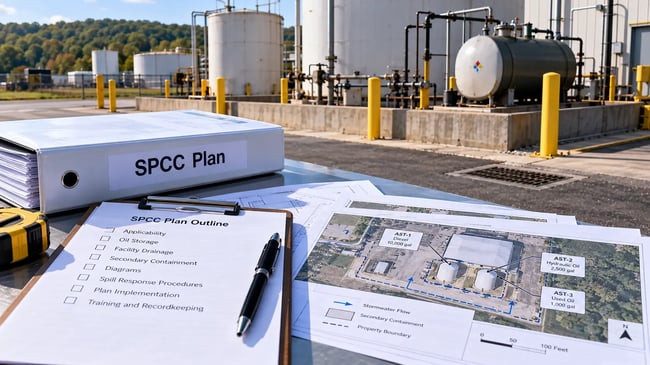
Every plan needs a facility diagram, and it's the page an inspector looks at first. The rule requires it to mark the location and contents of each fixed oil container and the storage area for mobile or portable containers. It also has to show transfer stations and the connecting piping, and it has to mark any exempt underground tanks as "exempt." The plan also needs a written description of the physical layout that goes with it.
We'd go beyond the minimum. Add drainage flow arrows, storm drains and inlets, the nearest waterway, containment structures, key valve locations, and where your spill kits are stored. A satellite image from a free mapping tool with labels added works well, as long as it's still readable when someone prints it in black and white. Update the diagram whenever you move, add, or remove a container, since a tank missing from the drawing is a gap an inspector will notice. Our post on the most overlooked SPCC plan requirements covers other details that tend to get missed.
Step 6: How Do You Write SPCC Spill Response Procedures?
Put safety first when you write this section. The opening line of your response procedures should tell people to get out of danger and call 911 for any fire, injury, or threat to life before anyone worries about the oil. After that, the plan needs to cover how your people discover a discharge, respond to it, and clean it up, including what your own staff can handle and what you'd need a contractor for. It also covers how you'll dispose of recovered material under the applicable legal requirements, and a contact list with phone numbers for your facility response coordinator, the National Response Center, any cleanup contractor you have an agreement with, and the federal, state, and local agencies you'd need to call.
Write this part so someone who has never read the plan can use it at 2 a.m. The rule says to organize the response portions so they're readily usable in an emergency, with supporting material in appendices. The plan also has to help the person making the report relay the exact address and phone number, the date and time, the type of material, the estimated quantity, the source, the affected media, the cause, any injuries or damage, what's being done to stop and clean up the discharge, whether an evacuation may be needed, and who else has been contacted. A one-page quick-reference sheet with those fields printed as blanks is the easiest way to make that work under pressure.
When Do You Have to Report an Oil Spill?
Federal reporting goes through the National Response Center at 800-424-8802, which is staffed around the clock. A discharge that leaves a sheen on water or shorelines gets reported, and our post on the sheen rule walks through the details. In Pennsylvania, put DEP's 24-hour emergency line, 1-800-541-2050, on your contact list next to the NRC number, because the state has its own notification requirements.
The SPCC rule adds a separate paperwork trigger. If your facility discharges more than 1,000 gallons in a single event, or more than 42 gallons in each of two events within any 12-month period, you must send information about the facility and the discharges to the EPA Regional Administrator within 60 days, with the same information going to the state agency in charge of oil pollution control. EPA can then require you to amend the plan. After a large spill, or if you receive a notice from EPA or DEP, bringing in an environmental attorney may be appropriate.
What Inspections, Training, and Recordkeeping Does Your SPCC Plan Need?
A signed plan on a shelf doesn't satisfy the rule. You have to carry it out, and most of the ongoing work falls in the categories below.
| Requirement |
What the rule asks for |
Timing |
| Inspection records |
Written inspection procedures, plus signed records of inspections and tests kept with the plan |
Keep records for 3 years |
| Container integrity testing |
Test or inspect each aboveground container on a regular schedule and after material repairs, following industry standards |
Schedule depends on container size, design, and the standard you follow |
| Discharge prevention briefings |
Briefings for oil-handling staff on the plan, past discharges, failures, and new precautions |
At least once a year |
| Plan review and evaluation |
Review the plan and sign a statement saying whether you'll amend it |
At least every 5 years |
| Plan amendments |
Update the plan when a change in design, construction, operation, or maintenance materially affects discharge potential |
Prepare within 6 months of the change, implement within 6 months after that |
Your written inspection procedures should say who inspects what, how often, and what they look for. Many facilities follow industry standards such as STI SP001 for shop-built steel tanks, and the visual checks that fall out of those standards are usually done monthly. Our list of the top 10 things to check during monthly SPCC inspections gives you a starting point. Records you already keep in the normal course of business count, as long as they're signed by the supervisor or inspector and stored with the plan.
On the people side, oil-handling employees need training in how to operate and maintain equipment to prevent discharges, your spill protocols, the pollution control rules that apply to you, general facility operations, and what's in the plan. You also have to name a person who's accountable for discharge prevention and reports to management. The plan has to describe how you secure oil areas, including access control, master flow and drain valves, pump starter controls, out-of-service connections, and security lighting. We break down annual SPCC training requirements separately, and our online training library has courses if you'd rather not build a briefing from scratch.
Keep a complete copy of the plan at the facility if it's attended at least four hours a day, and have it available for EPA to review on site during normal working hours. When the five-year review comes around, our guide to SPCC plan five-year reviews explains when a signed statement is enough and when the plan needs real work.
What Pennsylvania Tank Rules Apply on Top of Your SPCC Plan?
The federal plan is one layer. Pennsylvania's Storage Tank and Spill Prevention Act and DEP's regulations at 25 Pa. Code Chapter 245 are another, and the SPCC rule itself expects your plan to discuss how you conform to any more stringent state rules. DEP's storage tank program handles registration of regulated tanks, annual registration fees, and certification of the tank installers and inspectors who work on them. In general, aboveground tanks over 250 gallons that hold a regulated substance must be registered with DEP, but Chapter 245 has its own definitions and exemptions, so check each tank against DEP's storage tank program before you assume you're in or out.
Larger facilities face more. A single aboveground tank over 21,000 gallons, or a facility with more than 21,000 gallons of regulated substances in aggregate, must file a Spill Prevention Response Plan with DEP, and that plan includes notifying downstream surface water users. A federal SPCC plan doesn't replace that document, and the two overlap without being interchangeable. Fire code requirements for tanks are enforced locally and vary by municipality, so check with your local fire marshal or code office as well.
If you're building or expanding, such as adding a tank or pouring a new containment pad, the construction side runs through other people. Tank installation in Pennsylvania may require DEP-certified installers, and building and fire permits, construction stormwater, and erosion and sediment controls go through your engineer, contractor, and local officials. RMA doesn't prepare those construction-phase permits or approvals. Once the facility is running, though, it needs an SPCC plan or amendment, DEP tank registration, inspections, integrity testing, and training, and that's the operational side we help with. We can also help you work out which construction-phase professionals you need and point you toward them.
Should You Write Your SPCC Plan Yourself or Get Help?
Writing your own plan makes sense when the facility is small and simple. If you have a handful of tanks and drums, you're comfortably under 10,000 gallons with no single container over 5,000, your discharge history is clean, and someone on staff can spend a few days on the plan and then own the inspections, the do-it-yourself route works. EPA's free Tier I qualified facility template, which includes sample plans for a farm and an auto garage, walks you through it. We'd rather tell you that than sell you something you don't need.
Getting help makes sense in other situations. You need a PE-certified plan above 10,000 gallons. You need a PE the moment you can't provide sized containment. Loading racks, multiple sites with their own drainage, and Pennsylvania's Spill Prevention Response Plan threshold all add layers that are easy to get wrong. Mistakes cost real money. In 2012, a Pennsylvania company paid $25,347 to settle EPA's allegations of inadequate oil spill prevention at its Harrisville facility, and federal civil penalties for these violations are adjusted for inflation every year under 40 CFR Part 19, so check the current figures before you assume what a violation could cost today. Our post on top SPCC plan violations and fines covers what inspectors cite most.
Don't hand the writing to a chatbot. A generic draft can't see your drainage, measure your containment, or walk your site, and you're the one signing the certification. We tested this in our post on whether ChatGPT or AI can write an SPCC plan, and RMA doesn't use AI to produce client plans. If you're weighing a do-it-yourself plan against an update of one someone else wrote, our post on updating your SPCC plan yourself is a useful read first.
What Does It Cost to Have RMA Write Your SPCC Plan?
The main cost of a do-it-yourself plan is your time, plus any containment or testing work it shows you need. If you'd rather hand it off, our Tier I plans run about $1,500 to $4,000, and SPCC plans overall run about $1,500 to $15,000. The spread comes from how many containers you have, how complicated the site's drainage and containment are, and whether the plan needs a PE. When it does, we work with an outside licensed PE who reviews, stamps, and seals the plan, which adds time and cost. Initial SPCC training is free with a new RMA plan, and we typically rebuild plans written by other firms from scratch rather than updating them. Our post on SPCC plan costs goes through the price factors in detail, and the pricing calculator below gives you a number for your own facility.
How RMA Helps With SPCC Plans for Pennsylvania Facilities
We're a family-run environmental consulting firm based in New Jersey, and we've been helping facilities with SPCC plans since 1992, including facilities across Pennsylvania. If you want to write your own plan, we hope this guide gets you most of the way there. If you'd rather have our senior staff take it on, or you just want to talk through whether you're a Tier I facility, a Tier II facility, or a PE-certified one, you can call us at 888-RMA-0230, email us, or fill out the form on our website. There's no pressure and no obligation, and sometimes the answer is that you don't need us. When you're ready, contact our team and we'll walk through your situation with you.